
Air Quality in New Hampshire
Air quality index (AQI⁺) and PM2.5 air pollution in New Hampshire •


Get Alerts For Unhealthy AQI In Your Area
When air quality in your area reaches unhealthy levels, we'll send you a quick alert, along with expert tips on how to reduce your exposure.
Live Air Quality Ratings in New Hampshire
Live Most Polluted City Ranking
Real-time most polluted cities in New Hampshire
Live Cleanest City Ranking
Real-time cleanest cities in New Hampshire
The Right Air Filter For High AQI Days
When outdoor air quality drops, the EPA recommends upgrading to a MERV 13 filter — or the highest-rated filter your HVAC system can handle — to help capture more of the fine particulate (PM2.5) that comes with poor air quality. MERV 13 is the highest rating most residential systems can run without restricting airflow.
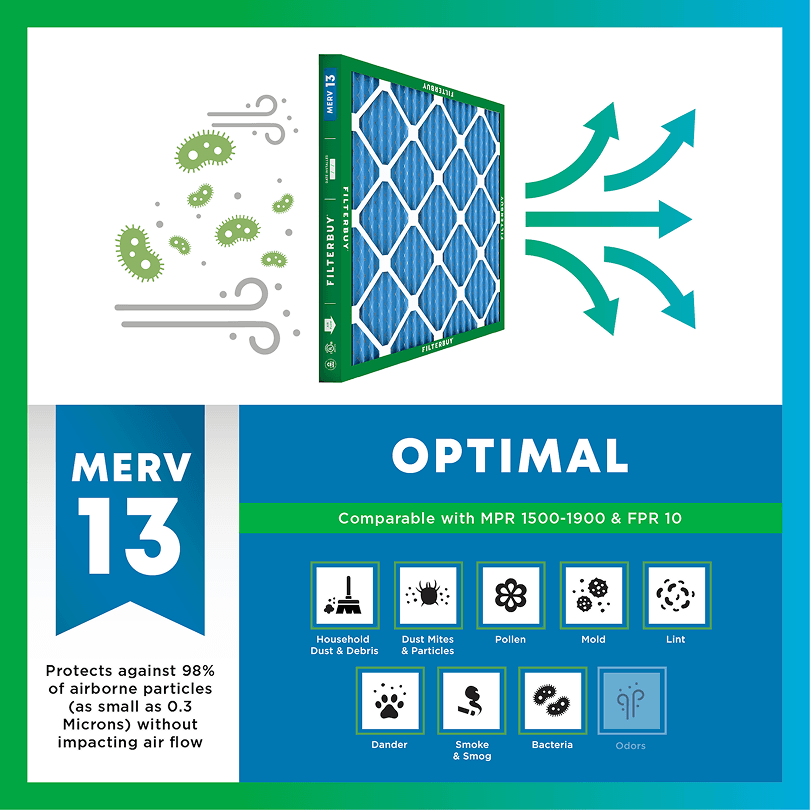
- Captures PM2.5 and other fine particulates
- Filters ash, soot, and smoke particles
- Rated to capture particles as small as 0.3 microns
- Matches the filter rating the EPA suggests during high-AQI and smoke events

AQI FAQs
What is AQI?
AQI stands for Air Quality Index, the EPA's scale for reporting daily air quality. It runs from 0 to 500. The higher the number, the greater the level of air pollution. Values at or below 100 are generally considered satisfactory; values above 100 mean air quality is unhealthy, first for sensitive groups, then for everyone as numbers climb.
What does AQI measure?
The AQI tracks five major pollutants regulated by the Clean Air Act: ground-level ozone, particle pollution (PM2.5 and PM10), carbon monoxide, sulfur dioxide, and nitrogen dioxide. The reported AQI value reflects whichever pollutant is highest at that time — most often ozone or fine particles (PM2.5).
How is AQI calculated?
Monitoring stations measure pollutant concentrations, and the EPA converts each into a standardized 0–500 score using set breakpoints. Each pollutant gets its own sub-index, and the highest sub-index becomes the reported AQI. That's why a single number can represent different pollutants on different days.
What is a good AQI?
An AQI of 0–50 is rated "Good" — air quality poses little or no risk. 51–100 is "Moderate," acceptable for most people though unusually sensitive individuals may want to limit prolonged outdoor exertion. Anything at or below 100 is generally considered satisfactory air quality.
What does an AQI of 100 (or 150) mean?
100 is the dividing line: at or below it, air quality is satisfactory for the general public. From 101–150, air is "Unhealthy for Sensitive Groups" — people with respiratory conditions, older adults, and children. From 151–200, it's "Unhealthy" and everyone may begin to feel effects.
Why is the AQI bad today?
Short-term AQI spikes usually come from wildfire smoke, temperature inversions that trap pollutants near the ground, high-ozone weather (hot, sunny, stagnant days), or heavy traffic and industrial activity. Check a real-time source like the map on this page to see which pollutant is driving today's reading in your area.
What AQI is bad for running or exercise?
Many runners follow the EPA category lines: below 50, no adjustment needed; 51–100, unusually sensitive people may shorten intense workouts; above 100, sensitive groups are advised to reduce prolonged or heavy outdoor exertion; above 150, that advice extends to everyone. Exercise increases how much air you breathe in, which is why thresholds matter more during workouts.
What AQI is safe to open windows?
A common rule of thumb is to keep windows open when the AQI is under 100 and close them when it climbs above, especially during wildfire smoke events when fine particles are elevated. When windows are closed, running your HVAC system with a fresh filter helps capture particles circulating indoors.
Should I wear a mask based on AQI?
Public health agencies generally suggest considering a well-fitted N95-style respirator outdoors when the AQI exceeds 150, particularly during smoke events. Cloth and surgical masks don't filter fine particles effectively. Follow guidance from your local health department, which may adjust recommendations during severe episodes.
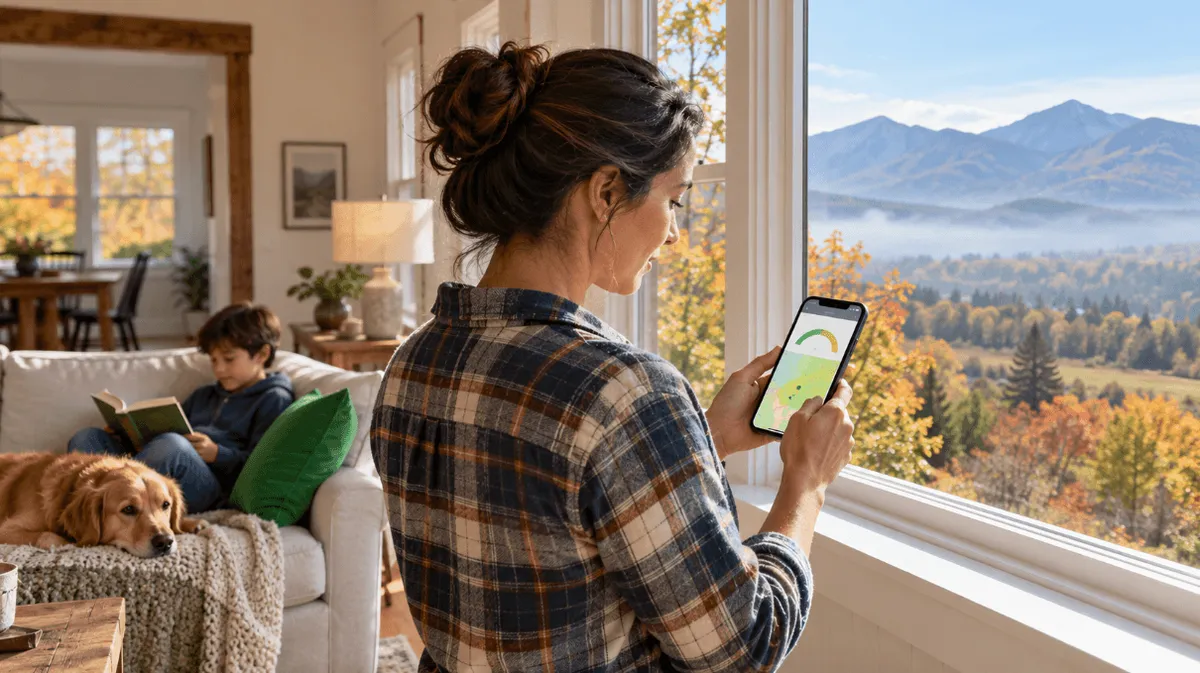
Check Today's Live Real Time Air Quality Index AQI Map in New Hampshire Now
TL;DR
Filterbuy's live map on this page shows New Hampshire's current air quality index (AQI), updated hourly from EPA and state monitors. The New Hampshire Department of Environmental Services (NHDES) rates the state's air Good more than 90% of the time. When it turns orange, the cause is almost always summer ozone from the Boston–New York corridor or Canadian wildfire smoke. If your reading reaches 100, Filterbuy's advice is to switch to a MERV 13 filter, set the fan to On, run a portable HEPA air cleaner in each occupied room, and close the house up.
How to Read New Hampshire's Live AQI Map
Start with the map above. Every reading is color-coded to the EPA's six AQI categories.
Tap any station to see which pollutant sets its number. In New Hampshire it's usually ground-level ozone or fine particulate matter (PM2.5), the tiny specks of smoke and soot too small to see.
Key Takeaways
New Hampshire's summer ozone alerts usually begin upwind, with pollution carried in from New York City and Boston.
PM2.5 spikes come from Canadian wildfire smoke in summer and from wood-stove smoke trapped in valleys such as Keene in winter.
EPA recommends a filter rated MERV 13 or higher in a central HVAC system during smoke events. Filterbuy's line for making that switch is AQI 100.
Homes without ductwork rely on portable HEPA air cleaners as their main defense.
Is New Hampshire's Air Quality Bad Today? What Each AQI Color Means
It depends on the live reading for your town. The U.S. AQI runs from 0 to 500. EPA splits it into six color-coded categories, so match the map's color to its row below.
| AQI | Category | When New Hampshire tends to see it | What to do |
|---|---|---|---|
| 0–50 | Good | Most days of the year | Normal activity for everyone |
| 51–100 | Moderate | Warm afternoons, light haze | Unusually sensitive people ease off; keep a MERV 13 spare |
| 101–150 | Unhealthy for Sensitive Groups | Hot Seacoast ozone days, incoming smoke, calm winter nights in Keene | Sensitive groups ease off; take the four smoke steps |
| 151–200 | Unhealthy | Heavier smoke episodes | Everyone cuts back; check filters often, keep spares |
| 201–300 | Very Unhealthy | Rare, severe smoke | Follow AirNow and NHDES first; use a clean room |
| 301+ | Hazardous | Extremely rare | Follow NHDES and local authorities first |
Categories, ranges, colors and activity guidance are EPA's (AirNow); filter steps are Filterbuy's. Sensitive groups include people with asthma, COPD, or heart disease, children, and adults over 65; with a diagnosed condition, follow your doctor's plan.
Filterbuy's action line is AQI 100. That's the top of Moderate, not a new category; it's where we tell customers to move. At 100 and above, take four steps: put a MERV 13 filter in your HVAC, set the thermostat fan to On, run a portable HEPA air cleaner in each occupied room (bedrooms first), and close the house up.
Why the New Hampshire AQI Can Lag the Sky
A hazy sky with a yellow reading usually comes down to timing. EPA reports current AQI as a NowCast, a rolling average of recent hours that trails fast-moving smoke, and about a dozen stations cover the whole state, so the nearest may be miles away.
Elevation matters too. NHDES has issued smoke alerts for elevations above 2,000 or 3,000 feet, since smoke can reach White Mountains summits before valleys. Hikers should check the EPA's AirNow Fire and Smoke Map before a ridgeline day.
Where to Check New Hampshire's Air Quality Forecast
NHDES posts a daily forecast and hourly readings on its Air Quality Data page and by phone at 1-800-935-SMOG. EnviroFlash sends those forecasts by email or text.
New Hampshire's bad-air days follow the calendar, so each season has its own forecast to watch.
| Season | What drives alerts | Your move |
|---|---|---|
| Summer heat waves | Ozone (forecast March–September) | Exercise before noon; close up by afternoon |
| Canadian fire season | Wildfire smoke, statewide and at elevation | The four smoke steps; keep spares |
| Heating season | Wood smoke on cold, calm valley nights | Delay burning; swap filters that look dark |
Compiled by Filterbuy from NHDES Action Day notices, 2019–2024.
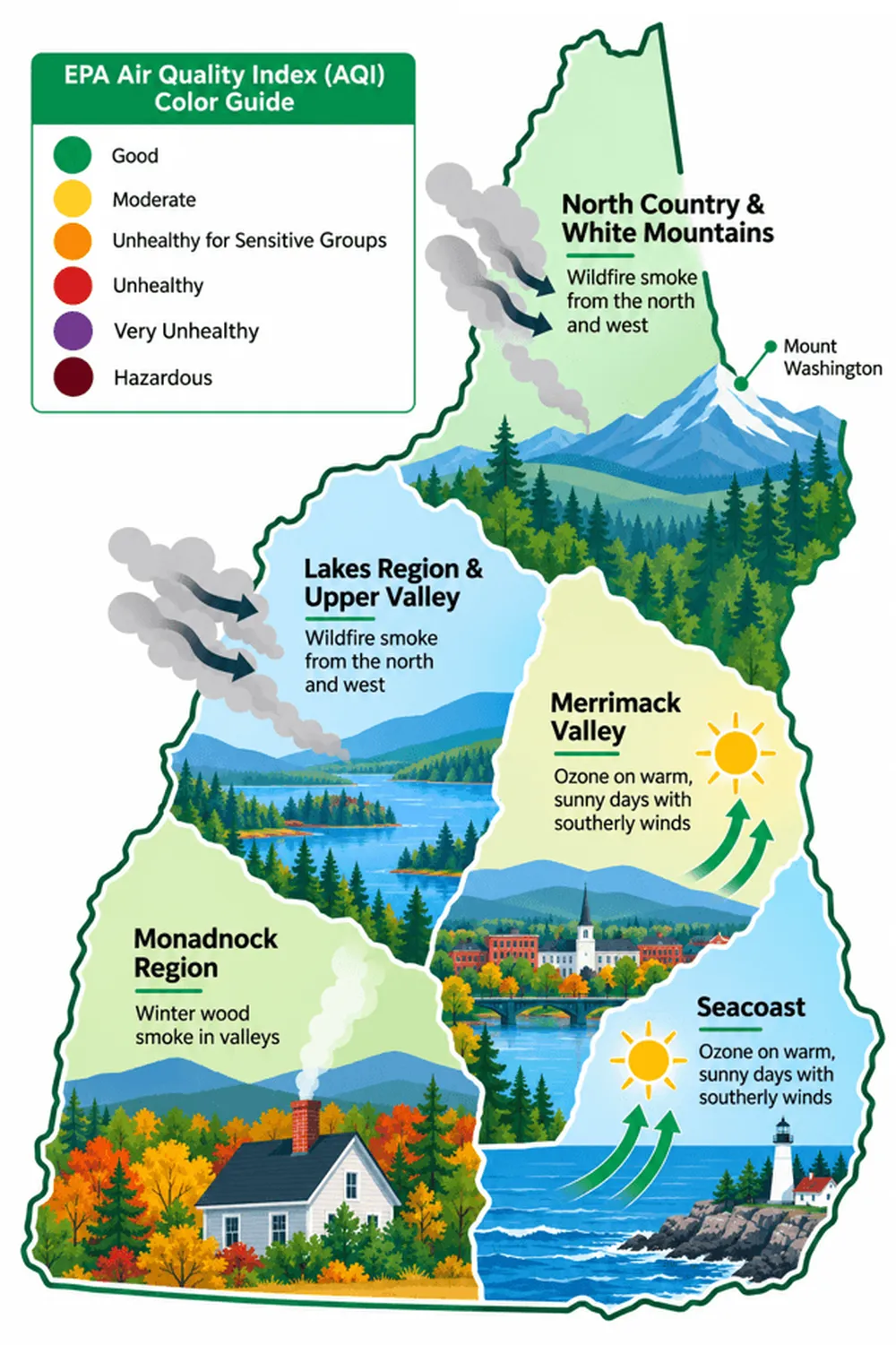
Air Quality Across New Hampshire's Regions
| Region | Representative places | What drives poor-air days |
|---|---|---|
| Seacoast | Portsmouth, Hampton, Rye, Seabrook | Ozone blown up the coast on hot days |
| Merrimack Valley | Manchester, Nashua, Concord | Transported ozone on heat-wave days |
| Monadnock Region | Keene, Cheshire County | Winter wood smoke; summer wildfire smoke |
| Lakes Region and Upper Valley | Laconia, Lebanon, Claremont | Wildfire smoke episodes |
| North Country and White Mountains | Coos County, Mount Washington | High-elevation ozone and smoke aloft |
In the American Lung Association's State of the Air 2026, every graded New Hampshire county passed, while the Boston–Worcester–Providence metro failed for ozone and daily particles. Filterbuy's live Massachusetts AQI map gives early warning of air blowing north, and city readings are on the Manchester, Nashua, and Concord AQI maps.
What Pollutes New Hampshire's Air?
The AQI reports whichever pollutant scores highest, and here that's almost always ozone or PM2.5. Ground-level ozone forms when sunlight reacts with vehicle and industrial emissions. PM2.5 comes mostly from wildfire and wood smoke: wood is the main heating fuel for 1 in 16 New Hampshire households, almost five times the national average (U.S. Energy Information Administration, or EIA, 2024).
Indoors, ozone breaks down quickly, while PM2.5 slips in around doors and lingers for hours. Reducing it takes filtration, which is where your MERV rating matters.
New Hampshire's Smoke Seasons: Wildfires in Summer, Wood Stoves in Winter
Summer smoke has hit hard twice in recent years. On July 26–27, 2021, NHDES declared a statewide Air Quality Action Day as smoke from western Canada and the western U.S. drifted east, and on June 6–7, 2023, smoke from eastern Canadian wildfires pushed fine particles to unhealthy levels for sensitive groups in six counties and above 3,000 feet.
Keene sits in a glacial valley, and on cold, clear, windless nights a temperature inversion traps wood-stove smoke close to the ground. NHDES has issued multi-day particle advisories for the city during those spells.
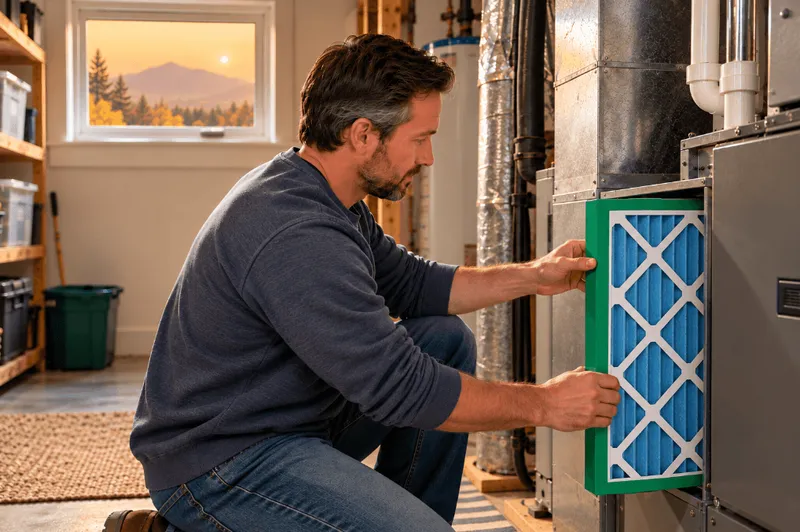
When smoke moves in, check AirNow and any NHDES advisory for your county first. Then take Filterbuy's four steps:
Put a MERV 13 filter in your HVAC.
Set the thermostat fan to On; Auto only filters while the system heats or cools.
Run a portable HEPA air cleaner in each occupied room, bedrooms first.
Close the house up, and skip candles, frying, and smoking until the smoke clears.
During smoke, check the filter and replace it when it looks dark brown or black, which can be well before its normal interval, per EPA. Keep spares on hand.
Filterbuy's live Canada and U.S. wildfire smoke maps show plumes before they arrive.
What an NHDES Air Quality Action Day Means for Your Plans
NHDES declares an Air Quality Action Day when it expects ozone or fine particles to reach Unhealthy for Sensitive Groups (AQI 101 or higher), naming the counties or elevations affected. If yours is listed, follow NHDES's advice first, then the four smoke steps above and Filterbuy's air quality alert checklist.
Filtering the Air in a New Hampshire Home Without Ductwork
Many New Hampshire homes have no ducts: about 59% of households heat with petroleum (EIA, 2024), often through oil boilers and baseboard radiators, and others use wood stoves or mini-splits. Filterbuy makes filters for forced-air systems, so we'll be direct: without ducts there's no filter slot, and portable HEPA air cleaners become your main defense.
Size each cleaner to its room. EPA's rule is a smoke CADR of at least two-thirds of the floor area, so a 300 sq ft bedroom needs roughly 200.
Choose a CARB-certified unit, which EPA advises because those make little or no ozone; skip ionizers and ozone generators.
Keep windows shut during smoke, with any window air conditioner set to recirculate.
Our Take: What a Filter Manufacturer Reads in New Hampshire's Numbers
Filterbuy manufactures HVAC filters in four U.S. plants for more than two million households, so we see New England's bad-air days in the filters that come back. Two patterns stand out in New Hampshire's data.
Most bad air days are imported. Ozone rides in from cities upwind and smoke drifts down from Canada, so residents can't prevent these days, only prepare for them.
Winter is the overlooked season. Ozone forecasts stop in fall, yet wood-smoke events continue all winter in valley towns.
Our records from 2023, just south of the border, show how fast that happens:
"After analyzing thousands of filter returns from Massachusetts homes during the 2023 Canadian wildfire event, we saw filters come back nearly black in just two weeks."
- Filterbuy Team
So we treat filtration as preparation: keep a spare MERV 13 on the shelf by June, or let auto-delivery send one.
Which Filter Matches the AQI on the Map
For wildfire smoke, the answer is MERV 13. EPA recommends a filter rated MERV 13 or higher in a central HVAC system during smoke events, and notes that most furnaces and HVAC systems can take MERV 13 without equipment problems when the filter is replaced often. Filterbuy's line for switching is AQI 100.
Our MERV 8, MERV 11, and MERV 13 filters come in the same 600+ sizes, so moving up never means measuring again. HEPA belongs in portable room units; see how MERV 13 and HEPA differ. Pleated filters capture particles, not odors, so for smoke smell see our Odor Eliminator line.
| AQI on the map | Filter | Best for |
|---|---|---|
| 0–50 (Good) | MERV 8 or MERV 11 | Dust, lint and pollen; MERV 11 for pet dander |
| 51–99 (Moderate) | Your usual tier, plus a MERV 13 spare | Getting ready before smoke arrives |
| 100 and above | MERV 13 | Smoke events and high-particle days |
Tiers are Filterbuy's recommendation. Match the size printed on your current filter frame. No MERV filter removes ozone.
Supporting Statistics
13.2% of New Hampshire adults have asthma, and CDC's 2014–2016 estimates ranked the state highest in the nation. Source: NH DHHS
Home wood burning emits more PM2.5 than all U.S. cars, trucks, and non-road vehicles combined. Source: U.S. EPA
With windows shut during smoke, indoor PM2.5 still runs at about 55–60% of outdoor levels. Source: U.S. EPA
Frequently Asked Questions
What filter should I use for wildfire smoke in New Hampshire?
MERV 13. Filterbuy recommends switching at AQI 100, setting the fan to On, and running a portable HEPA air cleaner in each occupied room.
How do I check New Hampshire's air quality right now?
Open Filterbuy's live AQI map at the top of this page and tap the station closest to your town.
Where can I see New Hampshire PM2.5 today?
Select PM2.5 on the live map, or check NHDES's Air Quality Data page.
Why is summer ozone worse on the New Hampshire Seacoast?
Winds carry pollution from New York City and Boston up the coast, and hot, sunny afternoons turn it into ozone.
Glossary
Air Quality Index (AQI): The national 0-to-500 air pollution scale. EPA sets its six color-coded categories.
PM2.5: Fine particles 2.5 micrometers or smaller, the main pollutant in wildfire and wood smoke.
Ground-level ozone: The main component of smog.
NowCast: EPA's weighted average of recent hourly readings.
Air Quality Action Day: An NHDES alert for forecast AQI of 101 or higher.
Temperature inversion: Warm air trapping cooler, polluted air near the ground.
MERV: Minimum Efficiency Reporting Value, the 1-to-16 filter efficiency scale.
HEPA: High-Efficiency Particulate Air, a filter standard used in portable air cleaners, not furnace slots.