
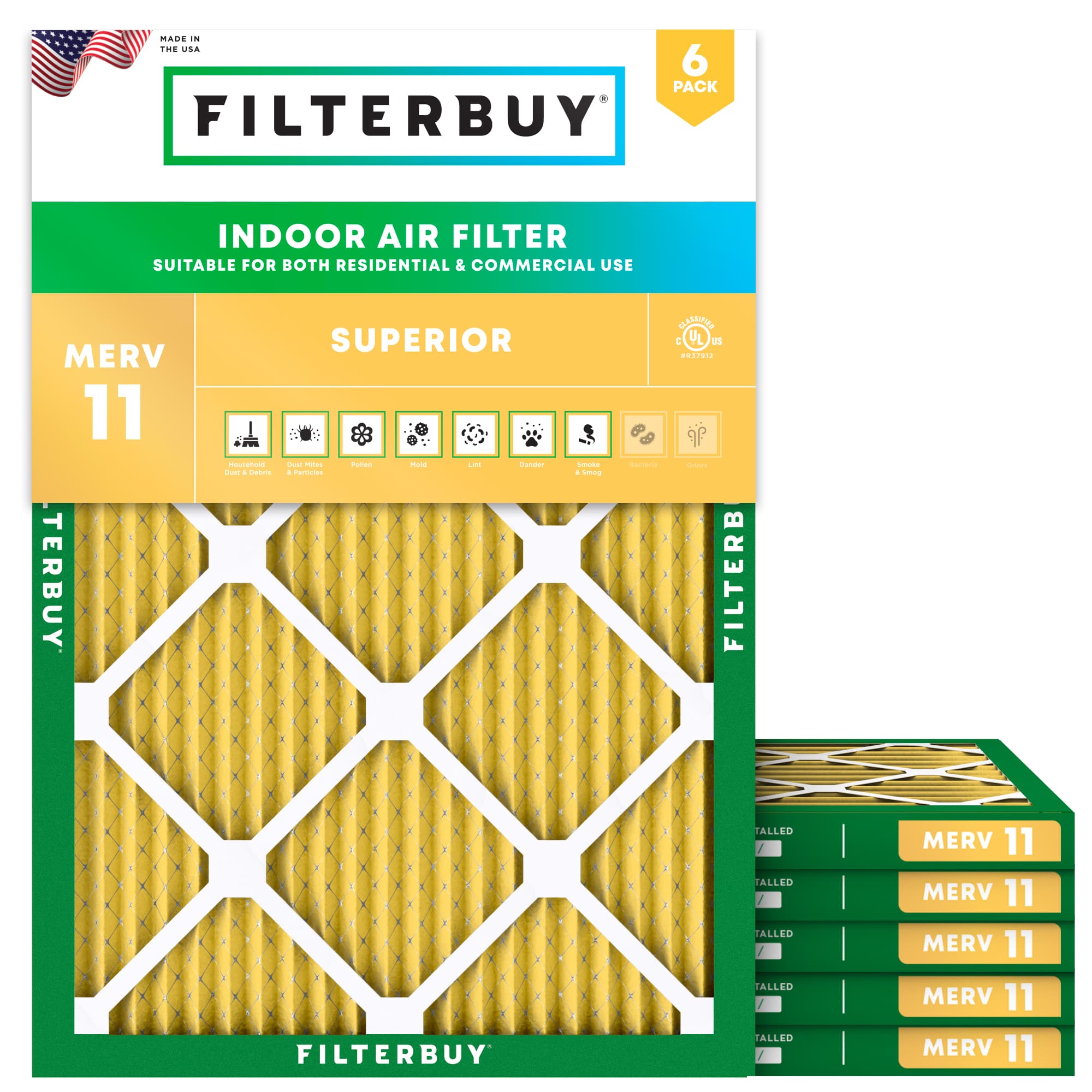
19x20x1 MERV 11 Pleated Air Filter
Actual Size: 19.0x20.0x0.75
 Free Delivery
  Factory-Direct Low Prices, Made in the USA
 Hassle-Free Returns & Free Exchanges
RESIDENTIAL AND/OR COMMERCIAL USE
Change Every 3 Months
19x20x1 MERV 11 Pleated Air Filter
Actual Size: 19.0x20.0x0.75
Free Delivery Factory-Direct Low Prices, Made in the USAHassle-Free Returns & Free ExchangesRESIDENTIAL AND/OR COMMERCIAL USE
Change Every 3 Months
19x20x1 MERV 11 Pleated Air Filter
Actual Size: 19.0x20.0x0.75
Free Delivery Factory-Direct Low Prices, Made in the USAHassle-Free Returns & Free ExchangesRESIDENTIAL AND/OR COMMERCIAL USE
Change Every 3 Months
About
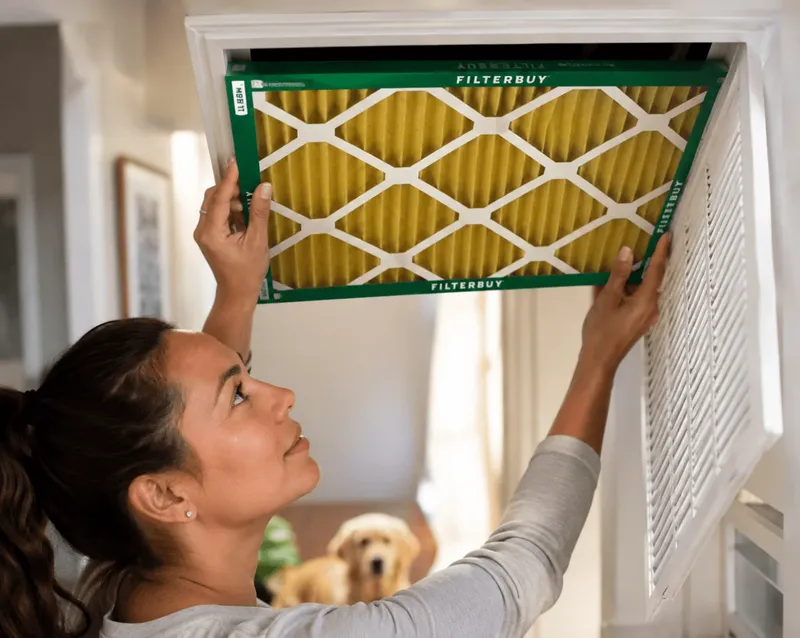
- This is a list 19x20x1 MERV 11 air filter replacement for your furnace, air conditioner, heat pump, or HVAC system
- Actual air filter size: 19.0x20.0x0.75
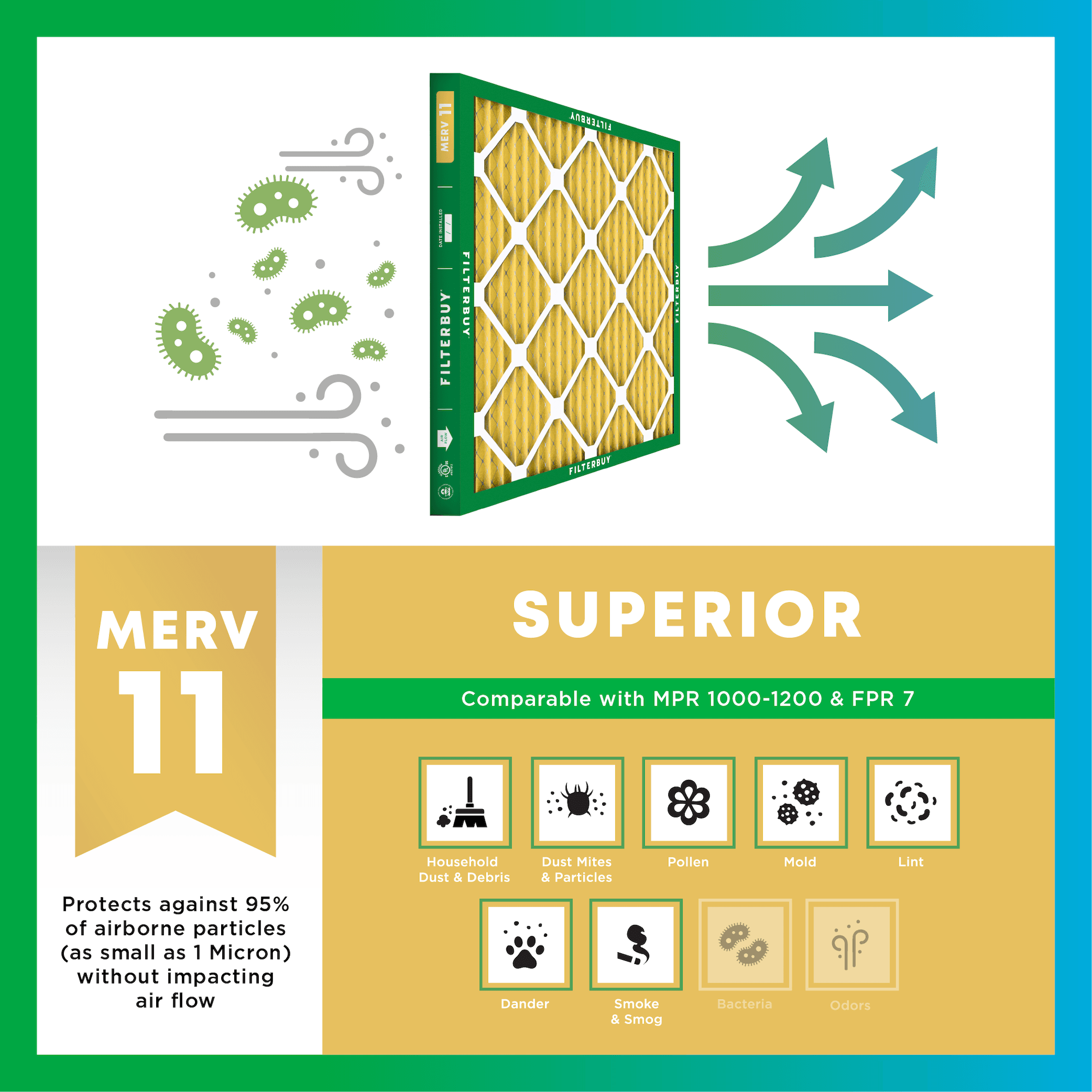
- MERV 11 synthetic media (comparable with MPR 1000/1200 and FPR 7) offers superior protection from dust, pollen, pet dander, mold, smog and more by trapping 95% of airborne particles without impacting air flow
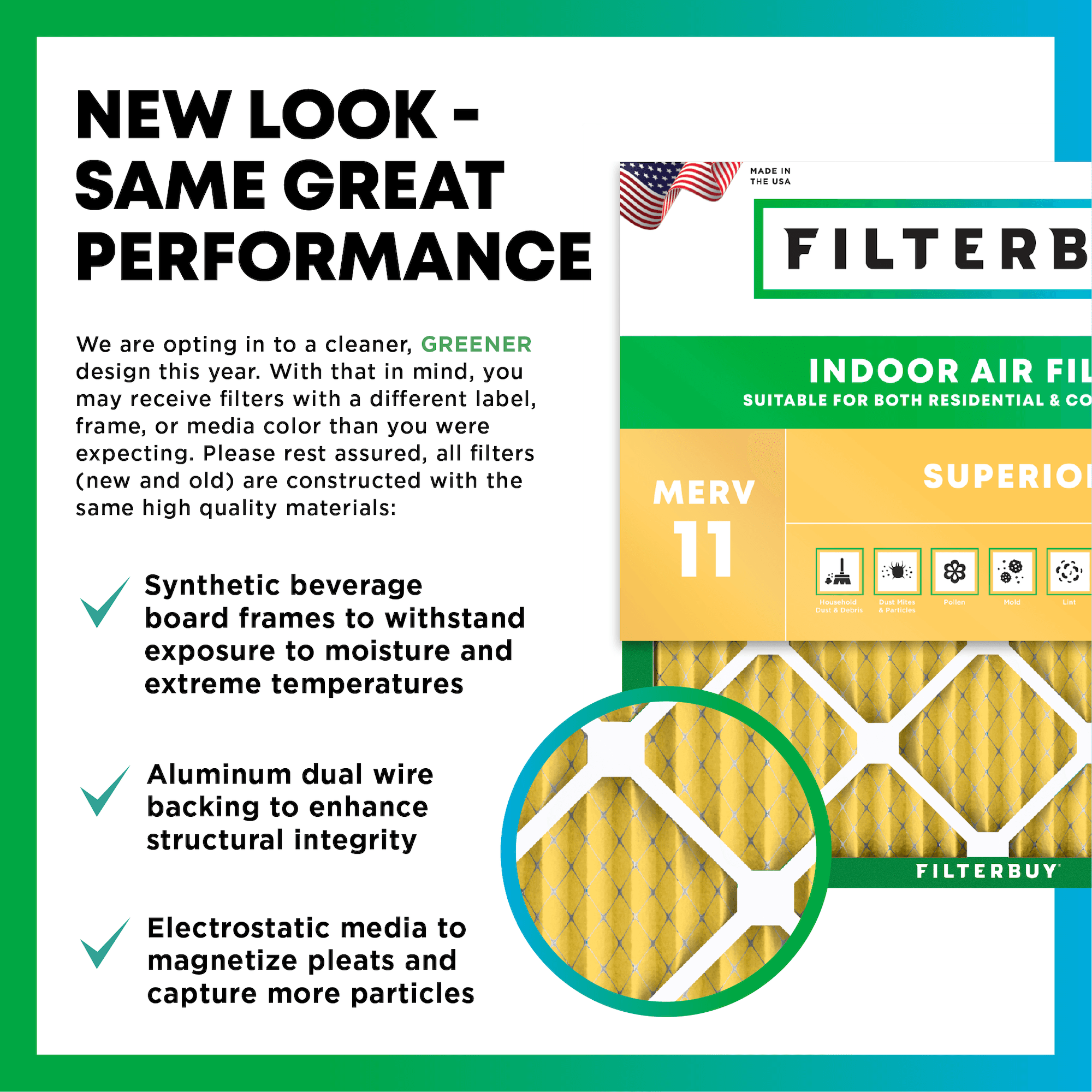
- High-quality construction means electrostatically charged pleated filter media, reinforced wire backing for structural integrity, and a durable frame to resist heat and humidity
- Built to last 3 months. 300% longer than fiberglass models
- 100% manufactured in the United States and designed with recyclable materials
- Learn more about 19x20x1 Air Filters
Top-Rated Filters. American Made. Delivered Free.
At Filterbuy, we don't cut corners—we craft high-quality air filters right here in the USA and ship them to your doorstep for free. No delays, no gimmicks—just clean air, made easy. With thousands of five-star reviews and filters built for real life & every HVAC system, it's no wonder why over 4 million families trust Filterbuy.

Proudly Made In The USA

Fast, Free Shipping on Every Order

Premium Materials That Go The Distance

85,000+ 5-Star Reviews From Happy Customers

Save Up to 70% Per Filter with Packs
Things to Know About Filter Sizes

Nominal Size
- The rounded size printed on your filter or HVAC unit (e.g., 19x20x1).
- Usually whole numbers to make identifying and ordering easier.
- A label for compatibility—not the exact measurement.

Actual Size
- The true, trimmed dimensions of the filter (e.g., 19.0x20.0x0.75 inches).
- Filters are manufactured slightly smaller so they slide into the filter slot without forcing.
- If you don't know your nominal size, measure your filter to get the actual size, then round up to find the nominal size to search on our site.

Why the difference?
- Nominal sizes simplify shopping and standardize categories.
- Actual sizes ensure the filter fits properly inside your HVAC's filter rack.
How To Find Your Nominal Size When You Don't Know It


Measure length × width × depth with a tape measure to find the actual size.

Round up each dimension to the nearest whole number to get the nominal size. Example: 19.0x20.0x0.75 in → 19x20x1 nominal.

Search by nominal size on our site for the best fit.

Why Getting the Right Size Matters
- Too small? Air can bypass the filter, reducing air quality and efficiency.
- Too big? It won't fit—risking bent frames and airflow issues.
- Just right? You get maximum performance, better filtration, and cleaner air.

Free Exchange Policy
If the filter you buy doesn't fit, we'll send you a better size.

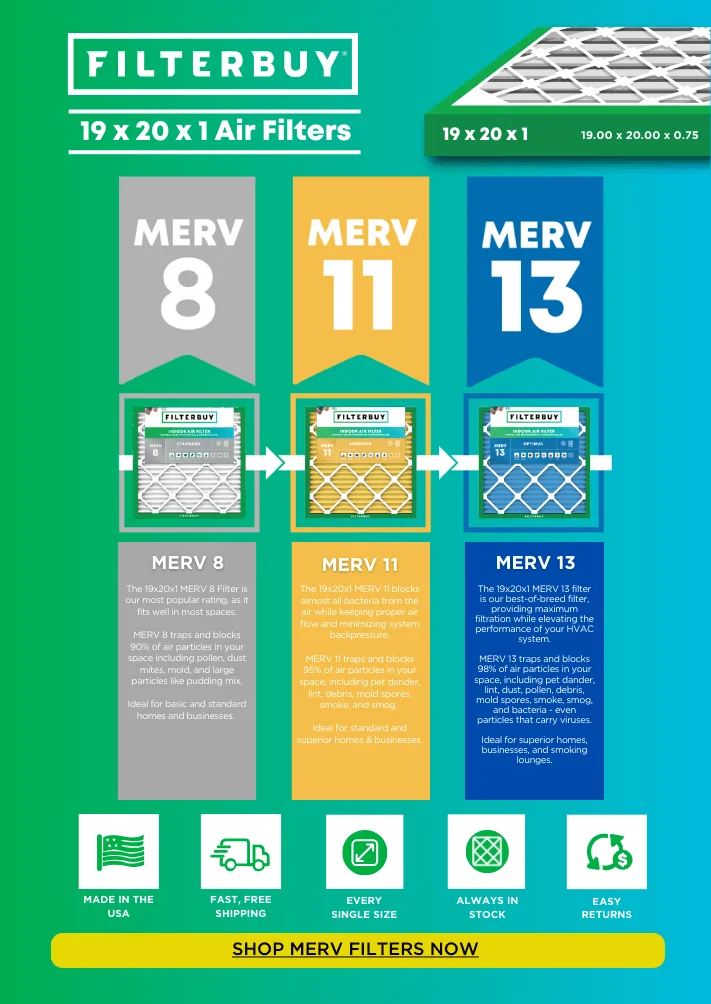
What's a MERV Rating?
MERV stands for Minimum Efficiency Reporting Value—but don't let the technical name fool you. It's just a way to rate how well an air filter traps stuff like dust, pollen, pet dander, and smoke. The higher the MERV number, the more particles it catches—and the cleaner your air will be.

Merv 8
Comparable to:FPR: 4-7
MPR: 600-1000
 Dust & Debris
 Dust Mites & Particles
 Pollen
 Mold
Mold Lint
Lint Dander
Merv 11
Comparable to:FPR: 6-9
MPR: 1200-1550
Dust & DebrisDust Mites & ParticlesPollenMoldLintDander Smoke & Smog
Merv 13
Comparable to:FPR: 10
MPR: 1900-2800
Dust & DebrisDust Mites & ParticlesPollenMoldLintDanderSmoke & Smog Bacteria
MERV 8
Comparable to:FPR: 4-7MPR: 600-1000


MERV 11
Comparable to:FPR: 6-9MPR: 1200-1550

MERV 13
Comparable to:FPR: 10MPR: 1900-2800
What Makes Our Filters Last 90 Days? Quality, From the Inside Out
We build every Filterbuy filter to deliver reliable 90-day performance—thanks to smart design and premium materials that do the heavy lifting. Here's what makes the difference:
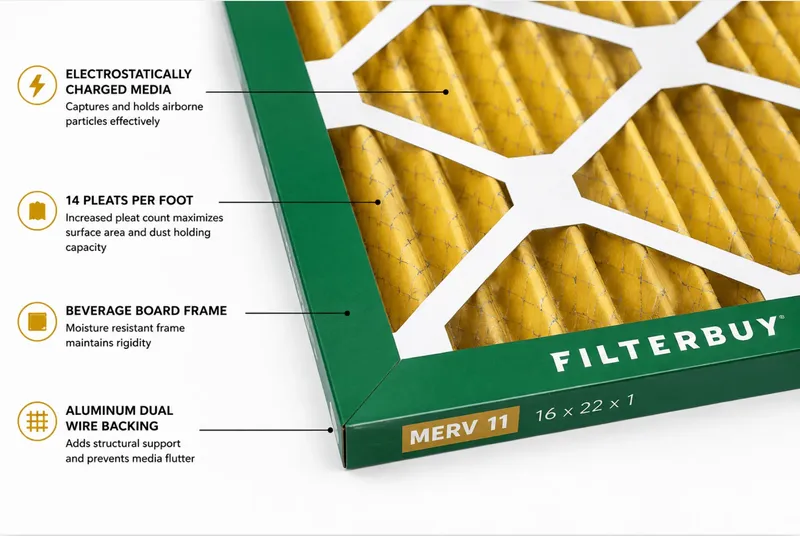
Pleated Design
More pleats = more surface area to capture dust and debris, keeping your air cleaner longer.
Electrostatically Charged Media
Pleats are magnetized to attract and trap microscopic particles—like pet dander, pollen, and smoke.
Synthetic Beverage Board Frame
Engineered to resist warping in extreme temperatures and high humidity.

Aluminum Dual Wire Backing
A layer of metal reinforcement keeps pleats evenly spaced and structurally sound—no sagging, even at high airflow.
Made in the USA
Assembled with care. Built to perform. Ships fast, free, and reliably from our U.S. facilities.
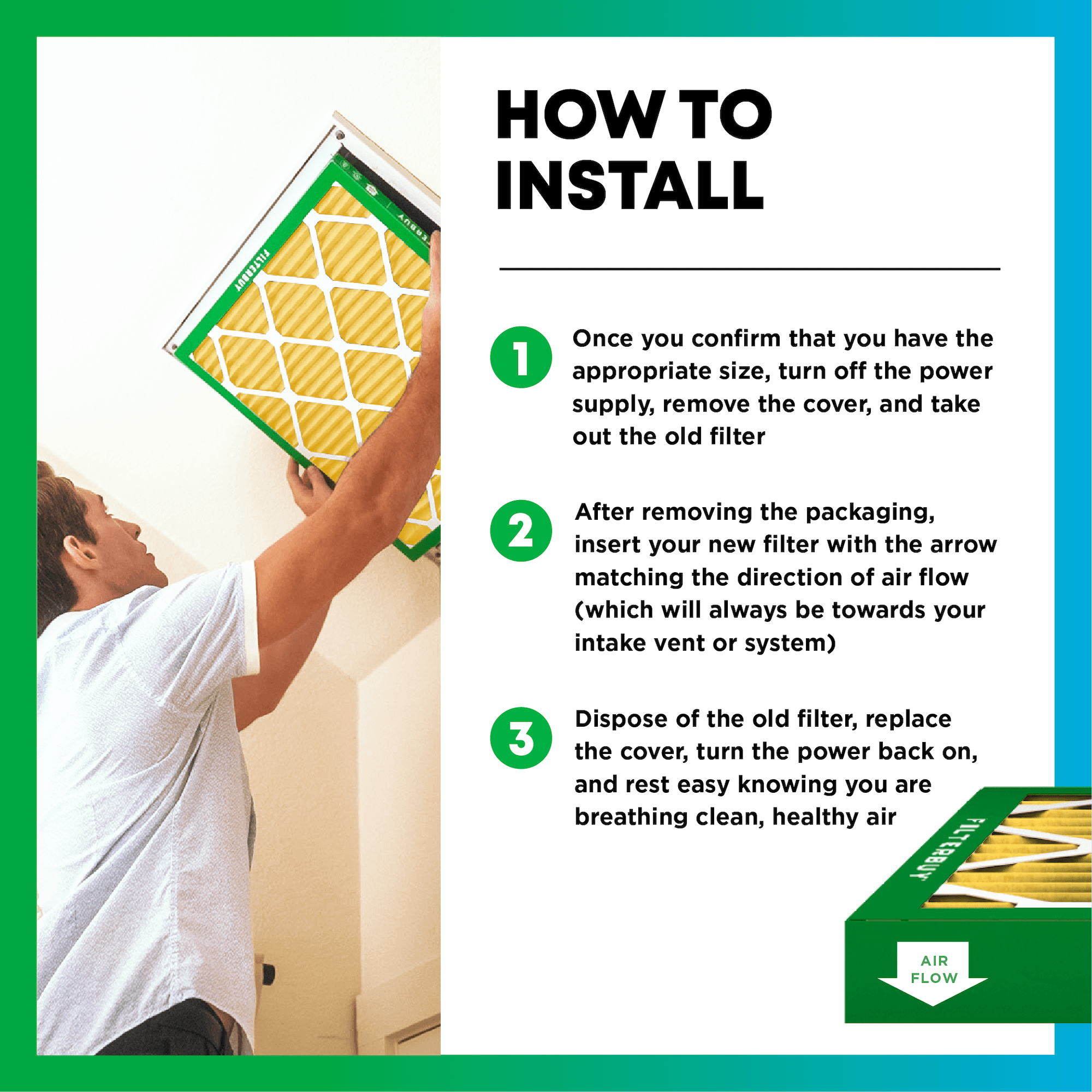
How to Install Your Filter in 4 Simple Steps

Turn Off Your HVAC SystemSafety first.

Remove The Old FilterLook for the airflow arrow and make note of the direction.

Slide In Your New FilterArrow should point toward the system (same direction as before).

Turn Your System Back OnAnd enjoy the fresh, clean air.

Never forget to replace your air filter again.
- Save 5% on every order
- Choose Your Delivery Schedule
- Edit, Skip, or Cancel Anytime.
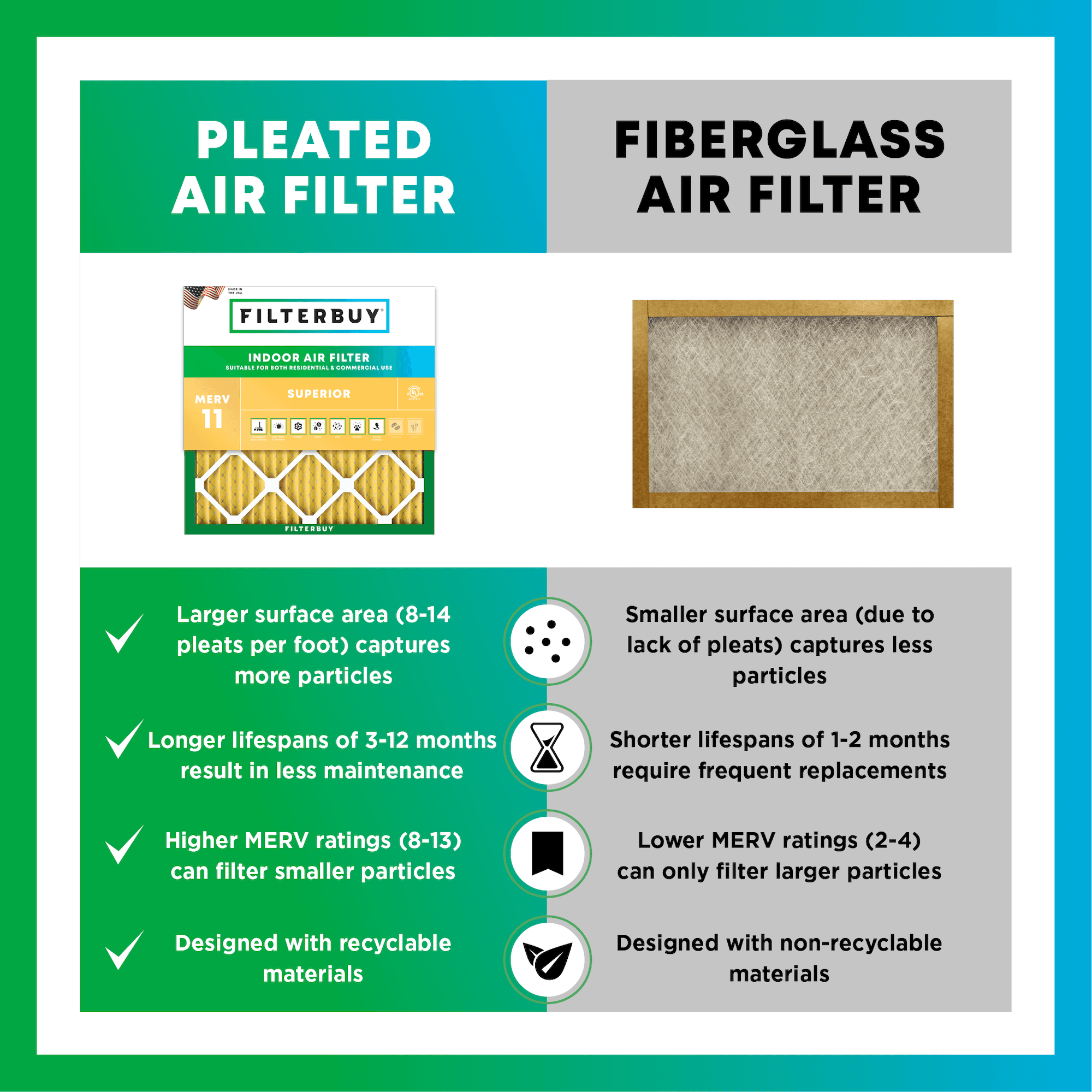
Pleated Filters vs. Fiberglass—What's the Difference?
Not all air filters are created equal. Pleated filters don't just last longer—they actually clean your air better. Here's how they stack up:

Pleated Filters
Efficiency:
High (MERV 8–13) – Traps more particles
Lifespan:
90 days – Long-lasting performance
Air Quality:
Excellent – Cleaner, healthier air
Materials:
Recyclable and durable

Fiberglass Filters
Efficiency:
Low (MERV 4 or less) – Misses small stuff
Lifespan:
30 days or less – Replace often
Air Quality:
Minimal – Basic protection only
Materials:
Thin, flimsy, and not recyclable
Pleated filters are a no-brainer—more protection, less hassle, and better air for your home.
How Often Should You Change Your Filter?
Changing your filter on time keeps your HVAC system running efficiently—and helps protect your lungs from dust, allergens, and airborne irritants. Here's how often to swap it out based on your needs:

Every 90 Days
Standard ScheduleFor most homes without pets or special air quality concerns. Great for general upkeep and energy efficiency.

Every 60 Days
If You Have Pets or AllergiesShedding fur, dander, and allergy triggers can build up fast. Changing your filter every two months helps keep the air fresher and symptoms at bay.

Every 30 Days
If You Have Respiratory Concerns or Live in Smog/Wildfire ZonesFor households affected by smoke, pollution, or respiratory conditions, monthly changes ensure maximum protection.

Want to stay on track? Set a reminder—or skip the stress with auto-delivery so fresh filters show up right when you need them.
Don't Just Take Our Word For It...
Got More Questions? We've Got Answers.
Product Specifications
| Nominal Size | 19 x 20 x 1 inches |
| Actual Size | 19.0 x 20.0 x 0.75 inches |
| Filter Type | Pleated |
| Media | Electrostatically Charged |
| Frame | Beverage Board |
| MERV Ratings Available | 8, 11, 13 |
| Lifespan | Up to 90 Days |
| Origin | Made in USA |
Best 19x20x1 MERV 11 Furnace & HVAC Air Conditioner Filters
By Michelle Wan, Brand Manager and Air Quality Writer · Technically reviewed by David Clark, Licensed HVAC Technician, Filterbuy HVAC Solutions · Published August 7, 2026 · Updated August 7, 2026
TL;DR
A 19x20x1 MERV 11 air filter is a one-inch pleated HVAC filter with an actual size of 19.00" x 20.00" x 0.75". It captures at least 85% of particles at 3–10 microns and 65% at 1–3 microns. It is the middle option in Filterbuy's 19x20x1 lineup, built for homes with pets, allergy sufferers or heavy dust. Made in the USA, rated for 90 days, shipped free.
Key Takeaways
Actual size is 19.00 x 20.00 x 0.75 inches. 19x20x1 is one of the few nominal sizes Filterbuy does not cut under.
A 20x20x1 will not substitute. It measures 19.50" x 19.50", leaving a half-inch gap that lets air bypass the media.
MERV 11 captures ≥85% at 3–10 microns, ≥65% at 1–3, and ≥20% at 0.3–1, per the EPA. Comparable to MPR 1000–1200 and FPR 7.
Filtration runs about 19 cents a day at the six-pack price of $17.49 across 90 days.
What Is a 19x20x1 MERV 11 Air Filter?
A 19x20x1 MERV 11 air filter is a pleated, one-inch HVAC filter rated MERV 11 on the ASHRAE 52.2 scale, sized for a slot with a nominal opening of 19 by 20 inches. The Filterbuy version measures 19.00" x 20.00" x 0.75" actual and drops in as a direct replacement in the return vent or filter housing of a central air conditioner, furnace, heat pump or air handler.
MERV stands for Minimum Efficiency Reporting Value, the 1-to-16 measure of how much airborne particulate a filter catches. Our complete guide to MERV ratings covers every level.
Filterbuy, a family-owned U.S. air filter manufacturer, makes this size in MERV 8, MERV 11 and MERV 13. MERV 11 is where most homeowners land when basic dust control is not enough but MERV 13 is more restriction than a one-inch slot wants to carry.
What Does a MERV 11 Filter Capture?
MERV 11 captures at least 85% of particles between 3 and 10 microns, 65% between 1 and 3 microns, and 20% between 0.3 and 1 micron, per the EPA's MERV rating table. That covers pollen, dust mite debris, mold spores, lint and pet dander, plus much of the smog and vehicle exhaust that drifts indoors.
Source: U.S. EPA, What is a MERV rating?, built on ANSI/ASHRAE 52.2. MPR and FPR are proprietary retailer scales, not ASHRAE measurements.
The dividing line is fine smoke. Wildfire particles sit mostly between 0.4 and 2.5 microns, where MERV 13 pulls ahead. If fire season is a fixture where you live, check the live USA AQI map and read which MERV to use on high-AQI days first.
Is 19x20x1 MERV 11 Right for Your Home?
MERV 11 is the right pick for homes with pets, seasonal allergy sufferers, a smoker or wood stove nearby, or more dust than a MERV 8 keeps up with. Choose MERV 8 if your only goal is protecting the equipment. Step up to MERV 13 if someone has asthma, or if wildfire smoke recurs and your system can handle the resistance.
That covers a lot of households. One in four U.S. adults and one in five children has a diagnosed seasonal allergy, and the EPA notes Americans spend roughly 90% of their time indoors.
Choose MERV 11 if you:
Have one or more shedding pets
Deal with spring or fall pollen indoors
Live near a highway or in a smog-prone metro
See dust resettle a day after cleaning
One honest caveat about one-inch filters. Depth, more than MERV rating, drives how hard your blower works. The pleat count surprises people: our one-inch filters carry 14 pleats per foot and our four-inch carry 8. Fewer pleats, far deeper ones.
Filterbuy's lab data, across more than two million filters manufactured, puts a one-inch MERV 11 at 0.15–0.18" w.g. initial pressure drop at 1,000 CFM, against 0.08–0.12" for MERV 8 and 0.22–0.28" for MERV 13. That step is comfortable in most systems built after roughly 2000. Older equipment or weak airflow is worth a technician's opinion first.
“When someone tells me a filter upgrade killed their airflow, it is almost never the rating. It is a one-inch slot on a system that was already marginal. Check the return sizing before you blame the filter.”
How to Confirm 19x20x1 Is Your Size
Read the size printed on your current filter frame. If it is blank or missing, measure the slot opening for length, width and depth, then round each up to the nearest whole inch. That figure is your nominal size, and nominal size is what you search on Filterbuy.
19x20x1 is where people get caught. Filterbuy cuts nearly every nominal size a half inch under on length and width, so a 20x20x1 leaves our line at 19.50" x 19.50". That half inch is a decision, not an accident. Cut it tighter and the filter binds going in. Cut it looser and air slips around the media.
The 19x20x1 is one of the few sizes we do not shave. It is a true 19.00" x 20.00", and these are numbers we cut to, not numbers we looked up.
So a 20x20x1 filter is not a workable substitute for a 19x20x1, even though the numbers look close. Dropped into a 19x20 slot, it leaves a half-inch gap along one edge. Air takes the path of least resistance straight through that gap, carrying every particle the filter was bought to catch.
A 20x20x1 filter sits 0.50 in short of a 19x20 slot on one face dimension, leaving a gap that lets unfiltered air bypass the media.
“Most sizes we make come off the line a half inch under the number on the box. 19x20x1 doesn't, and that catches people out, because a 20x20x1 looks close enough to work. It isn't. Half an inch of gap on one edge is half an inch of air that never touches the filter.”
Our air filter sizes chart lists nominal against actual for every standard size. If your slot lands on a true fraction, build a custom filter to the exact dimension. If what you order does not fit, Filterbuy's free exchange sends the right size.
Why 19x20x1 Filters Are Hard to Find in Stores
19x20x1 is not a size big-box stores stock. The four most common in American homes are 20x20x1, 16x25x1, 16x20x1 and 20x25x1, and shelf space goes to those. If you have measured carefully and keep coming up empty, nothing is wrong with your tape measure.
Builders frame the filter compartment to the ductwork, and ductwork does not care what a catalogue stocks. Older homes, renovations, apartments and mobile homes are where non-standard slots turn up most. That is why Filterbuy cuts 600+ sizes, not the two dozen that move fastest.
How Filterbuy Builds the 19x20x1 MERV 11 Filter
We build every 19x20x1 MERV 11 filter in our own U.S. plants, with electrostatically charged synthetic media, 14 pleats per foot, a beverage board frame and aluminum dual wire backing. Each is rated for 90 days, roughly three times the life of a fiberglass panel.
The charged pleats pull in microscopic particles rather than relying on the weave alone. The beverage board resists warping in a hot attic, and the metal backing holds pleat spacing so the media cannot sag. Filterbuy is family-owned and has built every filter it sells in American factories since 2013, with 85,000+ five-star reviews behind it.
The most common ordering mistake our team sees is not the rating. It is depth: people measure length and width, then guess the third number.
What It Costs, and How Many to Buy
A single filter is $37.99 from Filterbuy, dropping to $19.99 each in a four-pack, $17.49 in a six-pack and $15.91 at twelve or more. Because each covers up to 90 days, packs turn filtration into a rounding error in the budget.
Cost per day = per-filter price divided by a 90-day service life. Pricing current August 2026.
How Many Should You Buy?
Count your filter slots and multiply by four, since each slot uses four filters a year on a 90-day cycle. Most homes have one; larger and two-system homes often have two, and both need changing. A four-pack is a year for a single-slot home, six months for two. A twelve-pack is three years, or 18 months, at the lowest price per filter.
Auto-delivery takes another 5% off.
How Often Should You Change a 19x20x1 MERV 11 Filter?
Replace a Filterbuy 19x20x1 MERV 11 filter every 90 days under normal conditions, every 60 days with pets or allergy sufferers, and every 30 days during wildfire smoke or if anyone has a respiratory condition. ENERGY STAR advises checking monthly and changing every three months at minimum, since a dirty filter slows airflow and makes the system work harder. Our replacement interval guide breaks it down by season.
Frequently Asked Questions
Will a 20x20x1 Filter Fit a 19x20x1 Slot?
No. A Filterbuy 20x20x1 measures 19.50" x 19.50" actual, while a 19x20x1 slot needs 19.00" x 20.00". It falls a half inch short on one side, leaving a gap that lets unfiltered air bypass the media. Actual sizes vary between manufacturers, so check the frame on whatever brand you are replacing.
Is MERV 11 Too Restrictive for a One-Inch Slot?
MERV 11 is a safe upgrade in most residential systems built after roughly 2000. Filter depth affects airflow resistance more than MERV rating does. If your system is older or already runs weak airflow, ask an HVAC technician first.
Does an Electrostatic Filter Lose Efficiency as It Is Used?
Yes, to a degree. Charged media captures particles mechanically, in the fibres, and electrostatically, by attracting them to the charge. ASHRAE notes charged filters can test high when clean and decline over their service cycle, which is why the standard added an optional second rating, MERV-A, measured with the charge neutralised. A MERV 11 does its best work in the first half of its life, which argues for changing on schedule rather than stretching it to five or six months.
Does MERV 11 Filter Wildfire Smoke?
Partially. It captures at least 20% of particles at 0.3–1.0 microns, where most smoke sits. MERV 13 captures at least 50% of that range and is the EPA-aligned choice for active smoke events.
What MPR or FPR Is MERV 11 Equivalent To?
MERV 11 is roughly comparable to MPR 1000–1200 and FPR 7. MPR and FPR are proprietary retailer scales created by 3M and The Home Depot. MERV is the ANSI/ASHRAE 52.2 standard and the only one independently defined, so it is the number to compare across brands.
Glossary
MERV (Minimum Efficiency Reporting Value): the ANSI/ASHRAE 52.2 scale, 1 to 16, reporting the minimum percentage of airborne particles a filter captures in defined size ranges.
MERV-A: an optional second rating under ASHRAE 52.2 Appendix J, measured after the electrostatic charge is neutralised.
Nominal size: the rounded whole-inch size printed on the frame. A compatibility label, not a measurement.
Actual size: a filter's true trimmed dimensions, 19.00 x 20.00 x 0.75 inches for a 19x20x1.
MPR and FPR: Microparticle Performance Rating (3M) and Filter Performance Rating (The Home Depot). Proprietary retailer scales, not industry standards.
Pressure drop: the airflow resistance a filter adds, in inches of water gauge. Higher MERV and shallower depth raise it.
Supporting Statistics
Three federal findings behind this page.
One in four U.S. adults has a diagnosed seasonal allergy. 25.2% of adults, 20.6% of children. CDC National Center for Health Statistics, 2026
Over 90% of U.S. homes carry three or more detectable bedroom allergens, and 73% have one at an elevated level, across nearly 7,000 measured. NIEHS, 2017
Two-thirds of U.S. households run central AC or a central heat pump, so one filter cleans every room. U.S. Energy Information Administration, RECS 2020
About the Author and Reviewer
Michelle Wan is Filterbuy's Brand Manager and Air Quality Writer (B.A., UC Santa Cruz). She works directly with Filterbuy's U.S. manufacturing teams and writes from how filters are built and used, not from spec sheets.
David Clark is a Licensed HVAC Technician with Filterbuy HVAC Solutions who reviews Filterbuy's technical guidance against what runs in real homes.