
Wind Chill Advisory: What It Means and How to Protect Your Family and Home
October 5, 2026
TL;DR
A wind chill advisory is a National Weather Service (NWS) alert that cold air and wind will make frostbite or hypothermia possible on exposed skin. Since October 1, 2024, the NWS has issued it under a new name, the Cold Weather Advisory, because cold is dangerous with or without wind. When one is issued, bundle up outside and check your furnace filter and carbon monoxide (CO) alarms.
Key Takeaways
The name changed in 2024. Wind chill advisories are now Cold Weather Advisories, and wind chill watches and warnings are now Extreme Cold Watches and Warnings.
Criteria depend on where you live. Local NWS offices set the thresholds, which range from -20°F in parts of upstate New York to 5°F in southern Arkansas.
Frostbite can start in 30 minutes. That's the risk at 0°F with a 15 mph wind, which feels like -19°F.
Wind chill hits people, not pipes, but your furnace still feels it. Longer heating cycles fill your air filter faster, so Filterbuy recommends checking it before a cold snap.
What Is a Wind Chill Advisory?
A wind chill advisory is a National Weather Service alert that cold air and wind together will push wind chill values low enough to be hazardous. That's the wind chill advisory meaning: head out without a hat, gloves, and layers, and frostbite and hypothermia become real possibilities.
Wind chill is the "feels like" temperature on your skin. The stronger the wind, the faster it pulls heat away from you. The NWS guide to understanding wind chill explains the science.
Why You May Not See "Wind Chill Advisory" Anymore
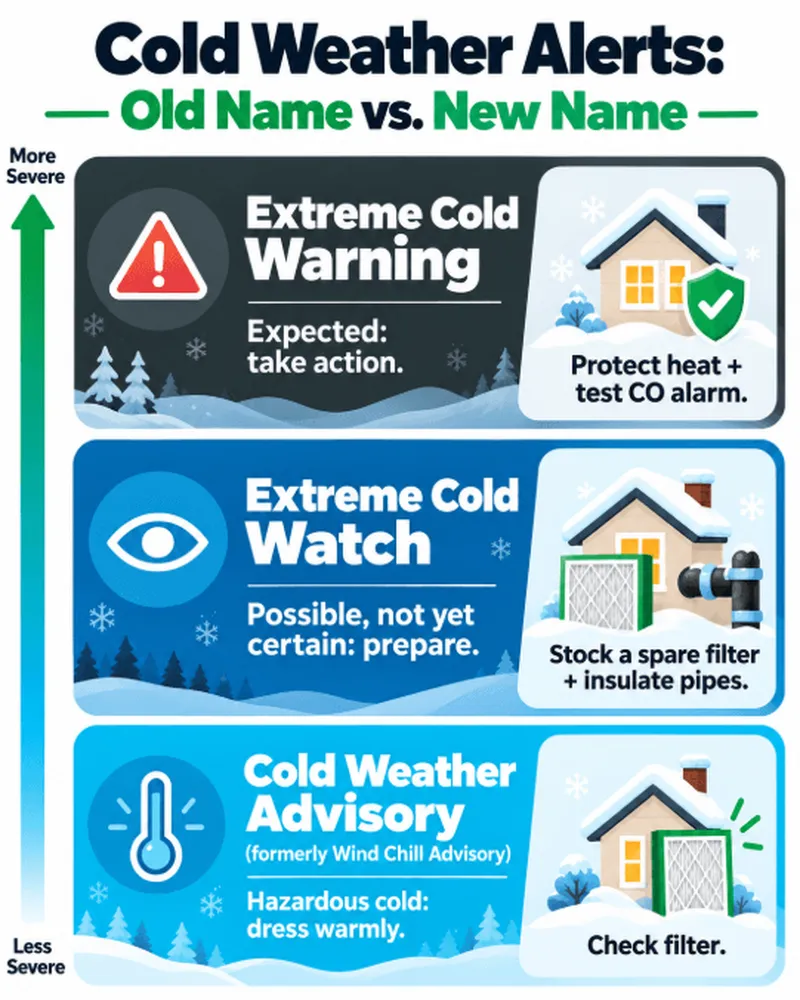
The NWS retired the term on October 1, 2024. In its announcement of the revised cold weather alerts, the agency renamed the wind chill advisory the Cold Weather Advisory. The Wind Chill Watch became the Extreme Cold Watch, and the Wind Chill Warning became the Extreme Cold Warning.
The goal was to clear up a common misconception, that cold is only dangerous when the wind blows. Calm, frigid air can cause frostbite too. Old habits stick, though, so you'll still hear people say "wind chill advisory" or search for a "cold weather wind chill advisory."
Wind Chill Advisory vs. Watch vs. Warning: What's the Difference?
A wind chill advisory, now called a Cold Weather Advisory, means the cold is hazardous. A watch means dangerous cold is possible, and a warning means life-threatening cold is on the way.
What Temperature Triggers a Wind Chill Advisory?
There's no national number. Each NWS forecast office sets its own wind chill advisory criteria based on what people in its area are used to, so the trigger temperature can differ by 25 degrees from one state to the next.
In other words, southern Arkansas can get a cold weather advisory at 5°F, a reading someone near Albany would shrug off as an ordinary January morning.
How Fast Can Frostbite Happen During a Wind Chill Advisory?
On exposed skin, frostbite can set in within 30 minutes during a wind chill advisory, and in 10 minutes or less as it gets colder and windier. The CDC's frostbite guidance lists numbness and a white or grayish-yellow patch of skin, most often on the nose, ears, cheeks, chin, fingers, or toes.
The NWS has published frostbite times on its Wind Chill Chart since November 1, 2001.
Hypothermia is the other danger. It's a drop in core body temperature, and the CDC's list of warning signs in adults includes shivering, exhaustion, confusion, slurred speech, and drowsiness. Treat it as a medical emergency: get the person somewhere warm and call 911.
Three Wind Chill Facts Most Guides Leave Out
Frostbite needs freezing air. As the NWS explains, skin can only freeze when the actual air temperature is below 32°F.
Sunshine changes the math. The chart assumes a clear night sky, and bright sun can make it feel 10°F to 18°F warmer.
The chart was tested on adults. Since NWS researchers didn't test children, treat the frostbite times as a best case for kids, older adults, and anyone in poor health.
Wind Chill Advisory Safety Tips for Your Family
Most wind chill advisory safety tips come down to two habits: keep your skin covered and keep your time outside short.
Dress in loose layers. Start with a moisture-wicking base, add an insulating middle, and finish with a wind-resistant shell.
Cover exposed skin. A hat and face covering matter most, and mittens keep fingers warmer than gloves.
Break up outdoor chores. Shovel or walk the dog in short bursts, and warm up inside in between.
Bring pets in. Dogs and cats feel wind chill too.
Check on older neighbors. People who live alone face more risk if their heat fails.
How to Protect Your Home and HVAC System During a Wind Chill Advisory
During a wind chill advisory, your furnace feels the wind but your pipes don't. According to the National Weather Service, wind chill doesn't affect objects like car radiators or exposed pipes, because they can't cool below the actual air temperature. Wind pushes cold air through gaps and pulls heat from your walls and roof, so your furnace or heat pump runs longer to keep up. See Filterbuy's guide to protecting your furnace during a cold snap.
Your Before-the-Cold Home Checklist
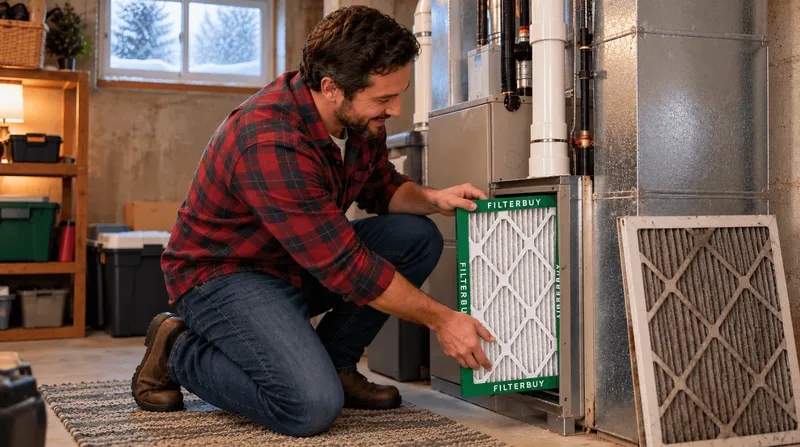
Start with your furnace filter. It's the first thing Filterbuy recommends checking. During a cold snap your blower may run far more hours than usual, pulling extra dust and pet dander into the filter. Once it clogs, airflow drops, and some furnaces overheat and shut off on a safety limit. If yours looks gray or is past 90 days, replace it now. Not sure of the size? Filterbuy's guide shows how to measure your air filter.
Keep the thermostat steady. The American Red Cross recommends holding the same setting day and night in severe cold, and never going below 55°F if you leave home.
Let a faucet drip. A trickle of cold water through exposed pipes helps keep them from freezing, and opening sink cabinets lets warm air reach the plumbing.
Clear outdoor vents and units. High-efficiency furnaces often vent through side-wall PVC pipes, and snow drifts can block them. Keep heat pump outdoor units clear as well.
Test your CO alarms. The CDC recommends battery-operated or battery backup CO detectors near every sleeping area.
Never heat with a generator, grill, or gas oven. The CDC says generators belong outdoors only, more than 20 feet from windows, doors, and vents.
Straight talk: No air filter can remove carbon monoxide, not even a high-MERV one. Working CO alarms are your only reliable protection. Read Filterbuy's guide on how HVAC airflow affects carbon monoxide and smoke safety.
What We See at Filterbuy Every Cold Snap
We make every filter to order in our own plants in Alabama, Florida, Pennsylvania, and Utah, and from November through March, calls about stuffy air and discolored filters rise sharply. Those calls have taught us a few things:
Filters load fast in winter. We've seen filters come back black after 30 days of February heating.
The fix is usually simple. Most winter airflow complaints we hear trace back to an overdue filter, not a broken furnace.
Depth trips people up. Our manufacturing team sees it ordered wrong more than any other dimension, and a 1-inch slot won't take a 4-inch filter.
Sealed homes trap air. With the windows shut, your system recirculates the same air for hours. Filterbuy's guide explains why indoor air quality gets worse in winter.
“The question I get most is which MERV to buy. The one to ask first is whether the filter you are holding actually fills the slot. A rating describes the media, not the gap around it.”
Michelle Wan, Brand Manager and Air Quality Writer, Filterbuy
Pro Tip: Filterbuy ships every order within 24 hours, but the best time to buy a filter is before the forecast turns. Set up Filterbuy auto-delivery for late fall, and keep a spare.
Supporting Statistics: What the Research Shows
1. Cold Killed About 1,300 Americans a Year (1999–2011)
The CDC counted 16,911 hypothermia deaths from 1999 to 2011.
Takeaway: Cover your skin and keep trips outside short.
Source: CDC, MMWR QuickStats
2. Carbon Monoxide Sends 100,000+ People to the ER Each Year
It also causes 400+ deaths and 14,000+ hospital stays a year.
Takeaway: Test your CO alarms before the heat starts running nonstop.
Source: CDC, Carbon Monoxide Poisoning Basics
3. Heating and Cooling Use Nearly Half of Home Energy
ENERGY STAR says to check filters monthly in winter and change them at least every 3 months.
Takeaway: Check your filter before the advisory starts.
Source: ENERGY STAR, Heat & Cool Efficiently
Frequently Asked Questions
Is a Wind Chill Advisory the Same as a Cold Weather Advisory?
Yes. Cold Weather Advisory is the National Weather Service's current name for what used to be called a wind chill advisory. The NWS made the change on October 1, 2024, to stress that cold air is dangerous with or without wind.
Should I Change My Furnace Filter Before a Cold Snap?
Yes, if it's dirty or close to its replacement date. Your system may run many more hours during an advisory, and a clean filter keeps warm air moving.
What Should I Do During a Wind Chill Advisory?
Limit your time outside, and cover every inch of exposed skin when you do go out. At home, keep the heat steady and test your CO alarms.
Can You Get Frostbite If It Is Above Freezing?
No. According to the National Weather Service, frostbite only forms when the actual air temperature is below 32°F. A low wind chill above freezing can still cause hypothermia.
How Do I Find Out If There Is a Wind Chill Advisory Near Me Today?
Go to weather.gov and enter your ZIP code, or turn on weather alerts on your phone. Look for "Cold Weather Advisory" or "Extreme Cold Warning," since the NWS no longer uses the wind chill name in its alerts.
Glossary
About the Author and Reviewer
Written by Michelle Wan, Brand Manager and Air Quality Writer at Filterbuy. Michelle works alongside Filterbuy's manufacturing teams to turn MERV ratings, filtration, and HVAC efficiency into plain-English advice (B.A., UC Santa Cruz).
Reviewed by David Clark, Licensed HVAC Technician, Filterbuy HVAC Solutions.