
Space Heaters Vs. Your Furnace: Which Is Cheaper To Heat With?
October 12, 2026
A space heater is cheaper than your furnace only when it lets you turn the rest of the house down. Filterbuy ran this winter's federal price forecasts through the math, and per unit of heat, a 1,500-watt space heater costs three to four times more than a gas furnace.
For whole-house heat, a gas furnace is cheaper than a space heater. Per unit of heat, a 1,500-watt space heater costs three to four times more than gas. It only saves money when it lets you turn the rest of the house down.
Your heating fuel decides the answer:
- Gas furnace: Keep it running at a modest setback. Use a space heater for short, one-room warmth.
- Electric furnace or baseboard: Same cost per BTU as a space heater, so heating one room and lowering the rest almost always wins.
Either way, your furnace carries most of the winter load. Take the quick quiz below to find the right filter for it.
Keep your furnace ready for winter.
Answer a few quick questions and we'll match you to your filter.
Already know your filter size? Shop Filterbuy filters
TL;DR
For whole-house heat, run a gas furnace at a lower setting and save the space heater for short, one-room warmth. A space heater costs about 28 cents an hour on high, roughly four times the price of the same heat from gas. In electric-heated homes, heating one room is almost always cheaper, and for a room you heat every day, a ductless mini-split cuts that cost about in half.
Key Takeaways
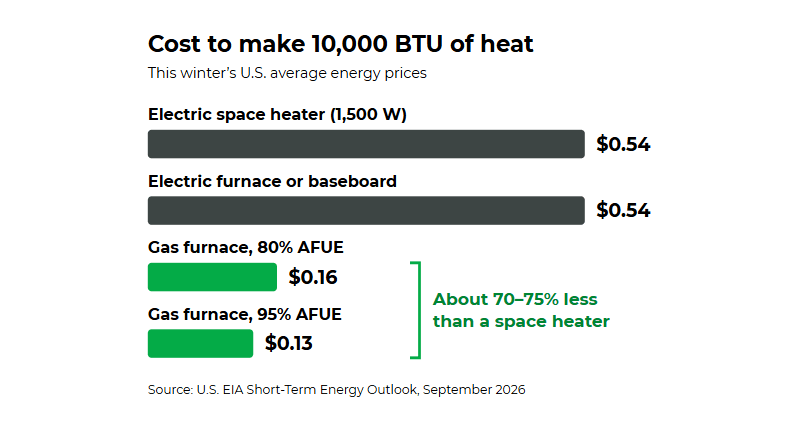
A space heater makes 10,000 BTU of heat for about 54 cents. A gas furnace makes the same heat for 13 to 16 cents.
Filterbuy's 4-to-1 rule: in a gas-heated home, a space heater saves money only if the setback cuts furnace output by 3.4 to 4.1 BTU for every BTU the heater adds.
In homes with an electric furnace or baseboard heat, a space heater costs the same per BTU, so heating one room is almost always cheaper.
Keep space heaters out of the thermostat's room, or other rooms will run colder than your setting.
How Much Does A Space Heater Cost To Run Per Hour?
A standard 1,500-watt space heater costs about 28 cents an hour on high, using the U.S. Energy Information Administration (EIA) forecast of 18.3 to 18.5 cents per kilowatt-hour this winter from its September 2026 Short-Term Energy Outlook. Eight hours a day comes to about $2.21, or roughly $66 a month. Treat those as ceiling figures, since a thermostat-controlled heater cycles off.
How Much Does It Cost To Run A Gas Furnace?
A gas furnace makes heat far more cheaply than a space heater. EIA expects residential natural gas to average about $13.10 per thousand cubic feet this winter, which puts furnace heat at 13 to 16 cents per 10,000 BTU.
Hourly costs can make a furnace look expensive. A 60,000 BTU furnace burns about 76 cents of gas per burner hour, nearly three times the space heater's cost, but it delivers 48,000 to 57,000 BTU in that hour to the heater's 5,100.
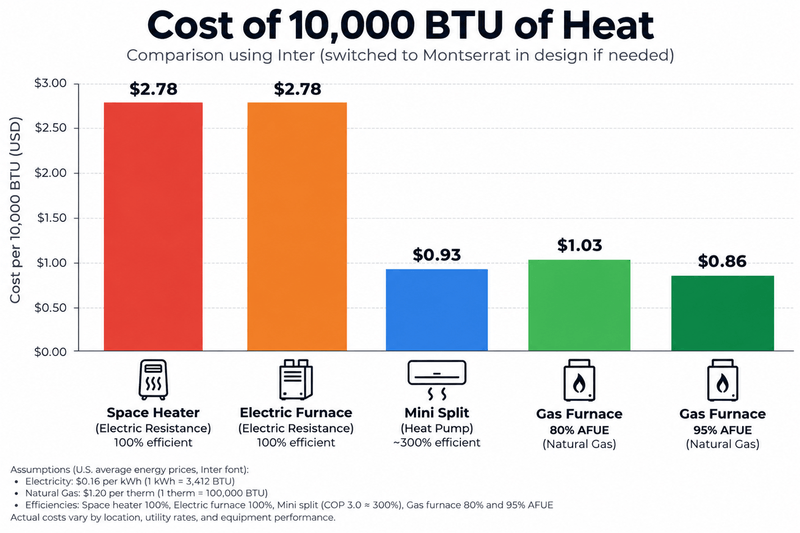
Cost To Make 10,000 BTU Of Heat This Winter
| HEAT SOURCE | EFFICIENCY | COST PER 10,000 BTU | COMPARED WITH A SPACE HEATER |
|---|---|---|---|
| Electric space heater (1,500 W) | 100% (electric resistance) | $0.54 | Baseline |
| Electric furnace or baseboard heat | 100% (electric resistance) | $0.54 | Same cost |
| Ductless mini-split heat pump | Moves heat instead of making it | About $0.27 or less | About 50% less |
| Gas furnace, 80% AFUE | 80% | $0.16 | About 70% less |
| Gas furnace, 95% AFUE | 95% | $0.13 | About 75% less |
When Is A Space Heater Cheaper Than Running The Furnace?
A space heater is cheaper only when lowering the main thermostat saves more gas than the heater uses in electricity. Because space heater heat costs 3.4 to 4.1 times more per BTU, Filterbuy's 4-to-1 rule says the furnace must skip 3.4 to 4.1 BTU for every BTU the heater adds.
A 1,500-watt heater adds about 5,100 BTU an hour, so the setback has to cut furnace output by roughly 17,500 to 20,800 BTU an hour to break even. That usually takes a deep setback in a large, drafty house. Small, tight homes rarely get there.
Your heating fuel decides the answer. In electric-heated homes, the U.S. Department of Energy (DOE) says zone heating can save more than 20% over heating the whole house.
How Your Heating Fuel Changes The Answer
Run Your Own Break-Even From Your Utility Bills
You can find your own break-even ratio with Filterbuy's one-minute check and two utility bills:
Find your electric rate in dollars per kilowatt-hour and your gas rate in dollars per therm.
Multiply the electric rate by 28 for a 95% AFUE furnace, or by 23 for an 80% AFUE furnace.
Divide that number by your gas rate. The result is your break-even ratio.
At national averages (18.4 cents and $1.26 per therm), a 95% AFUE furnace works out to 0.184 x 28 / 1.26, or about 4.1. The higher your ratio, the deeper the setback a space heater needs to pay off. A ratio near 1 means space heater heat costs about the same as your main heat.
Winter Heating Habits That Change The Math
Five winter habits decide whether zone heating actually lowers your bill.
Set back, don't shut off. Lower the main thermostat while a space heater warms your room, but keep the furnace on to protect pipes elsewhere. During a hard freeze, the Red Cross advises keeping the thermostat at the same temperature day and night and no lower than 55°F when you're away.
Leave supply vents open. Too many closed registers raise duct pressure and cut airflow across the furnace.
Keep the heater away from the thermostat. A space heater near the thermostat makes the furnace read the whole house as warm, so other rooms and their pipes run colder.
Check the furnace filter monthly. As an air filter manufacturer, Filterbuy thinks about airflow first. A clogged filter makes the blower work harder in the coldest weeks, and when space heaters let the furnace rest, less air passes through the filter at all. Our guide shows how to replace your furnace air filter, or let air filter auto-delivery send your exact size on your schedule.
Book a yearly inspection. Have a pro check your furnace before the first hard freeze, and work through a preventative HVAC maintenance checklist.
Are Space Heaters Safe To Use All Winter?
Space heaters are safe when used as directed, but they need more attention than a furnace, as the Filterbuy guide to space heater safety and your HVAC system explains.
Portable heaters were involved in an average of 1,600 fires, 70 deaths, and 150 injuries per year from 2020 through 2022, according to the U.S. Consumer Product Safety Commission (CPSC).
Follow CPSC's winter heating safety guidance:
Keep the heater at least three feet from anything that can burn, like drapes or bedding.
Plug it directly into a wall outlet, never an extension cord or power strip.
Turn it off when you go to sleep.
Put carbon monoxide (CO) alarms on every level and outside sleeping areas, and test them monthly. The EPA lists leaking furnaces and unvented gas space heaters as indoor CO sources.
When Does A Mini Split Make More Sense?
For one room you heat every day, a ductless mini split heat pump runs at about half the cost of a space heater, because it moves heat in from outdoor air instead of making it. DOE puts the electricity savings over resistance heat at about 50%. Gas heat still costs less per BTU, so a mini split pays off most in electric-heated homes and in rooms your ducts struggle to reach.
A home office heated eight hours a day costs up to about $66 a month with a space heater and about $33 or less with a mini split.
Filterbuy ductless mini-split systems start at $749 for a 12,000 BTU single-zone unit and come with fast and free 2-day delivery to most US states, plus a 7-year compressor and 3-year parts warranty. At 17 SEER2, the line clears the federal efficiency minimum and is built for value. In very cold climates, compare low-temperature heating ratings, because mini-split performance in cold weather varies widely by model.
"A space heater is a spot tool, not a heating system. Keep the furnace running at a modest setback, keep the heater three feet from anything that can burn, and change the filter before the coldest weeks."
David Clark, Licensed HVAC Technician
Supporting Statistics
1. Space heaters cause few heating fires but many of the deadly ones.
Portable heaters were involved in just 3% of residential heating fires from 2017 to 2019, yet 41% of fatal ones. The leading cause, at 48%, was a heat source too close to something that burns. Our takeaway: the three-foot rule targets that top cause.
Source: U.S. Fire Administration, Portable Heater Fires in Residential Buildings (2017-2019)
2. U.S. homes split almost evenly between electric and gas heat.
In 2017, 43.9% of homes were heated with electricity and 42.8% with natural gas. With a split that close, the right answer depends on your fuel.
Source: U.S. Census Bureau, Differences in Fuel Usage in the United States Housing Stock
3. Heating and cooling drive almost half of a home's energy bill.
For the average household, that tops $900 a year. Why it matters: a few degrees of setback hits the biggest line of your bill.
Source: ENERGY STAR, Smart Thermostats
Space Heater Vs. Furnace Frequently Asked Questions
Is It Cheaper To Run A Space Heater Or The Furnace Overnight?
In a gas-heated home, running the furnace at a modest overnight setback usually wins, because gas heat costs about a quarter as much per BTU. Skip the setback during a hard freeze, and turn space heaters off while you sleep, as CPSC advises.
Are Some Space Heaters Cheaper To Run Than Others?
Not per hour on the same setting. Every electric space heater, ceramic or oil-filled, turns all of its electricity into heat, so any 1,500-watt model costs about 28 cents an hour on high.
Can I Turn Off My Furnace And Heat With Space Heaters Only?
Rarely. Unheated rooms put pipes at risk, gas heat costs less per BTU, and each 1,500-watt heater draws 12.5 amps, most of a standard 15-amp circuit. Keep the furnace on at a setback instead.
Do I Need To Change My Furnace Filter More Often In Winter?
Yes, check it more often. Your filter loads faster in winter because the system runs more hours, so check it monthly and replace it when it looks clogged, or at least every three months. Filterbuy auto-delivery defaults to 90 days, and homes with pets often choose 60.
Keep Your Furnace Ready For Winter
Even with a space heater, your furnace carries most of the winter load. Filterbuy makes filters in hundreds of sizes, so you can shop furnace air filters by size, shipped fast and free.
Glossary
AFUE (Annual Fuel Utilization Efficiency)
The share of a furnace's fuel that becomes usable heat over a year.
BTU (British Thermal Unit)
A unit of heat energy. One kilowatt-hour equals about 3,412 BTU.
Ductless Mini Split Heat Pump
A heat pump with an outdoor unit and indoor wall units but no ductwork.
Electric Resistance Heat
Heat made by running electricity through a heating element.
Kilowatt-Hour (kWh)
The unit utilities use to bill electricity.
SEER2
Seasonal Energy Efficiency Ratio 2, the federal cooling efficiency rating.
Thermostat Setback
A temporarily lower heating setpoint, such as overnight.
Zone Heating
Heat for only the rooms in use.