February 11, 2026
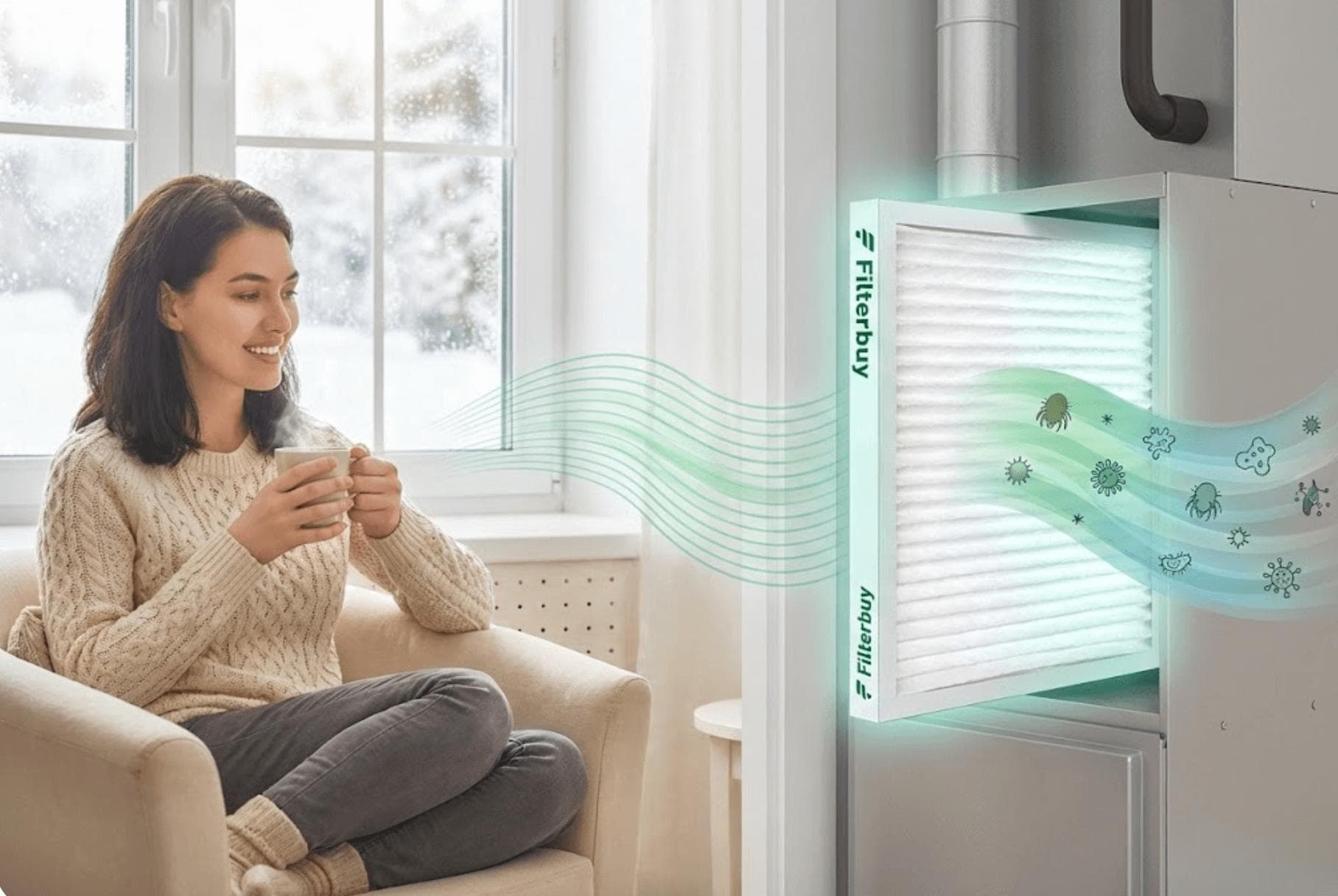
Think winter means a break from allergies? Think again. For millions, winter triggers sneezing and sniffling as indoor allergens like dust mites, pet dander, and mold spike when the heat kicks on. If your nose starts running the moment you turn up the thermostat, you’re not imagining it because winter indoor allergies are real.
The good news? Your HVAC air filter is your first line of defense. Often overlooked, the right filter doesn’t just protect your furnace, it protects your lungs. Upgrading to a high-quality air filter can trap allergens and help you breathe easier all season long. Here’s how to make it work for you.
Air filters help winter allergies by trapping airborne allergens — dust mites, pet dander, and mold spores — as your furnace circulates air through your home's ductwork. In winter, sealed windows and constant heating cause these particles to recirculate and concentrate indoors. A quality pleated HVAC filter rated MERV 8 to MERV 13 captures these allergens before they reach your lungs, reducing your total exposure and alleviating symptoms like sneezing, congestion, and itchy eyes.
What homeowners need to know at a glance:
The problem: Winter forces you indoors where pollutant levels can be 2–5x higher than outside
The fix: Upgrade from a basic fiberglass filter to a pleated MERV 11 or MERV 13 filter
The impact: Your HVAC filter cleans every room simultaneously — unlike a purifier, which only handles one
The timing: Most homeowners notice improvement within 24–48 hours of installing a new pleated filter
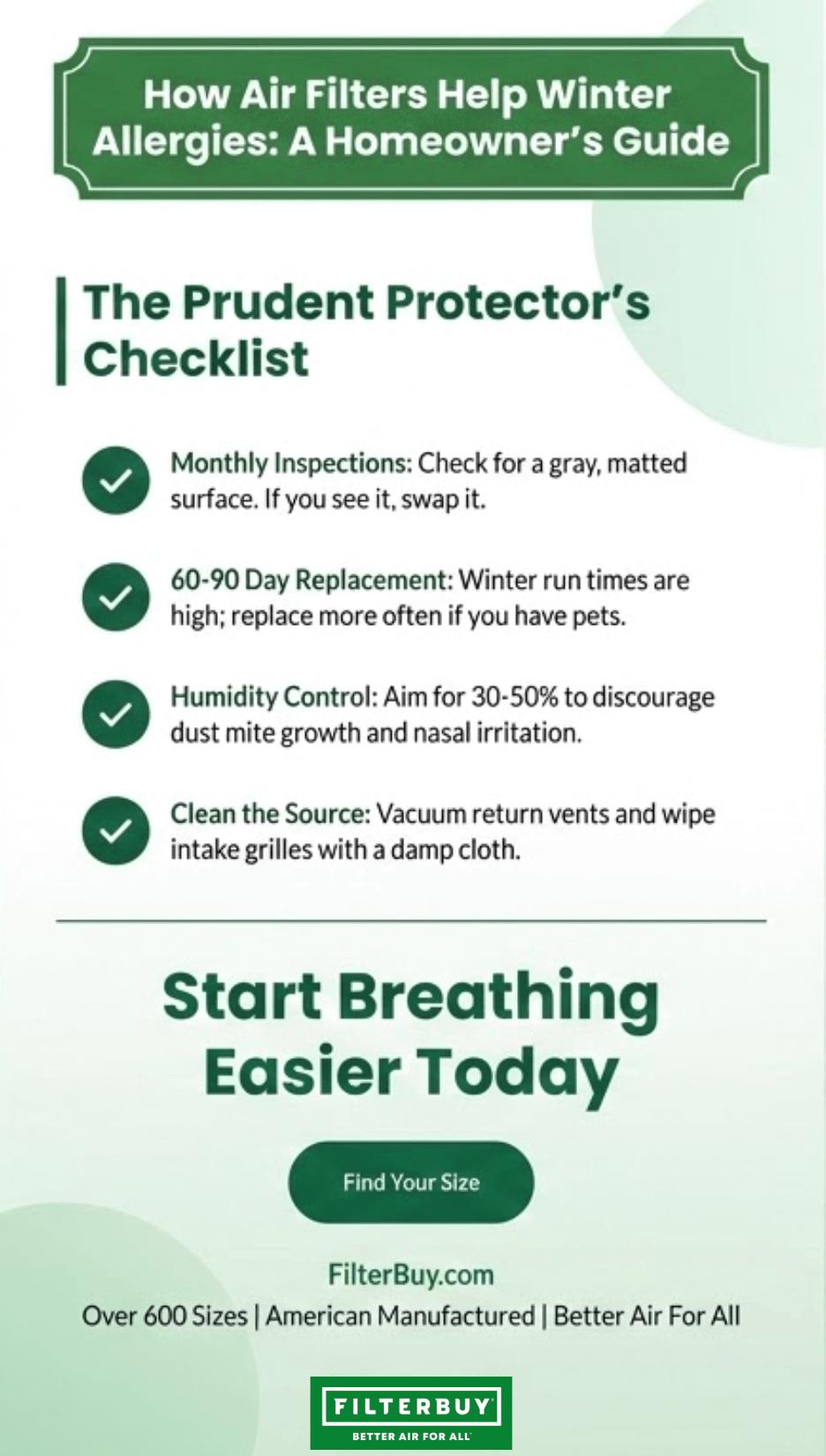
The maintenance: Check monthly, replace every 60–90 days (more often with pets)
From our experience manufacturing millions of filters since 2013: the homeowners who struggle most with winter allergies are almost always running a cheap fiberglass filter that lets allergens pass right through — or a clogged filter that hasn't been changed in months. Swapping in the right pleated filter is the fastest, most cost-effective upgrade you can make for your family's winter comfort.
Winter makes your indoor air worse, not better. Sealed windows and running furnaces trap and recirculate dust mites, pet dander, and mold spores. The EPA reports indoor pollutant levels can be 2 to 5 times higher than outdoors. From what we've seen shipping filters to millions of homes, winter is when that gap hits hardest.
Your HVAC filter is your most powerful allergy tool. It treats every cubic foot of air in your entire home, every time the system runs. Upgrading from fiberglass to a pleated MERV 11 or MERV 13 is the single highest-impact change most homeowners can make — and it takes less than two minutes.
The difference between filter types is bigger than you think. Fiberglass lets allergens pass right through. Pleated filters create a dense maze that traps microscopic particles while still letting your furnace breathe. Based on our experience manufacturing millions of filters, the jump from fiberglass to pleated is transformational, not incremental.
Consistency beats perfection. The best filter can't help if it's clogged. Stay on track with a simple routine:
Check your filter monthly
Replace every 60–90 days (more often with pets)
Set up auto-delivery so you never fall behind
Better air doesn't have to be complicated or expensive. The foundation is three things: the right filter, the right size, and the right replacement schedule. Layer in basic habits — clean your vents, keep humidity between 30–50%, keep pets out of the bedroom — and you've got a whole-home winter allergy defense plan without breaking your routine or your budget.
It seems counterintuitive that allergies would flare up when everything outside is dormant. However, the mechanics of your home and the winter climate create a perfect storm for allergens.
When your furnace sits idle during the mild autumn months, dust and debris settle in the ductwork and on the system components. The first time you fire up your winter allergies heater, the system blasts those accumulated particles into your living space. This is often why the first few weeks of heating season are the hardest on allergy sufferers.
In the summer, you might open windows to let fresh air circulate, which dilutes indoor pollutants. In the winter, we seal our homes tight to conserve heat. While this is great for energy bills, it means that pet dander, dust mites, and mold spores have nowhere to go. They continue to recirculate through your home, becoming more concentrated over time.
Cold air holds less moisture, and running a furnace dries out the air even further. When humidity levels drop, your nasal passages and throat can become dry and inflamed. This makes them more susceptible to irritation from allergens that might not bother you as much when the air is humid.
If you haven't changed your filter since summer, it is likely clogged with debris. A dirty filter cannot trap new particles effectively. Worse, it restricts airflow, forcing your system to work harder and potentially bypassing the filter entirely, allowing unfiltered air to circulate through your vents.
The primary job of an HVAC filter is to protect the equipment, but high-quality filters perform a dual role: they clean the air you breathe.
Not all filters are created equal. The inexpensive fiberglass filters (often called "spun glass") you see in bargain bins are designed only to stop large debris like lint from damaging your furnace motor. They do almost nothing for air quality. To fight allergies, you need pleated air filters. The pleats (folds) provide a much larger surface area to trap smaller particles without blocking airflow.
MERV stands for Minimum Efficiency Reporting Value. It is a scale from 1 to 16 that rates how well a filter captures particles.
Low MERV (1-4): Captures less than 20% of large particles. Good for equipment, bad for allergies.
Medium MERV (8-13): The sweet spot for homes. These capture dust, pollen, mold, and pet dander.
Filterbuy’s pleated filters use electrostatic technology. Think of this like a magnet for dust. As air passes through the synthetic material, the static charge attracts and holds onto microscopic particles like mite debris and fine dander, preventing them from blowing back into your rooms.
Upgrading to a fresh pleated filter before the temperature drops ensures your system starts the season with maximum efficiency. It allows your furnace to "breathe" without strain while simultaneously scrubbing the air of the dust accumulated during the fall.
Many homeowners wonder if they should buy a standalone unit or rely on their central air system. You will often see searches for the "best air purifier for allergies and asthma," but it helps to understand how these two tools work together.
An air purifier is excellent for targeting a specific zone, but it cannot clean the air in the entire house. Your HVAC system, however, circulates all the air in your home several times an hour. A high-quality HVAC filter treats the air in every room simultaneously.
If you are looking for the best air purifier for allergies bedroom use, by all means, get one. We spend a third of our lives sleeping, so clean air there is vital. However, for the best results, pair that device with a clean MERV 11 or MERV 13 HVAC filter. This ensures that the air entering the bedroom from the vents is already scrubbed of most contaminants, allowing your purifier to polish the air rather than doing all the heavy lifting.
Similarly, if you are researching the best air purifier for pet allergies and asthma, remember that pet dander is light and sticky. It travels through ductwork easily. A standalone purifier in the living room won't stop dander from the cat in the kitchen from traveling to the upstairs hallway. Only a central HVAC filter can capture dander as it travels through the return vents, stopping the spread at the source.
Selecting the right filter for your winter allergies depends on your specific sensitivity to allergens and who lives in your home.
For homes without pets or severe allergies, a MERV 8 filter is a fantastic baseline. It captures dust, lint, pollen, and dust mites. It provides significantly better protection than fiberglass filters while maintaining excellent airflow for your furnace.
If you have pets or mild respiratory issues, MERV 11 is usually the recommended choice. These filters are fine enough to trap pet dander and auto emissions, making them a strong ally against winter indoor allergies.
For those who need the highest level of protection—such as households with asthmatics, smokers, or heavy shedding pets—MERV 13 is the gold standard for residential systems. It captures bacteria, virus carriers, and smoke, offering hospital-grade air quality for your home.
We cannot stress this enough: fiberglass filters are porous. If you hold one up to the light, you can see right through it. If light can get through, so can mold spores and dander. Pleated filters create a dense maze that traps contaminants while still allowing air to pass through, giving you the best of both worlds.
Beyond buying the right filter, these maintenance habits will keep your air breathable all winter.
Replace filters every 90 days: This is the standard rule, but if you are running the heat constantly or have pets, check it every 30 to 60 days. A gray, clogged filter is a sign it’s time to swap.
Pair filters with a purifier: Use portable units in high-traffic areas or bedrooms for an added layer of protection.
Keep vents and dust surfaces clean: Vacuum your intake vents and dust surfaces with a damp cloth to prevent dust from becoming airborne.
Consider humidity control: Aim for indoor humidity between 30% and 50% to keep nasal passages moist and discourage dust mites (which thrive in high humidity) and viruses (which thrive in very low humidity).
When it comes to protecting your home air quality, the source of your filter matters. Filterbuy has become the go-to choice for thousands of homeowners because we focus on quality and convenience.
US-made pleated filters: Our filters are manufactured right here in the USA, ensuring strict quality control.
Wide size selection: We carry thousands of sizes, including custom dimensions. No matter how old or unique your HVAC system is, we can build a filter that fits perfectly.
Better airflow + allergen capture: Our pleated design balances high capture rates with the airflow your furnace needs to run efficiently.
Easy ordering: With our subscription service, you never have to remember to buy a filter again. Fresh filters arrive at your door right when you need to change them.
In the end, winter should be a time of cozy comfort, not constant sneezing. By understanding how your home’s heating system interacts with allergens, you can take control of your indoor air quality. Don't let a dirty or low-quality filter compromise your health this season.
Ready to breathe easier? Find your perfect Filterbuy MERV 8–13 filter today and give your lungs—and your furnace—the protection they deserve.
"After manufacturing millions of pleated filters and hearing from homeowners every winter, we've seen the same pattern: the families who swap in a fresh MERV 11 or 13 filter before the first cold snap almost always report fewer allergy flare-ups—because catching dander and dust at the ductwork is the one upgrade that protects every room at once."
A fresh, high-quality air filter is one of the best things you can do for your home's air — we've seen that firsthand after manufacturing millions of them. But tackling winter allergies doesn't stop at the filter. These seven trusted resources from leading health and government organizations will help you take charge of your indoor air from every angle, no guesswork required.
Source: U.S. Environmental Protection Agency (EPA) — Guide to Air Cleaners in the Home MERV ratings, HEPA filters, portable purifiers — it can sound like a lot. The EPA's consumer guide cuts through the jargon and helps you figure out what type of filtration actually makes sense for your system. It's the same science we rely on when we design our filters, and it's worth a quick read before your next purchase. Read the EPA Guide to Air Cleaners in the Home →
Source: Asthma and Allergy Foundation of America (AAFA) — Control Indoor Allergens to Improve Indoor Air Quality Dust mites in the couch. Pet dander on the curtains. Mold hiding under the bathroom sink. This room-by-room guide helps you pinpoint exactly what's triggering your winter sneezing — so you can stop guessing and start fixing. A great companion to any filter upgrade because it shows you where allergens live beyond the ductwork. Read AAFA's Indoor Allergen Control Guide →
Source: Mayo Clinic — Dust Mite Allergy: Diagnosis & Treatment If dust mites are your main battle, this one's for you. Mayo Clinic walks through allergen-proof bedding, ideal humidity levels, smart cleaning habits, and when medication might help. Think of it as the clinical playbook that pairs with your pleated filter to tackle dust mites from both sides — in the air and at the source. Read Mayo Clinic's Dust Mite Allergy Guide →
Source: American College of Allergy, Asthma and Immunology (ACAAI) — 5 Ways You Can Manage Indoor Winter Allergies Real allergists, real advice. ACAAI's guide covers the everyday stuff that makes a big difference: cleaning routines, keeping pets out of the bedroom, protecting your bedding, and stopping mold before it spreads. If your winter symptoms aren't going away despite a clean filter, this is where you'll find your next steps — including when it's time to see a specialist. Read ACAAI's Winter Allergy Management Tips →
Source: American Society of Heating, Refrigerating and Air-Conditioning Engineers (ASHRAE) — Filtration and Disinfection FAQ We talk about MERV ratings a lot (it's kind of our thing), but if you want the full technical backstory, ASHRAE is the source. They invented the MERV scale, and their FAQ explains how filters are tested, what the numbers mean at each level, and what rating your home's system can safely handle. It's the kind of knowledge that makes you the most informed person at the hardware store. Read ASHRAE's Filtration FAQ →
Source: American Lung Association — Air Cleaning This is the "why it matters" resource. The American Lung Association explains the connection between the filter in your furnace and your family's long-term respiratory health. They also cover CADR ratings for portable purifiers, replacement schedules, and even how to build a DIY air cleaner in a pinch. Great for anyone who wants to understand the health payoff behind the filter change. Read the American Lung Association's Air Cleaning Guide →
Source: U.S. Environmental Protection Agency (EPA) — Protect Indoor Air Quality in Your Home Your air filter handles what's in the ductwork. But what about humidity, ventilation, cleaning products, and that musty basement? The EPA's home IAQ guide helps you build a bigger-picture plan — so you're not just filtering the air, you're improving it at the source. It's the final piece for homeowners who want cleaner air in every room, every season. Read the EPA's Home IAQ Protection Guide →
Since 2013, we've manufactured millions of air filters across four U.S. plants in Alabama, Florida, Pennsylvania, and Utah. When you build filters at that scale and hear directly from the families using them, you notice patterns. Every winter, the same question floods our support lines: "Why are my allergies worse when I'm inside?"
The answer usually comes down to three things the research has been saying for years.
Most people assume outdoor air is the bigger concern. We did too, early on. But after years of manufacturing pleated filters and studying how they perform in real HVAC systems, we've learned that what's inside your home deserves just as much attention.
The EPA confirms what we've observed through customer feedback: Americans spend approximately 90 percent of their time indoors, where concentrations of some pollutants are often 2 to 5 times higher than typical outdoor concentrations.
In winter, those numbers get worse because:
Your windows are sealed, trapping pollutants with nowhere to go
Your furnace pushes air through the same dusty ductwork for months
Allergen concentrations build up instead of being diluted by fresh air
It's the reason we engineer our pleated filters to balance high particle capture with the airflow your system needs — a filter working 24/7 in a sealed-up home has to do both.
Source: U.S. Environmental Protection Agency — Indoor Air Quality https://www.epa.gov/report-environment/indoor-air-quality
From fulfilling orders across all 50 states, we've noticed a clear pattern: the customers who report the biggest improvement after upgrading their filter almost always have pets, older homes, or both.
The Asthma and Allergy Foundation of America backs this up — eight out of 10 people in the United States are exposed to dust mites, and six out of 10 are exposed to cat or dog dander.
Those are the exact particles our MERV 11 and MERV 13 pleated filters are designed to trap. When we test our filter media, we target these key allergen sizes specifically because:
Dust mite debris is microscopic and recirculates easily through ductwork
Pet dander is light and sticky — it travels from room to room through your vents
Both allergens spike in winter when homes are closed up and HVAC systems run constantly
Based on what our customers tell us, these two triggers are what make winter miserable in the majority of American homes.
Source: Asthma and Allergy Foundation of America — Control Indoor Allergens to Improve Indoor Air Quality https://aafa.org/allergies/prevent-allergies/control-indoor-allergens/
When we started Filterbuy, we knew there was a need for better air filters. What we didn't fully appreciate was the scale. The AAFA puts it in perspective: more than 100 million people in the U.S. experience various types of allergies each year, and nearly 1 in 3 adults and more than 1 in 4 children have a seasonal allergy, eczema, or food allergy.
For the millions whose triggers are indoor allergens, the filter in your HVAC system can be the difference between a comfortable winter and months of constant symptoms. That's why we've invested in:
600+ standard sizes so virtually every system is covered
Custom filter dimensions for older or unusual HVAC units
MERV 8, 11, and 13 options to match your household's specific allergy needs
Auto-delivery subscriptions so a fresh filter shows up right when you need it
No home should be stuck with a flimsy fiberglass panel that lets allergens pass right through.
Source: Asthma and Allergy Foundation of America — Allergy Facts https://aafa.org/allergies/allergy-facts/
Why we share this: We're a filter company, not a research lab. But the best decisions start with good information. These statistics come from the EPA and the nation's leading allergy foundation — and they validate what we hear from real families every day. Our job is to take that knowledge and turn it into filters that actually make a difference in your home.
Here's an opinion we've earned after more than a decade of manufacturing air filters in the USA and shipping them to millions of homes: the HVAC filter is the single most undervalued piece of health equipment in the American household.
We've seen it play out over and over again. A homeowner calls our support line in January, frustrated that their allergies are worse indoors than outdoors. We ask what filter they're running. Nine times out of ten, it's a dollar-store fiberglass panel — the kind you can literally see through if you hold it up to a window.
They didn't know there was a difference. Nobody told them. That assumption is costing families their comfort, their health, and — ironically — their money.
When we sold our first filter in 2013, the conventional wisdom was simple: filters protect the furnace, not the family. We disagreed then. Everything we've learned since has proven that instinct right.
Three things we wish every homeowner understood:
Your filter touches every cubic foot of air in your home. Not your purifier. Not your vacuum. Your HVAC filter. In winter, it runs most of the day — making it your most important line of defense.
The jump from fiberglass to pleated MERV 11 is transformational, not incremental. We've heard from customers who thought they had chronic colds for years, only to discover they had dust mite allergies a proper filter could have reduced all along.
Winter is the hardest season on your indoor air — but the easiest to fix. You're already running the furnace. The air is already cycling. All you need is a quality filter waiting to catch what's in it.
We'll be blunt about something most filter companies won't say: the air filter aisle at your local hardware store is designed to sell you the cheapest option, not the best one.
Bargain-bin fiberglass filters have great margins for retailers — but capture almost nothing that matters to your lungs
The EPA, the American Lung Association, and ASHRAE all recommend MERV 13 or higher for optimal protection
Yet the vast majority of American homes are still running filters rated MERV 4 or below
That gap between what the science recommends and what most people actually use is the problem we set out to solve. It's why we:
Manufacture MERV 8, 11, and 13 pleated filters to cover every level of protection
Offer 600+ sizes, including custom dimensions so no system gets left out
Ship factory-direct with free delivery to eliminate the price markup
Provide auto-delivery subscriptions so you never fall behind on a replacement
We removed every barrier we could think of — because from what we've seen, the only thing standing between most families and better air is access to the right filter at the right time.
Winter allergies aren't something you just have to live with. Your heater isn't the villain — a dirty or low-quality filter is.
The dust mites, pet dander, and mold spores circulating through your home right now can be dramatically reduced with a filter upgrade that:
Takes less than two minutes to install
Costs less than a takeout dinner
Protects every room in your house simultaneously
We've built our entire company around that simple idea. From our first filter sold to the millions we manufacture today across four U.S. plants, the mission has never changed: better air for all — without the hassle, without the markup, and without leaving any home behind.
If your nose is running, your eyes are itching, and you've been blaming "winter colds" for months — check your filter. If you can see light through it, it's time for an upgrade.
Ready to breathe easier this winter? Find your perfect Filterbuy MERV 8–13 filter today.
You've read the research. You understand the problem. Now here's exactly how to fix it — no overwhelm, no guesswork.
Locate your return vent — usually on a wall or ceiling near your thermostat, or at the base of your furnace
Slide the filter out and hold it up to a light source
If you can see light through it, the filter needs to go
Here's what you're looking at:
Gray, matted surface → Filter is overloaded and restricting airflow
Thin, flimsy frame with loose mesh → Basic fiberglass filter that protects your furnace, not your lungs
Thick pleated filter, still clean → You're in decent shape. Check the MERV rating on the frame and confirm it's MERV 8 or higher
Not sure which level you need? Here's a quick guide based on what we've seen work best for real families.
If your home is pet-free and no one suffers from allergies, a MERV 8 filter is a solid starting point. It captures everyday particles like dust, pollen, lint, and dust mites — the basics that keep your air noticeably cleaner.
If you have pets or someone in the household deals with mild allergies, step up to a MERV 11. It catches everything a MERV 8 does, plus pet dander, finer dust particles, and even auto emissions. MERV 11 is actually our most popular choice — it's the sweet spot most families land on.
For homes with asthma sufferers, heavy-shedding pets, or smokers, a MERV 13 delivers the highest level of filtration we offer. It handles all of the above and adds protection against bacteria, virus carriers, and smoke particles.
Wrong sizing is the number one reason homeowners put off a filter upgrade. Here's how to get it right:
Check your current filter's frame — dimensions are printed on the side (e.g., 20x25x1)
No label? Measure it yourself with a tape measure and round to the nearest inch
Enter your size at Filterbuy.com — we carry 600+ standard sizes, plus custom dimensions for unusual systems
Pro tip from our team: If your store-bought filter never seems to fit snugly, you likely need a custom size. Gaps around the frame let unfiltered air bypass the media entirely — meaning allergens circulate no matter what MERV rating is on the box. A perfect fit matters more than most people realize.
The best filter can't help you three months past its replacement date. Winter is especially hard on filters because your system runs more frequently.
Recommended replacement schedule:
Every 90 days — Standard for most homes
Every 60 days — Homes with one or two pets
Every 30–45 days — Multiple pets, heavy shedding, smokers, or severe allergies
Check monthly regardless — A quick visual inspection takes 10 seconds
The easiest way to stay on track: Set up a Filterbuy auto-delivery subscription. Pick your size, choose your MERV rating, select your frequency — done. Fresh filters show up at your door right when it's time to swap.
Checked current filter and confirmed it needs replacing
Selected the right MERV rating for your household
Verified your filter size (length x width x depth)
Ordered your Filterbuy pleated filter or set up auto-delivery
Scheduled a monthly visual filter check
Cleaned return vents and dusted surfaces near intake grilles
Set indoor humidity between 30–50%
Paired with a bedroom air purifier for extra protection (optional)
Four steps. A few minutes of your time. Dramatically better air this winter.
From our experience, the biggest obstacle to better air isn't knowledge or cost. It's just getting started.
A: This is the question we love answering most — because it's exactly why we got into the filter business.
Every time your furnace cycles on, it:
Pulls air through the return vents
Passes it through your filter
Pushes cleaned air back into every room
A quality pleated filter captures dust mite debris, pet dander, and mold spores during that process — removing them before they reach your lungs.
The key difference from a portable purifier is scale:
Air purifier → cleans one room
HVAC filter → treats your entire home's air supply simultaneously
After manufacturing millions of pleated filters and hearing back from the families using them, we've found that homeowners who upgrade from fiberglass to MERV 11 or MERV 13 typically notice less sneezing, less congestion, and better sleep within the first few weeks of winter. That's not marketing — it's the pattern we see in customer feedback year after year.
A: This is hands down the most common question our support team fields from November through February.
When outdoor allergens go quiet, indoor allergens take center stage. Here's what happens:
Your home is sealed tight to conserve heat — pollutants have nowhere to go
Your furnace pushes dust, dander, and mold spores into every room on repeat
Months of accumulated duct dust get blown into your living space the moment the heat kicks on
Dry furnace air irritates nasal passages, making them more reactive to allergens that might not bother you in humid summer months
The EPA confirms indoor pollutant concentrations can be 2 to 5 times higher than outdoors. Based on what we've observed across millions of filter shipments that spike every October and November, homeowners are feeling that reality whether they understand the cause or not.
The good news: once you understand it, the fix is surprisingly simple.
A: We hear this one constantly. Our honest answer: a purifier is a great teammate, but it shouldn't be your starting lineup.
Here's why, based on what we've seen work in real homes:
A purifier cleans air in one room — great for the bedroom where you sleep eight hours a night
It can't reach dander in your ductwork, dust mites circulating to the living room, or mold spores drifting down the hallway
Your HVAC system moves all of your home's air multiple times per hour — a pleated filter catches allergens at the source before they spread
The feedback pattern from our customers over the years has been clear. The families who see the biggest improvement use both:
MERV 11 or MERV 13 HVAC filter → whole-home heavy lifting
Portable purifier in the bedroom → added nighttime protection
The HVAC filter does the hard work. The purifier polishes what's left. In our experience, that combination delivers the best winter allergy relief.
A: After more than a decade of talking with homeowners about their air, we've identified five warning signs that come up so regularly we consider them near-universal:
You sneeze more when the furnace kicks on. The number one red flag. Your system is blowing allergens your filter isn't catching.
Dust accumulates faster than it should. If surfaces are coated again within days of cleaning, your filter is either clogged or too porous. Especially common in homes still running fiberglass.
Your filter looks gray, matted, or is sagging. It's overloaded — not just failing to clean your air, but restricting airflow and potentially forcing unfiltered air around the edges of the frame.
You can see daylight through your filter. This tells us immediately it's a basic fiberglass filter. If light passes through, so do mold spores, dander, and dust mite debris.
Your symptoms improve when you leave the house. The telltale sign that indoor air quality — not a virus — is the culprit. We've lost count of how many customers thought they had chronic colds until they made this connection.
If any of these hit home: swap in a fresh pleated filter rated MERV 8 or higher and check it monthly through the heating season.
A: Faster than most people expect. Based on what our customers consistently report, most notice a real difference within 24 to 48 hours. Some tell us they felt it the first night.
The reason is simple: your HVAC system circulates your home's full air volume multiple times per hour. A quality MERV 11 or MERV 13 filter starts scrubbing allergens from circulation almost immediately. It's not a slow build — it's more like flipping a switch.
To accelerate results, we recommend pairing your new filter with three quick actions:
Vacuum your return vents — removes dust buildup at the source
Wipe hard surfaces with a damp cloth — catches settled allergens without kicking them airborne
Wash bedding in hot water (130°F+) — eliminates dust mites where you sleep
This attacks allergens from both sides. Your new filter stops fresh particles from recirculating. Cleaning removes what's already settled on surfaces.
Within the first week, most customers tell us they're sleeping better, breathing easier, and reaching for tissues far less often. After over a decade of hearing these stories, it still never gets old.
Don't let another winter go by breathing through a filter that isn't doing its job. Shop Filterbuy's MERV 8–13 pleated filters by size and start breathing easier today — with free shipping, factory-direct pricing, and auto-delivery so you never miss a replacement.
