
How Much Does It Cost to Install a UV Light in Your HVAC System?
October 8, 2026
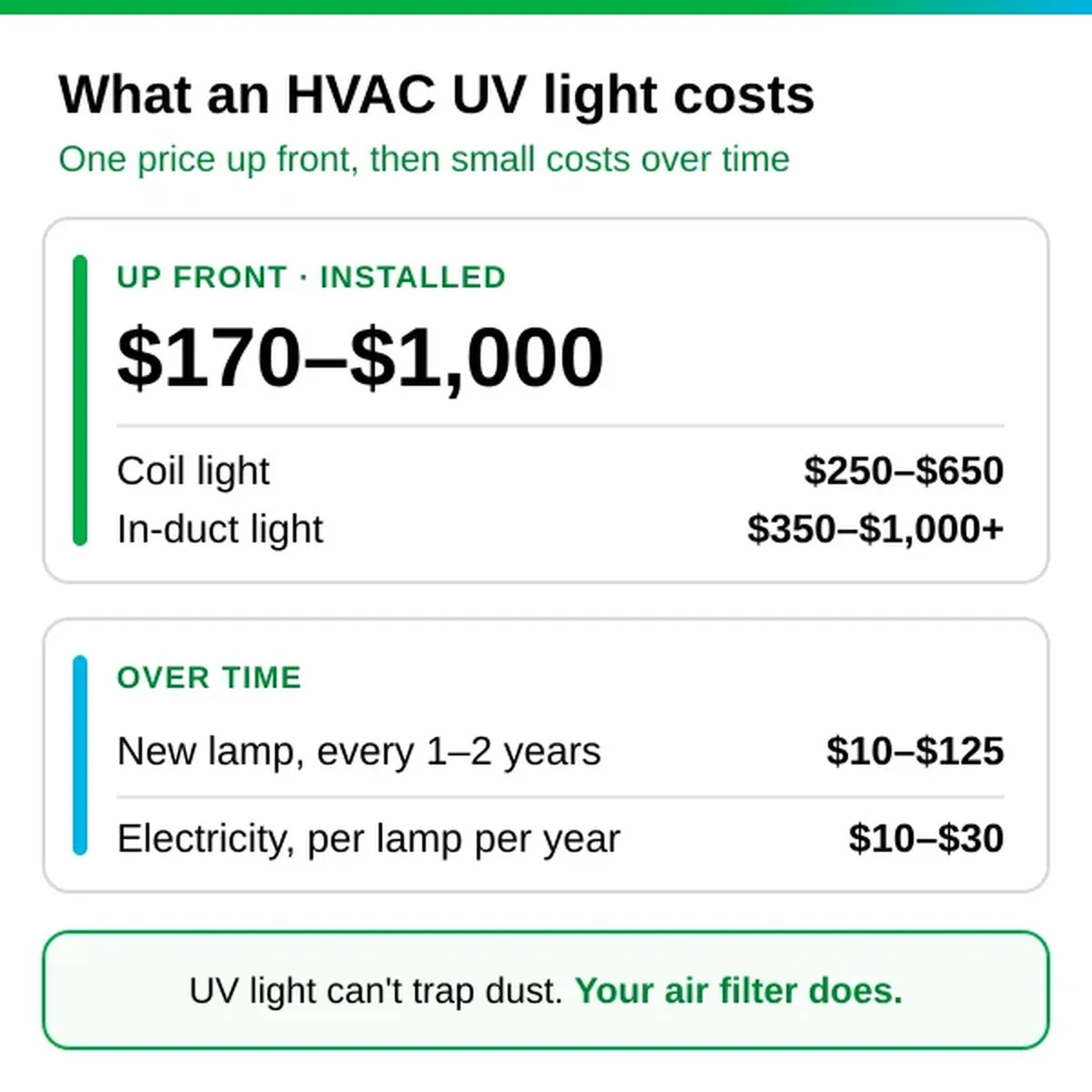
Installing a UV light in an HVAC system typically costs $170 to $1,000, and a single coil light usually lands between $250 and $650. After that, budget $10 to $125 for a new lamp every year or two, plus $10 to $30 a year per lamp in electricity.
Coil light: 250–650 installed. It keeps the AC coil free of mold and biofilm.
In-duct light: 350–1,000+ installed. It treats air moving through the ducts.
UV light can't trap dust or pollen, so your air filter still does that work. Take the quick quiz below to find the filter that fits your home.
Find your filter match
Answer a few quick questions and we'll match you to the right MERV rating for your home.
Already know your size? Shop air filters at Filterbuy
Installing a UV light in an HVAC system typically costs $170 to $1,000, and a single coil light usually lands between $250 and $650. That covers the unit plus labor and wiring. After installation, budget $10 to $125 for a new lamp every year or two and $10 to $30 a year per lamp in electricity.
We see this purchase from both sides. Filterbuy has made air filters in company-owned U.S. plants since 2013, and our Florida service team, Filterbuy HVAC Solutions, installs UV lights in customers' homes.
TL;DR
A UV light for an HVAC system costs $170 to $1,000 installed, plus a new lamp every year or two. It keeps the AC coil free of mold and biofilm, but it can't trap dust or pollen, so a good air filter still does the heavy lifting.
Key Takeaways
Coil UV lights run $60 to $280 plus $100 to $225 to install; in-duct lights run $80 to $400 plus $150 to $295, according to Angi.
Replacement UV-C lamps cost $10 to $125, and most last one to two years.
An 18-watt lamp running around the clock uses 158 kWh a year, or roughly $29 at the 2026 U.S. average electricity rate.
UV-C light doesn't capture particles, so Filterbuy recommends pairing it with a MERV-rated air filter rather than replacing one.
How Much Does HVAC UV Light Installation Cost?
Most homes pay $170 to $1,000 for HVAC UV light installation. Angi's national cost data puts the total at $170 to $800, unit and lamp included. A 2026 New Jersey contractor price list lands higher, at $250 to $650 for coil lights and $350 to $1,000 or more for in-duct lights. Whole-house UV purification systems run $750 to $3,500.
Sources: Angi and Clean Air Technologies NJ. Prices checked October 7, 2026.
How Filterbuy sourced these prices: Every range traces to a named source, checked October 2026.
The AprilAire AUV24V, a 17-watt, 24-volt coil cleaner made by Research Products Corporation, sells for $204.99 at The Home Depot. Its AUVRPB replacement lamp costs $84.99.
What Filterbuy's installers charge: In South Florida, Filterbuy HVAC Solutions currently charges $299 to install a UV light, parts and labor included. Every part but the bulb carries a five-year warranty.
How Much Does a UV Light for an AC Unit Cost by Type?
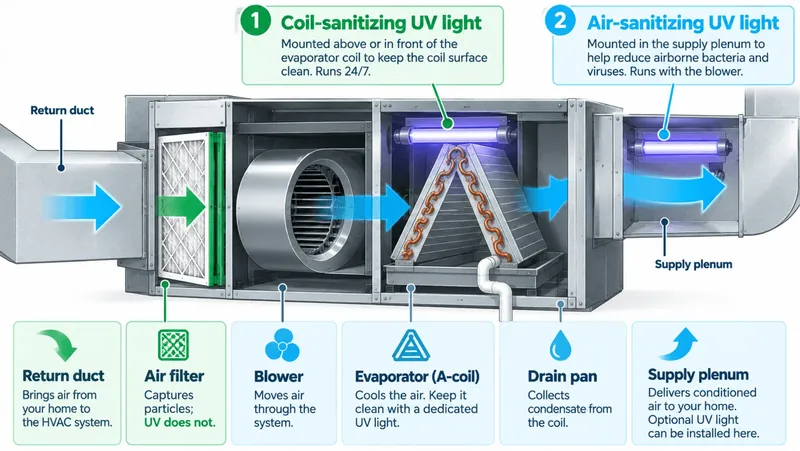
The type you choose sets most of the price. A coil-sanitizing light shines on the evaporator coil inside the air handler, and it's the cheaper option. An in-duct, air-sanitizing light treats air as it moves through the ductwork, so it costs more to buy and install. New to the technology? Start with how UV lights work in HVAC and Filterbuy's coil vs. in-duct UV lights guide.
Unit and labor ranges: Angi. Installed ranges: Clean Air Technologies NJ, 2026.
For most homes, the coil light is the better value. Filterbuy HVAC Solutions technicians mount most lights at the evaporator coil because that's where moisture and microbial growth build up. For more coverage, they can add a second light at the blower or plenum. The case for treating moving air is weaker: the EPA notes that killing most mold and bacterial spores takes far more UV exposure than a typical home unit delivers.
What Moves an Installed Quote Up or Down?
Five factors explain why two homes get different quotes for the same light.
Lamp type and count. Dual-lamp and higher-wattage units cost more to buy and to re-lamp.
Power source. Units run on 24-volt or 120-volt power, and adding a new outlet or transformer can tack on $60 to $300.
Access. HVAC labor typically runs $75 to $150 an hour, and a single coil light takes one to three hours, longer in attics.
Sheet-metal work. Cutting and sealing a duct opening adds labor.
Lamp design. Proprietary lamps tie you to one supplier's pricing for years.
How to Tell if a UV Light Quote Is Fair
One coil light should cost $250 to $650 installed. Check each line of a quote against these benchmarks.
Sources: Clean Air Technologies NJ and Filterbuy HVAC Solutions. Checked October 7, 2026.
Red flags:
Promises to cure allergies or prevent illness.
No written price for the replacement lamp.
What Are the Ongoing Costs of a UV Light?
Once the light is in, you'll pay for replacement lamps ($10 to $125 each) and electricity ($10 to $30 a year per lamp). UV-C lamps lose germicidal strength as they age, even while they still glow, which is why most manufacturers rate them for roughly 12 months. Dust also dims the bulb, so Angi suggests wiping it every couple of months.
"Most lights last one to two years," says David Clark, Licensed HVAC Technician and President of Filterbuy HVAC Solutions.
Where they fit, Filterbuy's installers recommend two-year bulbs. They cost more up front but cut bulb changes in half.
Filterbuy electricity math (using the U.S. Energy Information Administration's 2026 forecast average of 18.2¢ per kWh):
An 18-watt coil lamp running 24/7 uses 18 W × 8,760 hours = 158 kWh a year, or roughly $29 a year.
An 18-watt air-sanitizing lamp that runs only with the blower (around 3,000 hours a year) costs roughly $10 a year.
What Does a UV Light Cost Over Three Years?
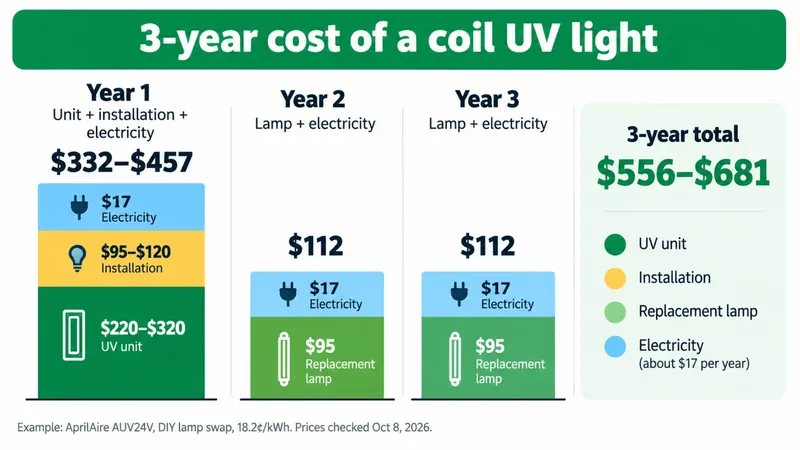
In this example, a coil-sanitizing light costs $560 to $680 over three years. That's 51 to 62 cents a day. It assumes the AprilAire AUV24V running 24/7 and a DIY lamp swap each year. A technician swap costs extra.
Example only: AprilAire AUV24V ($204.99) and AUVRPB lamp ($84.99) at The Home Depot, Oct 7, 2026; DIY lamp swap each year; electricity at 18.2 cents per kWh (EIA 2026 forecast). A technician lamp swap adds a service fee.
Is a UV Light in Your HVAC System Worth the Cost?
A UV light earns its keep when the evaporator coil stays damp and keeps growing mold or biofilm, which is common in humid climates. It's a weaker buy if allergy relief is the goal. The EPA notes that typical home units have limited effect and that dead mold spores can still trigger allergic reactions.
A UV light is a good fit if:
You live in a humid climate and run the AC most of the year.
A technician has found mold or biofilm on the coil or drain pan.
You keep paying for chemical coil cleanings.
You can probably skip it if:
You mainly want less dust or pet dander. UV-C light doesn't capture particles.
Your coil looks clean at annual maintenance.
At Filterbuy, our advice is simple: start with the filter, then add UV if the coil needs it. As our installation team puts it:
"Air filters are not replacements for UV lights, and UV lights are not replacements for air filters."
A clean filter traps the dust and pollen UV light can't, and it keeps debris off the coil and lamp. Pick the right one with Filterbuy's guide to MERV ratings, and if you suspect growth, read how to remove mold from your air ducts.
Supporting Statistics: What the Research Says
Three U.S. government findings back Filterbuy's "filter first" approach.
Americans spend about 90% of their time indoors. Indoors, some pollutants run 2 to 5 times higher than outside. Source: EPA's Report on the Environment.
Dampness and mold are linked to 30% to 50% more respiratory problems. Source: Lawrence Berkeley National Laboratory, a U.S. Department of Energy lab.
A clean filter cuts AC energy use 5% to 15%. Source: U.S. Department of Energy.
What this means for your home:
Your HVAC system moves the air your family breathes most. Outdoor air matters too, so check your local AQI.
A damp coil is where a coil UV light pays off.
A fresh filter does the daily work UV light can't.
Can You Install an HVAC UV Light Yourself?
You can with a kit, but for most homes a professional install is the safer choice. The job means cutting into ductwork and wiring the lamp into the air handler, and DIY installs can also void the manufacturer warranty.
UV-C light can burn skin and damage eyes, so switch off power before opening a panel and never look at a lit lamp. Choose a unit that states it produces no ozone, such as one validated to UL 2998, since some UV devices give off ozone, a lung irritant.
Buying in California? In-duct air cleaners with UV light components generally need CARB certification to be sold there. The AprilAire coil cleaner in our cost example is not sold in California.
Frequently Asked Questions
Does a UV light replace my air filter?
No. After more than a decade of making filters at Filterbuy, we hear one misconception again and again: that a UV light makes filter changes less important. It doesn't. UV light inactivates microbes, but it removes no dust, pollen, dander, or smoke. Keep changing your filter on schedule; see how often to change your air filter, or let Filterbuy auto-delivery handle it.
Will a UV light lower my energy bill?
It can if biofilm has built up on the coil. ASHRAE-sponsored field research in humid Tampa measured roughly 15% gains in heat transfer and airflow. The lamps didn't clear existing buildup, so clean the coil first.
How often should you replace an HVAC UV light bulb?
Every one to two years, depending on the bulb. Output fades before the lamp goes dark, so follow its rated life.
What should you ask a contractor before installing a UV light?
Get two quotes and ask:
What does the replacement lamp cost?
How long is it rated to last?
Does the unit need a new outlet or transformer?
Is it certified ozone-free?
Is it a bare UV-C lamp or a photocatalytic oxidation (PCO) unit?
Do HVAC UV lights produce ozone?
Standard germicidal lamps emit at 254 nm and generally produce little or no ozone, but some UV devices do. For proof, look for UL 2998 validation.
Glossary
UV-C: Short-wavelength ultraviolet light (100–280 nm) that inactivates microbes; HVAC lamps emit at about 254 nm.
Coil-sanitizing UV light: A UV-C lamp aimed at the evaporator coil, usually running 24/7.
Air-sanitizing (in-duct) UV light: A UV-C lamp in the ductwork that treats moving air.
Evaporator coil: The indoor AC or heat pump coil that cools and dehumidifies air.
Biofilm: A slimy microbial layer that can restrict airflow.
Air handler: The indoor cabinet housing the blower.
Plenum: The duct box attached to the air handler.
UL 2998: A UL Solutions validation that an air cleaner's ozone stays below 5 parts per billion.
MERV (Minimum Efficiency Reporting Value): A 1–16 rating of how well an air filter captures particles; higher numbers catch smaller ones. Filterbuy makes filters rated MERV 8, 11, and 13.