July 16, 2026

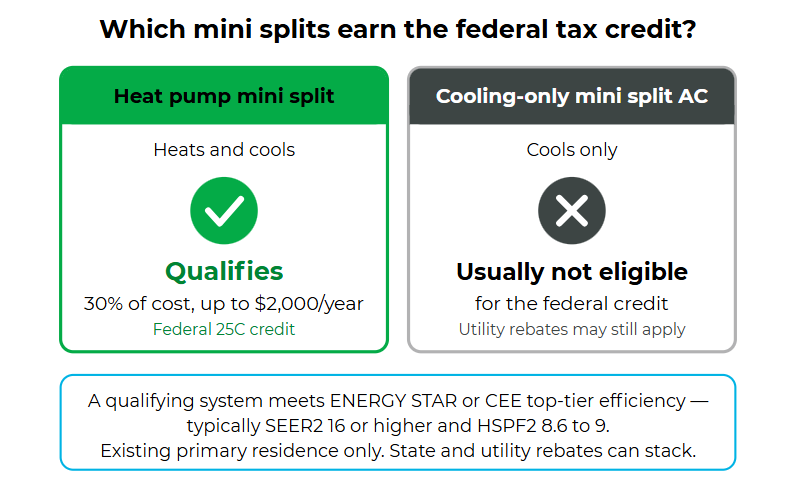
Yes — mini split heat pumps qualify. Cooling-only mini split AC units usually do not. The federal 25C credit covers 30% of what you pay to buy and install a qualifying heat pump, up to $2,000 a year. The system has to heat and cool, meet ENERGY STAR or CEE top-tier efficiency, and go into your existing primary residence. State and utility rebates can stack on top of it.
Heat pump mini split (heats and cools): eligible — 30% of cost, up to $2,000 per year.
Cooling-only mini split AC: usually not eligible for the federal credit, though local utility rebates may still apply.
Efficiency: ENERGY STAR or CEE top tier — typically SEER2 16 or higher and HSPF2 8.6 to 9.
Where it counts: existing primary residence only — not new construction or rentals.
Not sure which size fits your space? Take the quick match quiz below, or browse Filterbuy mini split systems.
Answer a few quick questions and we’ll match you to the right mini split for your space.
Eligibility depends on the specific model’s certification. Consult a licensed HVAC professional and a tax advisor about your situation.
Upgrading your home’s heating and cooling system is a major investment. Because of upfront costs, many homeowners are seeking ways to lower the price tag while securing better long-term energy savings. Ductless systems have become incredibly popular for their efficiency, but figuring out the financial incentives can be confusing.
So, do mini splits qualify for federal tax credits? The short answer is yes, but the rules are highly specific. Finding out exactly what you are eligible for requires looking past flashy marketing claims and understanding the government and local utilities' actual requirements.
If you are short on time, here is the basic rundown of how mini split energy rebates in the USA work right now:
Yes, mini split heat pumps qualify. Systems that provide both heating and cooling are eligible for major federal incentives.
No, cooling-only mini split AC units usually do not. If the system only provides air conditioning, you will likely miss out on the federal tax credit.
Federal credit = 30% up to $2,000. You can claim a sizable chunk of your installation costs.
Additional state and utility rebates can stack. Depending on your location, local programs can add hundreds or thousands to your total savings.
Federal energy incentives have expanded significantly over the past few years. Understanding the exact terms will help you choose a system that keeps your initial costs as low as possible.
The 25C tax credit mini split incentive allows homeowners to claim 30% of the total cost of purchasing and installing a qualifying heat pump. The maximum amount you can claim for heat pumps is $2,000 annually.
Keep in mind that this credit only applies to upgrades made to your existing primary residence. It does not apply to new construction builds or rental properties.
Not every unit on the market will earn you a tax break. To claim the ductless heat pump tax credit, your system must meet specific criteria. First, it must be a true heat pump capable of both heating and cooling your space.
Second, the unit must meet the strict ENERGY STAR or Consortium for Energy Efficiency (CEE) highest efficiency tiers. While exact numbers can vary slightly by region, the typical SEER2 requirements for a heat pump include a SEER2 rating of 16 or higher and an HSPF2 rating between 8.6 and 9.
It is important to know what the government excludes. Standard cooling-only mini split AC systems generally do not qualify for the federal credit. Furthermore, any non-certified, low-efficiency units will be rejected, even if they have heating capabilities.
You might have seen advertisements promoting a “mini split ac tax credit – 30/mo” or “mini split ac rebates – 30/mo.” These claims are highly misleading.
The federal government does not send you a $30 check every month. The incentive is a one-time tax credit applied when you file your annual tax return.
When marketers use the “$30/month” figure, they are usually estimating your potential monthly savings on your energy bill, not describing an IRS benefit. Always read the fine print to separate actual tax credits from estimated utility savings.
To understand your total savings potential, let’s look at a realistic breakdown. By combining federal and local incentives, you can significantly reduce your final out-of-pocket costs.
System cost: $7,500
Federal credit: $2,000
Utility rebate: $300–$1,000
Final cost: ~$4,500–$5,200
By choosing the right equipment and claiming available rebates, you can achieve a 30% to 50% reduction in your total project cost.
Homeowners dealing with extreme heat and humidity can definitely benefit from high-efficiency systems. Fortunately, mini split rebates in Florida are widely available.
Florida residents can claim the exact same 30% federal tax credit (up to $2,000) for qualifying heat pumps installed in their primary homes.
Local power companies in Florida frequently offer additional cash back. You can typically expect utility rebates ranging from $200 to $1,150 per system, depending on your provider and the efficiency of the unit you choose.
State-level programs funded by the federal government are actively developing. Availability and payout amounts for these programs will largely depend on your household income and specific location within the state.
Texas has a unique power grid and massive temperature swings, making efficient temperature control a top priority. Mini split rebates in Texas offer great opportunities for savings.
Texans are fully eligible for the federal 25C credit, allowing you to claim up to $2,000 annually for a qualifying heat pump.
Many local utility companies in Texas incentivize energy efficiency to reduce grid strain. Typical utility rebates range from $200 to $600 or more per system. Certain regions offer even higher combined incentives.
When you combine federal credits with Texas utility rebates, you can often reach $1,500 to $3,000+ in total combined savings.
Getting your money requires proper documentation. Follow these basic steps to ensure you do not miss out.
Install a qualifying system: Verify that your chosen heat pump meets all ENERGY STAR requirements.
Save AHRI certificate and receipts: Your installer should provide an Air-Conditioning, Heating, and Refrigeration Institute (AHRI) certificate proving the system's efficiency ratings. Save this alongside your final invoice.
File IRS Form 5695: You will use this form to calculate and claim your residential energy credits.
Claim during tax filing: Submit the form alongside your standard annual tax return.
Disclaimer: Always consult a licensed HVAC professional and tax advisor regarding your specific eligibility and documentation requirements.
Federal credits are easy to find, but local rebates require a little digging. Start by checking your utility provider’s website. They usually have a dedicated “rebates and incentives” page. State energy offices also list available local programs.
For a quick shortcut, open your search engine and type: “[your utility company name] + heat pump rebate.” Your local HVAC contractor should also be able to guide you toward the best available programs in your zip code.
Proper sizing is crucial for maximizing both comfort and energy efficiency. At Filterbuy, you can browse high-efficiency mini split systems with fast free shipping. We make it easy to find the right BTU size for your space.
Here is a quick sizing guide to help you plan:
12,000 BTU: Covers up to 250–300 sq ft (Available in 115V or 230V). Best for 1-car garages or small rooms.
18,000 BTU: Covers up to 350–400 sq ft (230V). Best for large 1-car or small 2-car garages.
24,000 BTU: Covers up to 500–550 sq ft (230V). Best for 2-car garages or larger living spaces.
Keep in mind that ENERGY STAR eligibility depends on specific model certification. A ductless system may qualify depending on its exact ratings, so always check the specifications before purchasing.
Yes, they are highly worthwhile, especially if you choose a heat pump over a cooling-only model. You secure a strong return on investment when you stack federal tax credits with local utility rebates. These systems are incredibly effective for generating energy savings, providing zoned comfort, and ensuring lower long-term operating costs.
No. Only heat pump mini splits that meet strict government efficiency standards qualify for the federal credit.
Yes, you can. The $2,000 maximum cap resets annually for new qualifying upgrades you make to your home.
Sometimes. Local utility rebates may apply to high-efficiency AC units, but federal tax credits usually require the system to be a dual heating and cooling heat pump.
Yes. You can access rebates mainly through utility companies, with payouts typically ranging from $200 to $1,150.
Yes. Many Texas utilities offer $200 to $600+ rebates, which are frequently stackable with federal incentives.
No. That specific number is a marketing estimate used by some companies to show potential energy savings. It is not an actual monthly IRS tax credit.