July 16, 2026

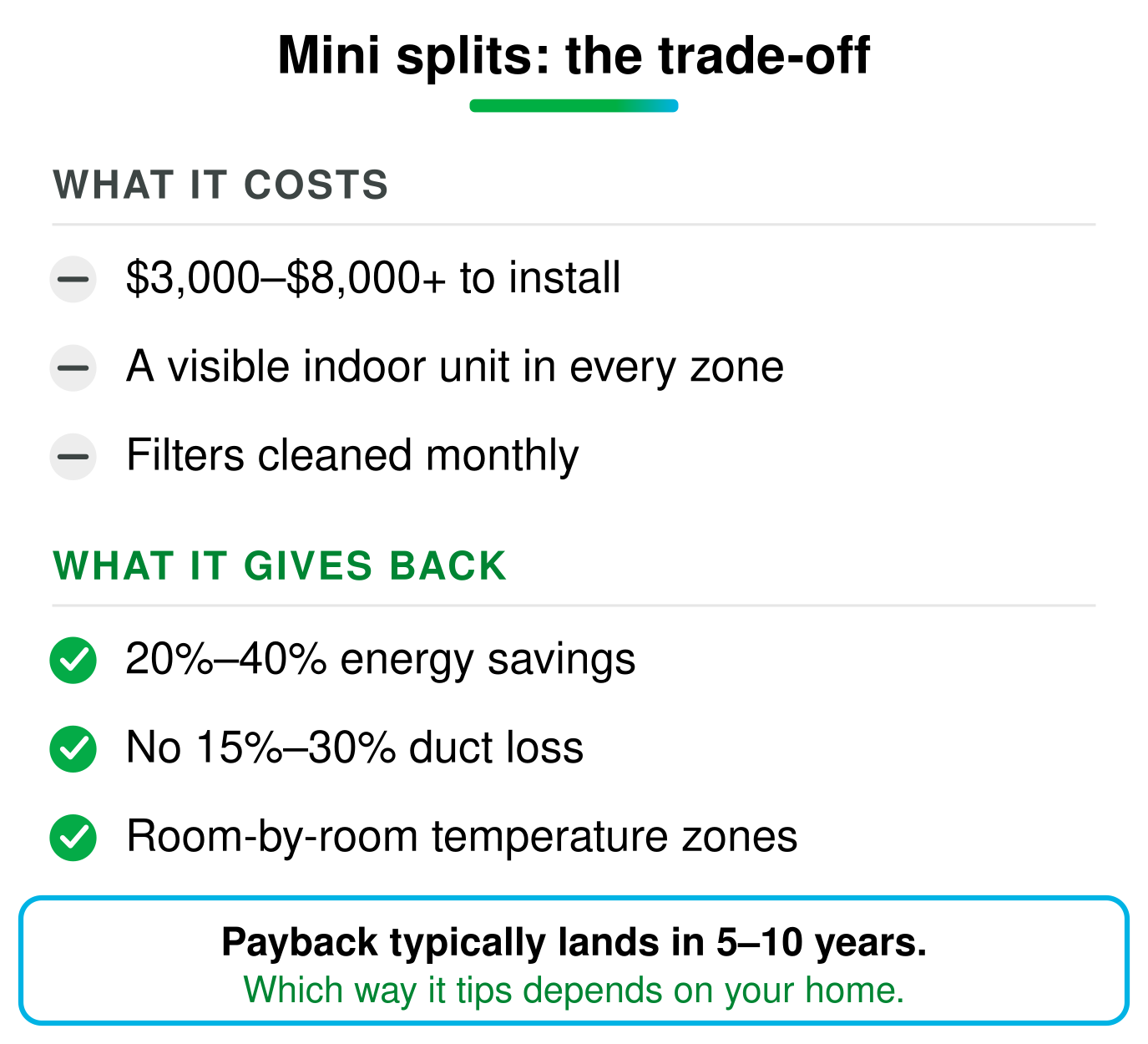
A mini split is worth it if your home has no ductwork, or if you want to set the temperature room by room. If you already have efficient central air and well-maintained ducts, it usually is not. The trade-off is straightforward: you pay $3,000 to $8,000+ up front, and you get back 20% to 40% energy savings, independent zones, and a 15 to 20 year lifespan. Homeowners typically see payback in 5 to 10 years.
Worth it if: you have no ductwork, you want separate temperature zones, or you are cooling one space like a garage, sunroom, or addition.
Not ideal if: you already have efficient central AC and good ducts, you want a climate system you cannot see, or you need the lowest upfront cost across a large home.
Sizing: 12,000 BTU covers 250 to 300 sq ft, 18,000 BTU covers 350 to 400 sq ft, and 24,000 BTU covers 500 to 550 sq ft. See Filterbuy mini split systems.
Not sure which side you land on? Answer a few quick questions below and we will match you to the right size for your space.
Answer 3 quick questions and we will match you to your mini split.
Already know your size? Shop Filterbuy mini split systems — free shipping and a 5-year warranty.
Ductless heating and cooling setups are rapidly gaining traction across U.S. homes. According to the U.S. Department of Energy, duct losses can account for 15% to 30% of energy waste in a typical house. By removing the ductwork entirely, homeowners are finding new ways to stay comfortable and lower their monthly utility bills.
Making the switch to a ductless setup is a significant investment. You want to make sure you are choosing the right heating and cooling solution for your property. We’ll break down the real pros, cons, and whether it’s worth it for your home.
Energy Efficiency: Ductless systems can significantly reduce energy waste, potentially lowering your utility bills by eliminating duct losses.
Improved Comfort: These systems allow for better temperature control in individual rooms or zones, providing a more customized and consistent indoor environment.
Initial Costs: While the upfront investment for a ductless system can be high, the long-term savings and efficiency often offset the initial expense.
Flexibility: Ductless setups are highly versatile, making them suitable for a variety of home layouts and renovations where traditional ductwork would be impractical.
Maintenance Needs: Regular maintenance is key to ensuring the system operates efficiently over time, making it a factor to consider when planning for your home.
A mini split system is a highly efficient heating and cooling solution that operates without traditional ductwork. The system consists of two main components: an outdoor compressor (or condenser) and an indoor air-handling unit. A conduit, which houses the power cable, refrigerant tubing, suction tubing, and a condensate drain, links the outdoor and indoor units.
Depending on your needs, you can install a single-zone system to climate-control one specific area, or a multi-zone system that connects one outdoor compressor to multiple indoor units (often up to eight), allowing you to cool or heat several rooms independently.
When evaluating the pros and cons of mini split systems, the advantages often center around efficiency and flexibility.
Mini splits are remarkably efficient. By eliminating ductwork, you avoid the 15% to 30% energy loss associated with forced-air systems. U.S. homeowners typically see 20% to 40% energy savings. With SEER2 ratings frequently hitting the 20 to 30+ range, these systems require far less electricity to operate. For a standard 250–300 square foot room, a system like the Filterbuy 12,000 BTU mini split provides optimal, cost-effective cooling.
One of the biggest reasons people ask, "Are mini split AC units good?" is the zoning capability. You can control the temperature of each room independently. If you prefer a cool bedroom but a warmer living room, zoning makes it possible. This targeted approach can save you roughly $30 to $40 per month during peak summer and winter seasons.
If you live in an older home without existing ducts, installing central air can be an expensive, invasive nightmare. Mini splits bypass this problem entirely. They are ideal for historic homes, new additions, sunrooms, and garages where running new ductwork simply isn’t feasible.
Nobody likes trying to sleep over the roar of a clunky window AC. Mini splits operate at incredibly low noise levels, often under 30 decibels (dB) for the indoor unit. That is roughly the sound of a whisper, making them much quieter than traditional window units and even many central air systems.
Most modern mini splits are heat pumps. This means they can reverse their operation to provide both heating and cooling from a single system. You can easily keep your space comfortable year-round, significantly reducing the need for dangerous or inefficient portable space heaters during the winter.
When properly maintained, a quality mini split system can easily last 15 to 20 years. This outpaces many traditional central AC units and standard window air conditioners, offering excellent long-term value.
While the benefits are impressive, a balanced look at mini split ac pros and cons requires examining the drawbacks.
The initial investment for a mini split can be substantial. The U.S. average ranges from $3,000 to $8,000 or more, depending on the system size, brand, and installation complexity. If you are outfitting an entire home with multiple zones, the cost can quickly climb higher than installing a standard central AC unit.
Unlike central air, where you only see small floor or ceiling vents, mini splits require a wall-mounted indoor unit in every zone you want to climate-control. While modern designs are relatively sleek, they are still visible appliances that take up wall space and may clash with your interior decor.
To keep efficiency high, regular maintenance is non-negotiable. You must clean the filters monthly. If you skip this simple step, debris builds up rapidly, reducing airflow, lowering efficiency, and potentially shortening the lifespan of the equipment.
Cooling a massive home exclusively with mini splits can become cost-prohibitive. Because you need an indoor unit for every individual zone, outfitting a sprawling five-bedroom house will require a complex, expensive multi-zone setup.
While heat pump technology has improved dramatically, standard mini splits can lose efficiency when temperatures drop below freezing or soar into extreme heat. If you live in a region with brutal winters, you may still need a backup heating source unless you invest in a specialized cold-climate model.
| Feature | Mini Split | Central AC |
|---|---|---|
| Efficiency | High | Moderate |
| Installation | Easy | Complex |
| Zoning | Yes | Limited |
| Cost | Higher upfront | Lower if ducts exist |
Are mini split ac units worth it? The answer usually comes down to your home’s layout and your specific climate needs. Homeowners typically see a return on investment within 5 to 10 years due to the massive energy savings.
Worth it if:
You have no existing ductwork.
You want distinct temperature zones.
You want massive energy savings.
You are cooling specific rooms, like a garage or home addition.
Not ideal if:
You already have efficient central AC and well-maintained ducts.
You want a completely hidden climate system.
You need the absolute lowest upfront installation cost for a large home.
Choosing the right capacity, measured in BTUs (British Thermal Units), is critical. If the unit is too small, it will run constantly, driving up your power bill. If it is too large, it will short-cycle, failing to properly dehumidify the air.
Here is a quick sizing guide to help you find the right fit:
12,000 BTU: Up to 250–300 sq ft (Available in 115V or 230V). Best for 1-car garages or standard bedrooms.
18,000 BTU: Up to 350–400 sq ft (230V). Best for large 1-car or small 2-car garages and living rooms.
24,000 BTU: Up to 500–550 sq ft (230V). Best for 2-car garages, large open-concept spaces, or basements.
When you shop for Filterbuy mini splits, you get access to fast free shipping and a comprehensive 5-year warranty, ensuring your investment is protected.
The decision to install a ductless system ultimately hinges on your home’s unique infrastructure. High efficiency and incredible flexibility are the key advantages of this technology. By doing away with leaky ducts, you secure lower utility bills and enjoy personalized comfort in the rooms you use most.
Evaluate your existing HVAC setup, calculate your square footage, and choose a system size that perfectly matches your lifestyle. If you are ready to upgrade your home comfort, explore Filterbuy Mini Split Systems to find the right size for your space.
Yes, mini split AC units are worth it for many U.S. homeowners—especially in homes without ductwork or for room-by-room cooling. They can reduce energy use by 20–40% and offer precise control, helping offset higher upfront costs within 5–10 years.
The main disadvantages include higher upfront costs, visible indoor units, and regular maintenance. They can also be less efficient in extreme temperatures and more expensive for whole-home use if multiple zones are required.
No, mini splits are highly energy efficient. They typically use 20–30% less electricity than central systems because they avoid duct losses and adjust output using advanced inverter technology.
Mini split systems usually last 15–20 years with proper maintenance. Cleaning filters monthly and scheduling professional servicing helps maintain performance and extend the lifespan of the equipment.
Yes, multi-zone systems can cool an entire house, but they require multiple indoor units. For larger homes, this can easily increase upfront installation costs compared to standard central HVAC systems.
Mini splits are better for homes without ducts, smaller spaces, or zoning needs. Central air is often better for large homes with existing ductwork and complete whole-home cooling needs.
Installation typically costs between $3,000 and $8,000+, depending heavily on the system size, the total number of zones, and the overall complexity of the installation process.
Yes, but performance varies by model. Standard units lose efficiency in freezing temperatures, while cold-climate models can operate effectively even when temperatures drop well below 0°F.