July 14, 2026
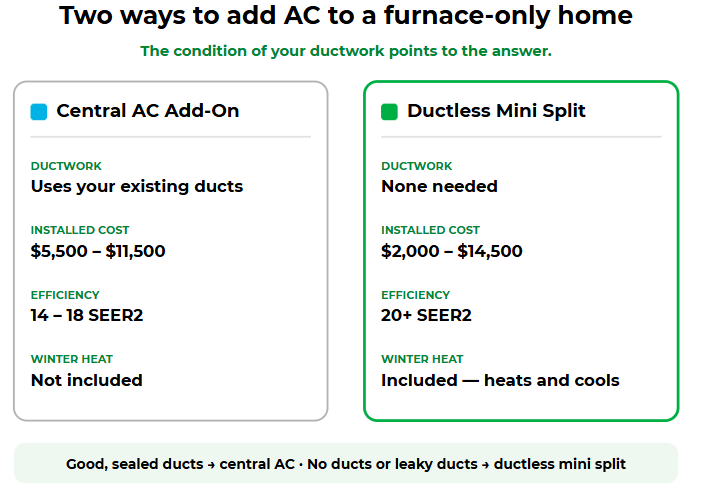
You can add AC to a furnace-only home two ways: bolt a central AC add-on onto your existing ductwork, or install a ductless mini split that needs no ducts at all. Which one fits comes down to your ductwork. If your ducts are newer and well sealed, a central add-on reuses them. If you have no ductwork — or older ducts that leak — a ductless mini split is the simpler path, and it heats as well as cools.
Central AC add-on — reuses existing ducts, $5,500–$11,500 installed, 14–18 SEER2, cooling only.
Ductless mini split — no ductwork needed, $2,000–$14,500, 20+ SEER2, heats and cools.
Not sure which is right for your home? Browse ductless mini split systems or take the quick match quiz below.
Answer 3 quick questions and we'll match you to the right mini split for your space.
If you live in an older home, you probably know what it's like to sweat through the summer without a modern cooling system. Relying on noisy, inefficient window units to survive the heat can be a drag.
The good news? Upgrading your home with air conditioning is easier than you think. You don't need a massive renovation to get a blast of cold air.
Homeowners typically have two main options:
Add central AC to your existing furnace.
Install a modern ductless mini split system.
Each option has its own costs, energy efficiency, and installation needs. Learn more about which one is right for your home.
Central AC systems are ideal if you already have ductwork in place, offering consistent cooling throughout your home.
Ductless mini split systems are perfect for homes without existing ductwork, providing flexible installation and customizable cooling for individual rooms.
Consider factors like energy efficiency, upfront costs, and long-term savings when choosing your cooling solution.
Both options can improve comfort and add value to your home, but the best choice depends on your specific needs and setup.
Yes, you absolutely can. Adding a cooling system to a heating-only home is incredibly common across the United States. Many homes built before the 1970s were constructed with only a furnace to handle the harsh winter months.
When you want to introduce cooling to this setup, you generally have two main options. First, you can pursue a central AC add-on, which utilizes your existing ductwork to push cold air through the house. Second, you can install ductless mini split systems. We will explore both options in detail so you can make a confident decision.
If your home already has a forced-air furnace with vents in every room, adding central air is a logical first thought. This method taps into the infrastructure you already have.
To adapt your heating system for cooling, a licensed HVAC technician will install an evaporator coil directly above or alongside your existing furnace. Next, they will place an outdoor condenser unit in your yard. The furnace's blower motor then works double duty. Instead of just pushing warm air in the winter, it forces chilled air through your existing vents during the summer.
A standard central air add-on costs USA homeowners roughly $5,500 to $11,500 for a fully installed system. However, you must also account for the condition of your home. If your system requires duct repair, expect to pay an additional $1,000 to $5,000. Upgrading an older electrical panel to handle the new AC load can also add $500 to $3,000 to your final bill.
The biggest advantage of this method is whole-home cooling. Because the system uses your existing vents, the mechanics remain largely invisible inside your living space. You control the temperature from a single central thermostat.
This option relies entirely on the quality of your existing ductwork. According to the U.S. Department of Energy and ENERGY STAR estimates, leaky ducts can waste up to 30% of energy. If your ducts are old, poorly sealed, or uninsulated, you will pay to cool the air inside your attic or crawlspace. Additionally, central AC systems typically offer lower efficiency ratings, hovering around 14 to 18 SEER2.
For many modern homeowners, skipping the ductwork entirely is the smartest move. A mini split ac and heat system provides incredible efficiency and flexibility, especially for older properties.
A ductless system requires two main components: an indoor air-handling unit mounted on your wall and an outdoor compressor. Refrigerant lines connect the two through a tiny hole in the wall. Because these systems bypass ductwork completely, they deliver conditioned air directly into the room. Better yet, heat pump technology allows these units to provide both robust heating and powerful cooling.
Ductless technology is rapidly taking over the U.S. market. In fact, the market is projected to reach over $19 billion. High energy savings and lucrative utility rebates drive this massive shift. The phrase "mini split ac and heat" generates nearly 9,900 monthly searches online, proving that homeowners are actively seeking better alternatives to traditional central air.
Depending on your needs, costs scale with the size of the project.
Single-zone systems: $2,000 to $8,000 (ideal for a large open room, an addition, or a garage).
Multi-zone systems: $7,000 to $14,500+ (capable of cooling multiple rooms using one outdoor compressor).
Ductless mini split benefits are hard to ignore. They regularly achieve 20+ SEER2 efficiency, which is significantly higher than standard central AC. This translates to up to 30% to 40% lower cooling energy use. You also gain zoned comfort, allowing you to cool only the rooms you actively use. Plus, you completely eliminate energy loss from leaky ducts. This is widely considered the best way to add AC to a home without ductwork.
The most notable drawback is aesthetics, as the indoor units mount visibly on your walls. They also require a higher upfront investment if you need to install individual units in several separate bedrooms.
Let's break down the key differences to help you visualize what each system offers for your older home.
| Feature | Central AC Add-On | Mini Split AC & Heat |
|---|---|---|
| Cost | $5,500–$11,500 | $2,000–$14,500 |
| Ductwork Needed | Yes | No |
| Efficiency | 14–18 SEER2 | 20+ SEER2 |
| Energy Loss | High due to ductwork | Minimal |
| Heating Included | No | Yes |
| Best For | Homes with good ductwork | Homes without ductwork or homes undergoing upgrades |
Choosing the right cooling system largely depends on your current home infrastructure. Both options offer a significant upgrade over window units, but they solve different problems. Let's break this down into scenarios.
Choose central AC if:
Your existing ducts are newer, properly sealed, and well insulated.
Your furnace is under 10 to 15 years old.
You want one centralized thermostat to control every room at the same time.
Choose mini split if:
Your home has no ductwork, or the existing ducts are in poor condition.
You want significantly lower energy bills each month.
You want a single system that provides both efficient heating and cooling.
Expert tip: If your furnace is over 15 years old, investing thousands of dollars to tie a brand new central AC to a dying unit is risky. When the furnace fails, you might have to replace both components. A mini split operates independently, completely sidestepping this issue.
For the vast majority of homeowners upgrading older properties, ductless mini splits are the superior long-term investment. They offer a simple, non-invasive installation that will not require tearing into your walls or ceilings to lay new sheet metal. Better yet, they can work right alongside your existing furnace, providing supplemental heat in the winter and powerful primary cooling all summer long. Eventually, they can replace the furnace entirely.
Filterbuy offers energy-efficient mini split systems designed perfectly for U.S. homes, complete with fast free shipping and a 5-year warranty. Consider these common use cases to find the perfect size for your space:
12,000 BTU (Up to 250–300 sq ft): Best for a 1-car garage, home office, or small bedroom. Available in 115V or 230V.
18,000 BTU (Up to 350–400 sq ft): Best for large 1-car or small 2-car garages, sizable living rooms, or home additions. Operates on 230V.
24,000 BTU (Up to 500–550 sq ft): Best for 2-car garages or larger, open-concept spaces. Operates on 230V.
Filterbuy systems consistently deliver SEER 17 level performance, keeping you comfortable year-round without skyrocketing your monthly energy costs.
Regardless of which path you choose, a few crucial steps stand between you and a perfectly chilled home. Always use a licensed HVAC professional for the final installation to ensure everything meets local building codes.
Duct inspection: If you are seriously considering a central AC add-on, hire a pro to inspect and pressure-test your existing vents.
Electrical panel capacity: Check your breaker box. Older homes often run on 100-amp service, which might not support the massive draw of a new compressor. You may need an upgrade to 200 amps.
Home size (BTU calculation): Proper sizing is critical. An oversized unit will cool the space too quickly without removing humidity, leaving your home feeling clammy.
Permits: Most cities require permits for major HVAC work. Expect to pay $250 to $400 for these municipal approvals.
Upgrading your home comfort is a major financial decision, but you do not have to shoulder the entire cost alone. The federal government heavily incentivizes energy-efficient upgrades. Under the a , homeowners can claim up to $600 for a qualifying central AC installation.
However, the incentives for heat pump technology are much stronger. You can claim up to $2,000 in federal tax credits for installing energy-efficient mini splits. On top of federal credits, local utility companies across the U.S. frequently offer their own rebates for ditching outdated systems. Be sure to check with your local provider before scheduling your installation.
Adding air conditioning to an older home is an exciting project that dramatically improves your daily life. While tying a central AC into your existing furnace works well for homes with pristine ductwork, the reality is that most older ducts leak like a sieve. For the vast majority of U.S. homeowners, ductless mini splits represent the smartest, most efficient path forward.
Ductless systems provide unmatched flexibility, incredibly high SEER ratings, and the ability to heat and cool your home without losing energy to your attic. They are a modern solution to an age-old problem.
Ready to make a confident decision about your home comfort? Shop our selection of energy-efficient mini split systems today. With fast free shipping and an ironclad 5-year warranty, Filterbuy makes finding the right mini split for your space easier than ever.
A mini split system is a type of heating and cooling system that allows for efficient temperature control without requiring ductwork. It consists of an outdoor condenser unit and one or more indoor air-handling units, making it perfect for both single rooms and multiple zones.
Yes, mini splits are highly energy-efficient due to their high SEER (Seasonal Energy Efficiency Ratio) ratings. They provide targeted comfort, reducing energy waste by cooling or heating only the spaces you need.
Absolutely! Many modern mini split systems are designed to operate efficiently even in extreme cold conditions, with advanced heat pump technology ensuring reliable heating performance.
Mini split systems are generally easier to install than traditional HVAC systems, as they do not require ductwork. However, professional installation is recommended to ensure proper setup and optimal performance.
Maintaining a mini split system is simple. Regularly clean the air filters, keep the outdoor unit free of debris, and schedule periodic professional inspections to maintain efficiency and longevity.
The size needed depends on the square footage of the area you're cooling or heating. The team at Filterbuy can help you calculate the ideal size system for your home or business to ensure maximum comfort and efficiency.