
Why Is NYC Air Quality Bad Today? The Real Reasons Behind New York’s Hazy Days
July 1, 2026
Author: Michelle Wan
Technically reviewed by: David Clark, Licensed HVAC Technician
Published: July 1, 2026 Last updated: July 1, 2026
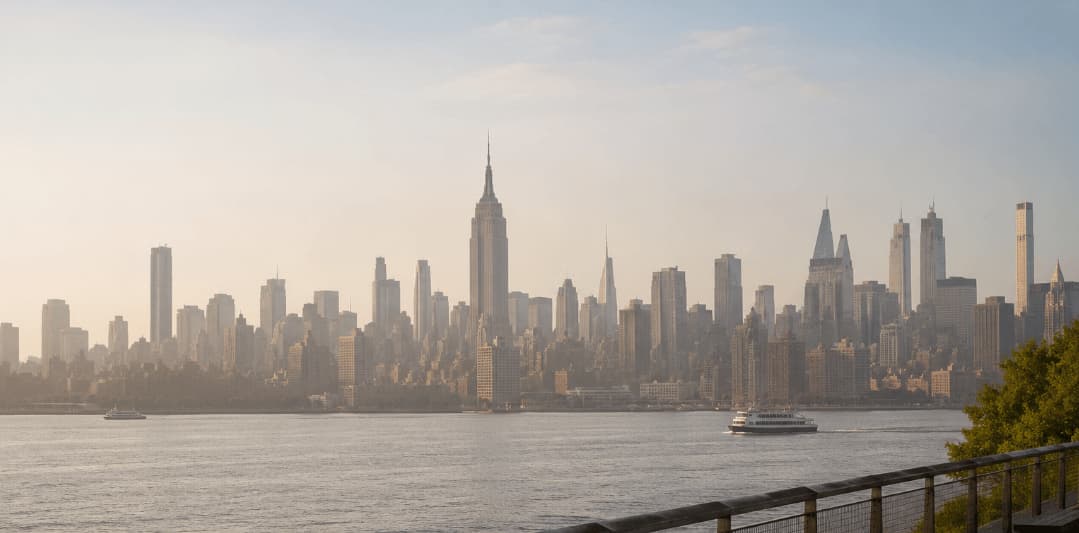
Why Is NYC Air Quality So Bad Today?
On a bad-air day, New York City’s air is usually bad for one reason, or a few stacking together: wildfire smoke, a summer ozone episode, a winter temperature inversion, or stagnant, windless weather. The fastest way to tell which one is to open your live AQI and read the dominant pollutant.
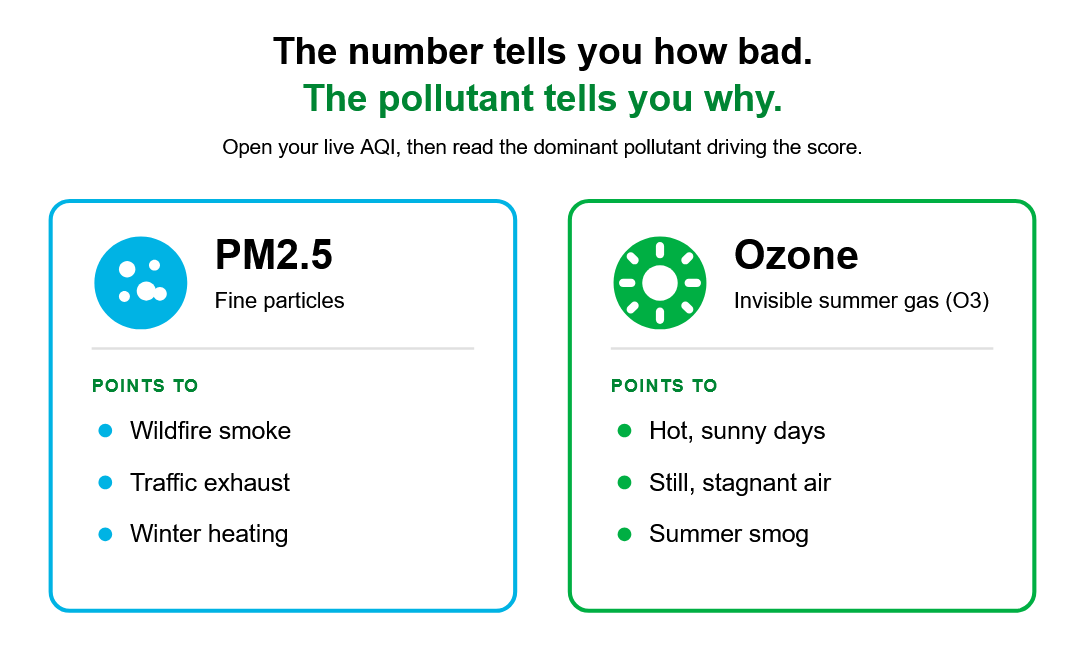
Ozone points to heat and sun. PM2.5 (fine particles) points to smoke, traffic, or heating. The number tells you how bad; the pollutant tells you why.
Real-time readings for all five boroughs, updated hour by hour.
Not sure which filter matches your air?
Answer a few quick questions and we’ll match you to the right filter for your system.
TL;DR
New York City’s air is usually bad on a given day because of one thing, or a few stacking together: wildfire smoke drifting in from Canada or the West, a summer heat-and-sun ozone episode, a winter temperature inversion trapping traffic and building emissions near the ground, or stagnant, windless weather that lets pollution pile up. The fastest way to know why today is bad is to check your live Air Quality Index (AQI) and see which pollutant is high: ozone points to heat and sun; fine particles (PM2.5) point to smoke, traffic, or heating.
Checking right now? See NYC’s real-time air quality, updated hour by hour for all five boroughs, on the Filterbuy New York City live AQI map. It’s the fastest way to see the current number for your block before you read on.
Key Takeaways
Check the pollutant, not just the number. A high AQI driven by ozone usually means a hot, sunny, stagnant day; a high AQI driven by PM2.5 (fine particles) usually means smoke, heavy traffic, or winter heating.
Wildfire smoke is now a leading cause of NYC’s worst air days. In June 2023, Canadian wildfire smoke briefly pushed New York City to rank among the most polluted major cities on Earth.
Most of NYC’s everyday pollution is local. Roughly more than half comes from local sources like vehicles and building boilers, per the NYC Health Department; about 30% blows in from far-away sources such as Midwest power plants.
AQI over 100 means “unhealthy for sensitive groups.” New York State issues an Air Quality Health Advisory when ozone or fine-particle levels are forecast to cross an AQI of 100.
The trend is improving. A peer-reviewed 2025 study found peak-hour PM2.5 fell about 22% inside Manhattan’s Congestion Relief Zone in the first six months of congestion pricing.
Your indoor air doesn’t have to follow the outdoor air. Closing windows and running your HVAC with a MERV 13 filter (fine particles/smoke) or an activated-carbon filter (smoke odor and VOCs) keeps the bad stuff outside.
Why You Can Trust This Guide
Filterbuy has built air filters in the USA since 2013 and shipped millions of them, in more than 600 sizes plus custom cuts, factory-direct to homes in all five boroughs and across the country. That hands-on vantage point shapes everything below. We spend our days helping people match the right filter to the air they’re actually breathing, and the same questions land in our inbox every time New York’s air turns bad: Is it safe to run the AC? Which filter stops smoke? Do I need to change it early? This guide is our answer, built from that first-hand experience and checked against primary data from the EPA, the CDC, New York State, and peer-reviewed research, then reviewed for technical accuracy by a licensed HVAC technician.
Our point of view, in one line: the AQI tells you what’s happening outside, but the filter in your HVAC decides what your family actually breathes inside. Most air-quality pages stop at the outdoor number. Our whole job is closing the gap between the two.
Why Is NYC Air Quality Bad Today? Start by Reading Your Live AQI
When New York City air quality is bad today, it’s almost always because of smoke, summer ozone, a winter temperature inversion, or stagnant weather, and the fastest way to tell which one is to open your local Air Quality Index and look at the dominant pollutant. Ozone means heat and sunshine; PM2.5 (fine particles) means smoke, traffic, or heating. The number tells you how bad; the pollutant tells you why.
Reading the AQI takes about ten seconds once you know what to look for:
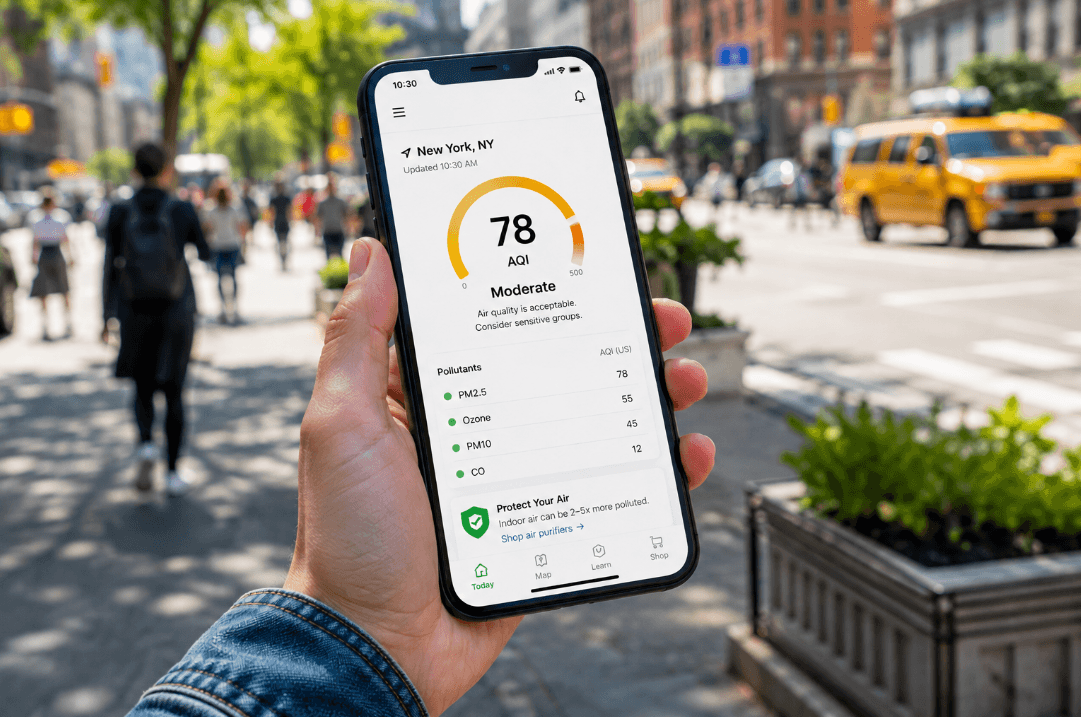
Find your NYC AQI number and color. Green (0–50) is good; yellow (51–100) is moderate; orange (101–150) is unhealthy for sensitive groups; red (151–200) is unhealthy for everyone.
Look at the “main pollutant” line. Most tools list which pollutant is driving the score, usually O3 (ozone) or PM2.5.
Match it to the weather. Hot, sunny, and still? Ozone. Hazy horizon and a campfire smell? Smoke-driven PM2.5. Cold snap with no wind? Trapped traffic and heating emissions.
Check your neighborhood’s live reading on the Filterbuy New York City AQI map before you plan your day, or pull up the live USA AQI map for anywhere else in the country.
The 5 Most Common Reasons NYC Air Quality Is Bad Today
NYC’s bad-air days almost always trace back to five recurring causes: wildfire smoke, summer ozone, winter temperature inversions, local traffic and truck corridors, and stagnant weather. Use the quick diagnostic below to match what you’re seeing and smelling outside to the most likely cause and the pollutant behind it.
1. Wildfire smoke drifting into the city
Wildfire smoke has become one of the biggest reasons New York air quality turns bad, sometimes overnight. Smoke particles are tiny enough to travel thousands of miles: in June 2023, smoke from Canadian wildfires blanketed the city and briefly made New York’s air quality among the worst of any major city in the world. In our experience helping households prepare, smoke is the scenario that catches the most people off guard. By the time you can smell it, the fine particles are already indoors, and standard filters aren’t built to stop them. Because smoke is made of fine particles, it drives PM2.5, the pollutant most harmful to your lungs. During fire season you can track active smoke plumes on our live wildfire smoke map.
2. Summer ozone (the “smog” days)
On hot, sunny, still summer afternoons, sunlight cooks tailpipe and industrial emissions into ground-level ozone. New York’s summers are traditionally more polluted than spring or fall for exactly this reason: abundant sunshine plus precursor gases equals smog. Ozone is invisible, so a “clear” summer sky can still carry an unhealthy AQI.
3. Winter temperature inversions
In winter, a layer of warm air can settle over colder air near the ground and act like a lid, trapping emissions where you breathe them. At the same time, thousands of building boilers burn oil and gas to make heat and hot water, which is why New York often sees more pollution in the winter, especially on calm, cold days.
4. Local traffic and truck corridors
Even with the lowest per-capita driving of any major U.S. city, New York’s sheer density makes vehicles a leading local pollution source. Neighborhoods near highways, bridges, and freight hubs (like the Cross Bronx Expressway and Hunts Point) carry heavier PM2.5 and nitrogen dioxide (NO2) loads, and levels typically spike during the morning and evening rush.
5. Stagnant weather with no wind
Sometimes nothing new is being added. The air just isn’t moving. A stalled high-pressure system with light winds lets pollution accumulate day over day. That’s why two identical-traffic days can have very different air: one breezy, one bad.
Where NYC Air Tends to Be Worst – and Why
NYC air quality isn’t uniform. It changes block to block, and a handful of areas run consistently higher than the citywide number. The heaviest readings cluster around dense traffic and freight corridors, waterfront industrial zones, and, in winter, anywhere with a lot of building boilers. If your live AQI looks worse than a friend’s across town, geography is usually why.
Per the NYC Health Department, Midtown usually shows the most PM2.5, and levels vary block to block.
Is It Safe to Go Outside in NYC Today?
Whether it’s safe to go outside in NYC today depends on your AQI number and whether you’re in a sensitive group. Below an AQI of 100, most people are fine. From 101–150 (“unhealthy for sensitive groups”), children, older adults, pregnant people, and anyone with asthma or heart conditions should ease up on strenuous outdoor activity. Above 150, everyone should limit prolonged outdoor exertion.
Sensitive groups include children and teens, older adults, pregnant people, and anyone with asthma, lung, or heart conditions.
Why Does NYC Air Quality Get Worse at Certain Times of Day and Year?
NYC air quality gets worse at predictable times: on hot summer afternoons (ozone), on cold winter mornings (heating plus inversions), and during weekday rush hours (traffic). Fine-particle levels usually climb in the morning as traffic builds and again in the evening commute. Seasonally, summer brings ozone smog and winter brings boiler emissions trapped by cold, still air, so “why is NYC air quality worse today than yesterday” often comes down to a shift in weather, not a new pollution source.
This is also why your worst indoor-air days tend to cluster: the same stagnant, smoky, or high-ozone conditions that spike the outdoor AQI are the days when opening a window does the most harm.
What’s Actually In NYC’s Air?
New York City’s air pollution is dominated by three pollutants: fine particles (PM2.5), ground-level ozone, and nitrogen dioxide (NO2), plus wildfire smoke when it blows in. Fine particles are the ones health experts watch most closely because they lodge deep in the lungs.
PM2.5 (fine particles): Roughly 30 times smaller than a human hair. Long-term exposure contributes to an estimated 2,000 excess deaths per year in NYC (about 1 in every 25 deaths), according to the NYC Health Department. It’s also the particle size Filterbuy engineers its MERV 13 filters to capture.
National standard: The EPA’s healthy-air threshold for PM2.5 is an annual average under 9 µg/m³ and a 24-hour average under 35 µg/m³.
Where it comes from: More than half of NYC’s PM2.5 is local (vehicles, building boilers, and commercial cooking), while roughly 30% blows in from distant sources like Midwest coal plants and out-of-state wildfires.
Is NYC Air Quality Actually Getting Better?
Yes – despite the bad days, New York City’s air has been improving for years, and a major recent policy accelerated it. A peer-reviewed 2025 study published in npj Clean Air found that in the first six months of Manhattan’s congestion pricing program, average daily-maximum PM2.5 dropped about 22% inside the Congestion Relief Zone, with smaller declines across all five boroughs and the suburbs (Cornell University summary). New York City has also met the national annual PM2.5 standard in recent years, even though hour-to-hour spikes still happen.
The takeaway for a bad-air day: the baseline is trending cleaner, but weather and smoke can still push any single day into unhealthy territory, which is why checking the live AQI beats assuming. We see it in the questions we field, too: even in a cleaner year, one smoke plume or a stagnant heat wave is all it takes to send New Yorkers looking for a better filter.
Supporting Statistics: The Research Behind This Guide
The guidance on this page is grounded in current U.S. government and national-health research. Three figures underline why NYC’s bad-air days matter, and why indoor filtration is the practical response.
Americans spend about 90% of their time indoors, where some pollutants run 2–5 times higher than outdoor levels.
This is the core reason a bad-air day outside becomes an indoor problem: your home isn’t sealed from the AQI. It’s also why what your HVAC filter captures matters as much as the number on the map. The EPA ranks indoor air pollution among the top environmental risks to public health.
Source: U.S. EPA – Report on the Environment: Indoor Air Quality (updated 2026)
During the June 2023 Canadian wildfire smoke event, asthma-related ER visits across New York State jumped about 82% in a single day.
On June 7, 2023, statewide asthma-associated emergency-department visits rose 81.9% versus the prior week, with a nearly threefold (197.6%) spike among people aged 10–29, as fine-particle (PM2.5) levels in the New York City metro region hit roughly 122 µg/m³, more than 1,200% above the June baseline. (The CDC analysis covered New York State outside NYC.) It’s hard evidence that smoke-driven PM2.5 sends New Yorkers to the ER.
Source: CDC, MMWR (Aug 2023) – Asthma-Associated ED Visits During a Wildfire Smoke Event, New York
The New York–Newark metro ranks 16th-worst in the U.S. (and #1 in the Northeast) for ozone smog.
The American Lung Association’s 2025 “State of the Air” report gave the metro a failing grade for ground-level ozone, the pollutant behind NYC’s hot-weather “bad air” days. It’s a reminder that summer smog, not just wildfire smoke, drives unhealthy AQI in New York.
Source: American Lung Association – “State of the Air” 2025 (New York metro)
How to Protect Your Indoor Air When NYC Air Quality Is Bad Today
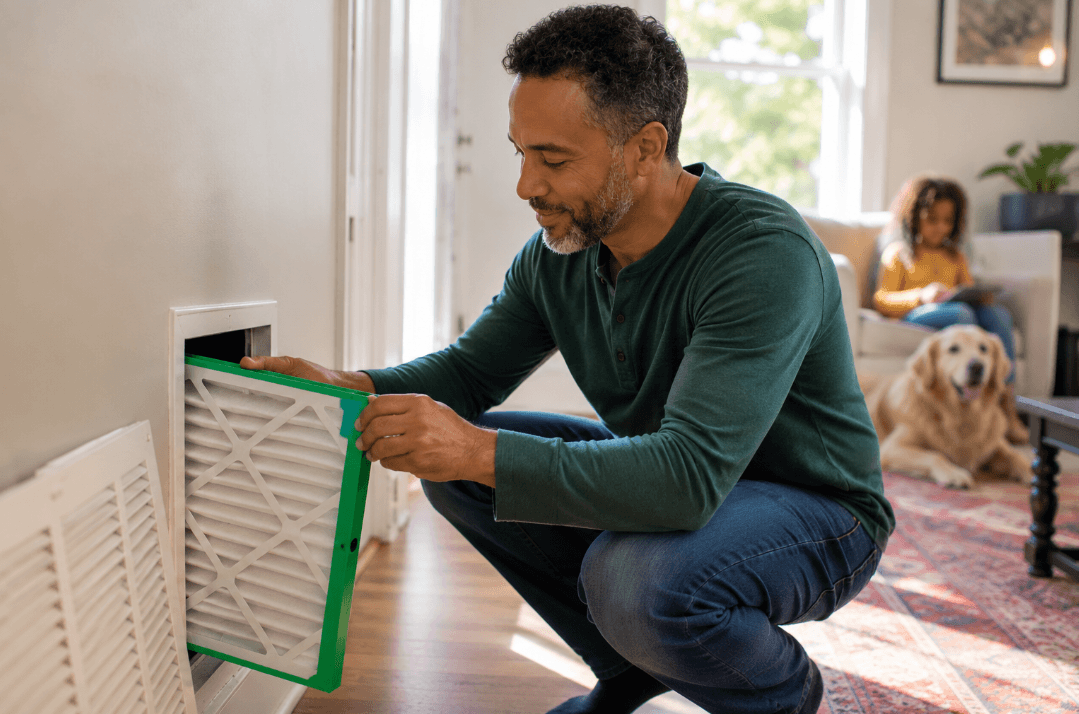
When outdoor air is bad, the best move is to keep it outside: close your windows, run your HVAC (or a portable purifier), and make sure you’re filtering with the right MERV rating. On smoke and high-PM2.5 days, a MERV 13 filter captures the fine particles that cheaper filters miss; for smoke odor and VOCs, an activated-carbon (Odor Eliminator) filter helps clear the smell.
Match today’s AQI to the right filter move
This is the tool we wish every weather app included: read your AQI, then match it to a filter action. It’s how the Filterbuy team translates the outdoor number into an indoor action, the whole reason we build filters in MERV 8, 11, and 13.
MERV 13 needs a compatible system, so check airflow first. Add an activated-carbon (Odor Eliminator) filter for smoke odor and VOCs.
The bad-air-day checklist we walk New Yorkers through:
Close windows and outside doors, especially on smoke or high-ozone days.
Run your HVAC system fan so household air keeps cycling through your filter, even if you don’t need heating or cooling.
Upgrade to MERV 13 if you’re in a smoke- or allergy-prone situation. The EPA recommends MERV 13 (or the highest rating your system allows) during smoke events. It’s the sweet spot for capturing fine particles while still working with most home systems. One caution we pass along from the HVAC pros we work with: check your blower’s capacity before jumping to the highest rating, since an older system can lose airflow if the filter is too restrictive. When in doubt, ask a licensed HVAC technician.
Add activated carbon for smoke smell and VOCs. A carbon (Odor Eliminator) filter tackles the odors a particle filter can’t.
Change your filter more often during bad-air stretches. Smoke and heavy pollution clog filters faster; a loaded filter can’t protect what it can’t pull air through.
The pattern we see over and over is simple: the households that stay comfortable on bad-air days aren’t the ones watching the AQI most closely. They’re the ones who already had a clean, high-MERV filter in place before the spike. At Filterbuy, we’ve built air filters in the USA for over a decade and ship more than 600 sizes, plus custom sizes, factory-direct with fast, free shipping. If you’d rather not think about it, auto-delivery sends your exact size right when it’s time to swap, so a smoky week never catches you with a clogged filter.
Find your exact filter size • Set up auto-delivery • Shop MERV 13 filters for smoke
Common Myths About NYC Bad-Air Days
A few beliefs come up constantly, and acting on them can leave you breathing worse air than you need to. The reality is often different.
Myth: “If I close my windows, I’m safe.”
Reality: Closed windows help, but your HVAC and many older NYC buildings still pull in and recirculate outside air. Without a good filter, the system quietly distributes what’s outside into every room, which is exactly why filtration, not just sealing up, is what protects you.
Myth: “If I can’t smell smoke, the air is fine.”
Reality: PM2.5 is often invisible and odorless, and ground-level ozone has no smell at all, and a clear blue summer sky can still carry an unhealthy AQI. Trust the number, not your nose.
Myth: “An air purifier alone will fix it.”
Reality: A portable HEPA purifier is great for one room (usually the bedroom), but it can’t clean a whole home. A Filterbuy MERV 13 in your HVAC does the whole-house work; the two are partners, not substitutes.
Myth: “Bad air in NYC is just a wildfire thing.”
Reality: Smoke grabs headlines, but New York’s most frequent unhealthy days come from summer ozone and winter heating emissions. The New York metro still earns a failing ozone grade from the American Lung Association. The smog season is longer than the smoke season.
The Bottom Line
On any given day, NYC’s air is usually bad because of one thing or a mix: wildfire smoke, summer ozone, a winter temperature inversion, or stagnant weather. Check your live AQI, note which pollutant is high, and decide from there. The number tells you how bad, the pollutant tells you why.
The part you actually control is indoors. Seal up on bad-air days, run your HVAC, and put a filter in place that can capture what’s floating around. That’s the difference between the AQI outside your window and the air in your living room. It’s the problem Filterbuy has focused on since 2013: American-made filters in 600+ sizes plus custom cuts, shipped factory-direct and backed by thousands of five-star reviews from families across the country.
Next steps: check your NYC AQI on the Filterbuy map → find your exact filter size → set up auto-delivery so a bad-air day never catches you with a clogged filter.
Frequently Asked Questions
Why is NYC air quality so bad today?
NYC air is usually bad on a given day because of wildfire smoke, a summer ozone episode, a winter temperature inversion, or stagnant weather trapping local traffic and building emissions. Check your live AQI and note the main pollutant: ozone points to heat and sun, while PM2.5 points to smoke, traffic, or heating.
Is the air quality bad in NYC today, and how do I check?
Open any live Air Quality Index tool for New York, or the Filterbuy New York City AQI map. An AQI of 0–50 is good, 51–100 is moderate, and 101 or higher means sensitive groups should take precautions.
Why is NYC air quality unhealthy today?
An “unhealthy” reading means the AQI has climbed past 100, most often from wildfire smoke (PM2.5) or a hot-weather ozone buildup. New York State issues an Air Quality Health Advisory when ozone or fine particles are forecast to exceed an AQI of 100.
Is NYC air quality bad today because of smoke?
Possibly. Wildfire smoke is now one of the top causes of NYC’s worst air days, and smoke can travel thousands of miles. A hazy horizon, an orange-tinted sun, and a faint campfire smell alongside a high PM2.5 reading all point to smoke.
Why is NYC air quality worse today than yesterday?
Usually the weather changed, not the pollution sources. A hotter, sunnier, or more stagnant day, a wind shift carrying in smoke, or a cold, still winter morning can all raise the AQI even when traffic and emissions are steady.
Glossary
Air Quality Index (AQI): A 0–500 scale used by the EPA and New York State to report daily air quality; higher numbers mean more pollution and greater health concern.
PM2.5 (fine particulate matter): Airborne particles 2.5 micrometers or smaller (roughly 30 times thinner than a human hair) that lodge deep in the lungs; the pollutant most associated with smoke and traffic.
Ground-level ozone (O3): A gas formed when sunlight reacts with vehicle and industrial emissions; the main driver of summer “smog” and unhealthy hot-weather air days.
Nitrogen dioxide (NO2): A traffic-related gas that is elevated near busy roads, highways, and truck corridors.
Temperature inversion: A weather condition where a warm air layer sits over cooler air near the ground, trapping pollution close to where people breathe; common on calm winter days.
Air Quality Health Advisory: An alert New York State issues when ozone or fine-particle levels are forecast to exceed an AQI of 100, warning sensitive groups to take precautions.
NAAQS: The National Ambient Air Quality Standards set by the EPA; the PM2.5 standard is an annual average under 9 µg/m³ and a 24-hour average under 35 µg/m³.
MERV: Minimum Efficiency Reporting Value, the 1–16 scale rating how well an air filter captures particles; higher MERV captures smaller particles.
MERV 13: A high-efficiency residential filter rating that captures fine particles including smoke and soot, while remaining compatible with most home HVAC systems.
Activated carbon (Odor Eliminator) filter: A filter that adsorbs gases, smoke odors, and VOCs that particle filters alone can’t remove.
Congestion Relief Zone (CRZ): The tolled area in Manhattan at or below 60th Street where congestion pricing began in January 2025; associated with measured PM2.5 declines.
NYCCAS: The New York City Community Air Survey, the city’s neighborhood air-monitoring network run by the Health Department and Queens College.
Related Reading
Author & Reviewer
Written by Michelle Wan, who covers indoor air quality and home health for Filterbuy, the U.S. filter manufacturer whose first-hand experience shapes this guide. See more from Michelle Wan.
Reviewed for technical accuracy by David Clark, Licensed HVAC Technician who checked this article’s claims on HVAC systems, MERV ratings, airflow, and filter compatibility.
Sources
NYC Dept. of Health – Environment & Health Data Portal – local vs. distant pollution sources; ~2,000 excess PM2.5 deaths/year.
NY State DEC – Air Quality Index Forecast & Health Advisory – AQI-100 advisory threshold; ozone and PM as forecast pollutants.
U.S. EPA – National Ambient Air Quality Standards for PM – annual PM2.5 < 9 µg/m³; 24-hour < 35 µg/m³.
U.S. EPA – What Is a MERV Rating? – MERV 13 guidance for fine particles and smoke.
IQAir – New York Air Quality – seasonal ozone/PM patterns; mobile-source emissions.
Fraser, Park, et al. (2025), npj Clean Air (Nature) – congestion pricing cut CRZ PM2.5 ~22% in six months. See also the Cornell summary
CNN (June 2023) – Canadian wildfire smoke ranked NYC among the world’s most polluted major cities.
AirNow.gov (EPA) – official real-time AQI for all five boroughs.
U.S. EPA – Indoor Air Quality (Report on the Environment) – 90% of time indoors; indoor pollutants often 2–5× outdoor levels.
CDC MMWR (2023) – Asthma ED Visits, Wildfire Smoke, New York – ~82% single-day rise in NY asthma ED visits, June 2023.
American Lung Association – State of the Air 2025 (NY metro) – NY–Newark 16th-worst nationally, #1 in the Northeast for ozone.