
How Air Quality Changes with the Seasons (And What to Do About It)
July 14, 2026
By Michelle Wan | Reviewed by David Clark, Licensed HVAC Technician | Published July 14, 2026 | Updated July 14, 2026
How Air Quality Changes Season by Season
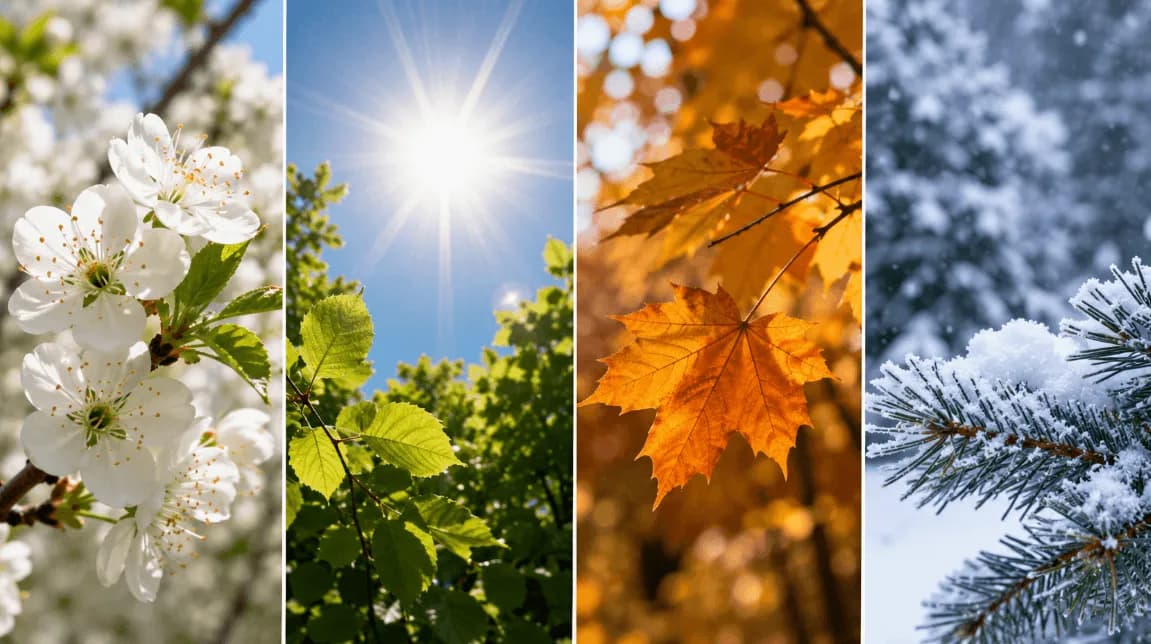
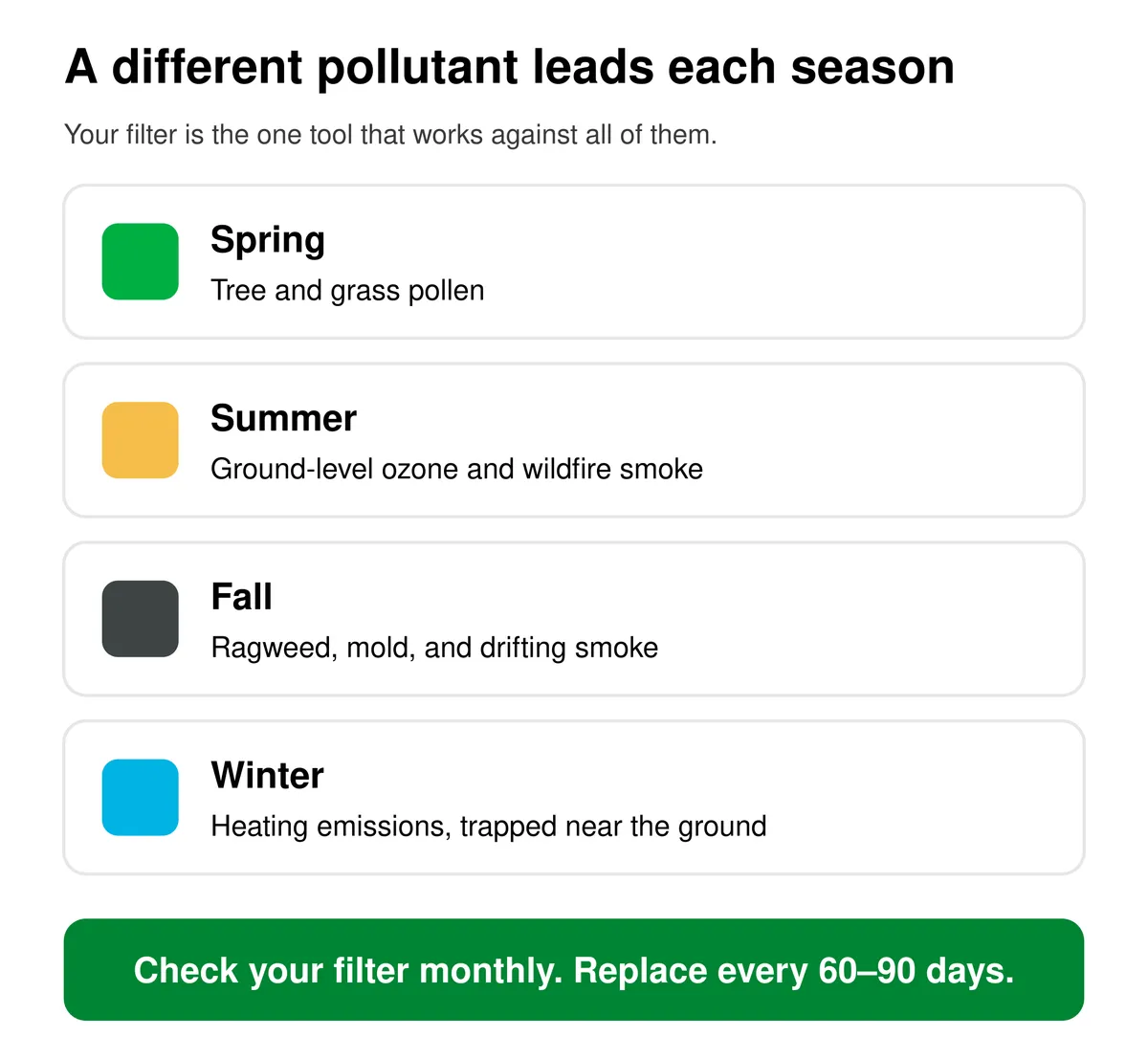
Air quality runs on a seasonal cycle, and a different pollutant leads each season. Spring brings pollen, summer brings ozone and wildfire smoke, fall brings ragweed and mold, and winter traps heating emissions close to the ground. Because the pollutant changes, the right response changes with it. Your HVAC filter is the one tool that works against all of them, checked monthly and changed every 60 to 90 days.
- Spring: tree and grass pollen, plus rising outdoor pollutant loads.
- Summer: ground-level ozone and wildfire smoke, both peaking on hot, still days.
- Fall: ragweed pollen and mold, with smoke that can drift in from distant fires.
- Winter: heating emissions and vehicle exhaust, trapped near the ground by temperature inversions.
Answer a few quick questions and we'll match you to the right filter for the season you're in.
Prefer to browse? Shop air filters at filterbuy.com.
Your allergies flare every April, fade by June, then come back every September when ragweed pollen and the season's first woodsmoke show up at the same time. That pattern is not random. Air quality moves on a seasonal clock, driven by pollen cycles, sunlight and heat, wildfire risk, and how tightly a home gets sealed against the weather outside. Once you know what each season brings, you can time your defenses instead of reacting after your family already feels it.
"Every season, we hear a version of the same question. Why does my air suddenly feel different? It is almost never one big event. It is pollen in spring, ozone and smoke in summer, ragweed and mold in fall, and trapped heating exhaust in winter, each one quietly building until a filter that worked fine in August cannot keep up in December. Once you see your air as a seasonal cycle instead of a single fixed problem, the fix stops feeling complicated."
— Michelle Wan, Brand Manager and Air Quality Writer, Filterbuy.
TL;DR
Air quality does not stay the same all year. Spring brings tree and grass pollen plus rising outdoor pollutant loads as people spend more time outside. Summer heat and sunlight drive up ground-level ozone, and wildfire smoke can spike PM2.5 far from the fire itself. Fall is a transition season, with ragweed pollen, mold from decaying leaves, and the first wave of wood smoke as temperatures drop. Winter traps pollutants near the ground through temperature inversions and adds carbon monoxide and particulates from heating systems and vehicle exhaust. Checking your local AQI by season and changing your Filterbuy filter on a schedule that matches these shifts helps keep indoor air cleaner year round.
Key Takeaways
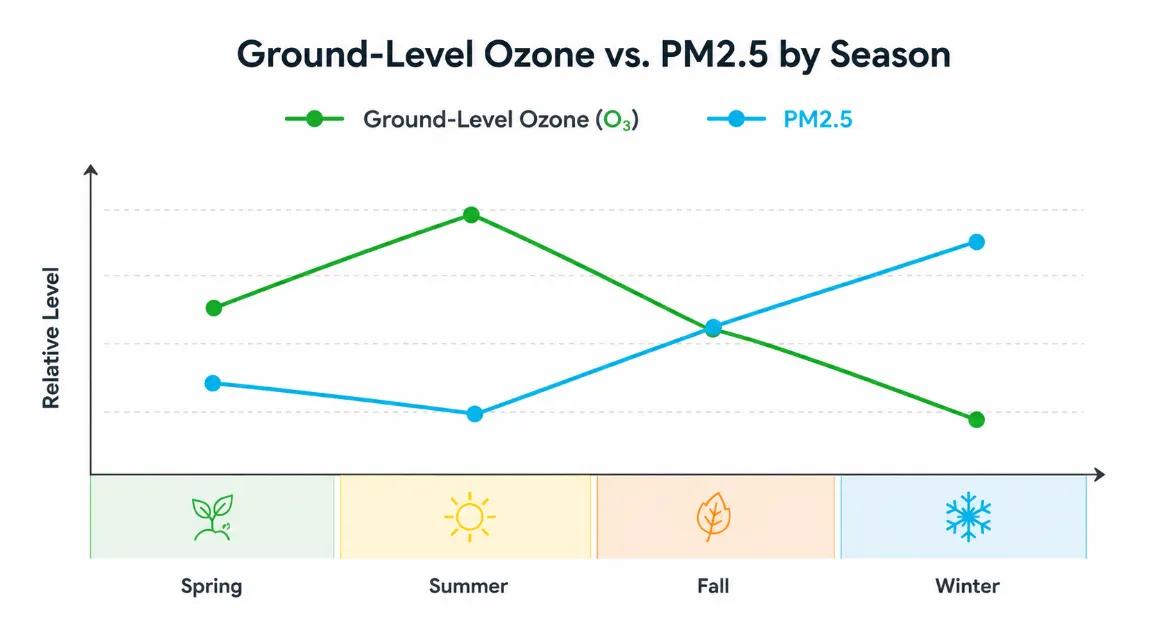
Ground-level ozone peaks in summer because it forms through a chemical reaction that needs heat and sunlight.
Particulate matter, or PM2.5, can spike in any season. Pollen drives it in spring, wildfire smoke drives it in summer and fall, and heating emissions plus inversions drive it in winter.
Temperature inversions trap cold, polluted air near the ground, and they happen most often during calm, clear winter nights.
Seasonal allergies affect up to 60 million people annually in the United States, and pollen seasons are starting earlier and lasting longer than they used to.
Matching your Filterbuy filter's MERV rating and replacement schedule to the season in front of you helps reduce how much outdoor pollution reaches your indoor air.
What Drives Seasonal Air Quality Changes
Outdoor air quality depends on three things that shift by season. Sunlight and heat drive the chemical reactions behind pollutants like ozone, people and nature release the pollutants themselves, and weather patterns either disperse those pollutants or trap them close to the ground. Ground-level ozone needs heat and sunlight to form, which is why it is mostly a summer problem, and EPA's national ozone trend data tracks how those levels shift by region and season. Fine particulate matter, or PM2.5, behaves differently. It can spike from tree and grass pollen in spring, wildfire smoke in summer and fall, or wood burning and vehicle exhaust in winter. Wind and precipitation usually clear pollutants out of the air. Stagnant, calm conditions, especially winter's temperature inversions, do the opposite and hold pollution in place for days, which is exactly the kind of stretch a properly sized Filterbuy filter is built to work hardest through indoors.
Spring Air Quality: Pollen And Rising Pollutant Loads
Spring's air quality story starts with pollen. Tree pollen dominates early in the season, and grass pollen picks up as temperatures climb. Warmer, wetter springs combined with a longer frost-free season have pushed pollen seasons to start earlier and last longer than they did a generation ago. Spring winds can carry pollen for miles, so an allergy trigger does not always come from a plant in your own yard. Outdoor pollutant levels also start climbing again after winter, as more vehicles are on the road and more people open windows and spend time outdoors. In our experience shipping Filterbuy filters through pollen season, spring is when we field the most questions about musty smells and sudden dust, both signs of a filter that spent winter collecting dust now meeting a fresh wave of pollen on top of it. For a household with allergy or asthma triggers, spring is usually the point where checking a daily pollen and AQI forecast starts to matter again, and our seasonal allergy calendar breaks down when tree, grass, and ragweed pollen typically peak by region.
Summer Air Quality: Ozone, Heat, And Wildfire Smoke
Summer brings two separate air quality problems that often overlap. The first is ground-level ozone, sometimes called smog, which forms when sunlight reacts with nitrogen oxides and volatile organic compounds from vehicles and industry. Hot, still, sunny afternoons are exactly the conditions that push ozone into unhealthy territory. The second is wildfire smoke. A fire does not need to be nearby to affect your air. Smoke plumes routinely travel hundreds or even thousands of miles and can drive PM2.5 to unhealthy levels in cities far from any active fire. Because ozone and smoke both peak on hot, sunny, low-wind days, summer afternoons are frequently the worst stretch of the year for outdoor air quality in much of the country. The Filterbuy filters we see returned during heavy smoke stretches are consistently the most visibly loaded of the year, sometimes gray within a couple of weeks instead of the usual 60 to 90 days, which tells us how much particulate a bad smoke event pushes through a home's HVAC system.
Fall Air Quality: Transitional Risks As Temperatures Drop
Fall is the season people notice least, but it carries its own risks. Ragweed pollen peaks in early fall in much of the country, and mold spores rise as fallen leaves decompose in damp yards. Wildfire season often extends into fall in the western United States, so smoke can still be a factor after summer ends, as our breakdown of the states most affected by wildfires shows. As temperatures drop, homes get sealed up again and heating systems come back on for the first time in months, which is also when dust and other particles that settled in ductwork over the summer get circulated back into the air. We hear from a lot of households in fall who assume allergy season ended when the leaves started falling, then wonder why symptoms come back within a few weeks. Ragweed and mold do not wait for pollen counts to make headlines. Fall is a good checkpoint for a home's air filter, both because outdoor pollen and mold pressure are still active and because a fresh Filterbuy filter installed now carries a household through the first weeks of heating season without a mid-winter scramble.
Winter Air Quality: Inversions, Heating Emissions, And Trapped Pollutants
Winter changes the physics of air pollution. Under normal conditions, warm air near the ground rises and carries pollutants up and away. In winter, calm winds, clear skies, and long nights often reverse that pattern, creating a temperature inversion where a layer of warmer air sits on top of colder air and traps pollution close to the ground. Regions with valleys or mountain basins are especially prone to multi-day inversion events. Wood-burning stoves and fireplaces, along with cold-weather vehicle emissions, add carbon monoxide and particulate matter right when the atmosphere is least able to disperse them. Indoors, sealed-up homes and near-constant furnace or heat pump operation mean whatever is in your air gets recirculated instead of exchanged with the outdoors, which is also why winter allergy symptoms often flare indoors even after outdoor pollen season has ended. Filterbuy filter reorders spike every winter, and it is rarely because people are careless. Furnaces and heat pumps simply run longer per day than in any other season, so a filter rated for 90 days can look done at 45.
Year-Round Air Quality Patterns Every Homeowner Should Know
A few patterns hold true across most of the United States. Ozone is almost always a summer problem because it depends on heat and sunlight. Particulate matter is a year-round concern that simply changes source. Pollen and dust dominate in spring, smoke takes over in summer and fall, and combustion byproducts lead in winter. Indoor air quality follows outdoor air quality more closely than most people expect, since outdoor pollutants enter through open windows, doors, and a home's HVAC system. Learning to check your local AQI takes under a minute and tells you which season's pollutant is driving conditions on a given day. Because the dominant pollutant changes by season, the right response changes too. A high-MERV Filterbuy filter that handles wildfire smoke well in August is doing different work than the same filter fighting pollen in April or dust in December.
Match Your Symptoms To The Season's Likely Cause
Most people notice a symptom before they notice a pollutant. Use this quick reference to connect what you are feeling to what is probably driving it, and what to check first.
Itchy eyes and sneezing that start in March or April: likely tree or grass pollen. Check a local pollen forecast and consider a higher-MERV filter before symptoms peak.
A scratchy throat or headache on a hot, still afternoon: likely ground-level ozone. Check your local AQI before planning outdoor activity.
A smoky smell with no fire nearby: likely wildfire smoke that traveled in from a distant fire. Check a live fire and smoke map rather than assuming it will clear on its own.
Allergy symptoms returning in September after a quiet August: likely ragweed pollen or mold from decaying leaves, not a new sensitivity.
Dust buildup and stuffiness right after your heat turns on for the first time: likely ductwork particles disturbed after months of sitting idle, or a filter that has been overdue since summer.
A stagnant, heavy feeling in the air on a clear, calm winter day: possibly a temperature inversion trapping outdoor pollutants close to the ground rather than a sign anything is wrong indoors.
Common Seasonal Air Quality Mistakes
These are the mistakes Filterbuy hears about most often from customers, not hypothetical ones.
Assuming winter air is automatically cleaner. Ozone drops, but heating emissions and inversions often push particulate matter higher instead of lower.
Waiting for symptoms before checking a filter. A filter usually loads up before anyone notices, especially during smoke or heavy pollen weeks.
Treating wildfire smoke as a West Coast problem only. Smoke plumes regularly reach the Midwest, Great Lakes, and Northeast with no local fire anywhere nearby.
Closing windows for pollen but forgetting ozone days. Keeping windows shut on high-ozone summer afternoons matters just as much as it does during high-pollen spring days.
Assuming one filter rating works year round. The pollutant driving your air quality changes by season, so the filter doing the most work in April is not always the one doing the most work in August.
How To Adjust Your HVAC Filter By Season
Your HVAC filter is one of the few tools that works against every season's pollutant on this list. During spring and fall pollen seasons, a higher-MERV filter, generally MERV 11 or MERV 13, These filters capture more of the fine particles that carry allergens indoors. During summer wildfire smoke events, the same higher-MERV filter helps reduce how much smoke particulate makes it past your HVAC system, though no residential filter fully replaces sealing up a home during a smoke event. In winter, filters work harder because HVAC systems run more continuously, so more frequent filter checks matter even if the MERV rating stays the same. As a general rule, follow a seasonal filter-change schedule. Check a standard 1 inch filter monthly and replace it every 60 to 90 days, checking more often during high-pollen, high-smoke, or heavy-heating stretches. We manufacture in MERV 8, 11, and 13, and the pattern we see across seasons is consistent. Households that match their filter to the season in front of them replace filters on a predictable schedule instead of scrambling after symptoms or airflow problems show up. Filterbuy makes filters in more than 600 sizes, so finding the right fit for a seasonal upgrade does not mean settling for whatever size happens to be on the shelf.
Supporting Statistics
Ozone Is Overwhelmingly A Summertime Pollutant
Ozone forms most easily on hot, sunny days.
Levels can still climb in colder months in some areas.
Source: EPA's ground-level ozone basics page
Seasonal Allergies Affect A Large Share Of The U.S. Population
Pollen-driven allergic rhinitis affects up to 60 million people annually in the U.S.
Pollen seasons are starting earlier and lasting longer.
Source: CDC's data on pollen and health
Wildfires Burned More Than Five Million U.S. Acres In A Single Recent Year
77,850 wildfires were reported nationwide in 2025.
Those fires burned 5,131,474 acres across the United States.
Source: the National Interagency Fire Center's wildfire and acreage statistics
Frequently Asked Questions
What Season Has The Worst Air Quality
It depends on where you live and what pollutant you're most sensitive to. Summer often produces the worst outdoor air quality because ozone and wildfire smoke can both peak at the same time. Winter can be worse in valley and mountain-basin regions prone to temperature inversions.
Does Air Quality Get Better Or Worse In The Winter
Both can be true. Ozone drops sharply in winter because it needs sunlight and heat to form. But particulate matter can rise in winter in regions prone to temperature inversions, where heating emissions and vehicle exhaust get trapped near the ground for days at a time.
How Often Should I Change My Air Filter For Each Season
A standard 1 inch filter should be checked monthly and replaced every 60 to 90 days as a baseline. Our full guide to HVAC filter replacement frequency breaks this down further. Check more often during spring and fall pollen peaks, during summer wildfire smoke events, and throughout winter, when HVAC systems run closer to continuously.
Why Do My Allergies Get Worse Every Spring And Fall
Spring and fall are the two peak pollen windows for most of the country. Tree and grass pollen dominate spring, while ragweed pollen and mold from decaying leaves dominate fall, which is why many people notice two distinct allergy seasons rather than one. Our guide to how air filters help with seasonal allergies covers which MERV rating fits each situation.
Is Wildfire Smoke A Year Round Problem Or Just A Summer One
Wildfire smoke is heaviest in summer but regularly extends into fall in the western United States, and smoke plumes can travel far enough to affect air quality in regions with no local fire activity at all.
Glossary
AQI (Air Quality Index): A 0 to 500 scale the EPA uses to communicate how clean or polluted outdoor air is on a given day, along with related health guidance.
PM2.5: Fine particulate matter smaller than 2.5 micrometers in diameter, small enough to travel deep into the lungs. Sources shift by season, from pollen to wildfire smoke to heating emissions.
Ground-Level Ozone: A gas formed when sunlight reacts with nitrogen oxides and volatile organic compounds. It is the main ingredient in summer smog.
Temperature Inversion: A weather pattern in which a layer of warm air sits above cooler air near the ground, trapping pollutants in place instead of letting them disperse.
MERV Rating: Minimum Efficiency Reporting Value, a 1 to 16 scale that rates how effectively an HVAC filter captures airborne particles of different sizes. Filterbuy filters span MERV 8 through MERV 13, the range that covers nearly all residential HVAC systems.
Volatile Organic Compounds (VOCs): Carbon-based chemicals that evaporate easily and react with sunlight to help form ground-level ozone.
Allergen: A substance, such as pollen or mold spores, that triggers an immune response in sensitive individuals.
Essential Resources
Check Your Local Air Quality Forecast Before Heading Outside
AirNow's daily and forecasted Air Quality Index covers most U.S. metro areas and breaks down which pollutant, ozone or particle pollution, is driving conditions on a given day.
Source: AirNow's guide to using the Air Quality Index
Understand How A Changing Climate Is Reshaping Allergy Season
A longer, more intense allergy season is not just anecdotal. Climate shifts are extending pollen exposure windows in many parts of the country.
Source: the American Lung Association's explainer on allergies and climate change
See How One Region Tracks Winter Temperature Inversions
Utah's air quality agency publishes one of the clearest public explanations of how winter inversions form and why they can trap pollution for days at a time.
Source: Utah's Department of Environmental Quality page on inversions
Learn How Wildfire Smoke Chemistry Affects Air Far From The Fire
NOAA's research into wildfire smoke chemistry explains why smoke plumes can degrade air quality hundreds of miles from an active fire.
Source: NOAA Climate.gov's reporting on wildfire smoke chemistry
Air quality does not take a season off, it just changes shape. Spring hands you pollen, summer hands you ozone and smoke, and winter traps everything closer to the ground. After manufacturing filters for over a decade and serving more than two million households, we have learned that the households paying the closest attention to seasonal air quality changes are the ones who stay ahead of their filter schedule instead of catching up to it.
— David Heacock, Founder and CEO, Filterbuy