July 14, 2026

Author: Michelle Wan | Reviewer: David Clark, Licensed HVAC Technician | Publish Date: July 14, 2026
Yes — poor air quality can cause headaches and worsen migraines for many people. Ozone, fine particulate matter (PM2.5), nitrogen dioxide, and indoor VOCs all have documented links to head pain in medical research. The strength of that link varies by pollutant and by person, and there is no single cause.
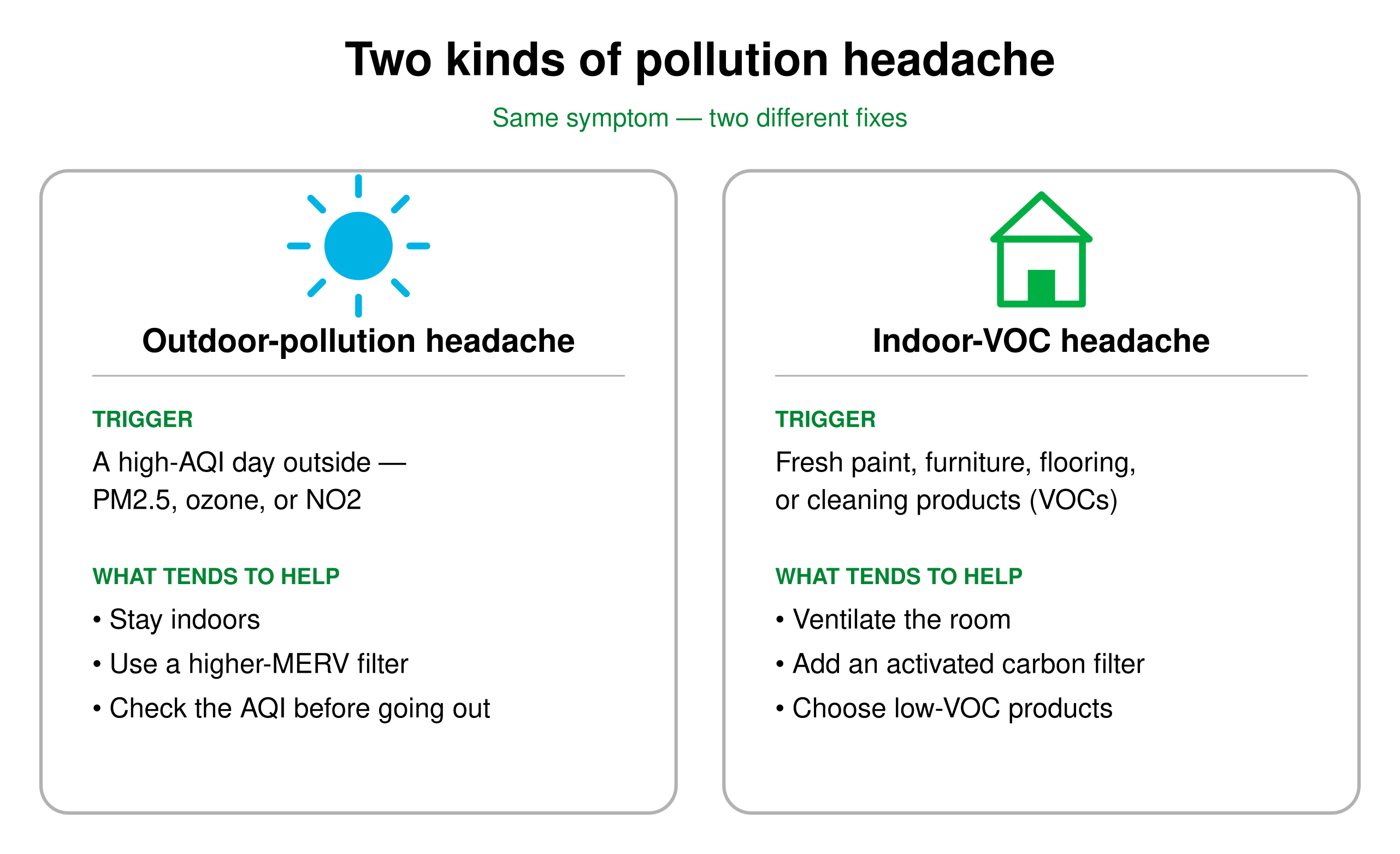
Most pollution headaches fall into two patterns:
Answer a few quick questions and we'll match you to the right filter for your home.
Yes, poor air quality can cause headaches and worsen migraines for many people. Ozone, fine particulate matter (PM2.5), nitrogen dioxide, and indoor volatile organic compounds (VOCs) all have documented links to head pain in medical research. The strength of the link varies by pollutant and by person, and researchers have not identified one single cause. Filterbuy recommends filtering indoor air, ventilating your home, and checking the daily Air Quality Index to lower your exposure.
Multiple population studies tie short-term spikes in PM2.5, nitrogen dioxide, and ozone to more migraine-related emergency and urgent care visits.
Long-term nitrogen dioxide exposure was linked to a 2 percent higher likelihood of migraine diagnosis for every 5 parts per billion increase, according to a Northern California health system study of nearly 90,000 migraine patients.
Indoor VOCs from paint, new furniture, and cleaning products cause a separate but related type of headache tied to what researchers call sick building syndrome.
Roughly 1 in 5 women and 1 in 10 men in the United States reported a severe headache or migraine in the past 3 months, per CDC survey data.
Air pollution appears to trigger headaches more often on hot, high-ozone days than on cooler days, according to several case-crossover studies.
Carbon monoxide, PM2.5, and nitrogen dioxide are all odorless at typical household levels, so a headache can be the first sign of a pollutant you cannot smell.
Poor air quality can cause headaches. Researchers have repeatedly linked short-term increases in fine particulate matter (PM2.5), nitrogen dioxide, and ground-level ozone to more frequent and more severe headaches, including migraines. Indoors, volatile organic compounds from paint, flooring, and household products trigger a related headache pattern known as sick building syndrome. The exact biological pathway is not fully mapped, but the statistical link between dirty air and head pain is well established across dozens of studies.
A retrospective study of the Sutter Health system in Northern California analyzed nearly 90,000 migraine cases alongside more than 270,000 matched controls and found long-term nitrogen dioxide exposure raised the odds of a migraine diagnosis. Separate case-crossover studies in Seoul and Taipei found particulate matter and ozone tracked closely with same-day emergency room and clinic visits for migraine, particularly during warm weather. Not every study agrees on which pollutant matters most, and a few large analyses have found weaker or inconsistent effects, so pollution should be treated as one migraine trigger among several rather than the sole cause for any one person.
At Filterbuy, we hear a version of this question often. Someone has already ruled out screens, stress, and dehydration, and the headache still will not go away. After years of manufacturing air filters and talking with homeowners about what is actually floating through their HVAC systems, our take is that headache is one of the most common, and most overlooked, signals that indoor air needs attention. It rarely shows up alone. Most people also notice a stuffy feeling in the room, or a smell they cannot place.
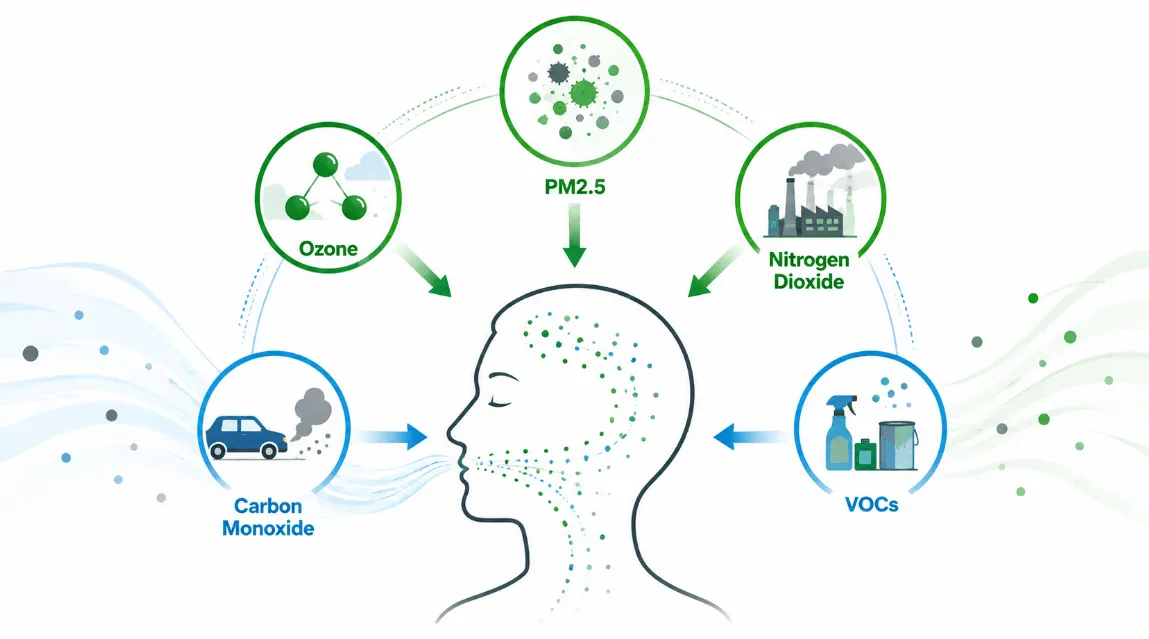
Five pollutants show up again and again in headache and migraine research: fine particulate matter, ozone, nitrogen dioxide, carbon monoxide, and indoor volatile organic compounds. Each reaches the body differently, and each has a different evidence base behind it.
Pollutant-headache links summarized from population studies. Individual sensitivity varies, and pollution is one possible trigger among several.
Air pollution appears to trigger headaches through more than one pathway. Fine particulate matter is small enough to activate the sympathetic nervous system, the body's stress-response network that also regulates blood vessel width, and that activation may alter blood flow to the brain in a way that provokes migraine. Carbon monoxide binds to hemoglobin and directly reduces the amount of oxygen your blood can carry, which produces a dull, band-like headache at high enough exposure. Ozone and nitrogen dioxide are respiratory irritants that can trigger inflammation, and inflammation is one of the pathways researchers connect to migraine attacks. Indoor VOCs work differently, irritating nerve endings in the eyes, nose, and sinuses directly, which is why VOC-related headaches often arrive alongside eye irritation, fatigue, or nausea.
Indoor air causes a distinct headache pattern from outdoor pollution. Volatile organic compounds off-gas from paint, new flooring, furniture, and cleaning products, and concentrations of many VOCs run higher indoors than outdoors because ventilation is limited. When multiple VOCs build up in a poorly ventilated space, the resulting symptom cluster, headache, eye and throat irritation, fatigue, and difficulty concentrating, is known as sick building syndrome. People often notice these headaches most after moving into a newly renovated home or office, or after a fresh coat of paint, and symptoms typically improve once the space airs out or ventilation improves.
Standard HVAC filters capture particles but do not adsorb VOC gases, so households dealing with frequent VOC-related headaches often pair particle filtration with an activated carbon filter to address odors and gases at the source.
Not every pollution headache has the same trigger. Sorting the research and years of homeowner questions into one working framework, Filterbuy sees two distinct patterns. An outdoor-pollution headache is driven by a high-AQI day outside. An indoor-VOC headache is driven by whatever is off-gassing in a specific room. Telling the two apart points toward a very different fix.
People who already live with migraine, since air pollution appears to act as an added trigger on top of an existing sensitivity
Households near highways, airports, or industrial facilities with consistently higher NO2 and PM2.5 levels
Residents of hot, high-ozone climates, where several studies found pollution's effect on headache risk was strongest
Occupants of newly built or newly renovated buildings with elevated indoor VOC levels
Children, older adults, and people with existing respiratory or cardiovascular conditions, who are more sensitive to air pollution in general
Each statistic below comes from a U.S. .gov source or a peer-reviewed study. Each backs a specific claim made earlier in this article.
Long-Term Nitrogen Dioxide Exposure Raises Migraine Odds
A Northern California health system study tracked nearly 90,000 migraine cases against more than 270,000 controls.
Every 5 ppb increase in long-term NO2 exposure raised migraine diagnosis odds by 2 percent.
PM2.5 exposure separately tracked with more neurology and urgent care visits.
Source: Air pollution and migraine headache prevalence study, National Institutes of Health (PMC, NIH)
Nearly 1 in 5 Women Report a Severe Headache or Migraine
Severe headache and migraine are common nationwide.
20.1 percent of women reported a severe headache or migraine in the past 3 months (2018 data).
10.6 percent of men reported the same.
That high baseline is one reason environmental triggers like air pollution matter to so many people.
Ground-Level Ozone Peaks Line Up With Unhealthy Air Days
The Air Quality Index flags a day as unhealthy for sensitive groups once pollutant levels cross set health thresholds.
Ozone and particle pollution are the two pollutants most likely to push a day into that range.
Several of the migraine studies above found their strongest pollution effects on exactly these higher-AQI days.
Source: AQI Basics for Ozone and Particle Pollution, AirNow (U.S. EPA)
No test proves a single headache was caused by air pollution, but a few patterns are worth tracking. A pollution-linked headache often starts or worsens on days when the local AQI is elevated, appears after spending time near heavy traffic or during wildfire smoke, or shows up shortly after entering a newly painted or renovated space. It frequently eases once you move to cleaner air, whether that means going indoors on a high-ozone day or increasing ventilation after using strong-smelling household products. Keeping a simple headache log next to a daily AQI reading for a few weeks can reveal whether this pattern applies to you.
One shortcut we point people toward is asking two questions. Did the headache line up with a specific outdoor air alert, or with a specific project at home, like painting or new flooring? Those two questions usually sort a pollution headache into one of the patterns above faster than a symptom checklist does.
Quick Self-Check
Is today's local AQI elevated for ozone or PM2.5?
Did the headache start near heavy traffic, wildfire smoke, or an industrial area?
Did it start soon after painting, new flooring, or a strong-smelling household product?
Does it ease once you change locations or increase ventilation?
Two or more yes answers point toward a pollution-linked headache worth tracking against your local AQI.
Your household's pollutant exposure is one of the few migraine and headache triggers you can directly control, and most of the steps below take less than an hour to put in place.
Pro Tip: After years of manufacturing air filters and fielding questions from homeowners nationwide, Filterbuy's team has noticed most people upgrade their filtration only after symptoms show up, not before. Getting ahead of high-pollution season, rather than reacting to it once your head already hurts, is the change that seems to matter most.
Check your area's daily Air Quality Index and live wildfire smoke map from Filterbuy and limit strenuous outdoor time when ozone or PM2.5 readings are elevated.
Use a pleated furnace or AC filter rated for finer particle capture, and confirm the right MERV rating for your home with Filterbuy's guide before upgrading, so filtration doesn't restrict your system's airflow.
Ventilate for at least a few days after painting, installing new flooring, or bringing in new furniture to let VOC off-gassing dissipate.
Choose low-VOC or zero-VOC paints, adhesives, and cleaning products where possible.
Run a portable air purifier on high-pollution or wildfire smoke days, especially in bedrooms and home offices.
Replace HVAC filters on the schedule recommended for your filter's rating rather than waiting until airflow noticeably weakens.

A few widely held beliefs about pollution headaches do not hold up once you look at how each pollutant actually behaves.
Myth: If You Can't Smell Anything, Your Air Must Be Fine
Fact: PM2.5, carbon monoxide, and nitrogen dioxide have no detectable smell at typical household levels. A headache can be the only early clue one of these is elevated. VOCs and wildfire smoke are the pollutants you are more likely to actually notice by odor.
Myth: Opening a Window Always Helps
Fact: Opening a window clears indoor VOCs, but it works against you on a high-ozone or high-PM2.5 day outside. Check the outdoor AQI first. If it is elevated, keep windows closed and run filtration instead of ventilating.
Myth: Any Air Purifier Handles Any Pollution Headache
Fact: A standard HEPA-style purifier captures particles like PM2.5 and dust, but does not remove gases. VOCs need a purifier or filter with an activated carbon stage, and carbon monoxide needs a dedicated CO detector, since no household air filter removes it from the air.
Myth: A Pollution Headache Means Something Is Medically Wrong
Fact: An occasional pollution-linked headache reflects a documented, common reaction, not a diagnosis. It is worth tracking if it happens often, and worth a doctor's visit if it is severe or does not fit the patterns above, but one bad-air day does not signal a medical problem on its own.
Emergency: Get outside immediately and call 911 or Poison Control at 1-800-222-1222 if a headache comes with dizziness, confusion, or nausea and you suspect a gas leak, a running vehicle in an enclosed space, or a malfunctioning furnace, water heater, or other fuel-burning appliance. Those symptoms together can signal carbon monoxide poisoning, a medical emergency that is different from the mild, ambient-level CO exposure discussed elsewhere in this article.
Outside of that emergency scenario, talk to a healthcare provider if your headaches are frequent, severe, or getting worse over time, if they come with vision changes, confusion, or weakness, or if they do not ease after you leave a polluted environment or improve your ventilation. A doctor can also help you determine whether migraine, rather than pollution alone, is driving your symptoms, since the two often overlap. This article is educational and does not replace personalized medical advice.
Air quality can cause or worsen headaches for many people. Research consistently links short-term increases in PM2.5, nitrogen dioxide, and ozone with more frequent headaches and migraine-related medical visits, though pollution is one trigger among several rather than a universal cause.
No. Sensitivity varies widely. People who already live with migraine, children, older adults, and those with existing respiratory or cardiovascular conditions tend to show the strongest pollution-related headache effects in research, while others may notice little to no connection.
Yes. Ground-level ozone is one of the pollutants most consistently tied to migraine and headache risk in population studies, with several studies finding the effect grows stronger on hot, high-ozone days.
There is no single pattern. Outdoor pollution tends to line up with migraine-type symptoms, including throbbing pain, light sensitivity, or nausea, while indoor VOC exposure more often produces a dull headache alongside eye irritation, fatigue, or trouble concentrating, the classic sick building syndrome cluster.
Duration depends on the trigger and the person. Headaches tied to a short-term VOC exposure, such as fresh paint fumes, often ease within hours of leaving the space or improving ventilation. Headaches linked to ongoing outdoor pollution exposure, or true migraine attacks triggered by pollution, can last anywhere from several hours to more than a day.
An air purifier with activated carbon and a high-efficiency particle filter can reduce indoor PM2.5 and some VOCs, which may lower exposure-related headache triggers indoors. It cannot change outdoor air quality, so pairing indoor filtration with AQI awareness for outdoor activity gives more complete protection.
AQI (Air Quality Index): A 0 to 500 scale the EPA uses to report daily outdoor air pollution levels and the associated health risk, covering ozone, particle pollution, carbon monoxide, nitrogen dioxide, and sulfur dioxide.
PM2.5: Fine particulate matter measuring 2.5 micrometers or smaller in diameter, small enough to penetrate deep into the lungs and bloodstream.
Ozone (O3): A gas formed when vehicle and industrial emissions react with sunlight, and the main component of ground-level smog.
Nitrogen Dioxide (NO2): A combustion byproduct from vehicle exhaust and gas appliances, tracked as one of the five pollutants in the AQI.
Carbon Monoxide (CO): A colorless, odorless gas from vehicle exhaust and fuel-burning appliances that reduces the blood's oxygen-carrying capacity. Ambient outdoor CO can contribute to mild headaches, while high indoor concentrations from a gas leak or malfunctioning appliance are a medical emergency.
Volatile Organic Compound (VOC): A carbon-based chemical that evaporates easily at room temperature, commonly released by paint, furniture, and cleaning products.
Sick Building Syndrome: A cluster of symptoms, including headache, eye or throat irritation, fatigue, and difficulty concentrating, linked to time spent in a specific building with poor indoor air quality.
MERV (Minimum Efficiency Reporting Value): An ASHRAE rating scale for how effectively an HVAC filter captures airborne particles of different sizes.
Migraine: A neurological condition causing recurring, often one-sided headaches, frequently with nausea, light sensitivity, or sound sensitivity, believed to involve changes in brain pathways that regulate pain.
Understand How VOCs Affect the Air Inside Your Home
Source: Review the EPA's guidance on VOCs and indoor air quality
Learn Which Triggers Beyond Air Quality Can Set Off a Migraine
Source: See the American Migraine Foundation's guide to common migraine triggers
See Why Air Pollution Ranks Among the Top Global Health Threats
Source: Read the World Health Organization's overview of air pollution and health
Headaches from bad air are one of the most common questions we hear, and it makes sense once you understand what's actually in that air. After manufacturing filters for over a decade and serving more than two million households, we've learned that most people can't see or smell the pollutants most likely to be bothering them. Checking your local AQI and keeping your indoor filtration up to date are two of the simplest things you can do to take that variable off the table.
— David Heacock, Founder and CEO, Filterbuy
The research on air pollution and headaches is scattered across a lot of separate studies, none of which agree on exactly which pollutant matters most. Once I laid them side by side while researching this piece, the outdoor-versus-indoor split became the clearest signal in the data, and it matched what our team hears from customers too. That's the framework I built this article around.
— Michelle Wan, Brand Manager and Air Quality Writer, Filterbuy
