July 6, 2026

By Michelle Wan · Reviewed by David Clark, Licensed HVAC Technician · Published July 5, 2026 · Updated July 5, 2026
For most healthy adults, exercising outside is generally safe when the AQI is 100 or below. Once it climbs past 100, sensitive groups should move their workouts indoors, and at 151 or higher everyone should train inside. Whichever call you make, indoor air is only clean if you filter it, because fine PM2.5 particles drift in through windows and your HVAC system.
Answer a few quick questions and we'll match you to the right filter for your system.
On a hazy afternoon, the air can look flat and calm and still tempt you outside for a run. That's exactly when outdoor exercise turns tricky. When you push the pace, you breathe faster and deeper, so your lungs pull in far more polluted air than they would while you're sitting still. A workout that normally protects your heart and lungs can quietly do the opposite on a bad-air day. At Filterbuy, we build air filters for a living, and the pattern we watch play out every wildfire season is the same. People check the outdoor number, make a smart call about their run, then head back into a house with air that's just as dirty. The Air Quality Index, or AQI, clears up the outdoor side of that decision. It gives you a color-coded number that tells you when the air outside is fine for a hard session, when to dial it back, and when to bring your training indoors. Knowing where that line sits, and keeping your air clean once you come inside, is the difference between a workout that helps your health and one that quietly sets it back.
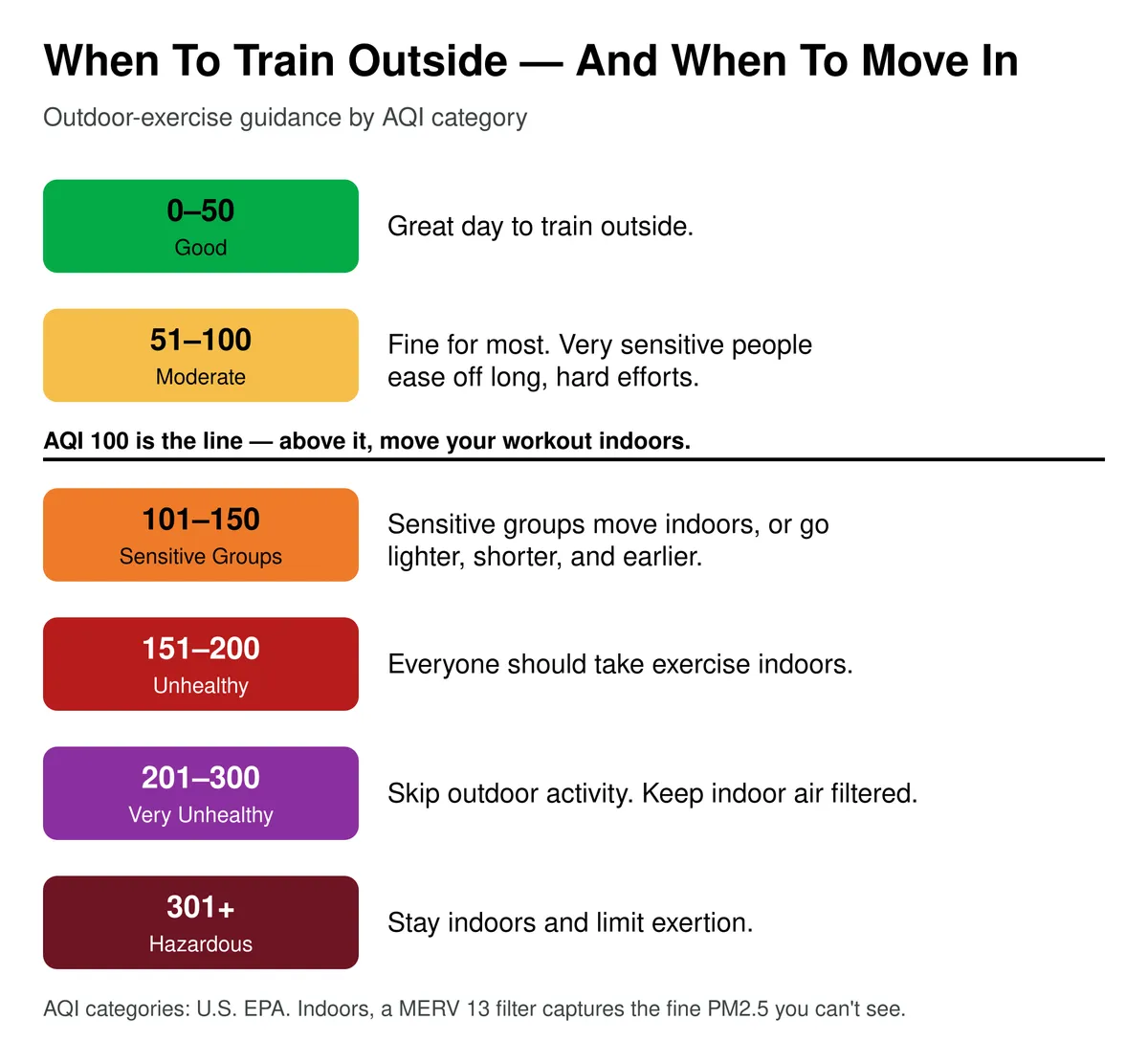
For most healthy adults, outdoor exercise is generally safe when the AQI sits at or below 100. Once the AQI climbs past 100 into code orange, sensitive groups should move their workouts indoors or scale them back. Once it reaches 151 and turns code red, everyone should take exercise inside. Above 200, skip outdoor activity altogether and keep your indoor air as clean as you can while you wait for conditions to improve.
AQI 100 is the practical line. At or below 100, most healthy people can exercise outdoors. Above it, the health risk climbs quickly.
Sensitive groups feel it first. Children, adults over 65, pregnant people, and anyone with heart, lung, or blood-sugar conditions should cut back once the AQI passes 100.
Exercise multiplies your exposure. Breathing harder drives more fine particles deeper into your lungs, so a hard workout in bad air is riskier than a slow walk.
Timing and place matter. Morning air is often cleaner than afternoon air, and staying away from busy roads lowers how much pollution you take in.
Indoors beats a mask. Moving your session inside and filtering the air protects you far better than a cloth or surgical mask ever will.
Know which pollutant is high. Ozone drops indoors once you close the windows, but smoke and particle pollution follow you inside unless you filter the air.
The AQI runs on a scale from 0 to 500 and tracks five major pollutants, including ground-level ozone and fine particle pollution known as PM2.5. Those two matter most for anyone exercising outdoors. Ozone tends to build through hot, sunny afternoons, while PM2.5 spikes with wildfire smoke, traffic, and industry. The higher the number, the more pollution is in the air and the greater the health concern. A value of 50 or below means the air is clean. A value over 100 means the air has crossed into unhealthy territory, first for sensitive people and then for everyone as the number keeps rising. Before you plan a workout, you can check the current AQI where you live.
The AQI shows one number, but two different pollutants usually drive it, and your best response changes depending on which one is high. AirNow and the EPA label the main pollutant of the day, so it's worth a quick look before you decide.
Ozone. This gas builds on hot, sunny afternoons. With your windows and doors shut, indoor ozone runs much lower, so heading inside genuinely fixes the problem, and an early-morning workout usually beats the afternoon peak.
Particle pollution and wildfire smoke. These fine particles slip indoors through windows, small gaps, and your HVAC system, so simply going inside is not enough. You have to filter the air with the windows closed and a high-efficiency filter running.
This is the distinction we care about most, because it decides whether staying inside is enough on its own or whether you also need to clean the air you bring in.
Here's the simple version. Green and yellow days, meaning an AQI of 100 or below, are safe for most people to train outside. Orange days, from 101 to 150, are the first warning. Sensitive groups should move indoors or choose a lighter, shorter, earlier session. Red days, from 151 to 200, are the point where every person should take exercise inside, not just those at higher risk. Purple and maroon days, above 200, call for staying indoors and keeping your air filtered. The chart below breaks down what each band means for your workout.
Guidance follows U.S. EPA AirNow AQI categories and American Lung Association activity advice. Check your local AQI before every outdoor session.
Outdoor exercise guidance by AQI category. Check your local AQI before every outdoor session.
At rest, you breathe slowly and mostly through your nose, which filters some of what you take in. During a hard effort you breathe much faster, much deeper, and often through your mouth, which skips that natural filter. The result is that a runner or cyclist can inhale several times more air, and several times more pollution, than someone standing on the same sidewalk. That's why federal health agencies suggest choosing an easier activity, like walking instead of running, when pollution levels rise. You breathe less hard, so you take in less of what's floating in the air. It also explains why active people who spend long stretches outdoors are treated as a higher-risk group even when they're otherwise healthy.
Some people feel the effects of dirty air sooner and more sharply than others. Children and teens are still developing their lungs and breathe more air pound for pound than adults. Older adults, pregnant people, and anyone living with asthma, COPD, heart disease, or diabetes also face higher risk. If you fall into one of these groups, treat an AQI of 101 as your signal to head indoors rather than waiting for a code red. And because prolonged outdoor exertion raises everyone's dose, dedicated exercisers should watch the AQI just as closely as any sensitive group does. For a closer look at how bad air affects at-risk lungs, see our guide to outdoor air quality and asthma.
Numbers on a chart only tell part of the story, and your body often flags trouble before the AQI does. If any of these show up while you're exercising outside, ease off and get to cleaner air.
Coughing, or a scratchy or burning feeling in your throat
Chest tightness, pressure, or pain
Wheezing or shortness of breath beyond your normal effort
Unusual fatigue, or a workout that suddenly feels much harder than it should
Headache, lightheadedness, or stinging, watery eyes
Stop, move indoors, and rest. If the symptoms stick around, or if you live with a heart or lung condition, check in with your healthcare provider. Anyone with asthma should follow their action plan the moment symptoms start.
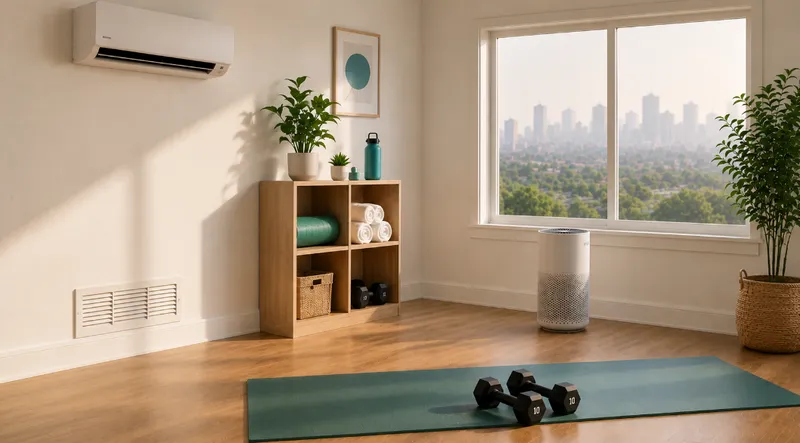
A bad-air day doesn't have to cost you a workout. In our experience, the most common mistake is nailing the outdoor call and then training in a room with a clogged filter and the windows cracked open. You can move a run to a treadmill, swap a ride for a stationary bike, or turn to bodyweight strength work, yoga, or a workout app at home. The catch is that fine particles drift indoors through open windows, doorways, and your heating and cooling system, so the room you train in is only as clean as the air moving through it. Keep windows and doors closed on high-pollution days, run your HVAC system's fan so it keeps filtering, and fit it with a high-efficiency air filter. The American Lung Association recommends a filter rated MERV 13 or higher to capture the fine particles that matter most, and our guide can help you choose the right MERV rating for your system. A portable air cleaner in your workout space adds another layer of protection. At Filterbuy, we like to say we make the invisible visible. You can't see PM2.5, but the right filter can pull it out of the air you're breathing while you move.
After manufacturing filters for over a decade and serving more than two million households, we've seen the same pattern every wildfire season. People do everything right outside, then walk into a home with air that's just as dirty. Moving your workout indoors only helps if the air indoors is actually clean.
— David Heacock, Founder and CEO, Filterbuy
These sources informed the guidance on this page. Each is worth a read if you want to go deeper on air quality and exercise.
U.S. Environmental Protection Agency – Should You Exercise Outside in Air Pollution?
AirNow – Air Quality Index (AQI) Basics
American Lung Association – Four Things to Know About Air Quality and Exercise
U.S. Centers for Disease Control and Prevention – About Air Quality and Protecting Your Health
American Heart Association – Air Pollution, Heart Disease and Stroke
American Academy of Pediatrics (HealthyChildren.org) – How Climate Change, Heat and Air Pollution Affect Kids' Health
Office of Disease Prevention and Health Promotion (Health.gov) – Top 10 Things to Know About the Physical Activity Guidelines for Americans
Trusted U.S. agencies and health groups back the guidance above.
Nearly 28 million Americans have asthma. That is about 1 in 12 people, including close to 5 million children. They feel bad air first.
Source: Asthma and Allergy Foundation of America – Asthma Facts, Figures, and Stats
PM2.5 causes an estimated 5,400 premature deaths a year in California. It also drives about 6,700 asthma-related emergency room visits there each year.
Source: California Air Resources Board – Inhalable Particulate Matter and Health (PM2.5 and PM10)
Wildfire smoke hits harder than everyday pollution. Respiratory hospitalizations rose 1.3 to 10 percent per 10 micrograms of wildfire PM2.5, versus 0.67 to 1.3 percent for other sources.
Source: Aguilera et al. (2021), U.S. National Institutes of Health (PMC) – Wildfire Smoke Impacts Respiratory Health More Than Fine Particles From Other Sources
We think the smartest move is to treat the AQI the way you already treat the weather forecast. You wouldn't head out for a long run in a thunderstorm without a second thought, and a code-red air day deserves the same respect. Skipping one outdoor workout costs you almost nothing, while a lungful of wildfire smoke during a hard effort can set back the very health you're training for. In our years making filters at Filterbuy and hearing from families on their smokiest, most polluted days, the habit that pays off most is a simple ten-second check before you lace up. If the number's good, enjoy the fresh air. If it's not, we'd rather see you move inside and keep breathing clean than tough it out and pay for it later.
Check your local AQI on a trusted app or on AirNow.gov before every outdoor workout, and set an alert for days above 100.
On orange or red days, move your session indoors and keep windows and doors closed to hold particles out.
Fit your HVAC system with a MERV 13 filter and run the fan so it keeps cleaning the air you train in. Explore MERV 13 air filters from Filterbuy to match your system size.
Add a portable air cleaner to your home gym or workout corner for an extra layer of protection during smoke events.
Q: What AQI Is Too High To Exercise Outside?
A: An AQI above 100 is the first caution point, and sensitive groups should move indoors there. An AQI of 151 or higher is too high for everyone, so plan to take your workout inside once the air turns code red.
Q: Is It Safe To Run When Air Quality Is Bad?
A: Running is riskier than lighter activity because you breathe harder and take in more pollution. When the AQI is between 101 and 150, swap a hard run for an easy walk or a morning session. At 151 or above, take the run indoors to a treadmill.
Q: Can I Work Out Outdoors During Wildfire Smoke?
A: Wildfire smoke is loaded with fine particles that appear to be more harmful than everyday pollution, so it's best to avoid outdoor exercise when smoke pushes the AQI into the orange range or higher. Move your workout inside and keep your indoor air filtered with the best filter for wildfire smoke until the smoke clears.
Q: Does A Mask Protect Me While Exercising In Bad Air?
A: A cloth or surgical mask does little against fine particle pollution, and even a well-fitted N95 makes hard breathing during exercise uncomfortable. The more reliable protection is to skip the outdoor session and train in a space with clean, filtered air.
Q: How Do I Keep Exercising When I Can't Go Outside?
A: Bring the workout indoors. A treadmill, stationary bike, bodyweight circuit, strength routine, or a follow-along app all keep you moving. Pair that with a MERV 13 filter in your HVAC system and a portable air cleaner so the air you're working hard to breathe stays clean.
Q: How Can I Lower My Exposure If I Have To Exercise Outside?
A: Go early in the morning, before ozone and traffic build for the day. Pick a route away from busy roads and highways, where particle levels run higher. Keep the session shorter and easier so you breathe less hard, and breathe through your nose when you can. Check the AQI right before you head out, since it shifts by the hour and can change from one block to the next.
Q: Is Indoor Exercise Always Safer Than Outdoor?
A: Only when the indoor air is actually clean. Fine particles from smoke and traffic drift inside through windows, gaps, and your HVAC system, so an indoor workout in an unfiltered room can be nearly as dirty as the air outside. Close the windows, run your system with a MERV 13 filter, and add a portable air cleaner to make indoors the safer choice.
Clean indoor air is the part of your workout you can control on any air-quality day. Filterbuy builds high-efficiency filters in the United States for over 600 sizes, so the air moving through your home stays as clean as the effort you put in. Shop Filterbuy filters for your home and keep protecting your health, indoors and out.
