August 27, 2026
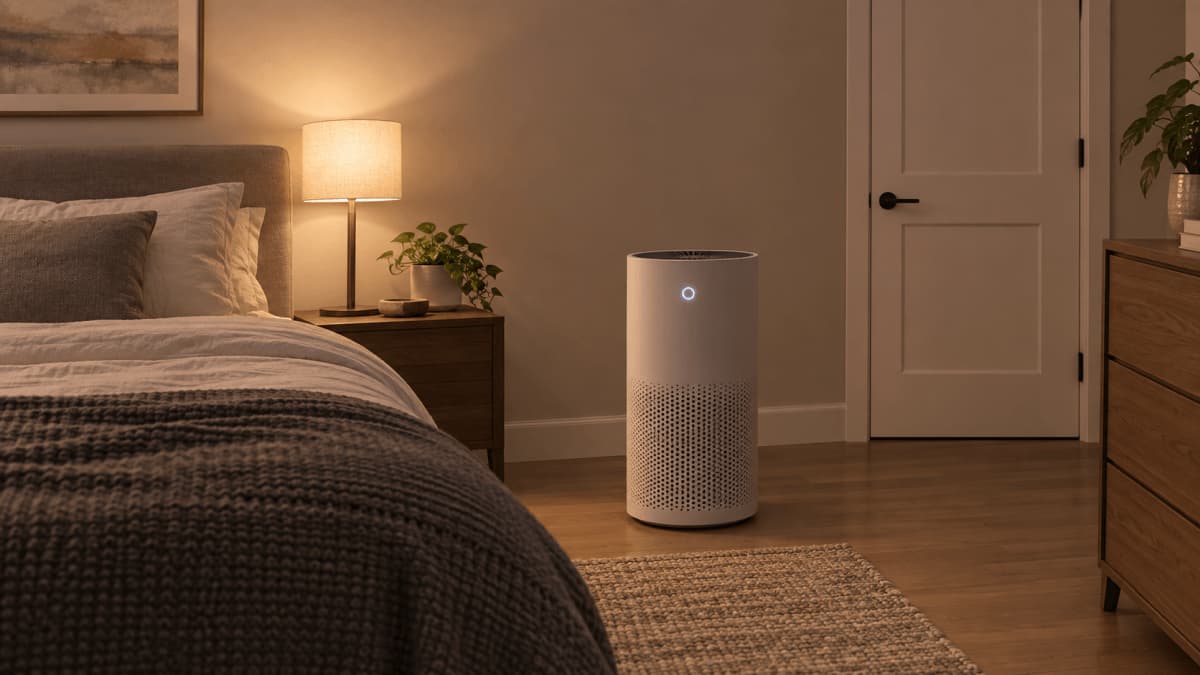
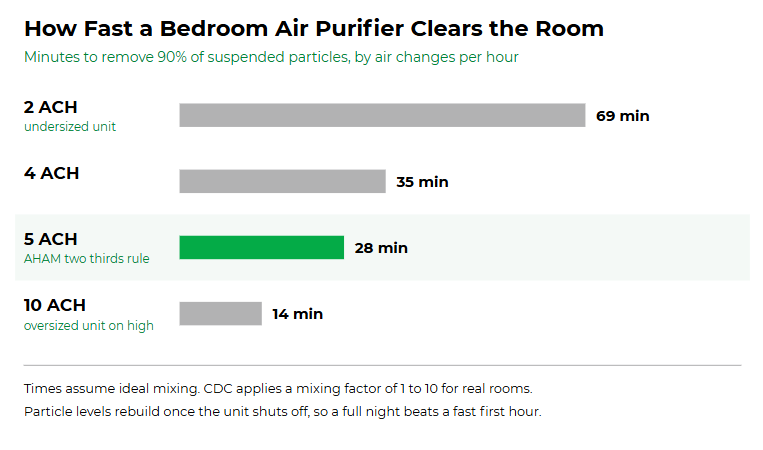
Run a bedroom air purifier continuously, or at minimum the entire time you occupy the room, including the full night. The EPA notes that longer run times and higher fan speeds filter more air. A unit sized to the AHAM two thirds rule moves about five air changes per hour, which clears roughly 90 percent of suspended particles in about 28 minutes under ideal mixing. Levels rebuild as soon as it shuts off.
Overnight baseline. Eight to ten hours, plus a 30 minute head start on the highest setting before bed.
All 24 hours. Pollen season, pets in the bedroom, wildfire smoke, or high AQI.
Watch the sleep setting. Clean air delivery rate is measured at the highest fan speed, so a quiet setting moves fewer air changes than the box implies.
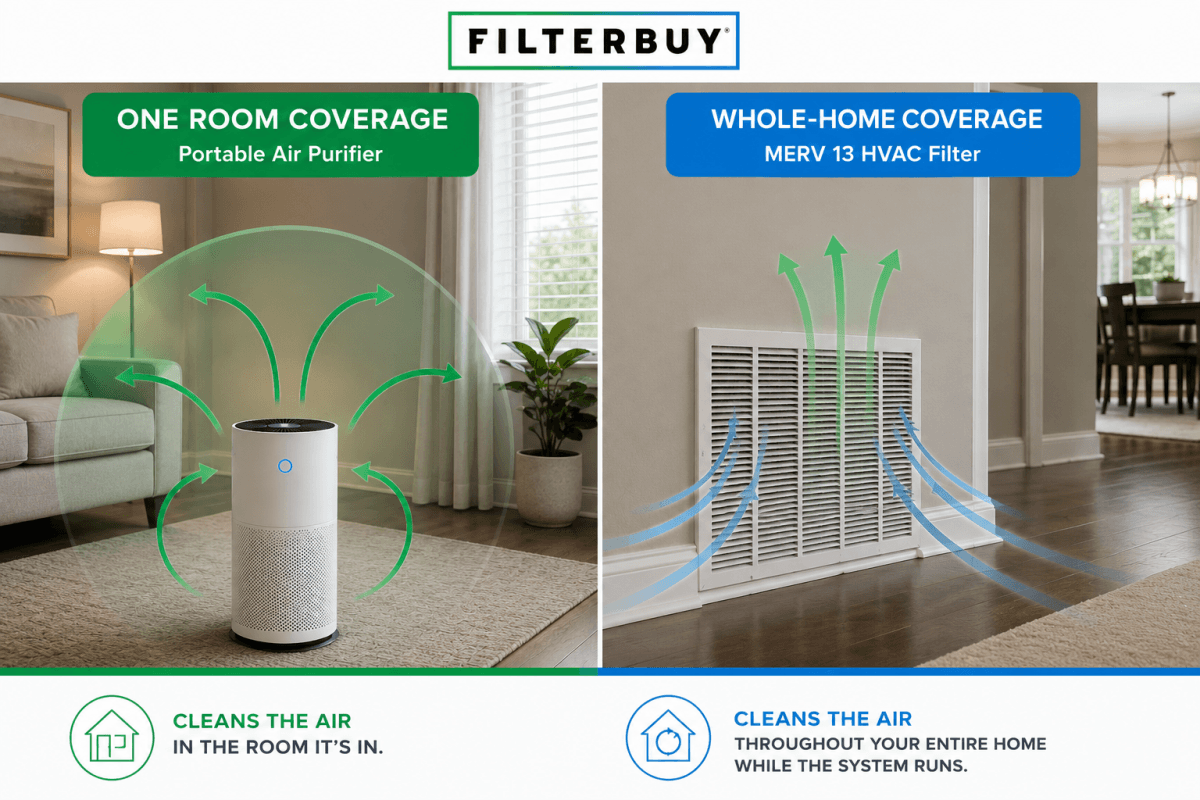
A purifier covers one room. Your central HVAC filter does the other half of the work, in every room the system serves.
Answer a few quick questions and we will match you to the right filter for your system.
By Michelle Wan, Brand Manager and Air Quality Writer at Filterbuy | Technically reviewed by David Clark, Licensed HVAC Technician | Published August 27, 2026 | Updated August 27, 2026
Run a bedroom air purifier continuously, or at minimum whenever you occupy the room, including the full night. The U.S. Environmental Protection Agency states that longer run times and higher fan speeds filter more air. A correctly sized unit clears roughly 90 percent of fine particles in about half an hour under ideal conditions, and levels rebuild the moment it shuts off.
Continuous operation is the default, because indoor particle sources refill a closed room as soon as filtration stops.
The AHAM two thirds rule, which calls for a clean air delivery rate of at least two thirds of the room's floor area, resolves to exactly five air changes per hour at an eight foot ceiling.
Five air changes per hour removes about 90 percent of suspended particles in roughly 28 minutes by the decay method the Centers for Disease Control and Prevention publishes, though CDC tells users to multiply that idealized time by a mixing factor of 1 to 10.
Clean air delivery rate is measured at the highest fan speed, so a unit on a quiet sleep setting delivers fewer air changes per hour than its packaging implies.
A standard room air cleaner running continuously uses about 394 kilowatt hours a year. ENERGY STAR certified models cut that by more than half.
Run a bedroom air purifier continuously. If that is not practical, run it the entire time the room is occupied, which for most households means eight to ten hours overnight plus a thirty minute head start before bed. EPA is direct about why, noting that longer run times and higher fan speeds filter more air.
A bedroom reloads with particles after you clean it. Skin flakes, dust mite debris, pet dander, and textile fibers lift off bedding every time a sleeper turns over, and outdoor particles infiltrate through window seals around the clock. CDC notes that particles 5 micrometers and smaller may not settle for hours or days, so a room clean at 10 p.m. is not clean at 3 a.m.
A bedroom air purifier sized to the AHAM two thirds rule delivers about five air changes per hour at an eight foot ceiling. At that rate, roughly 90 percent of suspended particles clear in about 28 minutes and 99 percent in about 55 minutes under ideal mixing.
The Association of Home Appliance Manufacturers, the trade body behind the AHAM Verifide certification program, recommends a clean air delivery rate of at least two thirds of the room's floor area. Run that rule through the air change formula and it lands on exactly five air changes per hour at an eight foot ceiling, the same minimum CDC recommends for occupied indoor spaces.
The figures below apply the decay method CDC publishes in Table B.1 of its environmental infection control guidance.
2 air changes per hour, an undersized unit: 69 minutes to 90 percent, 138 minutes to 99 percent.
4 air changes per hour: 35 minutes to 90 percent, 69 minutes to 99 percent.
5 air changes per hour, what the AHAM two thirds rule delivers: 28 minutes to 90 percent, 55 minutes to 99 percent.
10 air changes per hour, an oversized unit on high: 14 minutes to 90 percent, 28 minutes to 99 percent.
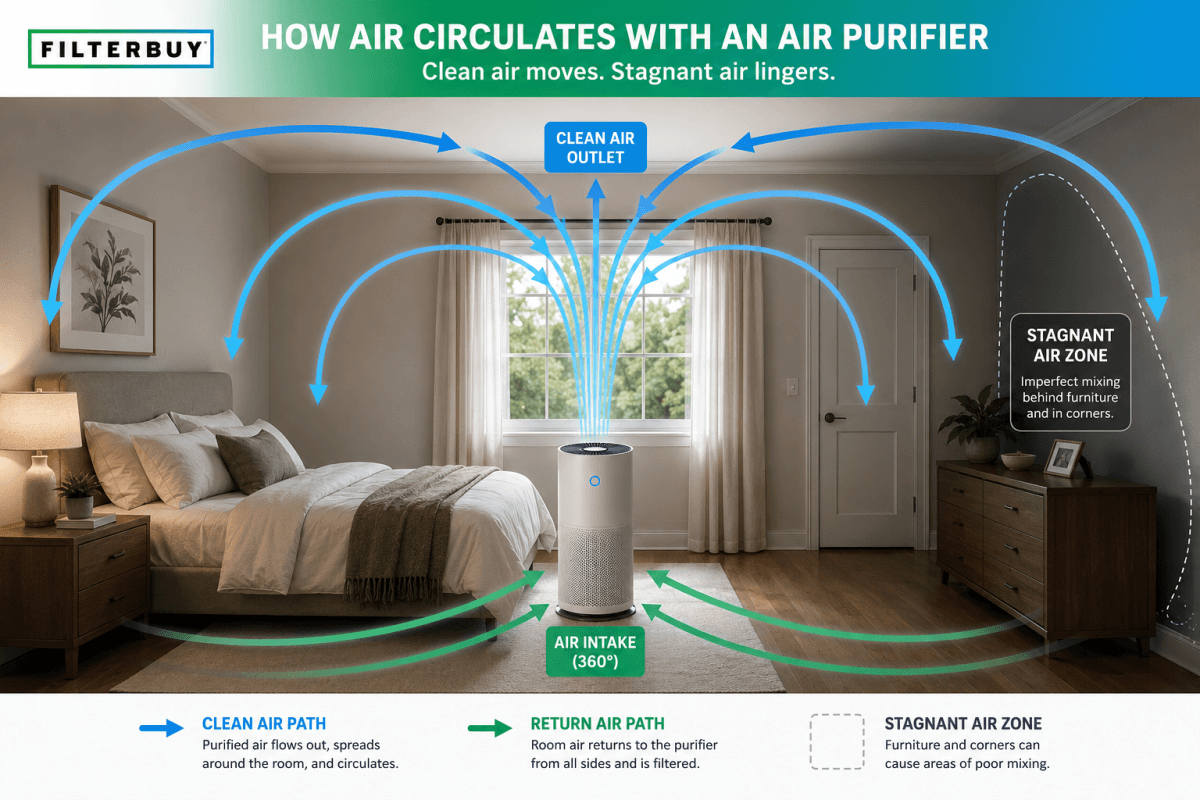
Here is the part most runtime guides omit, and it is why we built the list above instead of repeating the usual thirty minute claim. Those times assume perfect air mixing, and CDC instructs users to multiply them by a mixing factor between 1 and 10 to reflect how unevenly real rooms mix. A bedroom with furniture and a purifier pushed against a wall sits toward the high end, so any thirty minute clean time quoted from CADR math alone is a best case, and a full night of runtime beats a fast first hour.
Clean air delivery rate is measured at an air cleaner's highest fan speed, and EPA guidance on portable air cleaners states that a unit filters less air on a lower speed. A purifier rated for your bedroom on turbo can fall well short of five air changes per hour on the quiet sleep setting you actually use at night, and that gap is the most common reason a full night of runtime underdelivers.
Size for the speed you will really use. Check the manual for airflow at each fan setting, then apply the two thirds rule to the quietest setting you can sleep through, which in practice means buying one size up. The larger unit also runs quieter, moving the same air more slowly. EPA notes a 50 decibel rating is roughly the sound of a refrigerator.
The two thirds rule assumes an eight foot ceiling, so a taller room needs more airflow than the rule alone suggests. CDC publishes the correction, which is to multiply the required airflow by your ceiling height divided by eight. Most sizing advice skips that step, and vaulted or nine foot bedrooms quietly run short.
The effect is easy to see in a 200 square foot bedroom. At eight feet it needs 133 CADR to reach five air changes per hour. At nine feet the target rises to 150, and at ten feet to 167. Put the eight foot unit in the ten foot room and it delivers 4.0 air changes instead of 5.0, a shortfall of 20 percent you cannot see or hear.
Check your own room in one line. Multiply your unit’s clean air delivery rate by 60, then divide by floor area times ceiling height, and anything at or above 5 clears the bar.
Bedroom air is dirtiest in the hour before you get into it, so the purge front loads the cleaning into the one window where noise costs you nothing.
Close the door and windows 30 to 45 minutes before bed. A smaller sealed volume clears faster.
Run the purifier on its highest setting for that half hour, the one window where noise is irrelevant.
Make the bed and change clothes at the start, because both launch settled particles back into the air.
Drop to the quietest setting that still meets your sizing target once you are in bed.
Leave it running until morning. Skip the shutoff timer, which strands the room for hours you are still in it.
A standard room air cleaner running continuously uses approximately 394 kilowatt hours per year, which ENERGY STAR compares to the annual draw of some new refrigerators. ENERGY STAR certified models are more than 50 percent more efficient, saving about 211 kilowatt hours and between 18 and 40 dollars a year depending on size.
Overnight operation lands near a third of that, which makes electricity a poor reason to shorten runtime. Filter replacement is the real recurring cost, and a loaded filter erodes the clean air delivery you paid for. See how long air purifier filters last for replacement timing.
Overnight operation measurably lowers bedroom particle levels, though the sleep benefit itself is modest in the published evidence, and EPA characterizes health improvements from portable air cleaners as typically small and not always noticeable.
In the HAFTRAP randomized crossover trial, homes running HEPA purifiers nearly all the time recorded 52 percent lower indoor PM2.5 than the same homes running sham units.
A 2023 randomized crossover pilot in the Journal of Sleep Research found HEPA filtration was associated with about 12 additional minutes of total sleep per night versus a placebo filter. Several sleep and mood measures showed no change, and time awake after sleep onset was higher under HEPA. The sample was 29 adults without clinical sleep disturbance, and two authors worked for a purifier manufacturer.
Filtration reliably improves the air, though sleep is shaped by many factors filtration never touches. Anyone managing a diagnosed respiratory or sleep condition should work with their clinician rather than an appliance. The Filterbuy guide to how indoor air quality affects sleep covers the wider evidence.
Runtime follows particle load, not the clock. All night is the baseline, and the cases below are where it stretches to a full 24 hours.
Good outdoor air quality: all night, plus the purge, on a quiet setting sized to the room.
Pollen season: 24 hours a day, on auto if the unit offers it.
Pets in the bedroom: 24 hours a day on medium, pre filter cleaned monthly.
Wildfire smoke or high AQI: 24 hours a day, windows closed, highest tolerable setting.
Cooking smoke reaching the bedroom: highest setting for an hour, then quiet.
For wildfire smoke, AHAM recommends a smoke clean air delivery rate equal to the full room area in square feet rather than two thirds of it. See the Filterbuy guide to the best MERV filter for wildfire smoke for the whole-home side of a smoke event.
Continuous runtime remains the right default, though a purifier only removes what is airborne. Four limits are worth knowing before you buy.
Mold. EPA is explicit that air cleaners do not address its cause. Fix the moisture and clean the growth.
Gases and odors. CADR rates particles only. Gas removal takes a thick carbon stage, and EPA notes no widely used performance rating exists for it.
Allergen reservoirs. A purifier treats air, not the mattress or carpet holding the allergen. Airborne levels fall, the source does not.
Source control. EPA ranks removing pollutant sources and ventilating with clean outdoor air ahead of filtration, which supplements them.
None of that argues for less runtime, only against asking one appliance to do a dehumidifier's job.
A bedroom air purifier treats one room, while a central heating and cooling filter treats every room the system serves. EPA recommends a furnace or HVAC filter rated at least MERV 13, or as high as the system fan and filter slot can accommodate, and notes most systems handle it without equipment problems if the filter is replaced frequently. The Filterbuy MERV rating chart breaks down what each rating captures.
The two work on opposite schedules, which is why they pair well. EPA points out that furnace and HVAC filters only clean air while the system runs, which in most homes is under 25 percent of the time during heating and cooling seasons, so the portable unit covers the bedroom through the hours the blower sits idle. Filterbuy pleated MERV 13 air filters are the practical ceiling for most residential systems, and the right air filter replacement interval depends on your household.
Ductless equipment deserves one caveat. EPA states that window air conditioners and wall-mounted ductless units are built for temperature control rather than air filtration, with filtration limited to keeping the unit clean. If a mini split serves your bedroom, the portable purifier is doing the particle work, not the head unit, and that holds for the Filterbuy mini split systems we build. The full comparison of air filters versus air purifiers sets out which device does what.
Three federal findings explain why runtime matters.
Americans spend about 90 percent of their time indoors. Indoor concentrations of some pollutants run 2 to 5 times higher than outdoor levels. Source: EPA Report on the Environment, updated May 2026.
More than 90 percent of U.S. homes carry three or more detectable allergens. In 73 percent, at least one was at an elevated level. The samples came from bedrooms in nearly 7,000 households. Source: NIEHS bedroom allergen study, the largest U.S. indoor allergen survey to date.
One quarter of U.S. adults had a diagnosed seasonal allergy in 2024. That is 25.2 percent, and the figure reaches 31.7 percent once eczema and food allergy are counted. Source: CDC National Center for Health Statistics, Data Brief 545, January 2026.
The bedroom holds the most indoor hours of any room, and national sampling found its allergen levels highest. Runtime acts on both.
Filterbuy manufactures pleated HVAC filters and ductless mini split systems in the United States. Whole home filtration is our business, not portable purifiers, so this guide has no unit to sell you and we earn nothing when you run one all night.
Every figure here is a published federal number or a calculation from a published federal formula, with the method stated in the open. Before publishing, we ran CDC's decay formula against CDC's own worked examples, and our arithmetic reproduces them to the minute at 69 minutes for a 99 percent reduction at 4 air changes per hour.
Yes, in the rooms where you spend the most time, since continuous operation stops particle levels from rebuilding between cycles. Rooms that sit empty need only an hour before you go in.
A HEPA and activated carbon air cleaner is built for continuous operation and is safe overnight. Avoid units that intentionally produce ozone, which the EPA calls a lung irritant. The California Air Resources Board and AHAM publish lists of air cleaners shown to emit little or no ozone.
Place it where airflow is unobstructed, several feet from the bed, away from curtains or furniture that block the intake. EPA advises pointing the airflow away from you if it creates an uncomfortable draft.
Yes. The two cover different territory. Manufacturers typically recommend HVAC filter replacement every 60 to 90 days, sooner if filters look heavily soiled.
Air Changes per Hour (ACH). The number of times per hour an air cleaner processes air equal to the room volume. ACH equals clean air delivery rate times 60, divided by room volume in cubic feet.
Clean Air Delivery Rate (CADR). The volume of contaminant-free air a portable air cleaner delivers, in cubic feet per minute. AHAM publishes a separate smoke score, and that is the one to size a bedroom by.
HEPA Filter. A high efficiency particulate air filter, at least 99.97 percent efficient at capturing 0.3 micrometer particles, the size most likely to penetrate.
MERV. Minimum Efficiency Reporting Value, the rating scale for HVAC and furnace filters, where higher numbers mean higher removal efficiency.
PM2.5. Fine particulate matter 2.5 micrometers or smaller, the fraction of greatest health concern indoors.
Mixing Factor (k). A CDC multiplier from 1 to 10 for how imperfectly a real room mixes its air. Higher values mean longer clearance times.
Every source below is hyperlinked inline at the point of use in the body copy. It is listed here unlinked so no URL appears twice on the page.
U.S. Environmental Protection Agency, Guide to Air Cleaners in the Home, updated February 17, 2026
AHAM Verifide, Air Filtration Standards and the Two Thirds Rule
CDC NIOSH, Ventilation Frequently Asked Questions, clearance times and mixing factor
ENERGY STAR, Room Air Cleaners product guidance and annual energy use
Lamport DJ, et al. Can air purification improve sleep quality? Journal of Sleep Research, 2023
HEPA filtration and cognitive function, HAFTRAP randomized crossover trial, Scientific Reports
U.S. Environmental Protection Agency, Report on the Environment, Indoor Air Quality, updated May 27, 2026
National Institute of Environmental Health Sciences, Allergens Widespread in Largest Study of U.S. Homes, January 2018
Bottoms-McClain L, Giri A, Ng AE. Diagnosed Allergic Conditions in Adults: United States, 2024. NCHS Data Brief No. 545, January 2026
