
Can a Dirty AC or Furnace Air Filter Make You Sick? Signs, Symptoms, and What to Do
September 21, 2026

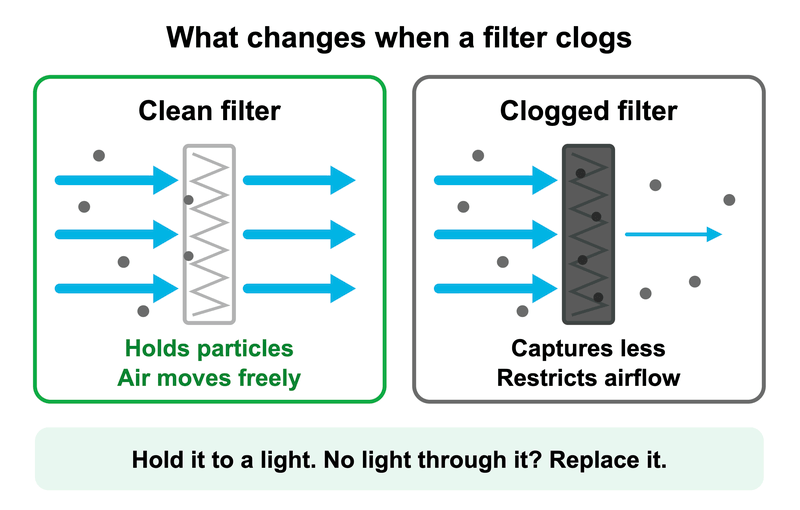
A dirty filter doesn’t make you sick on its own, but it stops doing its job. Once it clogs, it captures fewer particles and restricts airflow, so more dust stays in circulation and your system runs longer.
Hold yours up to a light. If you can’t see light through the media, replace it today, or take the quick match quiz below to find the right one.
Made in the USA. Shipped to your door.
Symptoms that persist are a question for a doctor. Changing a filter is maintenance, not a diagnosis.
Find Your Filter Match
Have a ductless mini split? Answer a few quick questions and we’ll match you to the right filter.
The Short Answer
A filter is only doing its job while there is still room in the media. Once it loads up, two things happen at once: it captures fewer of the particles it was rated to capture, and it restricts the airflow your system depends on. More dust stays in circulation, rooms stop feeling even, run times get longer, and in the worst cases the coil freezes or the furnace trips its limit switch.
Check it now: hold the filter up to a light. If you can't see light through the media, it's done.
Typical replacement: every 30–90 days for a 1" filter, longer for thicker media. Shorter with pets, smoke, or construction dust.
The fix takes two minutes and costs less than one service call.
If someone in your home has symptoms that persist, that's a conversation for a doctor. Changing a filter is maintenance, not a diagnosis.
Check Your Air Filter in 60 Seconds
Before you read the rest of this, go look at it. Everything below is easier to judge with the filter in your hand.
Find the return grille or the filter slot at your air handler and slide the filter out.
Hold it up to a window or a lamp and look through the pleats.
Check the frame for bowing, and the media for damp spots or dark patches.
5 Things That Change When Your Air Filter Clogs
Each one below follows the same pattern: what you notice first, what's actually happening behind the grille, and what fixes it.
1. It Captures Less Than It Used To
What you notice: dust settling on furniture faster than it used to, gray film on the vent louvers.
What's happening: A pleated filter works by holding particles in the depth of the media. As it fills, air starts to find the paths of least resistance, and finer particles — pollen, pet dander, fine dust — pass through instead of being held. The rating on the box describes a clean filter, not a loaded one.
What fixes it: Replacement, not cleaning. Once pleated media is loaded, washing it collapses the fibers and ruins the seal.
2. It Starts to Smell
What you notice: a musty or stale smell near a return grille, strongest right when the system kicks on.
What's happening: A loaded filter is a layer of organic debris sitting in a moving air stream. Add moisture — a humid basement, a leaking return, a coil draining poorly — and you have the conditions the EPA describes for mold growth on damp materials, which can begin within 24 to 48 hours.
What fixes it: Replace the filter, then deal with the water. A new filter in a damp return will look the same in a month. If you find standing water, staining, or growth on the ductwork itself, that's an HVAC service call, not a filter problem.
3. Airflow Drops and Rooms Stop Matching
What you notice: weak air at the vents, the far bedroom running warm in summer and cold in winter, the thermostat never quite landing on its setpoint.
What's happening: Pressure drop across the filter rises as it loads. Your blower is trying to move a fixed volume of air through a smaller and smaller opening, and the rooms at the end of the longest duct runs are the first to lose out.
What fixes it: A clean filter of the right size. A filter that's loose in the slot is its own version of this problem — air goes around the media instead of through it. More on how airflow moves through a filter.
4. Your System Runs Longer to Do the Same Job
What you notice: cycles that don't end, and a utility bill that drifts up without a change in weather or rates.
What's happening: Less air across the coil means less heat moved per minute, so the system stays on longer to hit the same temperature. Longer run times mean more kilowatt-hours. The Department of Energy lists replacing a clogged filter among the routine maintenance steps that keep a system running at its rated efficiency.
What fixes it: Replacement on schedule. The filter is the cheapest input in the whole system.
5. The Equipment Takes the Strain
What you notice: ice on the line set in summer, a furnace that lights and shuts off a minute later in winter, a blower that sounds like it's working.
What's happening: Starved airflow hits differently in each season.
What fixes it: Replace the filter first, because it's the cheapest thing to rule out. If the symptoms continue on a clean filter, stop there and call an HVAC technician. Repeated freezing or limit trips point to something a filter won't solve.
Don't run the system without a filter. It's a common workaround when someone is out of the right size, and it sends every bit of debris straight onto the coil and the blower wheel, where it's far harder to remove. An off-size filter that seals poorly has the same effect on a smaller scale.
How Often to Replace Your HVAC Filter
Thickness drives the interval more than anything else. A 4" filter holds far more debris than a 1" filter of the same rating, so it lasts longer before pressure drop becomes a problem. Treat these as starting points, then adjust to what the filter actually looks like at the 30-day check.
Make the next one automatic. Write the install date on the filter frame in marker when you put it in, or put the interval on a repeating calendar reminder. An air filter subscription does the same job without the reminder.
Which Filter Should You Put Back In?
MERV describes what size of particle a filter captures and how much of it. Higher isn't automatically better for every system — it's a trade between capture and airflow, and the right answer depends on your equipment and how you live.
For the full breakdown — capture percentages, particle sizes, and how MERV lines up against MPR and FPR numbers on other brands — see All About MERV Ratings.
Replace It in Two Minutes
Turn the system off at the thermostat.
Slide the old filter out and note the size printed on the frame — that's nominal size, and it's what you order by.
Check the airflow arrow on the new filter and point it toward the blower, in the same direction the old one faced.
Seat it flat in the slot so there are no gaps around the edges.
Close the grille, write the date on the frame, turn the system back on.
Step-by-step with photos: how to replace your air filter.
When It Isn't the Filter
A filter change is the first thing to rule out because it's fast and cheap. It isn't the answer to everything.
Symptoms that persist — congestion, coughing, or irritation that continues regardless of maintenance is a question for a doctor, not a filter. A filter captures particles; it doesn't diagnose or treat anything.
Visible growth on ducts, standing water, or a smell that survives a new filter — get an HVAC professional to find the moisture source.
Repeat coil freezing or short cycling on a clean filter — that points to refrigerant charge, a failing blower, or duct restriction.
Dust that keeps returning right after a change — check for duct leaks pulling unfiltered air in downstream of the filter.
Indoor air is worth taking seriously on its own terms. The EPA reports that indoor concentrations of some pollutants often run two to five times higher than outdoors — filtration is one input among several, alongside ventilation, source control, and humidity.
Supporting Statistics
8.6% of U.S. adults and 6.5% of U.S. children currently have asthma (2024). Source: CDC National Center for Health Statistics, FastStats: Asthma
About 4 in 5 U.S. homes have dust mite allergens in at least one bed. They settle into fabrics, so pair a fresh filter with hot-water bedding washes. Source: American Lung Association, Dust Mites
A MERV 13 filter must capture at least 50% of the smallest particles tested (0.3–1.0 microns), compared with 20% for MERV 11. Source: U.S. EPA, What Is a MERV Rating?
Frequently Asked Questions
What Are the Signs of a Dirty Air Filter?
An even gray coat on the intake face, no light passing through the media, a frame bowed toward the blower, weaker air at the vents, more dust settling on surfaces, and a musty smell near the return.
How Often Should I Change My Air Filter?
Check monthly and go by what you see. As a starting point: 30–90 days for a 1" pleated filter, around 90 days for a 2", and 6–12 months for 4" and 5" media. Pets, smoke, and construction dust shorten all of those.
Can a Dirty Air Filter Cause Allergies?
A filter doesn't cause allergies. What it does is capture particles like pollen and pet dander while it has capacity — and once it's loaded, more of what it used to hold stays in circulation instead. If symptoms are ongoing, talk to a doctor about what's driving them.
Can a Dirty Filter Cause Ice on the Coil?
Yes. Restricted airflow lets the evaporator coil drop below freezing, and condensation turns to ice. Cooling falls off until it thaws. Turn the system to fan only to melt the ice, replace the filter, and call a technician if it ices again.
Does a Dirty Air Filter Raise My Energy Bill?
It makes your system work longer to reach the same temperature, and longer run times use more energy. How much depends on your equipment, your climate, and how far gone the filter is.
Can I Clean a Dirty Air Filter Instead of Replacing It?
Only filters built to be washed, like some purifier pre-filters — rinse and dry those completely before reinstalling. Disposable pleated HVAC filters are replaced, not cleaned. Washing collapses the media and wrecks the seal.
What Does a Dirty Air Filter Look Like Next to a New One?
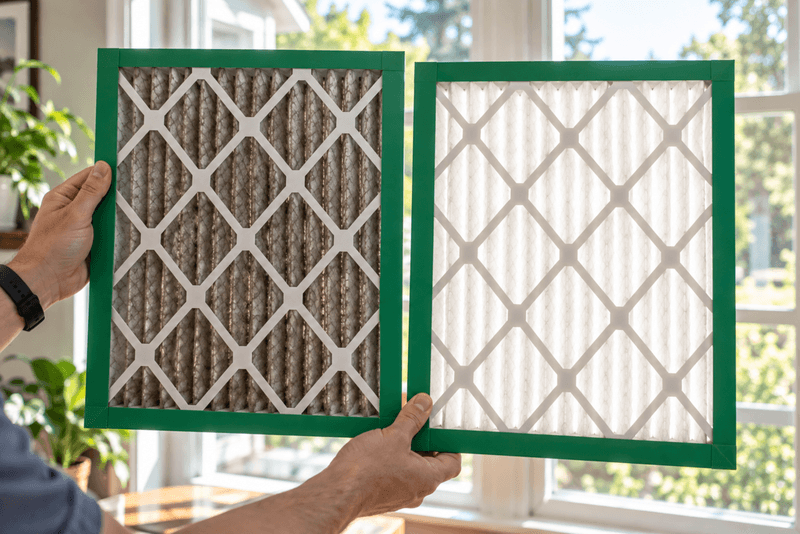
A new filter is white or off-white with crisp, evenly spaced pleats you can see light through. A spent one is gray to near-black, matted flat between the pleats, sometimes damp, often with a frame that has started to bow.
How Long Can I Run the System on an Overdue Filter?
There's no fixed limit, but the trade gets worse the longer you wait: less capture, more pressure drop, more run time, and more load on the blower and coil. Once light won't pass through the media, there's no benefit left to gain by waiting.
What About a Dirty Filter in My Car?
Same principle, smaller scale. A loaded cabin air filter weakens airflow at the dash vents and can leave a stale smell when the fan runs. Follow the interval in your owner's manual, and go shorter if you drive dusty or unpaved roads.
I Rent My Apartment — Who Changes the Filter?
It varies by lease. Many leases put routine filter changes on the tenant and equipment service on the landlord. Check yours, and if it's your responsibility, the size is printed on the frame of the one already in the slot.
Keep Reading
All About MERV Ratings — what the numbers mean and how they compare to MPR and FPR
How to Replace Your Air Filter — step by step
How Your Air Filter Works — airflow, pressure drop, and media
Does Furnace Filter Thickness Matter? — why a 4" lasts longer than a 1"
Glossary
Filterbuy: A family-owned U.S. air filter manufacturer founded in 2013.
MERV: Minimum Efficiency Reporting Value, ASHRAE's 1-to-16 scale for how well a filter captures particles.
Pressure drop: The airflow resistance a filter creates, which rises as it loads with debris.
Evaporator coil: The indoor AC coil that absorbs heat from household air.
About the Author and Reviewer
Michelle Wan is Filterbuy's Brand Manager and Air Quality Writer. She works closely with Filterbuy's four U.S. factories, so her advice comes from how filters are built and used. "I don't want anyone to feel like they need an HVAC license just to pick the right filter."
David Clark is a Licensed, EPA-certified HVAC Technician who leads Filterbuy HVAC Solutions.
About Filterbuy: Family-owned U.S. manufacturer since 2013. Filterbuy makes 600+ standard sizes plus custom sizes and ships factory-direct.