
How Long Do HEPA Air Purifier Filters Last?
August 21, 2026
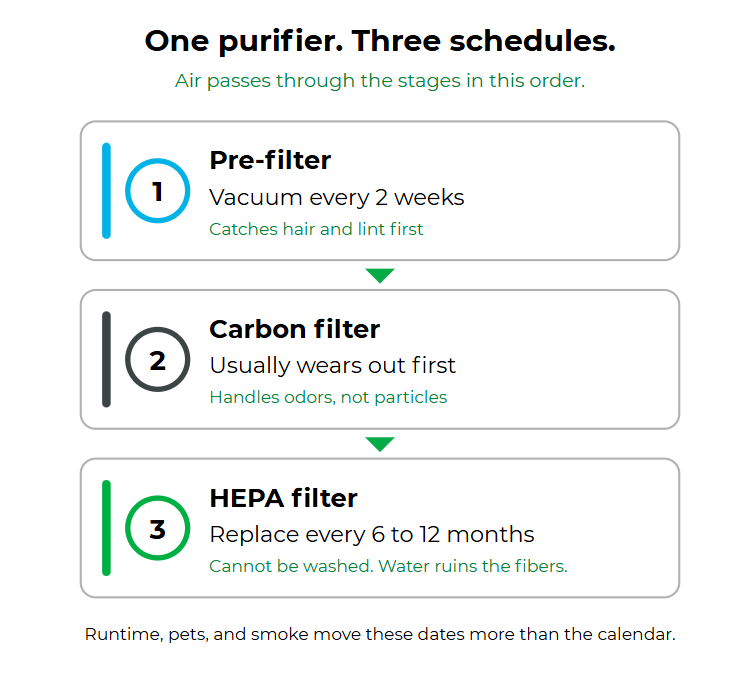
A HEPA filter in a portable air purifier lasts about 6 to 12 months of normal use. State health guidance widens that range to 3 to 12 months. But a purifier is not one filter. It is three stages stacked in a row, and they do not wear out on the same schedule.
Pre-filter: vacuum it every couple of weeks.
Carbon filter: usually the first stage to wear out.
HEPA filter: 6 to 12 months, and it cannot be washed.
Runtime moves that date more than the calendar does. We do not make replacement filters for portable purifiers, so buy what your purifier maker specifies. For the MERV-rated HVAC filters that handle the rest of the house, shop Filterbuy air filters.
Answer a few quick questions and we will match you to the right filter.
Author: Michelle Wan, Brand Manager and Air Quality Writer, Filterbuy
Reviewed By: David Clark, Licensed HVAC Technician
Published: August 22, 2026
Updated: August 22 2026
TL;DR
HEPA filters in portable air purifiers last about 6 to 12 months of typical use. Pre-filters need cleaning every few weeks. Carbon filters usually wear out first. Runtime, air quality, pets, and smoke move that date more than the calendar does. A HEPA filter can't be washed, so once it loads, you replace it.
Key Takeaways
A HEPA filter lasts roughly 6 to 12 months. State health guidance cites 3 to 12.
Three filter stages run on separate schedules inside one machine.
HEPA and carbon filters can't be washed, because water breaks down the fibers that do the capturing.
Most indicator lights count runtime hours, not filter loading.
A room purifier and a MERV-rated HVAC filter do different jobs, so most homes need both.
How Long Does A HEPA Filter Last In An Air Purifier?
A HEPA filter in a portable air purifier lasts about 6 to 12 months under normal use. State health guidance widens that to 3 to 12 months, plus a change after heavy smoke. Manufacturer intervals assume average air and moderate runtime, so a unit running around the clock gets there sooner.
The 6 to 12 month range hides something most guides skip. A portable air cleaner isn't one filter. It's three media types stacked in a row, each with its own service life. Put all three on one annual schedule and you'll either throw away good HEPA media or leave spent carbon in place for months.
The University of Washington Department of Environmental and Occupational Health Sciences advises vacuuming the pre-filter as often as every two weeks. It's the cheapest way to stretch HEPA life, because every gram of lint it catches never reaches the media. The Montana Department of Public Health and Human Services describes the same staggered pattern.
What The Hour Rating On Your Filter Box Actually Means
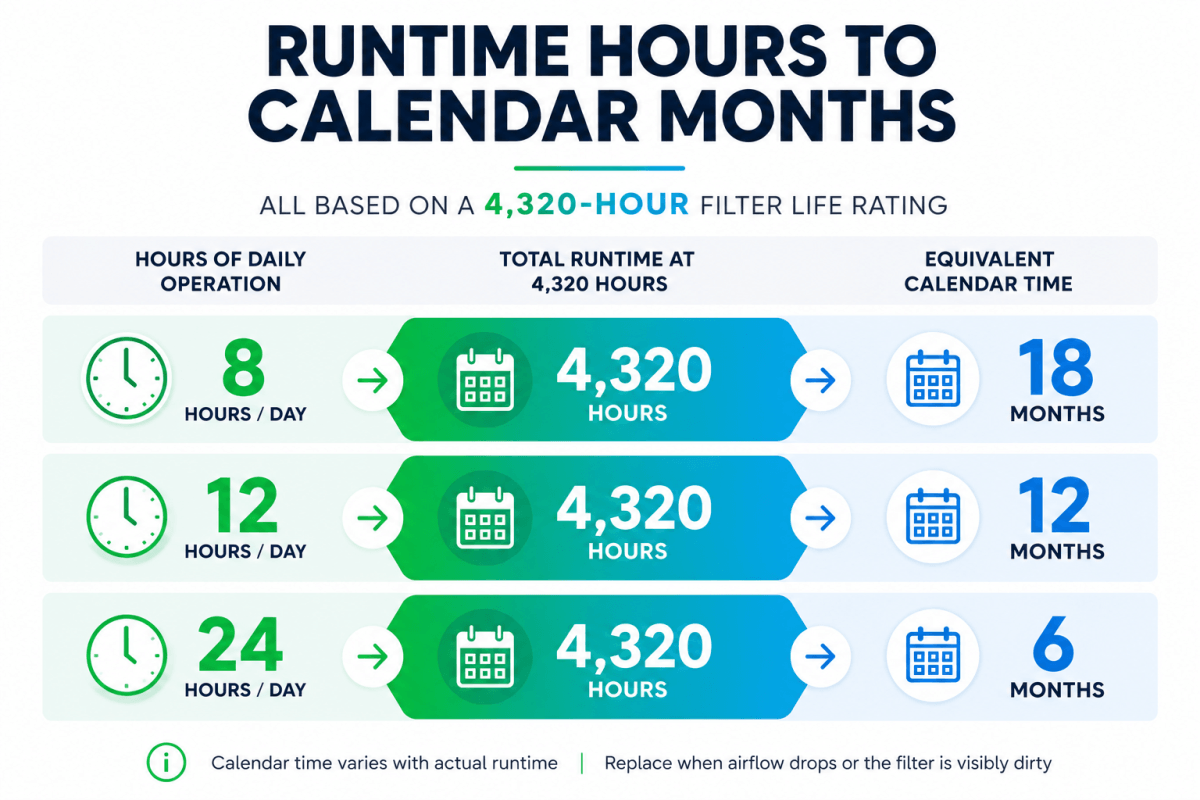
Many manufacturers rate filter life by the hour. A filter labeled 4,320 hours is rated for 180 days at 24 hours a day. Run it 8 hours a night and it covers roughly 18 months. The hour rating is honest. The month estimate on the box assumes your habits.
What Shortens HEPA Air Purifier Filter Life
Filter life shortens whenever more particles pass through the media each day. Runtime and fan speed set the pace, and the room's particle load does the rest. Apply the runtime math above and two identical purifiers in one house can land six months apart on which room they sit in.
Continuous operation. High speed for 24 hours moves triple the air of 8.
Pets. Dander and fur load the pre-filter fast, and the rest reaches the HEPA.
Smoke of any kind. Tobacco loads the particle and carbon stages at once, and the American Lung Association advises changing filters more often during wildfires.
Renovation dust retires a filter in weeks, and an undersized unit runs flat out to keep up.
Room sizing drives several of those factors. The Association of Home Appliance Manufacturers recommends a clean air delivery rate, or CADR, of at least two-thirds of the room's square footage, rising to the full room area in wildfire country. An undersized purifier cleans less air and burns filters faster doing it.
Signs Your HEPA Filter Needs To Be Replaced
A loading HEPA filter announces itself through airflow long before air quality, because resistance climbs as the media fills and clean air delivery falls with it. Most owners notice these symptoms months before blaming the filter. Hold it up to a bright light. If light won't pass through the pleats, it's done.
Weaker airflow at the same setting.
Rooms clear more slowly.
Odors return while dust control holds.
The media face has gone grey or brown.
Odors returning is the signal most likely to send you after the wrong filter, because carbon soaks up gases and can only hold so much, while HEPA traps particles physically. Public Health Seattle and King County notes that carbon filters usually need changing more often than HEPA filters do.
Can You Wash Or Vacuum A HEPA Filter?
You can't wash a HEPA filter. The Washington State Department of Health states plainly that HEPA and carbon filters can't be washed and must be replaced, because washing makes them ineffective. The fiber structure that traps 0.3 micron particles doesn't survive water, so a rinsed filter that looks clean has lost what you paid for.
Two narrow exceptions exist. A damp cloth or vacuum can lift large debris off the outer surface without saturating the media, and separate pre-filters are often washable. If a purifier advertises a washable HEPA or carbon filter, that guidance recommends a different device. Our guide to whether air purifier filters can be washed covers those exceptions.
How HEPA Purifier Filters Compare To HVAC Air Filters
HEPA and MERV measure different things for different machines. The EPA defines HEPA as a pleated mechanical filter removing at least 99.97 percent of particles at 0.3 microns, the most penetrating particle size. MERV rates capture between 0.3 and 10 microns and applies to central HVAC filters.
True HEPA media is much denser than anything a home HVAC return is built around, which is why portable purifiers use it and central systems don't.
Filterbuy cuts, pleats, and frames filters to order in our own US plants, so here's the part we can speak to directly. Pleats add surface area, and surface area buys service life. More media spreads a dust load thinner, so a 4-inch HVAC filter outlasts a 1-inch filter, and a thin purifier filter loads fast.
That manufacturing vantage point also sets the honest limit of this page. We don't make replacement HEPA filters for purifiers, so there's nothing for us to sell you here and no reason to talk you into an early change. Buy what your purifier maker specifies. For the rest of the house, MERV 8 is the standard choice for most homes and MERV 11 suits allergies and pets. MERV 13 air filters handle smoke, and Odor Eliminator activated carbon filters take on odors.
How Much Do Replacement HEPA Filters Cost Per Year?
A replacement HEPA filter costs $40 to $100, according to Washington State Department of Health guidance. Compare the common cadences and the cost of an early-change habit becomes obvious, which is why runtime beats the calendar.
Every 6 months: two filters a year, $80 to $200.
Every 9 months: 1.3 filters a year, $53 to $133.
Every 12 months: one filter, $40 to $100.
Clean air delivery doesn't improve at the six-month cadence, so that first row is $40 to $100 a year for capacity you threw away. Electricity is the forgotten line item, and ENERGY STAR puts a continuously running unit at roughly 394 kilowatt-hours a year.
Run one check before you buy, and look up the replacement filter price. Montana guidance puts purifiers at $50 to $1,000, so on a cheap unit one filter can cost nearly what the machine did, turning a bargain into the expensive option by year two.
How To Keep Fresh Replacements On Hand
A spent filter often sits an extra three months because nobody ordered one. Three habits close that gap.
Write the install date on the frame, then order the next filter that day.
Inspect the pre-filter monthly and the HEPA media quarterly, whatever the indicator says. The same habit sets the ideal air filter replacement interval for HVAC filters.
Stock a spare before wildfire season.
Replacement quality matters as much as timing. AHAM now tests replacement filters in accredited labs against original manufacturer performance, so look for the Verifide mark. An off-brand filter that doesn't seal undoes what you bought the purifier for.
On the HVAC side, a Filterbuy air filter subscription ships pleated MERV filters on a schedule, so the next arrives before the current is spent.
How To Change A HEPA Filter Without Breathing What It Caught
The filter coming out holds months of concentrated dust, smoke, dander, and mold spores. Every guide tells you to swap it. Almost none mentions that opening the cabinet indoors puts that load back into the room you'd been cleaning. King County publishes a two-minute procedure.
Put on a well-fitting N95 first.
Unplug it first. Never open a running purifier.
Open it outdoors or somewhere ventilated.
Bag it straight away.
Wipe the cabinet with a damp cloth or HEPA vacuum.
Reset the timer and restart, then confirm airflow.
If only the carbon stage is due, vacuum the HEPA filter and pre-filter while the cabinet is open. A new filter sealed into a dirty housing gives back part of what you paid for.
Essential Resources
Each source below is linked inline at the point it supports in the body copy. URLs are listed here as plain text for reference.
What Is A HEPA Filter? - U.S. Environmental Protection Agency. https://www.epa.gov/indoor-air-quality-iaq/what-hepa-filter
Choosing A Portable Air Cleaner - Washington State Department of Health. https://doh.wa.gov/community-and-environment/air-quality/indoor-air/portable-air-cleaners/choosing
Air Cleaning - American Lung Association. https://www.lung.org/clean-air/indoor-air/protecting-from-air-pollution/air-cleaning
Air Filtration Standards And Clean Air Delivery Rate - Association of Home Appliance Manufacturers. https://ahamverifide.org/ahams-air-filtration-standards/
Using A HEPA Air Purifier - University of Washington Department of Environmental and Occupational Health Sciences. https://edge.deohs.washington.edu/sites/edge/files/2025-01/HEPA%20filter%20fact%20one%20page%20sheet.pdf
HEPA Air Cleaner Selection Guide - Montana Department of Public Health and Human Services. https://dphhs.mt.gov/assets/publichealth/Asthma/Wildfire%20Smoke/HEPAFilterGuide.pdf
HEPA Cleaners - King County, Washington Public Health. https://kingcounty.gov/en/dept/dph/health-safety/environmental-health/healthy-water-air-soil/indoor-air-quality-mold/technology/hepa
Supporting Statistics
Three verified statistics from U.S. government sources. Each sits on a separate root domain.
1. Cost Keeps HEPA Out Of Homes, Not Doubt About The Science
The numbers
46.0 percent say HEPA units cost too much.
29.6 percent have never heard of a HEPA filter unit.
Base: adults who run an air cleaner without a HEPA filter.
Why it matters here
Price decides the purchase. Filtration science does not.
So the service life is the money question.
Swapping at 6 months when runtime supports 12 doubles the yearly cost.
Clean air delivery does not improve.
Source: National Center for Health Statistics, Rapid Surveys System, Round 1. Fielded August 2023. 7,599 adults, probability-based panels. Centers for Disease Control and Prevention. NCHS Rapid Surveys System data on air cleaner and HEPA filter use
2. Continuous Operation Is The Normal Case
The numbers
394 kilowatt-hours a year for a standard unit running continuously.
More than some new refrigerators use.
ENERGY STAR models run over 50 percent more efficiently.
That saves about 211 kilowatt-hours and $18 to $40 a year.
Why it matters here
A 394 kilowatt-hour draw means the fan runs around the clock.
Media loads at that same pace.
This is why manufacturers rate filter life in hours, not months.
It is also why the runtime conversion table above matters more than the box estimate.
Source: ENERGY STAR, Room Air Cleaners. U.S. Environmental Protection Agency program. Current specification effective October 9, 2025. ENERGY STAR figures on room air cleaner electricity use
3. One Smoke Event Can Compress Millions Of Replacement Schedules At Once
The numbers
37 million people forecast into air rated Unhealthy for Sensitive Groups or worse.
9 million forecast into air rated Unhealthy.
Timeframe: a single Canadian wildfire smoke episode, June 2025.
Area: the contiguous United States.
Why it matters here
Smoke arrives with days of warning, not weeks.
Filters load fast once it does.
Buy the spare before the season, not during the event.
Source: U.S. Census Bureau, 2025 Canada Wildfires and United States Air Quality. National Weather Service PM2.5 forecast guidance combined with Census Bureau population data, scored on the EPA six-category AQI scale. Published June 10, 2025. Census Bureau analysis of population exposure during the 2025 wildfire smoke event
Frequently Asked Questions About HEPA Filter Lifespan
Is It Safe To Keep Using A HEPA Filter Past Its Replacement Date?
It keeps working. You just get less clean air per minute as resistance rises, and the fan works harder to push through it.
What If My Purifier Model Is Discontinued And Filters Are Gone?
Check the dimensions against the AHAM Verifide directory before you write the unit off, since many purifiers share filter sizes across model years. If nothing fits, the machine's finished. A filter that doesn't seal lets air slip past the edges, and you'd never know.
Glossary Of Air Filtration Terms
HEPA: High efficiency particulate air filter. A pleated mechanical filter, defined by the U.S. Department of Energy, that removes at least 99.97 percent of particles at 0.3 microns.
True HEPA: Verified at 99.97 percent at 0.3 microns. HEPA-type and HEPA-style labels don't.
MERV: Minimum Efficiency Reporting Value. The rating scale for HVAC filters, covering 0.3 to 10 microns.
CADR: Clean Air Delivery Rate. Filtered air per minute at top fan speed, measured against smoke, dust, and pollen.
AHAM Verifide: A third-party mark from the Association of Home Appliance Manufacturers covering air cleaners and replacement filters.
Pre-filter: The first stage in a purifier. Catches hair and lint before they reach the HEPA filter behind it.