Mini Split AC in Salt Lake City, UT
Installation, Costs & Filter Guide (UT Climate)
Author: Michelle Wan, Brand Manager and Air Quality Writer · Reviewed by: David Clark, Licensed HVAC Technician, Filterbuy HVAC Solutions Published: August 26, 2026 · Updated: August 26, 2026
What Does a Mini Split Cost in Salt Lake City, UT?
A single-zone mini split runs about $3,800 to $6,800 installed in Salt Lake City. Multi-zone runs $9,000 to $13,500. Most of that is not the equipment. On a $5,000 job, roughly $4,200 is labor, line set, electrical, and permits.
- One head: $3,800 to $6,800
- Two to three zones: $9,000 to $12,000
- Four or more zones: $12,000 to $13,500 and up
Not sure which size fits your room? Take the quick match quiz below.

Answer 3 quick questions and we will match you to the right mini split size.
Shop Filterbuy single-zone mini split systems — free 2-day delivery on in-stock units. Professional installation required.
A single-zone mini split runs about $3,800–$6,800 installed in Salt Lake City; multi-zone runs $9,000–$13,500. The city sits at 4,200 feet in a cold, dry valley, so sizing here is not a sea-level calculation. And because the unit’s screen carries no MERV rating, the room it serves loses filtration in a valley known for winter particle pollution.
Disclosure: Filterbuy manufactures air filters and sells ductless mini split systems, including units named on this page. We apply the same criteria to our equipment as to everyone else’s, and we say plainly where ours is not the right choice.
Where I’m writing from: Filterbuy manufactures air filters in Utah, and has since long before we sold mini splits. That plant sits on the Wasatch Front, in the same valley air our Salt Lake customers breathe, and our people drive to work through the same January inversions. It shapes what follows, including the parts that are inconvenient for us. (Michelle Wan)
Shop Filterbuy ductless mini split systems · Check today’s Salt Lake City AQI
TL;DR
Mini split installation in Salt Lake City costs roughly $3,800–$6,800 single-zone and $9,000–$13,500 multi-zone, and needs a mechanical permit plus a licensed S350 contractor. Three local factors change the job: elevation cuts delivered capacity, historic-district homes need a Certificate of Appropriateness before the condenser goes up, and pulling a roof swamp cooler leaves an opening a roofer must close. The washable screen filters lint, not PM2.5.
Key Takeaways
Single-zone runs about $3,800–$6,800 installed; multi-zone $9,000–$13,500. Most of that is labor, line set, electrical, and permits, not equipment.
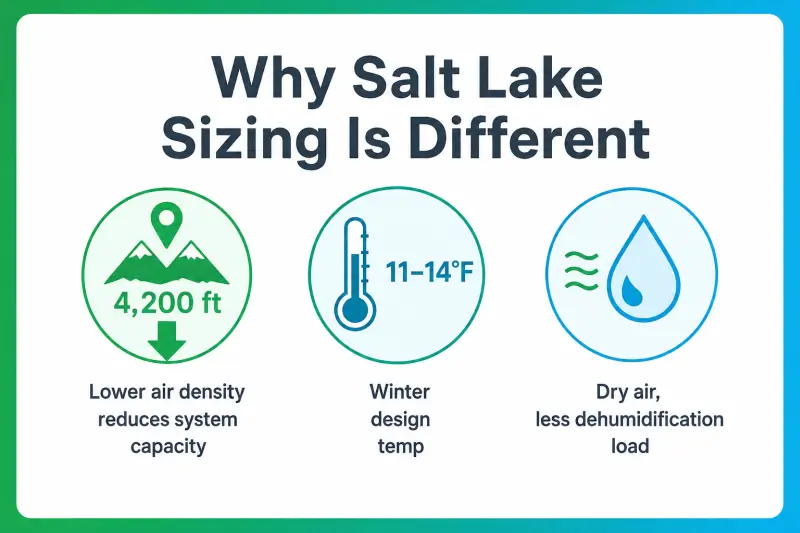
The 99% winter design temperature is 11–14°F at roughly 4,200 feet, and ACCA Manual J includes altitude correction factors for air density, so sea-level sizing understates what the system must deliver.
A mechanical permit and an electrical permit are both required, and skipping them triggers a red tag and double fees. Historic-district homes need a Certificate of Appropriateness first, which governs where the condenser can go.
A ductless mini split does not filter PM2.5, in a valley averaging five to six inversion episodes each winter. And budget two trades: removing a roof swamp cooler is roofing work your HVAC contractor probably will not do.
What Does a Mini Split Cost to Install in Salt Lake City?
Mini split installation in Salt Lake City runs about $3,800–$6,800 single-zone and $9,000–$13,500 multi-zone in 2026. Price moves with head count, capacity, cold-climate rating, and electrical work.
What each configuration costs. A single-zone system, meaning one indoor head, runs roughly $3,800 to $6,800 installed. That is the configuration for a finished Sugar House basement or a hot upstairs bedroom, and it is the most common ductless job in the valley. Two- and three-zone setups run about $9,000 to $12,000, which is what it takes to cover a main floor plus bedrooms in a home that never had ducts. Four or more zones run $12,000 to $13,500 and up, the whole-home figure for an Avenues or Capitol Hill house. These are Salt Lake Valley prices as published in 2026, and they are wide enough that three quotes will tell you more than any range can.
Equipment is the smaller half of that bill, and Filterbuy will use its own product to prove it. Our 12,000 BTU single-zone unit lists at $799 with free 2-day delivery on in-stock systems, which is unusual in a category that normally ships freight on a multi-week lead time. On a $5,000 Salt Lake job, the other $4,200 is labor, line set, electrical, and permits. Shopping brands barely moves your number. A second install quote moves it a lot. We’d rather you knew that than assumed our box was the expensive part. Our pricing guide breaks a quote into four comparable numbers.
To be clear about what we do and don’t make: Filterbuy builds single-zone systems only. If your Salt Lake home needs three or four heads, the multi-zone figures above are market pricing, and you’ll shop other brands for the equipment.
Raise the electrical question before you sign. The 12,000 BTU head runs off a standard 115V outlet, while 18,000 and 24,000 BTU units need a dedicated 230V circuit. In a pre-war home with a full panel, that circuit is its own quote. For rebates, see Utah mini split rebates and costs.
How Salt Lake City’s Altitude and Dry Climate Change the Sizing
Salt Lake City sits in IECC Climate Zone 5B, cool and dry, at roughly 4,200 feet. Both facts change how a mini split is sized. Thinner air carries less heat per cubic foot, so the same equipment delivers less capacity here than at sea level. Not guesswork: ACCA Manual J Table 10A publishes altitude correction factors for air density, and Manual S governs selection against the maker’s performance data.
The second number is design temperature. SLC International Airport carries a 99% winter design temperature of 14°F, ASHRAE data for the county lands nearer 11°F, and parts of the valley design colder. Heat pumps publish headline ratings at 47°F and deliver meaningfully less at 14°F.
Here is where we’ll talk ourselves out of a sale. Filterbuy sells a $799 single-zone system with free 2-day delivery on in-stock units and a 7-year compressor warranty, which is a strong value package for a garage, a workshop, a finished basement, or a room addition the furnace never reached. It is rated for reliable heating down to 5°F, so if a mini split is carrying the winter heating load for a room you actually live in, buy a unit built for deep cold from Mitsubishi, Daikin, or Fujitsu instead. Filterbuy is not affiliated with or endorsed by any of those brands.
So ask your installer something specific: show me the expanded performance data at my design temperature, corrected for elevation. Sizing from square footage skips both corrections. Our BTU sizing guide covers the room math, and the 2026 buying guide covers which units hold capacity in the cold. Then resist rounding up. Zone 5B’s dry summers mean the dehumidification load that drives oversizing elsewhere barely applies.
The Two-Season Filter Rule for Salt Lake City
A mini split helps your indoor air in summer and quietly hurts it in winter, and Salt Lake City is one of the few U.S. cities where both halves matter. We sell you both the mini split and the filter, so we gain nothing by hiding either half. Most pages on this topic are written by someone who sells only one of the two.
Summer: a net win. A swamp cooler pushes 100% outdoor air inside; a mini split recirculates room air. That matters during a July smoke event or a PM10 plume off the exposed Great Salt Lake lakebed, which winds above 25 mph carry into the county in under an hour.
Winter: a gap opens. When the mini split carries part of the heating load, your furnace cycles less. Whole-home filtration is a function of blower runtime, so the MERV 13 filter in your return does less work per day during the exact episodes when it matters most. Salt Lake City led the nation for poor air quality in January 2026. And because inversion pollution pools on the valley floor, check your neighborhood’s AQI, not the citywide average.
“The thing Salt Lake homeowners get wrong isn’t the filter they pick. It’s assuming the mini split made that filter optional. It didn’t. It just made the furnace run less, right when the valley air is at its worst.” Michelle Wan, Brand Manager and Air Quality Writer, Filterbuy
Before you step up a MERV rating, confirm your system can take it. EPA guidance notes that higher-MERV media restricts airflow, and that ducts and filter slots have to be sized for it. Check your HVAC manual or ask your technician. Our guide to how MERV ratings compare covers the trade-off.
What maintenance actually looks like here. Rinse the mini split’s mesh screens every two to four weeks through inversion and fire season, more often than the manual assumes, because it restores the airflow fine valley dust takes away. Replace your central HVAC filter every 60 to 90 days, and monthly during an inversion episode, since that filter is rated media and the mini split’s pre-filter is not. If you are stepping up to MERV 13, do it once before November and then simply maintain it, provided your system can handle the finer media. Filterbuy cuts MERV 8, 11, and 13 in its own U.S. plants, so these are production intervals rather than spec-sheet estimates. See how often to change a filter.
What Happens to the Swamp Cooler You’re Replacing
If you are pulling a roof-mounted swamp cooler, budget a second trade. This is the gap Filterbuy sees Salt Lake homeowners fall into most: the HVAC contractor installs the mini split and leaves the cooler where it sits, because removing it is roofing work. Taking the unit off leaves the plenum plus an opening through your roof deck, and closing that means patching sheathing, matching shingles, flashing the seam, and insulating behind it. That is why Utah roofers sell it as its own service.
Left as an afterthought, it becomes a slow attic leak two winters later, or a hole in your thermal envelope every heating hour of every inversion. Ask both contractors the same question: who closes the roof, and is it in this number?
Permits, Historic Districts, and Contractors in Salt Lake City
A new mini split in Salt Lake City requires a mechanical permit, and almost always an electrical permit for the circuit. Utah has adopted the 2021 International Mechanical Code, and the permit covers refrigerant work, the line-set penetration, and the circuit. Under state law the contractor pulls it and schedules inspections. Skipping it brings a red tag, double fees, and a Certificate of Non-Compliance that holds up your home sale.
In a local historic district, there is a step before the permit. The Avenues, Capitol Hill, Marmalade, Central City, and other H Historic Preservation Overlay properties need a Certificate of Appropriateness for exterior work, issued before the building permit completes. A condenser on a street-facing wall is exactly what that review covers, and Code 21A.34.020 sets the standards.
Where the condenser lands changes what the job costs, and that is the connection nobody makes out loud. We know where our own pre-charge ends because we publish it: 25 feet of line set, with a 50-foot maximum run on the 12,000 and 18,000 BTU units and 65 feet on the 24,000. If historic review pushes the condenser to the back of a deep lot instead of the near side wall, that run can pass 25 feet, and your installer has to add refrigerant and possibly longer line set. Modest as a line item, expensive as a surprise. Settle the location before accepting a quote, and mount the unit on a stand clearing typical snow.
How long the paperwork actually takes. Nobody publishes this, so here is the realistic sequence for a ductless AC install in an Avenues or Capitol Hill home:
Certificate of Appropriateness. Minor exterior alterations get administrative review by Planning staff; some are handled at the counter. Major work goes to the Historic Landmark Commission with a public hearing.
Mechanical and electrical permits, which cannot complete until the COA is issued. Salt Lake City routes minor work through a quick-turnaround queue in 1–3 business days, and state law caps plan review for a one- or two-family dwelling at 14 business days.
Install, four to eight hours for a single zone.
The install is the short part. Start in late winter if you want the system running by July.
If the house is a rental, the rules change. A Salt Lake owner-occupant can pull permits on their primary residence with an Owner/Builder Certification. On a rental or commercial property, state law requires a licensed contractor to pull the permit and do the work. No exceptions, and no DIY kit workaround. Landlords with older Avenues duplexes hit this constantly.
Three things to confirm about your mini split contractor before anyone drills:
An active S350 HVAC contractor license. Search “CONTRACTOR” in the Utah DOPL lookup. Rocky Mountain Power won’t pay a Wattsmart rebate on an unlicensed or DIY install. Filterbuy would sell more units without the restriction, but our systems require professional installation and the 7-year compressor / 3-year parts warranty is void if self-installed. We keep it that way for the same reason the utility does.
EPA Section 608 certification for whoever handles refrigerant.
A written Manual J using Salt Lake’s elevation and design temperature.
Supporting Statistics
Filterbuy does not have proprietary Salt Lake data to publish yet. Until we do, three federal findings back the arguments above, including one that cuts against the alarmed version of this story.
1. Salt Lake City spent 15 years in PM2.5 nonattainment, then exited it in 2025.
Designated nonattainment in 2009 for the 24-hour PM2.5 standard of 35 µg/m³
Reclassified Moderate to Serious in 2017
Redesignated to attainment November 19, 2025, after three clean years
Why it matters: the air is better than a decade ago, but a clean 24-hour average does not stop individual episodes
Sources: EPA, Federal Register · Utah DEQ
2. Evaporative coolers are used in just 2% of U.S. homes.
About half of those homes have no conventional AC at all
Non-ducted units are common in older homes where adding ductwork is difficult or expensive
Why it matters: it shows how unusual Salt Lake’s housing stock is, and why ductless AC beats a central retrofit in a swamp-cooled bungalow
3. Americans spend about 90% of their time indoors.
Indoor concentrations of some pollutants run 2 to 5 times higher than outdoors
Why it matters: closing up the house during an inversion is correct, and it makes your filter the dominant variable in the air you breathe
Frequently Asked Questions
Do Mini Splits Work in Salt Lake City Winters?
Yes, with a cold-climate rated model sized for the valley. The 99% winter design temperature is roughly 11–14°F, and heat pumps deliver less there than their headline rating suggests. Ask for the capacity table at that temperature, corrected for 4,200 feet.
Do I Need a Permit for a Mini Split in Salt Lake City?
Yes. A mechanical permit plus an electrical permit for the circuit, and pre-charged DIY kits are not exempt. In a local historic district, a Certificate of Appropriateness comes first.
Does a Mini Split Replace My Air Filter?
No, and Filterbuy sells both the mini split and the filter, so take it from us. The pre-filter protects the coil. Your whole-home filter does the work on the air. With ductwork you still need a properly sized pleated filter, changed more often than the label suggests in inversion season. See how mini splits affect indoor air quality.
Which Mini Split Is Best for a Salt Lake City Home?
The best mini split for a Salt Lake home depends on what job the unit is doing, and we’ll answer it against ourselves.
Supplemental cooling, a garage, a workshop, a finished basement, or a room addition. A value single-zone system fits here, ours included: $799 for the 12,000 BTU, which covers up to 550 sq ft, with free 2-day delivery on in-stock units and a 7-year compressor warranty.
Carrying the winter heating load for a room you live in. Buy a deep-cold unit from Mitsubishi, Daikin, or Fujitsu, none of whom we are affiliated with or endorsed by. Ours is rated to 5°F and the valley designs to 11–14°F.
Whole-home, three or four heads. Multi-zone, which Filterbuy does not make.
Whatever you pick, the deciding spec is capacity at your design temperature corrected for 4,200 feet, not the number on the box. Our 2026 buying guide compares the category.
How Much Does Mini Split Repair or Service Cost in Salt Lake City?
Published Salt Lake County AC repair figures span roughly $90 to $771 and are not ductless-specific, so treat them as a floor and ceiling rather than an estimate. Ask three things when you book: the diagnostic fee, whether the shop services your brand, and whether it will touch a system it did not install. That last one matters, because our warranty, like most in the category, applies only to professional installation.
Get the Filter Part Right Before Installation Day
The mini split is a comfort fix. Clean air is a separate job. Filterbuy air filters are manufactured in the USA, Utah included, and shipped factory-direct. Shop MERV 13 filters in 600+ sizes plus custom cuts, set up auto-delivery, or browse single-zone mini split systems with free 2-day delivery on in-stock units.
Glossary
Ductless mini split. A mini split heat pump: an outdoor compressor and wall-mounted indoor heads on refrigerant lines, heating and cooling without ducts.
Inversion. A winter pattern in which warm air caps the valley, trapping pollution near the ground and driving PM2.5 spikes.
MERV. Minimum Efficiency Reporting Value, a 1–16 scale of filter particulate capture, per ANSI/ASHRAE 52.2.
Manual J. The ACCA load calculation that sizes equipment from construction, design temperature, and elevation.
Certificate of Appropriateness. Planning Division approval for exterior changes in a local historic district, required before a building permit issues.
Filterbuy. A family-owned company founded in 2013 that manufactures pleated HVAC air filters in the USA, in 600+ sizes plus custom cuts, from plants including one in Utah. It also sells single-zone ductless mini split systems.