2026 Rebates, Real Costs, and the Filter Step Most People Skip
By Michelle Wan · Reviewed by David Clark, Licensed HVAC Technician · Published July 22, 2026 · Updated July 22, 2026
A single-zone mini split runs about $3,000–$6,000 installed in Utah, and Rocky Mountain Power’s Wattsmart Homes program pays $600 to $1,700 back. Your tier is set by the heat you are replacing, not by what the system costs. Because most Utah homes heat with gas, most projects land at $600.
The federal 25C tax credit expired December 31, 2025, so a 2026 install earns the utility rebate only. One line the quote will not mention: a mini split’s washable mesh screen carries no MERV rating, so the room it cools loses the filtration your central filter was giving it.
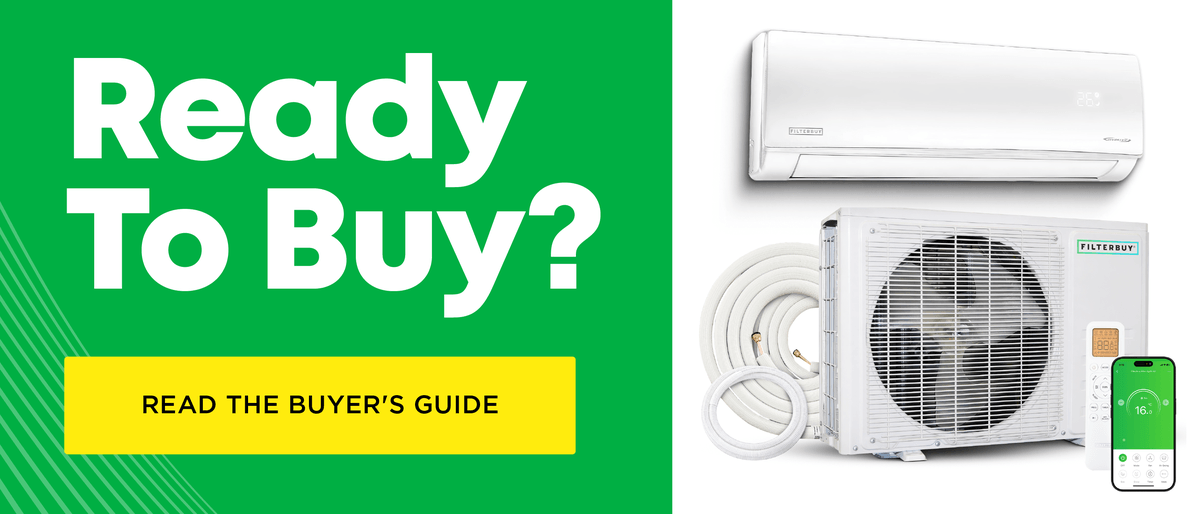
Not sure which unit fits the room, or which filter keeps working alongside it? Take the quick match quiz below, or browse Filterbuy’s ductless mini split systems.

Answer 3 quick questions and we’ll match you to your mini split and the right filter to pair with it.
Adding a mini split AC system in Utah costs roughly $3,000–$6,000 for a single-zone install and $6,500–$15,000+ for multi-zone. Rocky Mountain Power’s Wattsmart Homes program pays $600 to $1,700, set by what the mini split replaces rather than what it costs. The federal 25C credit expired December 31, 2025, so 2026 installs get utility rebates only. The step most homeowners skip: a mini split’s mesh screen is not a MERV-rated filter, so the room it cools loses the filtration your central system gave it.
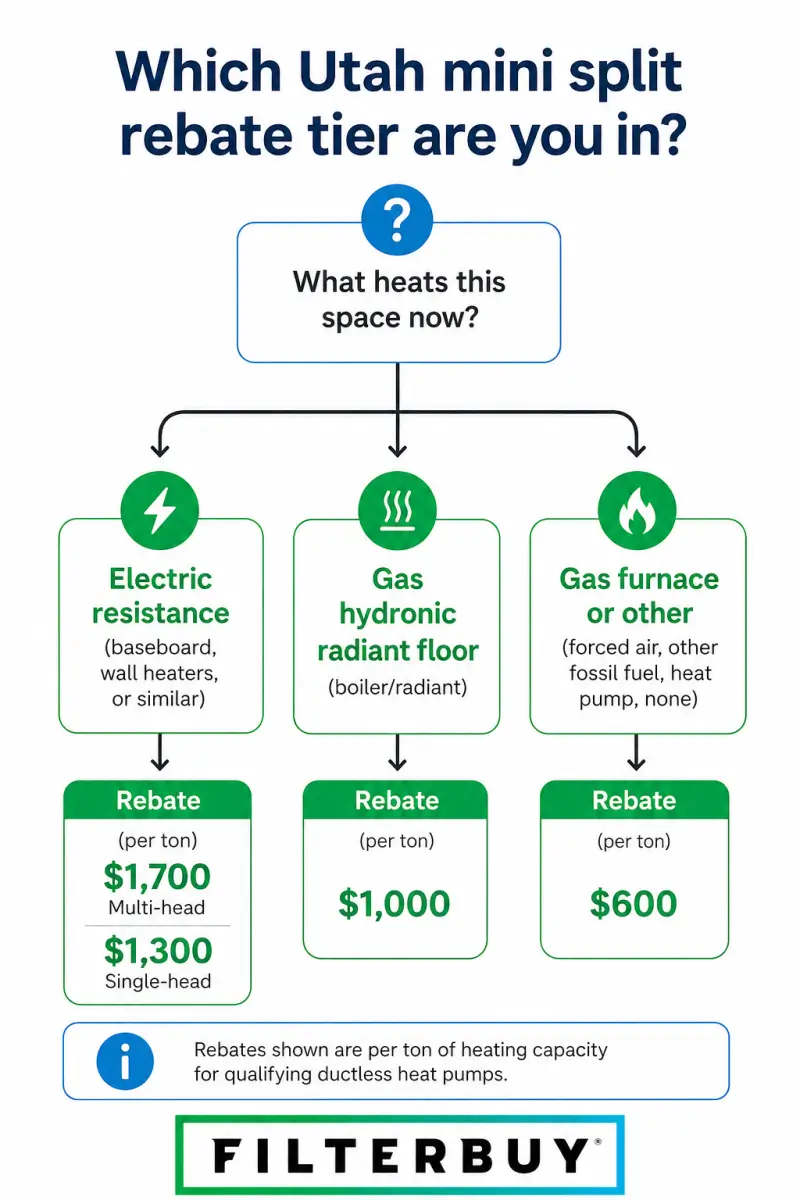
Rocky Mountain Power’s Wattsmart Homes rebate for a ductless mini split ranges from $600 to $1,700 in Utah, and the tier is set by the heat source you are replacing, not by system price.
Most Utah homes heat with gas, so most mini split projects land in the $600 supplemental tier. The $1,300 and $1,700 tiers require converting from electric resistance heat.
The federal Section 25C tax credit expired on December 31, 2025 under the One Big Beautiful Bill Act, so systems placed in service in 2026 earn no federal credit.
Wattsmart applications are due within 180 days of installation, and DIY installs are not eligible.
A ductless mini split filters lint and hair, not PM2.5. That is a real gap in a metro ranked 22nd worst in the nation for short-term particle pollution in "State of the Air" 2026.
Adding a mini split AC system in Utah runs about $3,000–$6,000 installed for single-zone and $6,500–$15,000+ for multi-zone, with each added head roughly $2,000–$7,000. Price moves with head count, capacity, cold-climate rating, and electrical work.
Cost ranges reflect Utah HVAC contractor pricing published in 2026. Confirm with a quote for your home.
Here is the split those quotes rarely show. Equipment is the smaller half: the Filterbuy 12,000 BTU single-zone unit lists at $799, with the 18,000 and 24,000 BTU units close behind. On a $4,500 job, roughly 80% of your money goes to labor, line set, electrical, and permits. Shopping brands barely moves the total. A second install quote does.
One line item worth asking about before you sign: the 12,000 BTU size can run off a standard 115V outlet, while the 18,000 and 24,000 BTU units need a dedicated 230V circuit. In an older Salt Lake bungalow with a full panel, adding that circuit is its own quote.
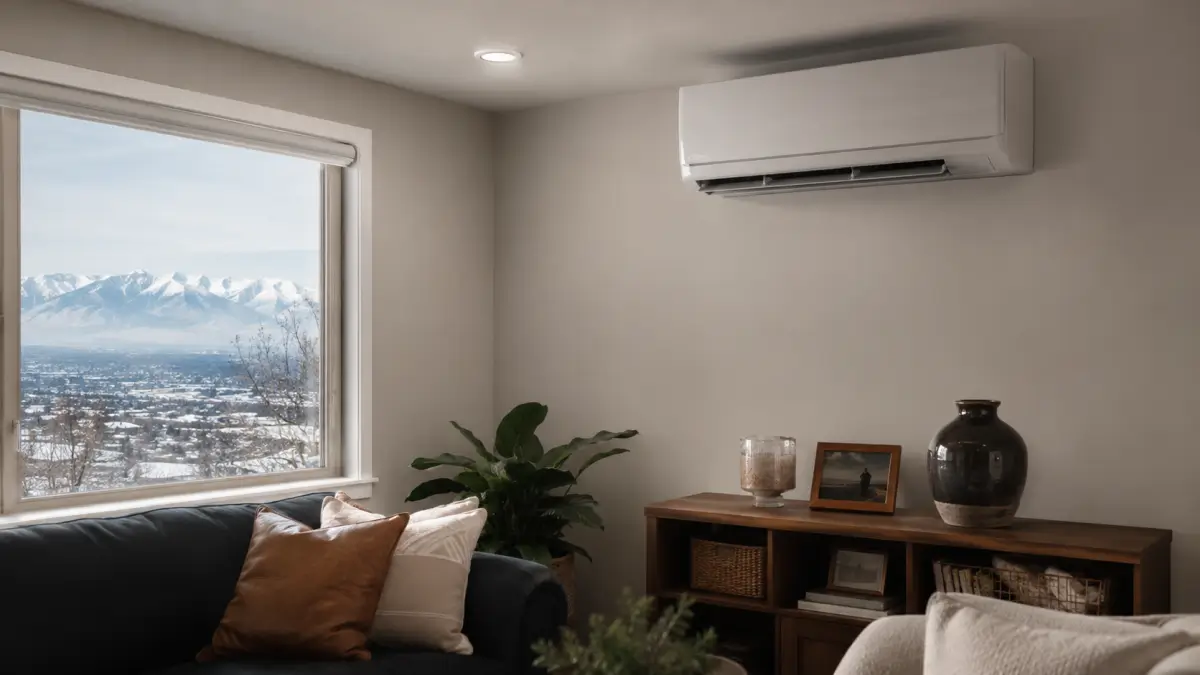
A ductless mini split is a heat pump: an outdoor compressor connected by refrigerant lines to one or more indoor heads. No ductwork, which is why it suits Utah’s older bungalows, walkout basements, and ADUs. Our buying guide covers BTU sizing room by room.
If your home already has ductwork and one room runs hot, a mini split may be an expensive fix for a cheap problem. DOE’s Building America Solution Center points out that duct losses disappear when the air handler and ducts sit inside the home’s thermal boundary. Sealing ducts, insulating them, or rebalancing a damper can solve a comfort complaint for a fraction of a $4,500 install.
Get a duct assessment before you get a mini split quote. If the ducts check out and the room is still miserable, the mini split is the right call. If they do not, you may have found a few hundred dollars of work that fixes the whole house instead of one room.
Rocky Mountain Power’s Wattsmart Homes program is the primary mini split rebate in Utah in 2026, paying $600 to $1,700 for a qualifying ductless heat pump. The rebate tier depends on what heating system the mini split replaces or supplements, as published on the program’s Utah ductless heat pump rebate page. Rocky Mountain Power revised these offerings effective February 27, 2026, adding a tier for homes with gas hydronic radiant floor heat.
Source: Rocky Mountain Power Wattsmart Homes, Utah ductless heat pump rebates, verified July 2026. Rebates follow the most recent tariff approved by the Utah Public Service Commission and can change with 45 days notice.
Enbridge Gas (formerly Dominion Energy) does not rebate a standalone mini split. ThermWise is a natural-gas program. It covers gas appliances, dual-fuel systems and weatherization work, but not a ductless heat pump by itself. Weatherizing the same room still stacks well: a tighter room needs a smaller, cheaper head.
The largest Wattsmart ductless rebates are conversion rebates, and conversion means leaving electric resistance heat behind. If a gas furnace heats your home, as in most Utah homes, a new mini split in a bonus room is supplemental, and that tier pays $600. Pages advertising "up to $2,000" quote the ceiling for heat pumps generally, not the ductless tier you will land in.
Three questions decide your tier:
What heats the space today? Electric baseboard, wall heaters, or an electric furnace serving at least 80% of conditioned space opens the $1,300–$1,700 tiers. Gas heat does not.
How many indoor heads? Under the conversion tiers, multi-head systems earn $1,700 and single-head systems earn $1,300.
Is the space fully conditioned living area? Garages do not qualify, and neither do manufactured homes or new construction.
Budget from your actual tier, not the headline. A $6,000 install planned around an imagined $2,000 rebate leaves a $1,400 hole when $600 arrives.
The federal Section 25C Energy Efficient Home Improvement Credit expired on December 31, 2025. The One Big Beautiful Bill Act (P.L. 119-21), signed July 4, 2025, terminated it for property placed in service after that date. A mini split installed in Utah in 2026 earns no federal tax credit. ENERGY STAR confirms the credits ran only through the end of 2025.
Installed and running on or before December 31, 2025? You can still claim it on your 2025 return using IRS Form 5695. Confirm your situation with a tax professional.
Confirm eligibility first. You must be a residential Rocky Mountain Power customer in Utah on rate schedule 1, 2, or 3, in an existing single-family home.
Hire a program-participating contractor. DIY installs are not eligible, and neither are used units.
Verify the equipment before purchase. The system must be listed in the AHRI Directory of Certified Product Performance and use an inverter-driven outdoor compressor with a variable-speed indoor blower.
Keep the itemized invoice. You will need your account number and a digital image of the contractor’s invoice.
Apply within 180 days of installation through the Wattsmart Homes portal. Approved rebates issue within 14 business days.
One caution before buying equipment yourself: the rebate follows the install, not the box. Filterbuy’s ductless mini split systems are AHRI certified at 17 SEER2 and the 12,000 BTU unit requires professional installation, but Wattsmart also sets an HSPF2 minimum. Confirm both with your installer first.
Order matters more than people expect. Wattsmart pays only when a program-participating contractor does the work, and that list is not every licensed HVAC company in Utah. Find your contractor before you buy equipment, not after. Filterbuy sells mini splits direct, and we would still tell you to make that call first: a $600 to $1,700 rebate is worth more than the convenience of ordering a box on a Tuesday.
A ductless mini split does not filter your air the way your central system does. The washable screens inside the indoor head are lint filters that protect the coil. They catch hair, dust, carpet fuzz. What they carry is no MERV rating at all, so they do not meaningfully capture PM2.5, the fine particles in wildfire smoke and Wasatch Front inversions.
That matters more in Utah than almost anywhere. The Salt Lake City–Provo–Orem metro area ranked 22nd worst in the nation for short-term particle pollution and 13th worst for ozone in the American Lung Association’s "State of the Air" 2026 findings for Utah. The pattern matters as much as the rank: Salt Lake County earned an F for daily spikes while passing on the year-round average. Utah’s problem is bad days, not bad years, and PM2.5 is what spikes.
We come at this from an odd angle. Filterbuy has built the filters that go inside HVAC systems in U.S. factories since 2013, and we now sell ductless mini splits too. We sell the thing that creates this gap and the thing that closes it, so here is the honest version.
"Every mini split we ship pulls the air your family breathes through a screen that was designed to protect a coil, not a person. The efficiency case for going ductless is real. The filtration trade-off is real too, and the spec sheet never mentions it."
Michelle Wan, Filterbuy
Two things change the day a mini split goes in:
The room gets its own recirculation loop. That air now cycles through a lint screen instead of your furnace’s pleated filter.
Your central blower runs less. Whole-home filtration is a function of runtime. When a mini split carries part of the load, the furnace cycles less often and the MERV-rated filter in your return does less work per day.
Neither is a reason to skip the mini split. Both are reasons to treat filtration as part of the project. Unsure which rating your system handles? See how the MERV ratings compare, and check today’s Salt Lake City AQI before opening windows.
One ownership cost that rarely comes up at the quote stage: because the screens filter so little, dust and moisture collect on the blower wheel inside the indoor head. DOE’s guide recommends a professional deep clean every one to three years and warns it is not a do-it-yourself job. Budget for it the way you would budget for a furnace tune-up.
Cleaning intervals reflect typical ductless manufacturer guidance. Check the owner's manual for your model.
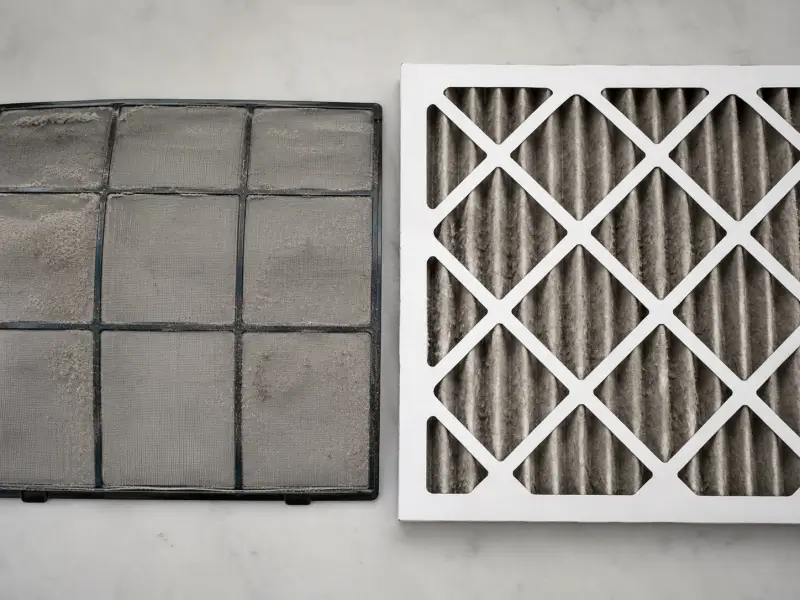
No. A mini split has washable mesh screens built to protect the coil inside it, not MERV-rated media that cleans your air. If your home has ductwork, you still need a properly sized pleated filter changed on schedule.
No. Wattsmart Homes excludes do-it-yourself installations. A program-participating contractor must complete the work for the rebate to be paid.
Yes, with a cold-climate rated model, but read the capacity table rather than the headline rating. Filterbuy’s ductless units heat down to 5°F, and plenty of Utah valleys design colder than that. DOE guidance calls for cold-climate sizing methods in climate zone 4 and higher, and Utah sits well above that line. Ask your installer what the unit actually produces at your design temperature.
No. Wattsmart requires installation in fully conditioned living space, and garages are specifically excluded.
Yes, in many cases. Rocky Mountain Power extends Wattsmart Homes eligibility to landlords who own Utah rental properties where the tenant is billed on rate schedule 1, 2, or 3. Rebate checks are issued in the name of the Rocky Mountain Power account holder, so sort out who receives the money before the work starts.
Most single-zone installs run four to eight hours, so a straightforward job is a same-day job. The contractor mounts the indoor head, sets the outdoor unit, runs the line set through a small wall penetration, pressure-tests, then commissions the system before leaving.
One unit per home under the ductless measure. Contact the Wattsmart Homes program before applying for two or more, because extra documentation is required.
Filterbuy has been making filters in the U.S. since 2013, and we have watched plenty of homeowners get blindsided by an HVAC quote. These are the pages we open ourselves before spending a few thousand dollars. Every one was checked and working on July 22, 2026.
Source: Rocky Mountain Power, Wattsmart Homes ductless heat pump rebates
This is where Rocky Mountain Power lists the real numbers: the $600 to $1,700 tiers, the equipment specs, and the 180 days you get to apply. Start here, because the tier you land in shapes your whole budget.
Source: Enbridge Gas, ThermWise weatherization rebates
ThermWise won’t pay for the mini split, but it helps cover insulation, air sealing, and duct work. Tighten up the room first and you might get away with a smaller unit, which costs less to buy and less to run.
Source: ENERGY STAR, Federal tax credits for energy efficiency
ENERGY STAR says it plainly: the Section 25C credits ended December 31, 2025. Plenty of HVAC pages still advertise that 30% credit, so it’s worth ten seconds before you build it into your numbers.
Source: DSIRE, Database of State Incentives for Renewables and Efficiency
DSIRE, run by the N.C. Clean Energy Technology Center at N.C. State University, tracks every incentive in the country by state and program. It’s the quickest way to catch a city or co-op offer that neither big utility bothers to advertise.
Source: AHRI, Directory of Certified Product Performance
Wattsmart wants your exact model listed with AHRI at 8.1 HSPF2 / 16 SEER2 or better. A strong SEER2 number won’t save you if the HSPF2 falls short, so look up the model number before you order anything.
Source: Utah Division of Professional Licensing, Licensee Lookup
Search CONTRACTOR and confirm an active S350 HVAC license before anyone drills a hole in your wall. Wattsmart won’t pay out on a DIY or unlicensed install, and in Utah unlicensed contracting is an offense.
Source: American Lung Association, State of the Air 2026 Utah findings
Salt Lake County earns an F for short-term particle spikes but passes on the year-round average. That’s Utah air in a nutshell: a handful of rough days each winter and fire season, and those are exactly the days your filter earns its keep.
The research behind this page, in three numbers.
Gas heat makes a new mini split supplemental, not a conversion.
That drops most Utah projects into the $600 tier, not $1,700.
Source: U.S. Energy Information Administration, Utah State Energy Profile
Going ductless skips that loss. That is the efficiency win.
It also skips the filtration. DOE rates ductless mesh filters as very low particulate capture.
Source: DOE Building America Solution Center (PNNL), Ductless (Mini-Split) Heat Pumps
Indoor air can be dirtier than the air outside a major city.
So the filter in your system matters more than the number on the AQI map.
Source: U.S. Environmental Protection Agency, The Inside Story
Ductless mini split. A heat pump with an outdoor compressor and one or more wall-mounted indoor heads, connected by refrigerant lines, that heats and cools without ductwork.
Wattsmart Homes. Rocky Mountain Power’s residential efficiency rebate program for Utah customers on rate schedules 1, 2, and 3.
ThermWise. Enbridge Gas Utah’s (formerly Dominion Energy) natural gas efficiency rebate program, covering gas appliances and weatherization.
Section 25C. The federal Energy Efficient Home Improvement Credit, which expired for property placed in service after December 31, 2025.
SEER2. Seasonal Energy Efficiency Ratio 2, the federal test standard for cooling efficiency. Higher is more efficient.
HSPF2. Heating Seasonal Performance Factor 2, the federal test standard for heat pump heating efficiency. Higher is more efficient.
MERV. Minimum Efficiency Reporting Value, a 1–16 scale of how much airborne particulate a filter captures. MERV 13 captures a meaningful share of fine particles.
PM2.5. Fine particulate matter 2.5 micrometers or smaller, the pollutant that spikes during Utah inversions and wildfire smoke.
Inversion. A winter pattern in which a warm air layer traps cold air and pollution in the valleys, driving PM2.5 spikes along the Wasatch Front.
AHRI Certified Directory. The industry database of certified HVAC performance ratings. Wattsmart requires ductless systems to be listed in it.
Filterbuy. A U.S. air filter manufacturer making pleated HVAC filters in 600+ sizes plus custom cuts, shipped factory-direct with optional auto-delivery, and now selling single-zone ductless mini split systems.
A mini split solves a comfort problem. Clean air is a separate job, and the one Filterbuy has done from U.S. factories since 2013. In inversion and smoke season, check your filter monthly instead of every 90 days.
Shop MERV 13 filters in 600+ sizes plus custom cuts, made in the USA and shipped free, factory-direct. Or set up auto-delivery and a fresh one arrives on schedule.