
Mini Split AC In Austin, TX
Installation, Costs & Filter Guide (TX Climate)
Author: Michelle Wan, Brand Manager and Air Quality Writer · Reviewer: David Clark, Licensed HVAC Technician, Filterbuy HVAC Solutions
Published: August 7, 2026 · Updated: August 7, 2026
A ductless mini split installed in Austin runs $3,000 to $5,000 for a single zone, or $6,500 to $14,500 for multi-zone. The equipment is a smaller share of that than most people expect. Filterbuy systems start at $799, and the rest of the quote is labor, electrical, and permits.
Size comes first, because BTU is what the space needs, not what the budget allows. Match your room to a system:
- 12,000 BTU covers up to 550 sq ft. Bedrooms, studios, small living rooms. Available in 115V or 230V. $799
- 18,000 BTU covers up to 850 sq ft. Large living rooms and open plans. 230V. $899
- 24,000 BTU covers up to 1,200 sq ft. Large open areas and combined spaces. 230V. $1,349

Answer 3 quick questions and we will match you to the right mini split size.
Prefer to browse? All three sizes are variable speed, heat and cool year round, and ship free in 2 days.
Systems ship direct to your door. Installation is handled by a licensed Texas contractor of your choice.
TL;DR
A ductless mini split is a heat pump system that pairs one outdoor compressor with one or more indoor heads, delivering cooling and heating without ductwork. In Austin, a single-zone install runs $3,000 to $5,000 and multi-zone systems $6,500 to $14,500. The federal 25C tax credit expired December 31, 2025, leaving Austin Energy’s $600 to $950 rebate as the only incentive, and it covers replacements only. The filter inside the head is washable mesh, not an allergen filter, so cedar season still needs a MERV 13 on your central return.
KEY TAKEAWAYS
Single-zone mini split installation in Austin runs about $3,000–$5,000. The Austin-area average sits near $2,943, with most homeowners paying $1,962–$4,905 (Angi, 2026).
The federal 25C tax credit is gone. It expired December 31, 2025 under the One Big Beautiful Bill Act. Systems installed in 2026 do not qualify.
Austin Energy pays $600 to $950 on a qualifying mini split. The catch: it covers replacements only, and the old system has to be at least 10 years old. A new head in a garage or ADU does not qualify. That is the trap we watch Austin homeowners walk into.
Mini split filters are washable mesh, not disposable pleats. Clean them every 2–4 weeks, roughly six times more often than a central system filter.
That mesh is the floor for your air quality, not the ceiling. After a decade of building filters, this is the single thing we most often have to correct: it will not stop cedar pollen fragments or wildfire PM2.5.
Two ownership costs nobody quotes you: ductless units dehumidify worse than ducted ones, which matters in Zone 2A, and wall-mounted heads need a professional deep clean every one to three years in a climate like ours.
A ductless mini split is a heat pump system that pairs one outdoor compressor with one or more indoor heads mounted on a wall, floor, or ceiling, delivering both cooling and heating without ductwork. In Austin, TX, a single-zone install typically runs $3,000–$5,000 and multi-zone systems $6,500–$14,500. Austin Energy rebates now carry the savings, because the federal 25C credit expired at the end of 2025.
Where this guide comes from. Filterbuy is a third-generation, family-owned American manufacturer that has built air filters in the United States since 2013, in our own plants in Alabama, Florida, Pennsylvania, and Utah. Filterbuy HVAC Solutions is our licensed HVAC contracting business, and Filterbuy also builds and ships its own line of ductless mini split systems. Three vantage points on one decision, and they rarely sit together: the quote a homeowner is handed, the equipment that goes on the wall, and the filter that comes out of the return six months later. Everything below is written from there, and where our experience contradicts the standard advice, we say so plainly.
How Much Does Mini Split Installation Cost In Austin, TX In 2026?
A single-zone mini split installed in Austin costs $3,000–$5,000. Multi-zone systems run $6,500–$14,500 depending on head count. Angi's 2026 Austin cost data puts the local average at $2,943, with a typical range of $1,962–$4,905, lower than the headline range because it includes simple garage and bonus-room jobs. Labor alone runs $500–$2,000 per zone. For national context, see our full mini split installation cost breakdown.
Ranges cover equipment, line set, mounting, refrigerant charge, and labor. Electrical upgrades run an additional $445–$1,845.
Three Austin-specific line items push quotes upward. Electrical is the big one: older homes east of I-35 and in Travis Heights often need a dedicated circuit or panel upgrade, adding $445–$1,845. Limestone and stone veneer exteriors slow the line-set penetration. And 2026 equipment uses low-GWP R-454B or R-32 refrigerant, which raised prices across every brand.
One way around the electrical line item. Most mini splits need a dedicated 208/230V circuit, which is exactly what triggers that panel-upgrade cost in an older Central Texas house. Some units run on standard 115V household power instead, including the 115V models Filterbuy builds. If your garage or bonus room already has a usable outlet circuit, a 115V unit can remove an entire trade from the job. Confirm the circuit is dedicated and correctly sized before anyone counts the savings.
One planning note: if you may want a second zone later, spec the outdoor unit for it now. Planning two zones upfront typically saves $1,200–$2,000 over adding a head later. Our guide to choosing a mini split system covers BTU sizing and zone count.
What Rebates Apply To An Austin Mini Split In 2026?
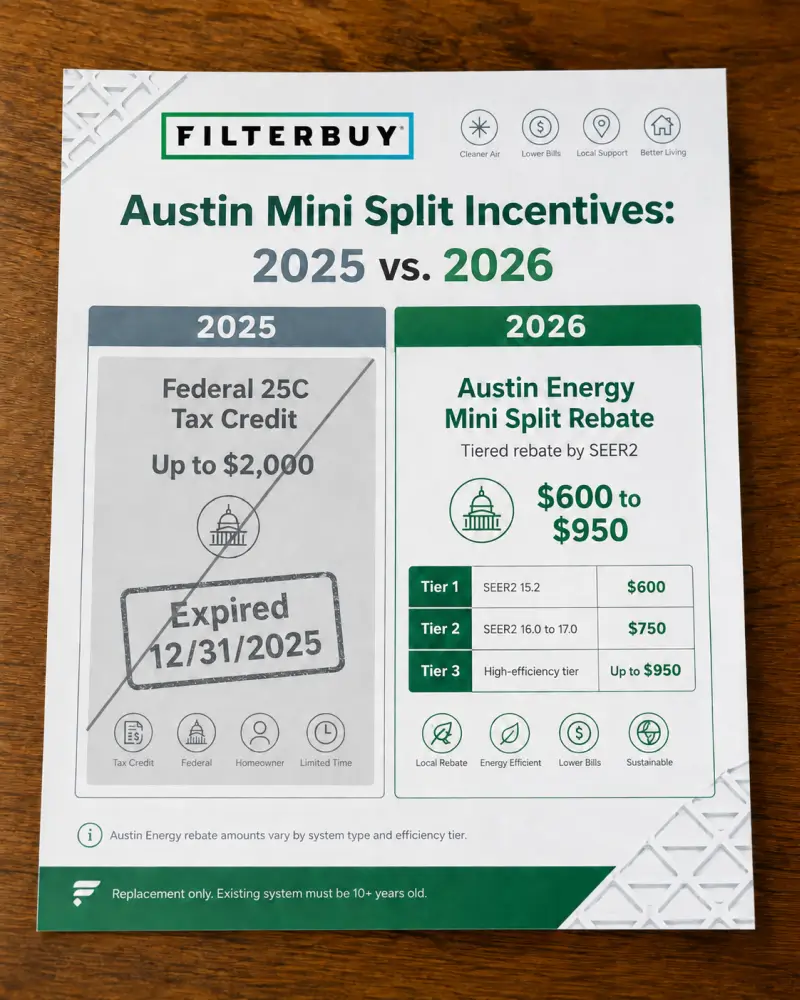
There is no federal tax credit for a mini split installed in 2026. The Section 25C Energy Efficient Home Improvement Credit, which offered up to $2,000 toward a qualifying heat pump, expired December 31, 2025 under the One Big Beautiful Bill Act (P.L. 119-21). The IRS Energy Efficient Home Improvement Credit page states plainly that the credit applies only to property placed in service before December 31, 2025. If a page tells you that you can still claim 30% back from the IRS this year, it is out of date. Texas also has no state income tax, so no state credit is possible.
What remains is a tiered utility rebate. Austin Energy pays $600 to $950 on a qualifying mini split, with the exact amount set by efficiency tier and by whether the system is cooling-only or a heat pump:
Austin Energy tiers as published February 24, 2026. Each tier also carries an EER2 minimum. Funding is first-come, first-served and amounts change by cycle, so confirm on the Austin Energy rebate page before you sign a contract.
The eligibility rules matter more than the dollar figure, and this is where most Austin homeowners get surprised:
Replacement only. The rebate covers replacing existing equipment. A brand-new mini split in a garage, ADU, or addition that never had a system does not qualify.
Ten-year rule. The system you are replacing must be at least 10 years old, and your home must be at least 10 years old.
Participating contractor required. Your installer must be on Austin Energy’s participating contractor list, and they submit the application on your behalf within 90 days of installation.
Documented sizing. You must attach proof that the equipment was sized to ACCA Manual J or to Austin Energy’s own Air Conditioning Sizing Guidance. This is a rebate condition, not a suggestion.
Permits in place. All required City of Austin permits must be pulled, and you must agree to a post-installation inspection.
Stackable. Enroll in Home Energy Savings within six months of your AC rebate and you can earn an additional $200, plus access to 0% financing on whole-home work.
Our take on that first rule. Read the replacement-only condition against the reason most Austin homeowners call us about a mini split in the first place, and the two do not line up. The jobs we see are garage conversions, backyard offices, ADUs, and bonus rooms over the garage. Those are spaces that never had a system, which means they are the exact projects the rebate excludes. We would rather you learn that here than after you have already budgeted the $800 into the job. If your project is a replacement, chase the rebate and pick equipment by tier. If it is new conditioned space, take the rebate off the table, stop shopping for SEER2 you do not need, and put the money into correct sizing and a clean install instead.
Outside Austin Energy territory, in Pflugerville, parts of Cedar Park, or PEC-served areas in the Hill Country, the numbers differ. Our Texas mini split rebate guide breaks the incentives down utility by utility.
How Do You Size A Mini Split For Austin’s Climate?
Austin sits in IECC Climate Zone 2A, hot and humid, so sizing has to solve for moisture removal, not just peak heat. Per KXAN’s analysis of Camp Mabry records, Austin averaged 29 days per year at 100°F or above between 1991 and 2020, and 2023 delivered more than 60. Winters are mild, and that mild January profile is exactly why a heat pump works here without a backup furnace.
The mistake local homeowners make is going bigger, and it is the correction our technicians make more than any other in hot, humid markets. An oversized mini split hits setpoint fast, shuts off, and never runs long enough to pull humidity out of the air, leaving a room that is 72°F and clammy. Right-sizing gets you the best dehumidification the equipment is capable of. Whether that is enough is a separate question, and one the next section takes up.
“A unit that cools the room in ten minutes feels impressive on install day. That is the one everybody wants to buy. By August the same customer is calling us about a room that is cold and sticky, and the fix is not a bigger unit, it is the right one.”
David Clark, Licensed HVAC Technician, Filterbuy HVAC Solutions
Ask for a Manual J load calculation in writing. A contractor sizing by square footage alone is guessing about your attic insulation, west-facing glass, and ceiling height. Austin Energy requires documented Manual J sizing (or its own Air Conditioning Sizing Guidance) as a rebate condition, so you should be getting this paperwork regardless. On equipment, our review of the most reliable mini split brands ranks Daikin first for Texas heat and Gulf Coast humidity, with Mitsubishi a close second on dehumidification.
How Do You Choose A Mini Split Contractor In Austin?
Verify the license, the permit, and the rebate status before you compare prices. Texas HVAC contractors are licensed by the Texas Department of Licensing and Regulation under an Air Conditioning and Refrigeration (ACR) license, typically a TACLA or TACLB class held by the company rather than each technician. The number is searchable free, and any legitimate contractor will give it to you without hesitation.
Run this checklist on every bid:
TDLR ACR license number, verified on the TDLR license verification search, not just "licensed and insured" on a truck.
Mechanical permit pulled by the contractor, not by you. Unpermitted work can complicate a future home sale.
Austin Energy participating contractor status, if you want the rebate.
Written Manual J, with the load calculation attached to the quote.
Line-item quote: equipment model numbers, labor, electrical, permit fee, and warranty terms broken out separately.
Warranty registration handled for you. Most manufacturers require it within 60–90 days or the parts warranty drops from 10 or 12 years to 5.
Get three bids. A quote that comes in dramatically low usually means an undersized unit, a skipped permit, or an unregistered warranty.
For a benchmark, that checklist is how Filterbuy HVAC Solutions runs its own installs: licensed direct-employee technicians rather than subcontracted crews, line-item estimates, and warranty registration handled in-house. You do not have to hire us to hold an Austin contractor to the same standard. Print the list and work down it.
Where to actually find one. Austin Energy publishes a searchable directory of its participating contractors, and it is the practical starting point for most Austin homeowners because those are the only companies that can file your rebate. Open the Find a Contractor tab on the Austin Energy rebate page, pull three names, and run each through the TDLR license search before you call. Austin Energy recommends getting at least three estimates, and so do we.
What The Brochures Leave Out About Owning A Mini Split In Austin
Four things shape the ownership experience in a hot-humid climate, and none of them appear in a sales brochure. Each is documented in the U.S. Department of Energy’s Building America Solution Center. We are raising them because Austin is where they bite hardest.
1. Ask For The SHR Number, Not Just The SEER2
Ductless systems dehumidify less effectively than ducted ones, and the most efficient models are often the worst at it. DOE’s guidance is explicit: ductless units tend to provide poorer dehumidification in cooling mode, and newer high-efficiency units tend to have higher sensible heat ratios, which means worse moisture removal. Sensible heat ratio, or SHR, is the number that captures this. Lower is better.
In Climate Zone 2A this matters more than the SEER2 figure on the sticker. Ask your contractor for the SHR from the manufacturer’s expanded performance table, not the AHRI certificate. If it is high and the space runs humid, budget for a dehumidifier in the same conversation rather than discovering the gap in July.
2. Budget For A Professional Deep Clean Every One To Three Years
Wall-mounted heads collect moisture on the blower wheel during cooling, and dust sticks to what is wet. DOE documents dust and mold accumulation on the blower wheel as a common outcome of this design, and recommends a deep clean every one to three years, with humid climates and heavy use at the short end of that range. Austin is both.
This is not a filter change. It means disassembling the casing, pulling the blower wheel, and using a foaming sprayer and a mini split bib, which is why it is a technician visit rather than a Saturday. Almost nobody raises it at the point of sale. It belongs in your ownership budget from day one, and it is a genuine argument for ceiling cassettes or floor consoles, which are less prone to the problem than high wall units.
3. On Multi-Zone Systems, Switching Heads Off Can Cost You Money
This one is counterintuitive. On a multi-split, shutting down indoor units can drop the load below the outdoor unit’s minimum capacity, forcing it to cycle and burn more energy rather than less. Setting one head to heat while another is set to cool is worse: some systems will flip the outdoor unit between modes, with severe efficiency losses. If you expect to run zones independently much of the time, two smaller outdoor units usually beat one large one.
4. When A Mini Split Is The Wrong Call
We sell mini splits and we sell the filters that go in them, so treat this list as the part we have least incentive to write:
Your ducts are intact and one room just gets weak airflow. A duct repair, a damper adjustment, or sealing is far cheaper than a new system.
Whole-home humidity is the actual complaint. A right-sized central system paired with a dehumidifier will usually beat a set of ductless heads in Zone 2A.
Your central system is over 10 years old and struggling. Replacing it can qualify for the Austin Energy rebate. Adding a mini split alongside it cannot.
You are adding one head and expecting cleaner air throughout the house. That is a filtration project, not an equipment project, and it costs a fraction as much.
Cedar Fever, Wildfire Smoke, And What Your Mini Split Filter Actually Does
This is the part most mini split guides get wrong: the filter in your mini split head is a washable mesh screen built to protect the coil, not to clean your air. It performs at roughly a MERV 4 equivalent. It catches hair, lint, and visible dust. It does not meaningfully capture the fine particles Austin homes actually deal with.
That matters here more than almost anywhere. Austin sits at the eastern edge of the Hill Country, where Ashe juniper makes up about a third of the tree canopy, roughly 12 trees per resident. The Texas A&M Forest Service notes that cedar fever is worst west of I-35 and that the pollen itself is not unusually allergenic, it is simply so concentrated that it overwhelms the immune system. On a bad cedar day, Austin pollen counts run 10,000–12,000 grains per cubic meter, and the worst years have topped 20,000. A bad oak day is about 800. The pollen releases in bursts after cold fronts, which is why symptoms spike overnight in January.
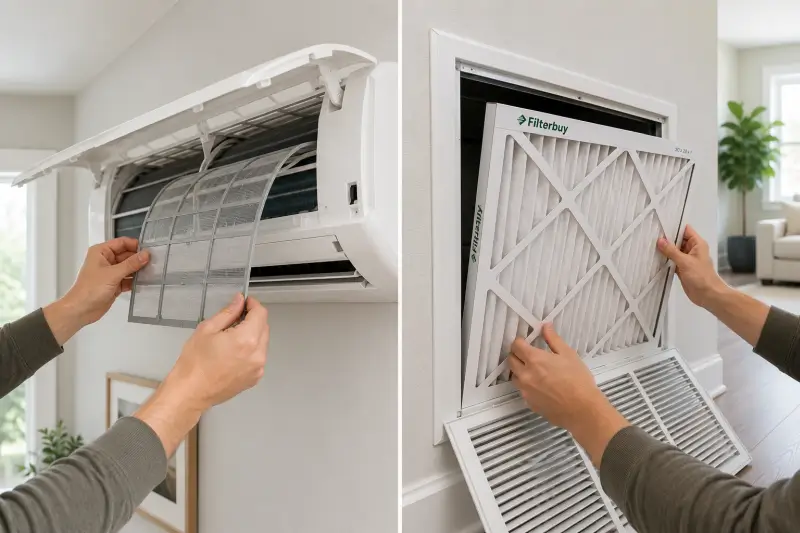
Never force a pleated MERV 13 filter into a ductless head. Low-static blower wheels cannot pull air through dense media.
Do not try to force a pleated MERV 13 filter into a mini split head. Ductless units use low-static blower wheels. Dense pleated media restricts airflow enough to freeze the evaporator coil, spike your energy use, and shorten the fan motor’s life. Clean the mesh on schedule instead, and add filtration elsewhere. Here is how to clean a mini split filter. Our mini split maintenance schedule covers the coil, drain line, and annual professional service too.
Here is the approach we actually recommend to Austin customers. Most homes here run a mini split alongside a central system, with the ductless head serving a garage conversion, ADU, or west-facing bonus room. Your central filter is doing the real air-quality work. For cedar season and summer wildfire smoke, a MERV 13 filter in the central return, changed on schedule, is the single highest-leverage move you can make. Filterbuy makes MERV 8, MERV 11, MERV 13, and carbon-lined Odor Eliminator filters in over 600 standard sizes, cuts custom sizes when yours is not one of them, and ships factory-direct with no middleman markup. Auto-delivery means the January filter shows up before cedar season does, not after.
“The mini split questions we get out of Austin almost never start with the filter. They start in January, when someone finally connects the ductless head in the bonus room to the fact that they still feel awful indoors. The head is not broken. It is doing exactly what it was built to do, and filtering your air was never on that list.”
Michelle Wan, Brand Manager and Air Quality Writer, Filterbuy
Austin’s Three Filtration Seasons
Cedar pollen releases in bursts after cold fronts, so replace before the season starts rather than reacting to symptoms.
Supporting Statistics
Three findings from federal sources underpin the advice on this page:
Sources: basc.pnnl.gov/resource-guides/ductless-mini-split-heat-pumps | epa.gov/report-environment/indoor-air-quality | epa.gov/wildfire-smoke-course/preparing-smoke-and-heat
Frequently Asked Questions
Is a mini split worth it in Austin’s heat?
Yes, particularly for spaces your ducts serve poorly: garages, additions, ADUs, and west-facing rooms. Inverter mini splits hold temperature through 100°F afternoons without short-cycling, and they add no duct losses.
How often should I clean my mini split filter in Austin?
Every two weeks during cedar season and peak summer, every four weeks otherwise. Do not borrow your 90-day central-system schedule; a mini split needs attention roughly six times more often.
Does a mini split help with cedar fever?
Only indirectly. It keeps windows closed and recirculates indoor air, which helps, but the mesh filter is not an allergen filter. Pair it with a MERV 11–13 filter on your central system and a portable HEPA unit in the bedroom.
Do I still need a permit for a mini split in Austin?
Yes. Mini split installation is permitted mechanical work in the City of Austin, and Austin Energy makes permits a rebate condition. Your contractor pulls it, and it should be a line item on your quote.
Ready to breathe easier? Whatever system you install, the filter is what stands between your family and Austin’s air. Find your exact filter size and set up auto-delivery so cedar season never catches you with a three-month-old filter. That is what Better Air For All™ means at the level of one house in Austin: the right filter, the right size, showing up before you need it.
ABOUT THE AUTHOR AND REVIEWER
Michelle Wan is Brand Manager and Air Quality Writer at Filterbuy, where she translates MERV ratings, filtration, and HVAC efficiency into plain-English advice for homeowners. She works directly with Filterbuy’s U.S. manufacturing team across plants in Alabama, Florida, Pennsylvania, and Utah, so her writing is based on how filters are built, tested, and used in real homes rather than on spec sheets. B.A., University of California, Santa Cruz.
David Clark is a Licensed HVAC Technician and heads Filterbuy HVAC Solutions, the company’s residential HVAC and indoor air quality contracting business. He reviewed the equipment, sizing, refrigerant, and installation guidance on this page.
About Filterbuy. Filterbuy is a third-generation, family-owned American manufacturer of residential and commercial air filters, employing over 1,000 people and serving more than two million households. We make MERV 8, 11, and 13 pleated filters and carbon-lined Odor Eliminators in 600+ standard sizes plus made-to-order custom sizes, and ship them factory-direct with free shipping. Filterbuy HVAC Solutions extends that work into installation, repair, maintenance, ductwork, and air quality services.
Glossary: mini split and filtration terms
Every term below appears somewhere on this page or in Austin Energy rebate paperwork. If a contractor uses one you do not recognise, ask them to point at it here.
Terms are defined as used on this page and in Austin Energy rebate paperwork. Manufacturer literature sometimes uses SEER and HSPF, the pre-2023 ratings, which are not directly comparable to SEER2 and HSPF2.