2026 Rebates, Costs, and the Rule That Disqualifies Most Homeowners
By Michelle Wan for Filterbuy · Reviewed by David Clark, Licensed HVAC Technician · Published July 17, 2026 · Updated July 17, 2026
Whether North Carolina helps pay for your mini split comes down to one question: is it replacing your main system, or adding to it? Energy Saver NC pays up to $8,000 toward a heat pump, and a ductless mini split is a heat pump. But that rebate only applies when the system becomes your home's primary heating and cooling. Most people add one to fix a single hot room while the central system keeps running, and the program calls that supplemental and excludes it.

Not sure which side you land on? Answer 3 quick questions and we'll match you to the right mini split for your space.
Prefer to browse? Shop Filterbuy mini split systems in 12,000, 18,000, and 24,000 BTU.
North Carolina offers up to $8,000 toward a heat pump through Energy Saver NC, and a ductless mini split is a heat pump. But the rebate only applies when that mini split becomes your home's primary heating and cooling system, and most people add one to fix a single room the central system can't reach, which the program classifies as supplemental and excludes. The federal 25C tax credit ended January 1, 2026, though the program's insulation and air sealing rebate is a separate door worth up to $1,600 that isn't tied to the heat pump. Before you shop, answer one question: is this mini split replacing your main system, or adding to it?
Energy Saver NC pays up to $8,000 for an ENERGY STAR heat pump, including ductless mini splits, for households at or below 150% of Area Median Income.
A mini split added to supplement an existing electric system is not eligible for the HEAR heat pump rebate. The program requirements exclude it explicitly.
Replacing an existing heat pump is not eligible either, whether it's broken or working fine.
The federal Section 25C tax credit was repealed effective December 31, 2025. There is no federal tax credit for a mini split installed in 2026.
The state rebate is an instant discount applied by a Registered Contractor, not a check you claim later, which means the equipment and labor both have to run through that contractor's invoice.
Excluded from the heat pump rebate? The insulation and air sealing for that same room may still qualify for up to $1,600. That category is not tied to the heat pump.
Every other guide starts with the program. Start with your room instead, because the reason you're adding the mini split is what decides your rebate, before income or equipment ever enters the picture. Every row below traces to one document: the Energy Saver NC Program Requirements (PDF, Ver 1.03), pages 6 and 11.
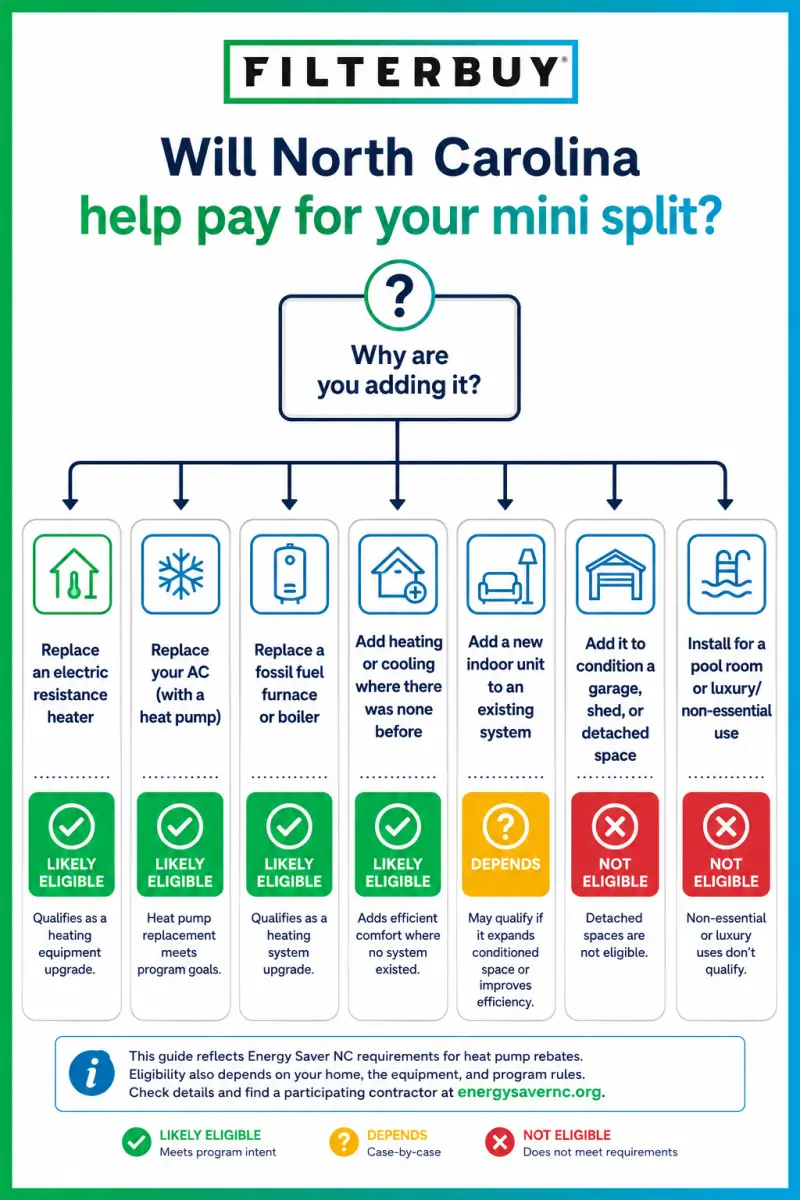
Filterbuy analysis of the Energy Saver North Carolina Program Requirements, Ver 1.03, May 2025, pp. 6 and 11. Income limits and Registered Contractor requirements apply on top of these rules. Confirm your project with a Registered Contractor before you buy.
If you landed on a red row, don't close the tab. Being excluded from the heat pump rebate does not mean being excluded from the program. The insulation and air sealing money is a separate door, and it's the one most people in your situation should be walking through. That's covered below, along with what the project actually costs and a filtration issue worth knowing about either way. If you're outside North Carolina, the rules change by state: our Arizona mini split rebate guide covers the APS, SRP, and Efficiency Arizona programs.
North Carolina runs one large rebate program and several small utility ones. The federal tax credit is gone. Here is all of it. Program links, in table order: Energy Saver NC HEAR, Energy Saver NC HOMES, Duke Energy Home Energy Improvement, and the IRS page for Section 25C.
Energy Saver North Carolina is the state's home energy rebate program, administered by the NC Department of Environmental Quality State Energy Office. It launched in January 2025 and reached all 100 counties on February 10, 2026, backed by more than $200 million in federal funding. The money is first-come, first-served.
Two rules trip people up. First, the income cap is a hard wall: households above 150% of Area Median Income are not eligible for Energy Saver NC at all. Second, HEAR and HOMES are separate tracks. You can participate in both, but not for the same piece of equipment.
If you see a page still advertising a $2,000 federal credit for a mini split, that page is out of date. The IRS states plainly that the Energy Efficient Home Improvement Credit can be claimed only for improvements made through December 31, 2025. Section 25D went with it. North Carolina has no state tax credit for heat pumps either.
The single most common reason to add a mini split in North Carolina is a bonus room over the garage that runs 15 degrees hot from May to September. That is also the reason the state's rebate won't cover it.
The program requirements are direct about this. A heat pump installed to supplement an existing electric appliance for space conditioning is not eligible for a rebate. A new system that isn't used as the primary heating and cooling method, and instead supplements the existing system, is not eligible. Replacing an existing heat pump, broken or functional, is not eligible.
Read that against the typical NC job. You have a central heat pump. It works. It just can't push enough air into the room over the garage. You add a mini split to that one room. Your central system stays and keeps doing the majority of the work. That mini split is supplemental. No $8,000.
Now read it against the other job. You have a propane furnace and window units. A contractor installs a multi-zone mini split system that takes over the majority of heating and cooling for the house. That's a direct replacement of a non-electric heating unit, and the mini split is now primary. That's the $8,000 case.
The distinction isn't about the equipment. A ductless mini split is an air-source heat pump either way. The program's HOMES track lists ducted and non-ducted air-source heat pumps side by side as eligible types. The distinction is about the job the system does in the house. Most guides skip this because it makes the headline smaller.
One more requirement that catches people: if a heat pump is part of your application, your contractor has to run an ACCA Manual J load calculation and size the system per Manual S. That's a real design step, not paperwork, and it's the same step that keeps an oversized unit from short-cycling and leaving your room clammy. Take the requirement as a feature.
If the decision table put you in a red row, almost every other guide has nothing further to say to you. That's the wrong place to stop, because being disqualified from the $8,000 heat pump rebate does not disqualify you from Energy Saver NC.
The insulation and air sealing rebate is not tied to the heat pump. Look closely at how the program footnotes its rebate table. The electrical panel ($4,000) and wiring ($2,500) rebates both carry an asterisk restricting them to work "required to enable installation of an eligible appliance on the same application." The insulation, air sealing, and ventilation rebate, up to $1,600, carries no such asterisk. In the program's definition of a qualified electrification project, insulation and air sealing sit in their own branch, not the branch that depends on an appliance.
Read plainly, that means a homeowner whose mini split is supplemental, and therefore excluded, may still claim up to $1,600 toward insulating and air-sealing the very room the mini split is going into. The mini split is ineligible. The envelope work around it appears not to be.
Why this is the most useful paragraph on this page for most readers. A bonus room over a garage that runs fifteen degrees hot is rarely an equipment problem. It's an envelope problem: knee walls with no insulation behind them, a floor sitting over an unconditioned garage, and a duct run that was an afterthought. The state's requirements make the point before we do. The Program Requirements state that weatherization should be seriously considered before sizing and installing a heat pump, because proper insulation and air sealing reduce the size of heat pump needed and therefore the cost to buy and run it.
So the sequence that actually serves you, if you're in a red row:
Fix the envelope first, on the state's money. Up to $1,600 toward insulation and air sealing, income permitting. Confirm eligibility for your specific project with a Registered Contractor before you commit.
Then size the mini split against the improved room. A properly insulated bonus room may need 9,000 BTU where the leaky version needed 18,000. That is a smaller unit, a cheaper unit, and often a 115V unit instead of a 230V one, which, per the voltage section below, removes an electrical bill you were about to pay out of pocket.
Buy the equipment on the direct-buy path and hire your own licensed installer.
The homeowner who does it in that order spends less than the one who leads with the biggest mini split they can afford, and gets a room that holds temperature instead of one that merely fights for it.
One honest caveat, because this is your money: Filterbuy is reading the program requirements as published, and the insulation rebate's independence from the heat pump is clear on the page but is not something the program markets. Confirm it against your own project with a Registered Contractor or by calling Energy Saver NC at 866-998-8555 before you build a budget on it. If a contractor tells you otherwise, believe the contractor and tell us. We would rather correct this page than be right in the abstract.
Two other doors worth knocking on:
Your electric cooperative. North Carolina has 26 of them and each sets its own rebates independently of Duke and the state. Some rebate ductless systems that Duke will not. This is a phone call, not a form.
Duke Energy's on-bill financing. Ten years, no credit check, repaid through your utility bill, with ductless systems listed among qualifying equipment. Not a rebate, but it is the difference between a project this summer and a project someday. [PLACEHOLDER: confirm current ductless eligibility with Duke.]
A single-zone ductless mini split installed in North Carolina generally runs $2,200 to $7,500, with most single-room jobs landing in the middle. Equipment is typically $800–$3,500 depending on capacity and efficiency; professional installation adds roughly $1,000–$2,000 for labor, electrical, and materials.
Three North Carolina–specific factors move that number:
Voltage. Larger mini splits have traditionally required a dedicated 230V circuit. If your space doesn't have one, expect $500–$2,000 in electrician time, permits, and possible panel work before the system ships.
This is the line item Filterbuy knows best, because it's the reason half our mini split line exists. Filterbuy built its 18,000 and 24,000 BTU units to run on standard 115V household power after watching the same thing happen over and over: homeowners would price a mini split, then discover the electrical work cost more than the equipment. On a lot of jobs the unit was the cheap part. The Filterbuy 24,000 BTU 115V system is the only 2-ton mini split on the market that doesn't require a 230V circuit. We built it because nobody should spend $1,000+ rewiring a room just to cool it. That's not a boast about the product so much as an admission about where this category hides its costs.
Elevation and climate zone. North Carolina spans IECC climate zones 3A, 4A, and 5A. Charlotte, Raleigh, and Wilmington sit at design temperatures where a standard inverter heat pump handles winter comfortably. Asheville, Boone, and anything above roughly 2,500 feet is different. Contractors there recommend cold-climate-rated equipment, which costs more and is worth it.
Sizing. Getting BTUs right matters more than brand. Garages get undersized; bedrooms get oversized. Both produce a system that runs badly. If you're working through this, size your mini split before you price anything, and if the space in question is a garage, the best mini split for a garage walks through why those rooms behave differently. New to the category entirely? Start with what a ductless mini split is, or, if you're solving the classic NC problem, how to cool a bonus room or home addition.
Here's a rule nobody publishes: the Energy Saver NC rebate is an instant discount applied at the point of sale by a Registered Contractor, and eligible costs must appear on that Registered Contractor's invoice. It is not a check you claim afterward.
That has a consequence worth being upfront about. Filterbuy sells mini split systems directly to homeowners, and Filterbuy HVAC Solutions does not operate in North Carolina. Our install crews serve South Florida and Orlando. So in North Carolina you buy the equipment from us and hire your own licensed installer. That's a legitimate way to control cost, but it does not fit the state's rebate mechanism, because the rebate flows through a Registered Contractor who purchases and installs.
So there are two honest paths:
If the decision table put you in a red row, the rebate path has nothing to offer you and the direct-buy path is simply the cheaper way to solve your problem. If it put you in a green row and you're income-qualified, check your eligibility at energysavernc.org and use a Registered Contractor. The $8,000 dwarfs any equipment savings. We'd rather tell you that than sell you a unit that costs you a rebate.
This is the connection we haven't seen anyone else make, and it falls out of reading the program requirements next to a parts list.
On the rebate path, the electrical work may not be your problem. HEAR carries separate line items beyond the heat pump itself: up to $2,500 for wiring and up to $4,000 for an electrical panel, but only when that work is required to install an eligible appliance on the same application. If you qualify and your room needs a 230V circuit, the state may cover the wiring that would otherwise wreck your budget. Voltage stops being a cost driver.
On the direct-buy path, the electrical work is entirely yours. No wiring rebate, no panel rebate, because there's no qualifying project to attach them to. That's the situation where a 115V unit stops being a convenience and becomes the difference between doing the project and abandoning it.
Same house, same room, same mini split, and the opposite right answer, decided entirely by which path you're on. Work out your eligibility before you choose a voltage, not after.
Above 150% AMI and shut out of the state program? Duke Energy's on-bill financing lets qualifying customers repay a system through their utility bill over ten years with no credit check, and ductless systems are listed among the qualifying equipment. It isn't a rebate, but it's real.
This is where we'll be blunt, because it's the one part of this decision we can speak to from the inside. Filterbuy has manufactured air filters in Talladega, Alabama for over a decade, across more than two million households. We are not a mini split company that added filters as an afterthought. We are a filtration company that started selling mini splits, and that order of operations shapes what we notice.
A mini split's built-in filter is a comfort filter, not a health filter. The washable mesh screen behind the indoor head catches hair, lint, and heavy dust. It protects the coil. It carries no MERV rating, because MERV is the ASHRAE scale that rates a filter's capture of particles from 0.3 to 10 microns, and a rinse-and-reuse mesh screen isn't built for that job. The EPA advises choosing a filter rated MERV 13 or as high as your system's fan and filter slot will accommodate. Your mini split's screen is nowhere near that.
Two practical consequences for a North Carolina home:
Adding a mini split to one room does not upgrade your home's filtration. It gives that room its own quiet, efficient climate control, which is genuinely valuable. But the pollen that makes April miserable in the Piedmont is still being handled by the filter in your central system, not by the unit on your bonus room wall. If allergens are the reason you started reading, a MERV 11 or MERV 13 pleated filter in your central return does more for that problem than any ductless head will.
If a mini split becomes your primary system, your central blower runs less, and so does your filtration. This is the trade-off nobody mentions. Whole-home filtration only works when air moves through the filter. Convert to ductless and you gain zoned efficiency, but you lose the one thing a central system does for your air that ductless can't: pull the whole house through a MERV-rated media filter. Homes that go fully ductless and care about particulate air quality generally need a deliberate plan for it: portable HEPA units in the rooms that matter, or filtered mechanical ventilation.
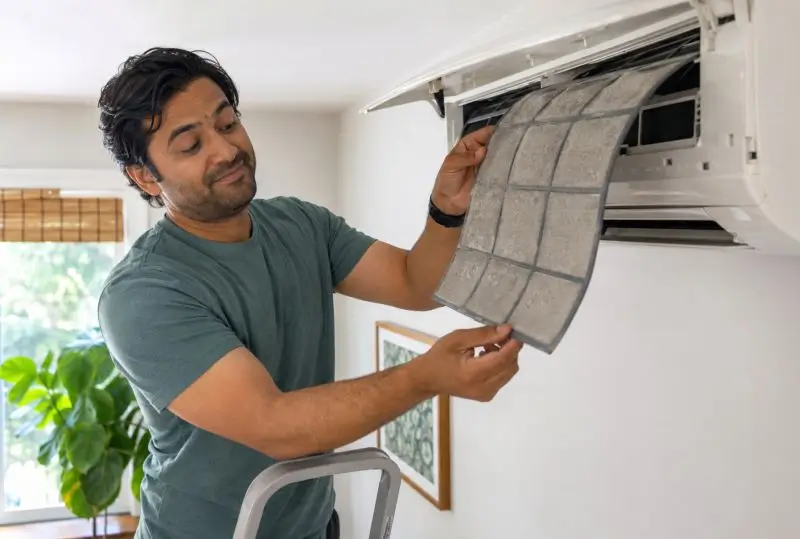
Whatever you install, clean the screen every two to four weeks during heavy use. Slide it out, rinse it, let it dry completely, put it back. A loaded pre-filter restricts airflow, makes the system work harder, and creates the damp, dusty conditions where mold and allergens settle in.
Neglected pre-filters are the most common cause of ductless performance loss Filterbuy has observed across the households we serve. Not compressor failure. Not refrigerant. A dirty screen. It is the cheapest problem in HVAC and the one homeowners are most surprised to hear about, because nothing in the buying process warns them that a ductless system asks for attention every few weeks rather than every few months. In North Carolina that maintenance interval collides with pollen season, and a screen that was fine in February is choking by mid-April. More on how mini splits affect indoor air quality and how to maintain your mini split. If remembering the central filter is the part that slips, air filter auto-delivery removes the decision.
Check the decision table above first. If your mini split will be supplemental, the heat pump rebate isn't available. Ask about the insulation and air sealing rebate before you write the program off entirely.
Check your income tier. Go to energysavernc.org and verify eligibility, or read the actual dollar thresholds for your county and household size in the state's AMI income summary (PDF). Enrollment in programs like SNAP may qualify you for Tier 1 automatically without separate income verification. This step commits you to nothing.
Pick your track. HEAR for a single piece of equipment. HOMES if you're bundling insulation, air sealing, and HVAC into a whole-home project modeled at 20%+ savings. That track requires a free home energy assessment.
Get quotes from Registered Contractors. The program's contractor finder lists them. If the project includes a heat pump, your contractor must run a Manual J load calculation. Get more than one quote.
Sign the quote showing the instant discount. The rebate comes off the invoice before you pay. Confirm the discount amount is on the paperwork before work starts.
Layer your utility rebate. Ask your utility or co-op what stacks. If you're a Duke customer, the free Home Energy Check has to be done within 24 months of the rebate. Confirm ductless eligibility directly, because trade allies report mini splits are excluded from Duke's HVAC rebate.
Start early, but for the right reason. The money is not the bottleneck. As of February 2026 the state had installed only $777,000 of more than $200 million available. The queue is. With roughly 50 registered contractors covering 100 counties and 4,800+ applications in the pipeline, plan this path in months, not weeks.
Filterbuy isn't a tax advisor or a rebate administrator. Confirm your eligibility with Energy Saver NC at 866-998-8555 and your tax situation with a tax professional.
"The call I get every spring is the same one. Somebody has a bonus room over the garage that's fifteen degrees hotter than the rest of the house, they've read that North Carolina will pay eight thousand dollars toward a heat pump, and they want to know how fast I can get out there. Then I have to explain that because their central system still runs the house, the state calls their mini split supplemental, and supplemental doesn't qualify. That conversation would go a lot better if the number they'd read had come with the rule attached."
David Clark, Licensed HVAC Technician
Three figures. Three U.S. government sources. Each one supports a specific claim on this page, not the category in general. Filterbuy verified each against the primary source on July 17, 2026.
38% of North Carolina homes use a central heat pump as their main heating equipment. Nationally, the figure is 13%.
1.54 million of North Carolina's 4.01 million occupied homes
Only South Carolina ranks higher, at 41%
44% of North Carolina homes also use secondary heating equipment
Source: U.S. Energy Information Administration, 2020 Residential Energy Consumption Survey, space heating by state (PDF)
Why it matters here: The Program Requirements exclude replacing an existing heat pump, broken or working. So the equipment that makes North Carolina a heat pump success story is the same equipment that disqualifies roughly 1.5 million households from the $8,000 rebate. Supplementing an existing system isn't fringe behavior here either. It's 44% of the state, and it's the exact thing the rebate excludes.
Energy Saver NC, thirteen months after launch (as of February 10, 2026):
Funding available: more than $200 million
Rebate-eligible projects installed: $777,000
Households completed: 51
Applications received: more than 4,800
Applications approved: more than 1,700
Approved contractors: just over 50, covering all 100 counties
Source: NC Department of Environmental Quality, program now available in all 100 counties (February 10, 2026)
Why it matters here: Every other guide says hurry, the money is first-come, first-served. The state's numbers point at a different risk. Under half a percent of the funding has been installed, so the pot is not about to empty. The queue is what's scarce:
Apply early, because of the wait, not the funding.
Expect months, not weeks.
Confirm a Registered Contractor actually serves your county before you plan around a rebate.
If your bonus room is unbearable this July, treat that timeline as a real input to the decision.
Where the EPA's MERV scale starts measuring each particle size:
Source: U.S. Environmental Protection Agency, "What is a MERV rating?", updated January 14, 2026. A mini split's washable pre-filter carries no MERV rating.
Yes, if the mini split will be your home's primary heating and cooling system and your household income is at or below 150% of Area Median Income. Energy Saver NC pays up to $8,000 for an ENERGY STAR-certified electric heat pump, and a ductless mini split is a heat pump. If the mini split will supplement an existing electric system, cooling one room while your central system keeps running, it is not eligible.
Yes, in principle. The program's eligible types include ducted and non-ducted air-source heat pumps. Eligibility turns on the system's role in the home, not its form factor: it must be ENERGY STAR certified, be installed as the primary heating and cooling source, and be installed by a Registered Contractor.
No. The Section 25C Energy Efficient Home Improvement Credit was repealed effective December 31, 2025 under the One Big Beautiful Bill Act. Equipment installed in 2026 does not qualify. If your system was placed in service on or before December 31, 2025, ask a tax professional about claiming it on your 2025 return.
Duke Energy's Home Energy Improvement program rebates qualifying heat pump and AC replacements up to $1,000 and requires a free Home Energy Check within the prior 24 months. Duke trade allies consistently report that mini splits and ductless systems are excluded from the HVAC rebate. Confirm current terms with Duke directly before you count on it.
Not for the mini split itself. A unit serving one room while your existing system handles the rest of the house is supplemental, and the program requirements exclude supplemental systems from the heat pump rebate. But the insulation and air sealing for that same room is a separate rebate category worth up to $1,600, and it is not tied to the heat pump. For a hot bonus room, that is often the upgrade that fixes the actual problem. Confirm your project with a Registered Contractor. Your electric cooperative is worth a call too, since some rebate ductless systems independently.
No. Energy Saver NC delivers the rebate as an instant discount on a Registered Contractor's invoice, covering equipment and installation together. Buying equipment separately and hiring your own installer is a valid approach, but it doesn't fit the rebate mechanism.
150% of Area Median Income for your county and household size. Households at or below 80% AMI qualify for Tier 1 (up to 100% of project cost). Households between 80% and 150% AMI qualify for Tier 2 (up to 50%). Above 150% AMI, the program isn't available, though utility and co-op rebates and Duke's on-bill financing may still be.
Only lightly, and only in the room they serve. The built-in washable screen catches hair and heavy dust and carries no MERV rating. It protects the equipment more than it protects your lungs. Whole-home particulate filtration still depends on the MERV-rated filter in your central system. That is worth remembering if a mini split is going to reduce how often that central blower runs.
Energy Saver North Carolina. North Carolina's home energy rebate program, funded by the federal Inflation Reduction Act and administered by the NC Department of Environmental Quality State Energy Office. Comprises two tracks: HEAR and HOMES.
HEAR (Home Electrification and Appliance Rebates). The Energy Saver NC track that rebates individual pieces of electric equipment, including heat pumps, up to $14,000 per household lifetime.
HOMES (Homeowners Managing Efficiency Savings). The Energy Saver NC track that rebates whole-home projects modeled to achieve at least 20% energy savings, up to $16,000.
AMI (Area Median Income). The median household income for a given county and household size, as determined by the U.S. Department of Housing and Urban Development. Energy Saver NC eligibility is capped at 150% of AMI.
Ductless mini split. An air-source heat pump that pairs one outdoor condenser with one or more wall- or ceiling-mounted indoor heads, connected by a refrigerant line through a small hole in the wall. Requires no ductwork. Heats and cools.
Registered Contractor. A contractor approved by Energy Saver North Carolina to install rebated equipment and apply the instant discount. Only a Registered Contractor's invoice counts toward the rebate.
Section 25C (Energy Efficient Home Improvement Credit). The federal tax credit that covered 30% of qualifying heat pump costs up to $2,000. Repealed effective December 31, 2025 by the One Big Beautiful Bill Act. Not available for 2026 installations.
Manual J. The Air Conditioning Contractors of America load calculation that determines how much heating and cooling a home actually needs. Required by Energy Saver NC for heat pump rebates.
MERV (Minimum Efficiency Reporting Value). The ASHRAE-derived scale rating an air filter's ability to capture particles between 0.3 and 10 microns. Higher means finer capture. Mini split pre-filters carry no MERV rating.
SEER2 / HSPF2. The current federal efficiency ratings for cooling (SEER2) and heating (HSPF2) performance. Higher is more efficient.
Michelle Wan is Filterbuy's Brand Manager and Air Quality Writer. She covers indoor air quality, filtration, and HVAC efficiency across Filterbuy's resource library, turning technical subjects like MERV ratings and pressure drop into plain-English advice for homeowners who would rather not need a degree in heating and cooling to make a decision. She is also the face of much of Filterbuy's educational content, appearing in the brand's videos and social posts to work through common air quality questions. Michelle earned her B.A. in Sociology from the University of California, Santa Cruz in 2021, and came into the air quality industry through a long-standing interest in the natural world. She lives in the San Francisco Bay Area. More of her work is on her author page.
"I don't want anyone to feel like they need an HVAC license just to pick the right filter. My job is to give you the straight answer, explain why it matters, and let you get back to your day."
Michelle Wan
David Clark is a licensed HVAC technician at Filterbuy. He reviewed this guide on July 16, 2026 for technical accuracy on heat pump sizing, electrical requirements, and real-world system compatibility.
One thing worth saying plainly: David is on Filterbuy's team, not an outside auditor. His review checks the equipment claims. It is not independent verification of the rebate analysis, which is why every eligibility rule on this page links to the state's published program requirements rather than asking you to take our word for it. Check it yourself. That is what the links are for.
Filterbuy is an American, family-owned air filter manufacturer that has been building filters in the United States since 2013, at its plant in Talladega, Alabama. Filterbuy ships MERV 8, MERV 11, MERV 13, and Odor Eliminator filters in over 600 sizes factory-direct to households nationwide, and sells ductless mini split systems direct to homeowners. Filterbuy HVAC Solutions, the company's installation arm, serves South Florida and Orlando, not North Carolina. Filterbuy does not administer, process, or profit from any rebate program described on this page.
Energy Saver North Carolina, Program Requirements, Ver 1.03 (PDF, May 2025). The eligibility rules in the decision table, pp. 6 and 11.
Energy Saver North Carolina, HEAR program page. Rebate amounts, income tiers, instant-discount mechanism.
Energy Saver North Carolina, HOMES program page. Whole-home track and the 20% savings threshold.
Energy Saver North Carolina, Find a Registered Contractor.
Energy Saver North Carolina, AMI Income Summary (PDF). Dollar thresholds by county and household size.
NC DEQ, Program now available in all 100 counties (February 10, 2026).
IRS, Energy Efficient Home Improvement Credit (Section 25C). Confirms the credit is claimable only through December 31, 2025.
Duke Energy, Home Energy Improvement rebates.
ENERGY STAR, Ductless Heating & Cooling.
U.S. Department of Energy, Ductless Mini-Split Heat Pumps.
U.S. EPA, What is a MERV rating?. The MERV scale and capture-efficiency table.
U.S. Energy Information Administration, 2020 RECS, Highlights for space heating in U.S. homes by state (PDF). NC heat pump and secondary-heating shares.
U.S. Energy Information Administration, 2020 RECS, Highlights for space heating fuel in U.S. homes by state (PDF). NC heating fuel mix.
Filterbuy sells ductless mini split systems and air filters. Filterbuy HVAC Solutions does not operate in North Carolina, so we do not install in this state. We are not a rebate administrator or tax advisor.
Shop Filterbuy mini split systems in 12,000 BTU, 18,000 BTU, or 24,000 BTU. Or check your Energy Saver NC eligibility first. In that order, if the decision table above put you in a green row.