Mini Split AC in St. Louis, MO: Installation, Costs & Filter Guide (MO Climate)
By Michelle Wan · Reviewed by David Clark, Licensed HVAC Technician · Published September 15, 2026 · Updated September 15, 2026
A professionally installed mini split in St. Louis costs about $2,000 to $6,000 for one room and $10,000 to $18,000 or more for a whole home in 2026. The number of zones drives most of that price.
Covering one room, garage, or addition? Filterbuy single-zone systems start at $799 for the equipment, with free 2-day delivery on in-stock systems and a 7-year compressor / 3-year parts warranty. Professional installation is required.
Shop Filterbuy mini split systems
Disclosure: Filterbuy sells the single-zone mini split systems and air filters mentioned on this page.

Not sure which size fits your room?
Answer a few quick questions and we'll match you to the right mini split size.
TL;DR
A professionally installed ductless mini split in St. Louis costs about $2,000 to $6,000 for one room and $10,000 to $18,000 or more for a whole home in 2026. The federal 25C tax credit was terminated for systems placed in service after December 31, 2025, but Ameren Missouri's Pay As You Save (PAYS) program lists $500 per ton for qualifying 19+ SEER2 mini splits. Filterbuy's advice: size the system for St. Louis humidity and pick a heat pump model for winter. Then rinse the washable indoor filters every two to four weeks in peak season.
Key Takeaways
• Cost (2026): about $2,000–$6,000 for one zone and $10,000–$18,000+ for a whole home, installed.
• Ameren rebate: $500 per ton for 19+ SEER2 mini splits through PAYS Tier 4.
• No federal credit: the 25C credit was terminated for systems placed in service after December 31, 2025.
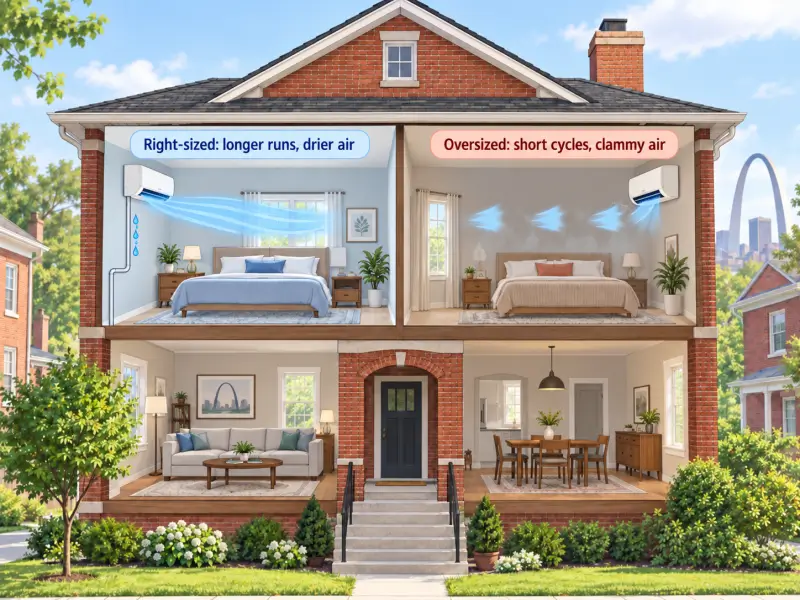
• Right-size it: an oversized unit short-cycles and leaves summer air clammy.
• Rinse, don't replace: clean mesh screens every two to four weeks in peak season.
Where this guide comes from. A ductless mini split is one of the smartest ways to fix a hot upstairs bedroom or heat an addition in a St. Louis home without new ductwork. Filterbuy sees that decision from three sides that rarely sit together:
• We make the filters: Filterbuy manufactures air filters in the USA.
• We sell the equipment: our own single-zone mini split systems.
• We explain the gap between them: what a mini split's pre-filter does, and what it doesn't.
Filterbuy doesn't install mini splits in St. Louis, so nothing here steers you toward an installer.
"We make air filters and sell mini splits, so we see both ends of the system. That view leads to a blunt rule for St. Louis homeowners: hire the installer who runs a Manual J, then treat the filter as the part that decides how your system breathes for 15 years."
The Filterbuy Team
How Much Does a Mini Split Cost in St. Louis in 2026?
A ductless mini split in St. Louis costs about $2,000 to $6,000 installed for a single-zone system and $10,000 to $18,000 or more for a whole-home, multi-zone system in 2026. Labor is typically 30–50% of the total, per our mini split installation cost guide.
Ranges reflect 2026 pricing for professionally installed ductless systems. Brick walls and electrical upgrades can push a quote higher, so ask for an itemized bid.
St. Louis homes add three cost factors (see our Missouri mini split cost and rebate guide):
• Brick walls. Core drilling a line-set hole through brick or stone typically adds $150–$400 per penetration.
• Older electrical panels. A century-old home may need circuit or panel work that isn't in the base HVAC quote. One option: 115V units run on household voltage instead of a new 230V circuit. Filterbuy's 12,000 BTU system comes in 115V or 230V; have an electrician confirm the circuit first.
• Historic districts. In areas like Benton Park or the Central West End, the Cultural Resources Office generally reviews exterior changes, including outdoor unit placement.
What Rebates Can St. Louis Homeowners Get?
Ameren Missouri's Pay As You Save (PAYS) program is the main 2026 incentive for St. Louis mini splits. Ameren's 2026 PAYS incentive chart lists $500 per ton for a mini split air conditioner or heat pump rated 19 SEER2 or higher, valid through December 31, 2026.
What most rebate roundups skip about how PAYS works:
• Qualify first: Tier 4 participation, 12 months in the home, and an existing AC that is 10+ years old, 14 SEER or lower, or not working.
• Not a loan: no credit check; costs are repaid through a fixed charge on your bill.
• Built-in guardrail: that charge can't exceed 80% of estimated monthly savings, or you co-pay the difference.
• It stays with the home: if you move, the next occupant pays it.
• Renters can join with owner consent.
Start with Ameren's free home energy assessment before you sign any quote.
Filterbuy's candid take, as a company that sells mini splits: our single-zone systems start at $799 with free 2-day delivery on in-stock systems. At 17 SEER2, they clear the federal minimum but not Ameren's 19 SEER2 line, so if the PAYS rebate drives your budget, shop 19+ SEER2. The chart expires December 31, 2026, so a fall assessment leaves time to install.
The federal 25C credit was terminated for systems placed in service after December 31, 2025; confirm eligibility with a tax professional. Missouri's HEAR rebates aren't open yet.
How Do You Size a Mini Split for the St. Louis Climate?
Size a St. Louis mini split with a Manual J load calculation, not a square-footage guess, because humidity control matters as much as cooling power here. July in St. Louis averages highs near 90°F and lows around 71°F, and the city logs about 47 days a year at 90°F or hotter, according to NOAA climate normals for St. Louis Lambert International Airport. By our count of that data, about 40 of those days fall in June, July, and August. An oversized unit cools the room fast, shuts off, and never runs long enough to pull moisture out. In our experience, bedrooms are the room homeowners oversize most often.
A correctly sized inverter system runs longer at lower speed, removing more moisture as it cools. The Asthma and Allergy Foundation of America (AAFA) recommends indoor relative humidity between 30% and 50%.
Filterbuy built this starting point by pairing ENERGY STAR's room air conditioner sizing guidance with Ameren's per-ton rebate (12,000 BTU equals one ton):
Capacity starting points follow ENERGY STAR room AC sizing guidance: add about 10% for very sunny rooms, subtract about 10% for shaded rooms, and confirm with a Manual J. Rebate math applies Ameren Missouri's 2026 PAYS rate of $500 per ton to qualifying systems; confirm eligibility and how partial tons are credited with Ameren.
Can a Mini Split Heat Pump Handle a St. Louis Winter?
Yes, a cold-climate mini split heat pump can heat a St. Louis home through most winters. January lows average about 24°F, and St. Louis averages about one night a year at or below 0°F. Ask for the model's rated heating output at 5°F, or keep a gas furnace as dual-fuel backup.
The winter detail most guides skip: NOAA data shows St. Louis averages about 85 nights a year at or below freezing. Defrost cycles release water that can form icy patches, so keep the condenser away from walkways and roof runoff.
How Do You Choose a Mini Split Contractor in St. Louis?
Choose a St. Louis mini split installer who is registered or licensed in your specific jurisdiction, holds EPA Section 608 refrigerant certification, runs a Manual J, and can install through Ameren's PAYS program. Missouri has no statewide HVAC license, so credentials depend on where you live. The EPA confirms connecting a mini split's refrigerant lines requires Section 608 certification.
Within city limits, the City of St. Louis Building Division issues mechanical permits only to City-licensed mechanical contractors. St. Louis County's mechanical permit guidance lists installing a heat pump unit as permit-required work, and many county municipalities run their own permit offices.
The pattern Filterbuy sees most: homeowners spend weeks comparing brands and minutes choosing the installer. Flip that. Use this checklist to read any St. Louis quote line by line:
1. Load calculation. A written Manual J, not a square-footage guess.
2. Efficiency. SEER2 of 19 or higher if you want the Ameren PAYS rebate.
3. Winter rating. Heating capacity listed at 5°F.
4. Matched system. An AHRI certificate for the exact indoor and outdoor pair; Ameren's rebate chart uses AHRI ratings.
5. Line set. Standard installs typically include about 25 feet; each extra 10 feet often adds $50–$150, per our installation cost guide.
6. Electrical. A dedicated circuit, often $300–$800, listed separately.
7. Permit. Named by jurisdiction: City, County, or municipality.
8. Warranty. Labor coverage in writing, on top of the manufacturer's.
More tips: finding mini split installation near you.
What Mini Split Repair and Maintenance Does a St. Louis Home Need?
A St. Louis mini split needs homeowner filter cleaning every few weeks in peak season and a professional service visit once a year, ideally in spring before cooling season. Call a technician for:
• Ice on the coil or lines, often restricted airflow or low refrigerant
• Water dripping from the head, usually a clogged condensate drain line
• Weak airflow or a musty smell, frequently a dirty filter or blower wheel
Your St. Louis Mini Split Maintenance Calendar
Filterbuy built this schedule by matching NOAA climate data to Missouri's ozone and ragweed seasons:
1. March and April: tune up. Book the annual pro service before cooling season. Missouri's ozone season runs March 1 through October 31.
2. May through September: cool and dry. Rinse screens every two weeks. Most 90°F days hit June through August.
3. August through October: pollen watch. Ragweed peaks in mid-September. Keep windows closed and your central filter fresh with Filterbuy auto-delivery.
4. November through February: heat and defrost. Rinse screens during heavy heating. Keep leaves and snow off the outdoor unit.
Full DIY steps are in our mini split cleaning guide.
"On a wall-mounted mini split, the filter is a washable screen most people don't even know is there. Rinse it every few weeks and you head off the airflow and frozen-coil problems that bring us the most service calls, with no new part required."
David Clark, Licensed HVAC Technician
How Do You Clean or Replace Mini Split Filters in St. Louis?
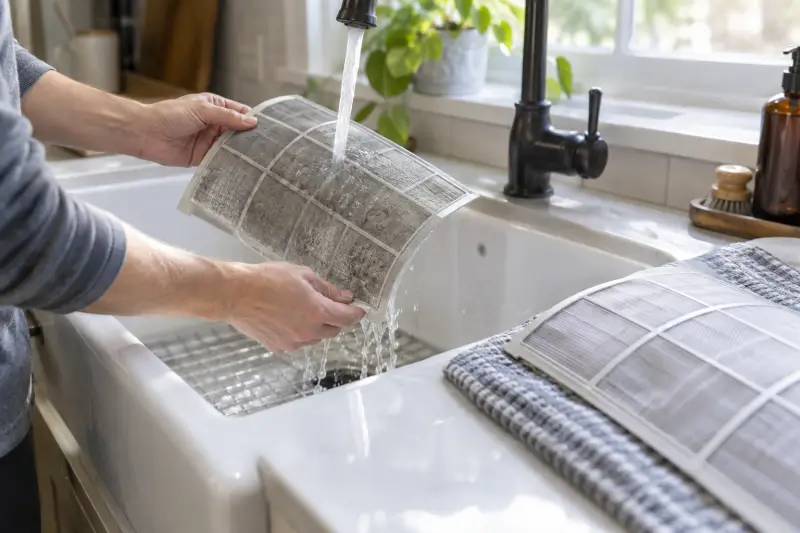
Most wall-mounted mini splits use washable mesh filters, so St. Louis homeowners clean them rather than replace them.
Power off, slide the screens out, vacuum, rinse, and air-dry fully. See our brand-by-brand mini split filter cleaning steps.
Mini split filter replacement depends on your filter type:
Intervals are general guidance. Your owner's manual has the final word for your model.
Filterbuy's two-filter rule for St. Louis homes: every mini split home has two filter jobs. The pre-filter protects the coil. Your whole-home filter, on a central furnace or a ducted mini split, does the heavy lifting for air quality.
Filterbuy doesn't stock brand-specific mesh panels and earns nothing when you buy one, so we'll always tell you to rinse first. We make the pleated side for ducted systems and central furnaces. See our mini split filter guide.
Does a Mini Split Improve Air Quality in St. Louis?
A mini split improves comfort and removes some humidity, but it does not clean St. Louis air by itself because it recirculates room air through a coarse screen. Of all the mini split questions Filterbuy fields, this fact surprises people most: a ductless system brings in no fresh outdoor air. The American Lung Association ranks the metro 24th worst nationally for ozone, with an F grade.
This is how a mini split screen and a central MERV 13 filter stack up on local concerns (more in our guide to mini split filtration and pollen):
Ozone is a gas, so particle filters do not capture it. The EPA recommends at least MERV 13 for finer particles if your system can handle the airflow; check your HVAC manufacturer's guidance. Sources: American Lung Association State of the Air 2026; AAFA 2026 Allergy Capitals report; U.S. EPA.
Check Filterbuy's live St. Louis AQI map. The EPA recommends at least MERV 13 for finer particles, if your system can handle the airflow; check your HVAC manufacturer's guidance. Pair a MERV 13 air filter with filter auto-delivery.
What Is the Best Mini Split for a St. Louis Home?
For a primary living space in St. Louis, the best mini split is a correctly sized inverter heat pump rated 19+ SEER2, with verified cold-weather heating capacity and a current refrigerant such as R-32 or R-454B. Our best mini split brands guide compares major brands on those points.
Where Filterbuy mini split systems fit:
• Best for: value single-zone jobs, such as a garage, workshop, room addition, or a room your central system can't reach.
• What you get: published prices from $799, free 2-day delivery on in-stock systems, and a 7-year compressor / 3-year parts warranty. Professional installation is required; the warranty is void if self-installed.
• Where to look elsewhere: our line is single zone only, and it's rated for reliable heating down to 5°F. For multi-zone or primary winter heat, choose a cold-climate model from another brand.
Your Next Steps
1. Book Ameren's free PAYS home energy assessment to confirm rebate eligibility.
2. Get two or three itemized quotes and check each one against the checklist above.
3. Choose your system: 19+ SEER2 for the rebate, or a Filterbuy mini split system for a value single-zone room.
4. Set your filter plan: follow the calendar above and put your central filter on Filterbuy auto-delivery.
Supporting Statistics
1. Up to 60% less energy
• Certified mini splits use up to 60% less energy than electric radiators.
• ENERGY STAR verifies cold-climate models' heating performance down to 5°F.
• St. Louis takeaway: Ask every contractor for the heating rating at 5°F.
• Source: ENERGY STAR (U.S. EPA): Ductless Heating & Cooling
2. 497,182 Missouri children
• That many Missouri kids breathe unhealthy air, and the St. Louis metro ranks 31st worst nationally for year-round particle pollution (American Lung Association, 2026).
• St. Louis takeaway: Mini split pre-filters miss fine particles. A MERV 13 central filter captures more of them, if your system can handle the airflow.
• Source: American Lung Association: 2026 "State of the Air" Missouri findings
3. A mid-September ragweed peak
• Ragweed populations are especially high in Eastern and Midwestern states.
• The season starts around August, lasts 6 to 10 weeks, and peaks in mid-September in most of the U.S.
• St. Louis takeaway: Rinse mini split screens more often from August through October.
• Source: Asthma and Allergy Foundation of America: 2026 Allergy Capitals report
Frequently Asked Questions
About This Guide
Author: Michelle Wan, Filterbuy's Brand Manager and Air Quality Writer, works alongside Filterbuy's manufacturing teams in Alabama, Florida, Pennsylvania, and Utah and translates filtration and HVAC topics into practical homeowner advice.
Reviewed by David Clark, Licensed HVAC Technician, for technical accuracy.
Sources
• Ameren Missouri: 2026 Pay As You Save Incentive Chart
• Ameren Missouri: Pay As You Save (PAYS) program
• IRS: Energy Efficient Home Improvement Credit (Section 25C)
• NOAA NCEI: 1991–2020 Monthly Climate Normals, St. Louis Lambert International Airport
• American Lung Association: 2026 "State of the Air" Missouri release
• Asthma and Allergy Foundation of America: 2026 Allergy Capitals report (PDF)
• City of St. Louis Building Division: Apply for a Mechanical Permit
• St. Louis County: Mechanical Work permit requirements
• City of St. Louis: Cultural Resources Office
• U.S. EPA: Section 608 Refrigerant Management Q&A
• U.S. EPA: What Is a MERV Rating?
• ENERGY STAR: Room Air Conditioners sizing guidance
• Missouri DNR: Air Quality Index Reports and ozone season
• ACCA: Manual J Residential Load Calculation
• ENERGY STAR: Ductless Heating & Cooling
Glossary
Ductless mini split: A heat pump or air conditioner that links an outdoor compressor to indoor heads by refrigerant lines, with no ductwork.
BTU (British thermal unit): The unit used to rate heating and cooling capacity; 12,000 BTU equals one ton.
SEER2: The U.S. seasonal cooling efficiency rating; higher numbers use less electricity.
Manual J: The ACCA standard load calculation used to size equipment for a specific home.
Ameren Missouri PAYS (Pay As You Save): Ameren Missouri's residential efficiency program with HVAC rebates and on-bill payment for qualifying upgrades.
AHRI certificate: Documentation from the Air-Conditioning, Heating, and Refrigeration Institute confirming the rated performance of a matched indoor and outdoor unit pair.
Defrost cycle: A heat pump's routine of briefly melting frost off the outdoor coil in cold weather.
MERV: Minimum Efficiency Reporting Value, a 1–16 scale for how well a pleated air filter captures particles.
R-32 / R-454B: Lower-global-warming refrigerants used in many new mini splits.
Ozone: A gas pollutant (smog) that particle filters don't capture.