Adding a Mini Split AC System in Missouri
Installation, Costs & Rebates (MO Guide)
By Michelle Wan · Reviewed by David Clark, Licensed HVAC Technician · Published July 5, 2026 · Updated July 5, 2026
Adding a ductless mini split in Missouri costs about $2,000 to $6,000 for a single room and $10,000 to $18,000 or more for a whole home in 2026. The federal tax credit ended on December 31, 2025, so your 2026 savings now come from Missouri utility rebates through Ameren, Evergy, your city utility, or a co-op. Take the 60-second quiz below to find the system that fits your space.

Answer 3 quick questions and we'll match you to the right mini split system. Prefer to browse first? See all mini split systems.
TL;DR
Adding a ductless mini split in Missouri costs roughly $3,000–$6,000 for a single room and $10,000–$18,000+ for a whole-home multi-zone system in 2026. The federal 25C tax credit that used to pay up to $2,000 toward heat pumps expired December 31, 2025, so 2026 installs rely on utility rebates from Ameren Missouri and Evergy, plus Missouri’s income-based HEAR rebate once the state launches it. For Missouri’s mixed climate, choose a cold-climate heat pump model and keep your filters clean to protect efficiency.
Key Takeaways
Mini split cost in Missouri (2026): A single-zone ductless system runs about $2,000–$6,000 installed; each added zone adds roughly $2,000–$7,000; a four- or five-zone whole-home system reaches $10,000–$18,000+.
The federal heat pump tax credit is gone for 2026 installs. Section 25C expired December 31, 2025 under the One Big Beautiful Bill Act. Equipment placed in service in 2026 does not qualify, but a system installed and running by December 31, 2025 can still be claimed on your 2025 return.
Missouri’s state rebates aren’t open yet. Missouri has about $75 million earmarked for Home Electrification & Appliance Rebates (HEEHR/HEAR) and $76 million for HOMES, but the state has said the rebates may not be available until 2027 at the earliest and potentially as late as 2028. Watch the Missouri DNR Energy page for the launch.
Utility rebates are the reliable 2026 path. Ameren Missouri (St. Louis and central/eastern MO) and Evergy (Kansas City and western MO) both offer heating-and-cooling rebates for qualifying high-efficiency mini splits through participating contractors.
A mini split heat pump can heat a Missouri winter, but pick a cold-climate (hyper-heating) model rated for low temperatures; many homeowners pair it with a gas furnace as a dual-fuel backup.
Keep filters clean. Mini-split indoor heads have washable filters that need a rinse every 60–90 days, and if you keep a central furnace or air handler, the right MERV filter on it protects your whole-home air. Filterbuy makes 600+ standard sizes plus custom filters on auto-delivery.
Where this guide comes from: Filterbuy has manufactured air filters in the USA since 2013 and shipped them to millions of households, and our Filterbuy HVAC Solutions team, including the licensed technician who reviewed this page, works on systems like these every day. So this guide reflects what we actually watch homeowners run into, not a spec sheet. Two of those real-world lessons shape everything below: the money math changed for 2026, and the part that quietly makes or breaks a mini split is the one nobody thinks about.
“I write about indoor air for a living, and I work side by side with the people who build our filters, so I look at a mini split a little differently than a spec sheet does. For a Missouri home, adding one is one of the smartest comfort upgrades you can make. Just go in knowing the two things most guides skip: the federal tax credit is gone for 2026, and the little filters inside each head are what keep the whole system breathing. Get those right and you’ll be glad you did for the next 15 years.”
Michelle Wan, Brand Manager & Air Quality Writer, Filterbuy
How Much Does It Cost to Add a Mini Split in Missouri in 2026?
Adding a ductless mini split in Missouri costs about $2,000–$6,000 for a single-zone system and $10,000–$18,000 or more for a whole-home multi-zone system in 2026. The biggest price drivers are the number of zones (rooms), the system’s size and efficiency (SEER2 and HSPF2), the indoor head style, and whether your home needs electrical upgrades. Labor typically makes up 30–50% of the total.
Missouri install prices track close to national 2026 averages, with local labor generally running $75–$150 per hour. Here’s what to expect by configuration:
Ranges reflect 2026 pricing for professionally installed ductless systems; your quote varies with home condition, line-set length, and equipment choices. Always get an itemized bid.
From what we see on real quotes, three things move a Missouri number up or down more than the equipment itself:
Indoor head style. Standard wall-mounted heads are the most affordable. Floor-mounted consoles and recessed ceiling cassettes cost more per zone because they take more labor to mount.
Electrical work. A new dedicated circuit, disconnect, or a panel upgrade can add anywhere from a few hundred to a few thousand dollars, and it’s not always in the base HVAC quote. Ask before you sign.
Heating capability. A mini split heat pump (heats and cools) usually costs $200–$800 more per head than a cooling-only model, and in Missouri, that heating ability is the whole point.
Related reading: For the full national breakdown, see Filterbuy’s guides to mini split installation cost and how much a mini split costs.
What Rebates and Incentives Are Available for a Missouri Mini Split in 2026?
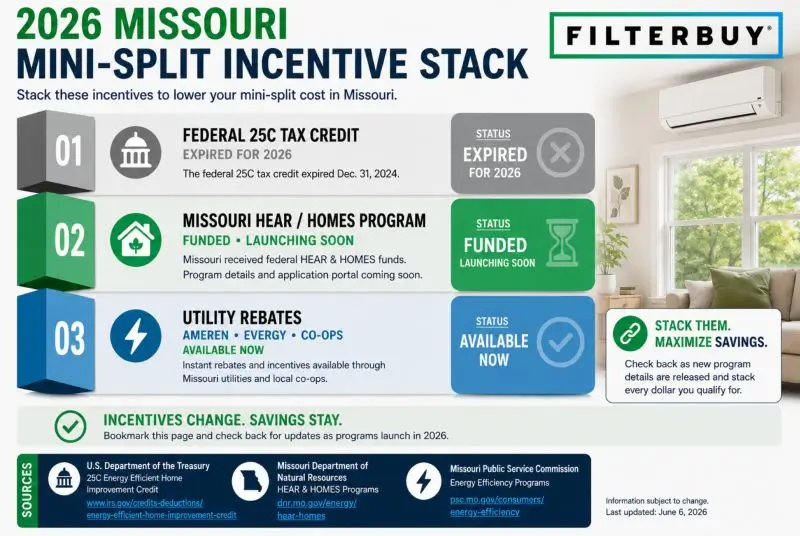
In 2026, the money for a Missouri mini split comes from utility rebates and, once it launches, the state’s income-based HEAR rebate, not from a federal tax credit. The federal Section 25C credit that paid up to $2,000 toward qualifying heat pumps expired December 31, 2025. If you’ve read that you can still get 30% back from the IRS in 2026, that information is out of date.
We flag this hard because we keep seeing it: several pages still ranking for Missouri rebate searches tell homeowners to claim a federal credit that no longer exists for 2026 installs. Getting it wrong can throw a budget off by up to $2,000, so we checked every figure below against its primary government source and gave the page a visible last-updated date.
The Federal Tax Credit Expired: The Exact Rule
The federal Energy Efficient Home Improvement Credit (Section 25C) was terminated by the One Big Beautiful Bill Act (Public Law 119-21), signed July 4, 2025. The IRS uses the “placed in service” date, which is the day your system is installed and operational. A mini split placed in service on or after January 1, 2026 earns nothing from the credit, regardless of when you bought it or signed the contract. If your system was installed and running on or before December 31, 2025, you can still claim it on your 2025 federal return (IRS Form 5695).
Missouri’s State Rebates (HEAR & HOMES): Funded, Not Yet Open
Missouri has federal Inflation Reduction Act money set aside for two rebate programs, but they are not accepting homeowner applications yet.
HEAR (Home Electrification & Appliance Rebates): up to $8,000 toward a qualifying heat pump for income-qualified households (at or below 150% of Area Median Income), applied as a point-of-sale discount rather than a tax refund.
HOMES: whole-home efficiency rebates based on modeled or measured energy savings, at any income level.
According to the Missouri Department of Natural Resources, the state submitted its funding application on November 22, 2024 and issued a request for proposals to select a program administrator in 2026. Missouri is set to receive roughly $151 million total, about $76 million for HOMES and $75 million for the electrification/appliance (HEEHR) rebates, administered as part of the federal Home Energy Rebates Program. Importantly, the department has said the rebates may not be available until 2027 at the earliest and potentially as late as 2028, so for a 2026 install, plan around utility rebates instead and check the Missouri DNR Energy page for status.
Utility Rebates: Your Reliable 2026 Path
This is where Missouri homeowners can actually save money on a mini split right now. Your options depend on who provides your electricity.
Utility rebate amounts and eligibility change during the year and some categories can hit annual caps. Confirm current figures with your utility or a participating/authorized contractor before you install.
Confirm current amounts and eligibility on Ameren Missouri’s energy-efficiency programs and Evergy’s heating and cooling discounts, or search your ZIP code in the ENERGY STAR Rebate Finder.
Not on Ameren or Evergy? Check Your City Utility or Co-Op
This is the step most Missouri homeowners skip. Ameren and Evergy don’t cover the whole state. If you live in Columbia, Springfield, or Independence, you’re on a city-owned utility with its own rebates, and some of them beat the big two. Rural homes are often served by an electric cooperative. Not sure who serves you? Your electric bill names your utility.
Columbia (Columbia Water & Light): $800–$1,200 for a qualifying air-source heat pump or AC (by SEER2), an Efficient Electrification rebate up to $1,400 for a dual-fuel heat pump, plus a discounted winter heat-pump electric rate. See Columbia Water & Light rebates.
Springfield (City Utilities of Springfield): ENERGY STAR HVAC rebates, including roughly $500 for a qualifying air-source heat pump and about $1,025 for geothermal. See City Utilities rebates.
Independence (Independence Power & Light): rebates on central AC, heat pumps, and heat pump water heaters, scaled by size and efficiency.
Rural Missouri (electric cooperatives, e.g., Co-Mo Electric): per-ton rebates for air-source, dual-fuel, and geothermal heat pumps; some require enrolling in a load-control program.
Amounts and rules change, and rebate funds are often first-come, first-served each fiscal year, so confirm on your utility’s own site before you buy.
A note on stacking: Utility rebates are generally independent of income-based state rebates, but the same piece of equipment usually can’t be paid for twice, and total incentives can’t exceed what you paid. Because rebate rules and your tax situation are personal, confirm eligibility with your utility and a tax professional before you count on any specific number.
Confirm current amounts and eligibility on Ameren Missouri’s energy-efficiency programs and Evergy’s heating and cooling discounts, or search your ZIP code in the ENERGY STAR Rebate Finder.
Not on Ameren or Evergy? Check Your City Utility or Co-Op
This is the step most Missouri homeowners skip. Ameren and Evergy don’t cover the whole state. If you live in Columbia, Springfield, or Independence, you’re on a city-owned utility with its own rebates, and some of them beat the big two. Rural homes are often served by an electric cooperative. Not sure who serves you? Your electric bill names your utility.
Columbia (Columbia Water & Light): $800–$1,200 for a qualifying air-source heat pump or AC (by SEER2), an Efficient Electrification rebate up to $1,400 for a dual-fuel heat pump, plus a discounted winter heat-pump electric rate. See Columbia Water & Light rebates.
Springfield (City Utilities of Springfield): ENERGY STAR HVAC rebates, including roughly $500 for a qualifying air-source heat pump and about $1,025 for geothermal. See City Utilities rebates.
Independence (Independence Power & Light): rebates on central AC, heat pumps, and heat pump water heaters, scaled by size and efficiency.
Rural Missouri (electric cooperatives, e.g., Co-Mo Electric): per-ton rebates for air-source, dual-fuel, and geothermal heat pumps; some require enrolling in a load-control program.
Amounts and rules change, and rebate funds are often first-come, first-served each fiscal year, so confirm on your utility’s own site before you buy.
A note on stacking: Utility rebates are generally independent of income-based state rebates, but the same piece of equipment usually can’t be paid for twice, and total incentives can’t exceed what you paid. Because rebate rules and your tax situation are personal, confirm eligibility with your utility and a tax professional before you count on any specific number.
Single-Zone vs. Multi-Zone: Which Does Your Missouri Home Need?
Choose single-zone to condition one room and multi-zone to cover several. If you’ll want more than one zone, it’s usually smarter to plan the multi-zone system from the start. With a multi-zone setup, several indoor heads share one outdoor condenser, so you pay for that condenser once. Add a second zone to a single-zone system later and you may end up replacing the outdoor unit entirely, paying that cost twice.
Where each option fits a Missouri home:
Single-zone is ideal for a room addition, a finished basement or bonus room, a garage workshop, a sunroom, or one bedroom that’s always too hot or too cold.
Multi-zone suits whole-home comfort, older Missouri homes without ductwork, and households that want room-by-room control so they’re not conditioning empty rooms.
The trade-off is upfront cost versus long-term control. Ductless systems cost more upfront than a window unit, but they deliver zone-by-zone efficiency and 15–20 years of service, which is why they’re often the most cost-effective option for homes that lack good ductwork.
How to Add a Mini Split in Missouri: Step-by-Step
Adding a mini split in Missouri is a licensed-contractor job that runs from a load calculation to a permitted, inspected install, and the rebate paperwork is easiest when your contractor handles it. Here’s the practical order of operations:
Get a load calculation (Manual J). A right-sized system is the difference between comfort and a unit that short-cycles or can’t keep up. Oversizing hurts humidity control in Missouri summers.
Pick your configuration and efficiency. Decide single-zone vs. multi-zone and target SEER2/HSPF2 that qualifies for rebates. For year-round use, choose a cold-climate heat pump.
Choose a qualifying contractor. Use an Ameren Missouri Participating Contractor or an Evergy Authorized (Trade Ally) Contractor depending on your utility. They confirm eligibility before install and file the paperwork.
Confirm rebate eligibility and any income-based options first. Verify current utility amounts, and if your household is at or below 150% AMI, ask about Missouri’s HEAR program status. Do this before installation, since rebates usually require pre-confirmation.
Handle permits and electrical. Most Missouri jurisdictions require a permit and inspection; budget for a possible dedicated circuit or panel work.
Install, commission, and keep your paperwork. A single-zone install often takes 4–8 hours; multi-zone can take 1–3 days. Save the AHRI certificate, invoice, and model/serial numbers, since you’ll need them for rebates.
Set up filter maintenance. Note your indoor heads’ filter-cleaning schedule, and if you keep a central system, put the right Filterbuy filter on auto-delivery so efficiency doesn’t slip.
5 Mistakes We See Missouri Homeowners Make
After years of fielding the same questions, these are the missteps that cost Missouri homeowners the most comfort and money, and every one of them is avoidable.
Skipping the load calculation. An oversized mini split short-cycles and never pulls the humidity out of a Missouri July. Insist on a Manual J before you buy.
Buying a cooling-only unit. In this climate, the heat-pump version, rated for cold, is the whole point. Cooling-only throws away the biggest advantage.
Budgeting for a tax credit that’s gone. The $2,000 federal 25C credit ended December 31, 2025. Plan around utility rebates, not the IRS.
Installing before confirming the rebate. Ameren and Evergy rebates usually require a participating or authorized contractor and pre-approval. The wrong contractor, or a DIY install, can void them.
Forgetting the head filters. The washable filters inside each indoor unit are the number-one overlooked maintenance item. Skip them and both efficiency and air quality slide within weeks.
Questions to Ask Before You Sign
Bring these to every quote. The answers separate a good Missouri installer from a cheap one. Print it as a checklist and take it with you:
Did you run a Manual J load calculation for my specific home?
Is this a cold-climate-rated heat pump, and what is its rated heating capacity at low temperatures?
Are you an Ameren Participating Contractor or an Evergy Authorized (Trade Ally) contractor, and will you file the rebate paperwork?
What refrigerant does the system use (R-32 or R-454B), and is it a current, 2026-compliant unit?
What electrical work is included, and what might cost extra?
What is the warranty on both the equipment and the labor?
Can I get a fully itemized quote covering equipment, labor, permits, line-set, and electrical, listed separately?
Keeping Your Mini Split and Central-System Filters Clean
A mini split only holds its efficiency if its filters stay clean, so rinse the indoor-head filters every 60–90 days, and keep the right MERV filter on any central furnace or air handler you still run. This is the part we know better than almost anyone. Across millions of filters shipped, the washable mesh filters inside each indoor head are the single most overlooked maintenance item we see on ductless systems, and the one with the most direct impact on airflow, air quality, and compressor life. Pop them out, rinse, dry, and reinstall on a regular cadence.
Many Missouri homes that add mini splits keep a central furnace or air handler too, especially dual-fuel setups where a gas furnace backs up the heat pump. That central system still pulls and filters your whole-home air, and it needs the correctly sized filter at the right rating (a MERV 13 filter captures the finest particles) to protect both your air and the equipment. Filterbuy makes 600+ standard sizes plus custom filters, built in the USA and shipped factory-direct, and auto-delivery means the right filter shows up on schedule so you never run a dirty one.
Your Next Steps
Ready to move forward? This is the order that keeps a Missouri mini split project on budget and on track:
Confirm your utility rebate with Ameren or Evergy, and if your household is income-qualified, watch the Missouri DNR Energy page for the HEAR launch.
Get an itemized quote from a qualifying contractor who runs a Manual J load calculation.
Choose a cold-climate heat pump if the mini split will be your primary heat, or a dual-fuel setup if you’re keeping a gas furnace.
Set your filter plan: rinse the indoor-head filters every 60–90 days, and put your central-system filter on a schedule so it never lapses.
Filterbuy can take that last step off your plate: set up filter auto-delivery in your exact size, made in the USA and shipped factory-direct, so clean air is one less thing to remember.
Frequently Asked Questions
Glossary
Ductless mini split: A heating and cooling system with an outdoor compressor connected to one or more wall-, floor-, or ceiling-mounted indoor heads by refrigerant lines, requiring no ductwork.
Zone: A single area conditioned by one indoor head. A single-zone system has one head; a multi-zone system has several sharing one outdoor unit.
Heat pump: A system that moves heat rather than burning fuel, providing both cooling in summer and heating in winter; a mini split can be a heat pump.
Cold-climate (hyper-heating) heat pump: A heat pump engineered to maintain useful heating capacity at low outdoor temperatures, relevant for Missouri winters.
Dual-fuel (hybrid) system: A pairing of an electric heat pump with a gas furnace that automatically switches to gas in the coldest weather.
SEER2 / HSPF2: Standardized efficiency ratings, where SEER2 measures cooling efficiency and HSPF2 measures heating efficiency for heat pumps. Higher numbers mean lower operating cost.
Manual J: The industry-standard load calculation an installer performs to size a system to your home’s actual heating and cooling needs, rather than guessing from square footage.
Section 25C: The federal Energy Efficient Home Improvement Credit, which paid up to $2,000 toward qualifying heat pumps; expired December 31, 2025.
HEAR (Home Electrification & Appliance Rebates): A federal, state-administered rebate program offering up to $8,000 toward a heat pump for income-qualified households (≤150% AMI), applied at point of sale.
HOMES: A federal, state-administered rebate program for whole-home efficiency improvements based on energy savings.
AMI (Area Median Income): The midpoint household income for a county or metro area, used to determine eligibility for income-based rebates.
PAYS (Pay As You Save): Ameren Missouri’s on-bill financing and rebate program that applies upfront rebates and repays the balance through the electric bill.
Trade Ally / Participating Contractor: A utility-approved installer trained on which systems qualify for that utility’s rebates and who files the rebate paperwork.
MERV: Minimum Efficiency Reporting Value, a 1–16 scale rating how effectively an air filter captures particles; higher MERV captures smaller particles.
R-32 / R-454B: Lower-global-warming refrigerants now used in new systems as R-410A is phased out under EPA rules.
About This Guide
Author: Michelle Wan. Michelle is Filterbuy’s Brand Manager and Air Quality Writer. She works directly with Filterbuy’s U.S. manufacturing team across factories in Alabama, Florida, Pennsylvania, and Utah, and turns the technical side of indoor air quality (MERV ratings, filtration, HVAC efficiency) into plain-English advice for homeowners, including on Filterbuy’s educational social and video content. See her author page.
Reviewed by David Clark, Licensed HVAC Technician, Filterbuy HVAC Solutions. David reviewed this guide for technical accuracy on mini split sizing, cold-climate selection, installation, and Missouri climate considerations. His field perspective informs the sizing and dual-fuel guidance above.
Published: July 5, 2026 · Last updated: July 5, 2026. This page covers programs and prices that change during the year; verify current rebate amounts with your utility and any tax questions with a licensed professional before making a decision.
Sources
IRS: Energy Efficient Home Improvement Credit (Section 25C) expiration (OBBBA, P.L. 119-21)
Missouri Department of Natural Resources: IRA Home Energy Rebates (HEAR/HOMES) status and funding
Ameren Missouri: Energy Efficiency Programs (PAYS / HVAC Fast-Track)
Evergy: Heating and Cooling Discounts (rebates for MO/KS customers)
Columbia Water & Light: Air Conditioner and Heat Pump Rebates (Columbia, MO)
City Utilities of Springfield: Residential Rebates (Springfield, MO)
EPA: Frequent Questions on the Phasedown of Hydrofluorocarbons (AIM Act refrigerant transition)
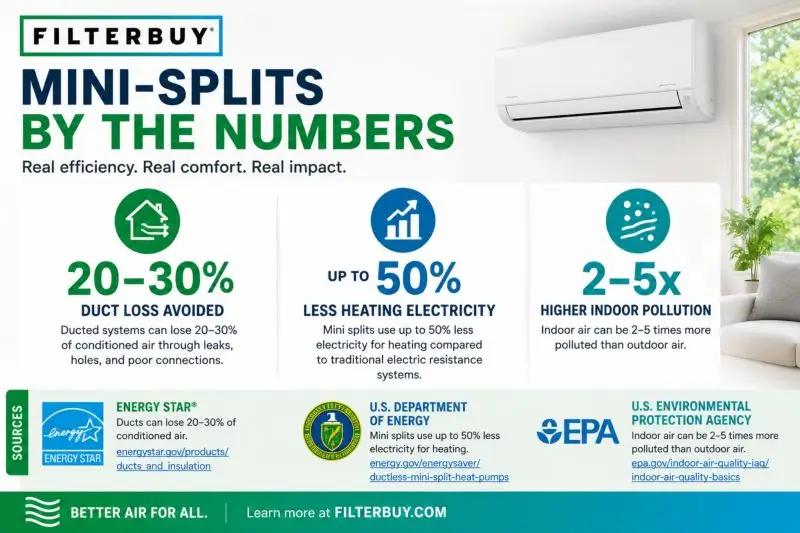
ENERGY STAR: Duct Sealing (20–30% of ducted air lost to leaks)