Installation, Costs & Rebates (MI Guide)
By Michelle Wan · Reviewed by David Clark, Licensed HVAC Technician · Published July 3, 2026 · Updated July 3, 2026
A ductless mini split runs about $2,500–$5,500 installed for a single zone, and $10,000–$15,000 for a whole home. The federal 25C tax credit ended December 31, 2025, so 2026 installs get nothing from the IRS. What lowers your cost now is Michigan money, not federal.
In 2026, an income-qualified Michigan household can stack:
Pick a cold-climate model rated at 5°F, and apply for rebates before you install, because HEAR is not retroactive. Ready to see systems? Shop Filterbuy mini split systems.

Not sure which system or size fits your home? Answer 3 quick questions and we’ll match you to the right mini split.
Prefer to browse first? See all Filterbuy mini split systems.
Adding a ductless mini split in Michigan typically costs $2,500–$5,500 for a single zone and $5,000–$15,000 for a multi-zone system, installed. The federal 25C tax credit that once paid up to $2,000 expired December 31, 2025, so 2026 installs earn nothing from the IRS. What remains: Michigan’s MiHER / HEAR rebate (up to $8,000 for income-qualified households), utility rebates from DTE and Consumers Energy, and low-interest Michigan Saves financing. Choose a cold-climate heat pump model and, if you’re keeping a ducted furnace, keep a quality Filterbuy MERV filter in it.
A single-zone mini split runs about $2,500–$5,500 installed in Michigan; whole-home multi-zone systems reach $10,000–$15,000, driven mostly by the number of indoor units (zones), efficiency rating, and labor.
The federal Section 25C tax credit (up to $2,000) ended December 31, 2025 under the One Big Beautiful Bill Act. Mini splits placed in service in 2026 do not qualify for any federal tax credit.
Michigan’s HEAR rebate pays up to $8,000 per qualifying heat pump for households at or below 150% of Area Median Income, applied as an upfront discount, but you must be approved before installation.
DTE and Consumers Energy each offer separate heat-pump rebates. DTE’s mini-split rebate (up to $1,200) is limited to electric customers replacing electric heat; most gas-heated Michigan homes won’t qualify for that specific rebate.
For Michigan winters, pick a cold-climate model (roughly 16+ SEER2 / 9.1+ HSPF2 to hit top rebate tiers). Very cold nights may still call for a backup heat source.
Mini splits use built-in washable mesh filters, not the sized pleated filters central systems use. If you keep a ducted furnace or AC for the rest of the house, that system still needs a quality MERV-rated filter. Filterbuy builds American-made pleated filters for exactly that job.
Before you spend a dollar: Check your local Michigan air quality on Filterbuy’s live AQI map so you know what your indoor air is up against, from summer ozone to wildfire smoke drifting in from Canada.
Where this comes from: Filterbuy has been obsessed with what American families breathe since 2013, and in that time we’ve helped more than two million households, many here in Michigan, manage their air through pollen season, Canadian wildfire smoke, and deep-freeze winters. The mini split question comes up constantly on our support lines, and it almost always turns into a filter question. So here’s our straight, no-upsell answer to both.
Yes, for the right home. A ductless mini split is an excellent fit for rooms without ductwork: finished basements, sunrooms, garages, additions, and that one bedroom that’s always too hot or too cold. Because modern units are heat pumps, one system both cools in summer and heats in the shoulder seasons, and cold-climate models keep working well below freezing. Where they make less sense is as a full replacement for a newer, efficient central furnace in a well-ducted home. There, a mini split is a smart supplement, not a swap.
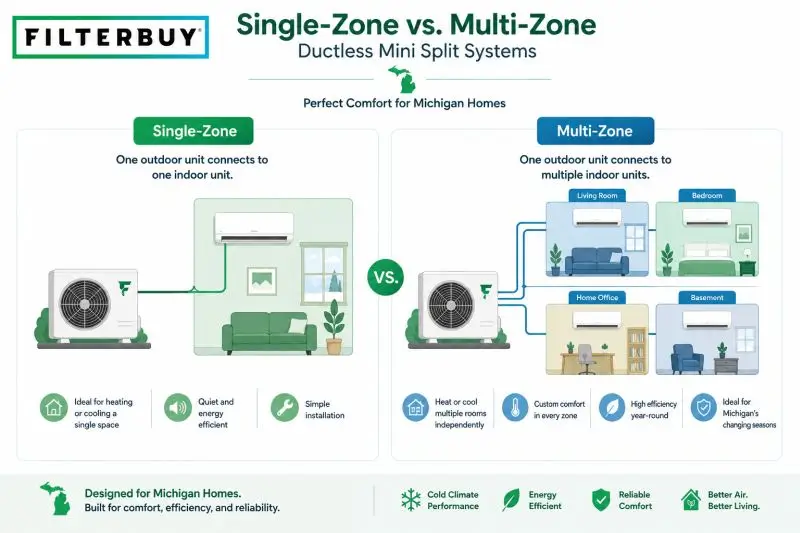
A mini split has two parts: an outdoor compressor and one or more indoor air handlers (wall-mounted, ceiling cassette, or floor console), connected by a small refrigerant line run through the wall. No ducts required. A single-zone system conditions one room; a multi-zone setup runs several indoor units off one outdoor unit, each with its own temperature control, so you only condition the spaces you’re actually using.
The Michigan-specific decision path, in four questions:
Does the space have ducts? No ducts → mini split is often the cheaper, less invasive option. Good ducts already → lean toward supplementing central air.
How are you heating today? Replacing electric baseboard or resistance heat? A mini split usually pays back in roughly 3–5 years and unlocks DTE’s electric-to-electric rebate. Heating with natural gas? The comfort case is strong, but the utility-rebate case is weaker (more on that below).
How cold does your location get? Southeast Michigan is milder than the Upper Peninsula. The colder your winters, the more you need a true cold-climate unit and possibly a backup heat source.
What’s your household income vs. Area Median Income (AMI)? At or below 150% AMI, Michigan’s HEAR rebate can cover a large share of the project, sometimes most of it. This single factor can swing the math more than the equipment brand.
Most Michiganders pay $2,500–$5,500 for a single-zone mini split and $5,000–$12,000+ for a multi-zone system, fully installed. Whole-home multi-zone projects (four to five indoor heads) commonly land at $10,000–$15,000, depending on square footage and how many zones you’re running. These are 2026 installed figures reflecting current Michigan labor rates.
Three things move the price more than anything else: the number of zones, the efficiency rating (SEER2 / HSPF2) of the equipment, and installation complexity. Long refrigerant line runs, second-floor or high-ceiling mounts, and electrical work all add hours. In our experience helping homeowners compare quotes, that first factor, how many indoor heads you run, swings the total far more than the brand name on the box, so decide your zones before you fixate on a model.
Ranges reflect fully installed pricing (equipment + labor). Your quote will vary with home condition and contractor.
Where the money goes. Equipment is usually 50–70% of the bill; labor is 30–50%. Licensed HVAC techs in Michigan charge roughly $75–$150/hour, and a standard single-zone install takes about 4–8 hours. Budget for common add-ons: a dedicated electrical circuit, extra refrigerant line (each additional ~10 feet adds $50–$150), a mounting pad or bracket, and permits ($100–$400 in most Michigan municipalities). Ceiling cassettes and floor consoles cost more to install than standard wall heads.
A money-saving tip that’s easy to miss: if you think you’ll eventually want a second zone, ask about a multi-zone-ready outdoor unit now. Adding a zone later almost always costs more than including it up front.
A bigger Michigan money-saver most quotes skip: many mini splits need a dedicated 230V circuit, and in an older Michigan home with a full electrical panel, that can add $500–$2,000 in electrical work before the unit even goes up. A handful of models, including Filterbuy’s 115V mini splits, run on a standard 115V outlet and can skip that upgrade entirely. Ask your installer which voltage your chosen model needs before you budget. It’s one of the biggest swing factors in a real quote.
For a national line-by-line breakdown by BTU size, see Filterbuy’s mini split installation cost guide. Weighing ductless against a traditional system? Compare them in mini split vs. central air.
It’s gone. The federal Section 25C Energy Efficient Home Improvement Credit, which paid 30% of a qualifying heat pump’s cost up to $2,000 expired December 31, 2025. It was terminated seven years early by the One Big Beautiful Bill Act (Public Law 119-21), signed July 4, 2025. The related Section 25D credit (solar and geothermal) ended on the same date.
The rule that catches people is the “placed in service” date, the day your system is installed, operational, and ready to use. Not the contract date, not the deposit, not the purchase date. If your mini split goes live on or after January 1, 2026, the 25C credit does not apply, even if you signed the paperwork in 2025.
Two things still matter here. First, if your system was fully installed by December 31, 2025, you can still claim the credit on your 2025 federal return (IRS Form 5695) filed in early 2026. Second, be skeptical of any 2026 contractor ad or older blog post still promising “$2,000 back from the IRS”. That information is out of date. (Source: IRS FAQs on the One Big Beautiful Bill energy credits.)
The good news: the rebate math shifted, it didn’t disappear. In many Michigan ZIP codes, state and utility programs now stack to more than the old federal credit ever paid on its own. You just claim them differently.
Filterbuy tracks this in depth in what happened to the federal mini split tax credit.
With the federal tax credit gone, state and utility rebates plus financing are the 2026 incentive stack in Michigan. Here’s what’s actually available, who administers it, and the catch on each.
Michigan’s federally funded rebates run through the Michigan Home Energy Rebates (MiHER) program, administered by the Department of Environment, Great Lakes, and Energy (EGLE) through CLEAResult. MiHER launched statewide in April 2025 and is accepting applications now. The HEAR track pays up to $8,000 for a qualifying heat pump for households at or below 150% AMI. Households under 80% AMI can receive up to 100% of project cost; those between 80–150% AMI, up to 50%.
The best part: HEAR is a point-of-sale discount applied on your contractor’s invoice, with no waiting for a tax refund. The non-negotiable rule: HEAR is not retroactive. You must be income-verified and working with an approved contractor before the work happens. Buy first and you forfeit the rebate. In our experience, that timing mistake is the most common way Michigan homeowners leave real money on the table. If you’re income-qualified, the smart move is to apply before you shop for a contractor, because state funding is finite and first-come, first-served. Start with EGLE or call CLEAResult at 855-510-7080. (Source: Michigan EGLE: Home Energy Rebates (MiHER).)
Michigan’s two big utilities run separate programs, and you can only use the one that serves your home. DTE covers southeast Michigan (metro Detroit); Consumers Energy covers west and central Michigan (Grand Rapids, Lansing, Kalamazoo, Flint, Traverse City). Check your utility bill to confirm.
The important honest caveat: DTE’s air-source heat-pump and ductless mini-split rebates are only for electric customers replacing electric heating, on individually metered single-family homes. If you heat with natural gas, as most Michigan homes do, you likely won’t qualify for that specific DTE rebate, though you can still pursue MiHER/HEAR if you’re income-eligible. Consumers Energy publishes a 2026 incentive catalog covering ducted, mini-split, and ground-source heat pumps for participating-contractor installs. (Sources: DTE heat pump & AC rebates; Consumers Energy heating & cooling rebates.)
How to think about stacking: In practice, an income-qualified Michigan household often layers HEAR (up to $8,000) + a utility rebate + Michigan Saves financing on the remaining balance. A gas-heated, higher-income household leans on Consumers/DTE efficiency rebates + financing. Rebates generally stack where each program’s rules allow, but one upgrade can’t be double-funded by two federal programs.
Yes, if you choose a cold-climate model. Modern inverter-driven mini splits modulate output like a dimmer switch and keep producing useful heat well below freezing. Cold-climate models publish their heating capacity at 5°F, and many hold useful output down to roughly 5–15°F below zero. That covers the vast majority of Michigan winter days.
The honest exception: on the coldest nights (think single digits and below, more common in northern Michigan and the U.P.), capacity drops, and a backup heat source (an existing furnace, electric strip heat, or a second system) is a wise design choice. Always check the specific model’s low-ambient heating capacity, defrost strategy, and AHRI ratings before buying, rather than trusting a generic spec.
For rebates and real Michigan performance, target roughly 16+ SEER2 and 9.1+ HSPF2. That’s the threshold DTE uses for its top cold-climate/mini-split rebate tier, and it’s a sensible floor for our climate generally. Higher HSPF2 means more heat per dollar on cold days.
What it costs to run. Because a heat pump moves heat instead of burning fuel, a cold-climate mini split can cut heating electricity use by up to 75% versus electric baseboard or resistance heat (U.S. Department of Energy), and it usually beats propane on all but the coldest days. Efficiency does slip as the temperature drops, which is why many Michigan homes run a dual-fuel setup, where the mini split carries fall, winter thaws, and the shoulder seasons, and an existing gas furnace takes over on deep-freeze nights.
Michigan isn’t one climate. It’s three. Where you live changes how you size the system and whether you should plan for backup heat. Here’s the quick regional read:
Design temperatures are approximate 99% ASHRAE values; confirm your exact figure with a local Manual J load calculation.
Two rules hold statewide: size to your region’s winter design temperature rather than square footage alone, and get a Manual J load calculation. Most Michigan building departments require one with the mechanical permit anyway. In the U.P. especially, a dual-fuel pairing (mini split for efficiency, gas furnace for the coldest hours) is the approach the DOE recommends for cold climates.
One 2026 equipment note: new mini splits now ship with A2L refrigerants, R-32 or R-454B, replacing the older R-410A under EPA’s HFC phase-down (AIM Act). These are mildly flammable and require updated installer handling and tools, which is one more reason to use a qualified pro. (Filterbuy’s own mini split lineup uses R-32.)
“After a decade of shipping filters into Michigan homes, through pollen season, wildfire smoke, and deep-freeze winters, the pattern is always the same: people buy the mini split for comfort, then are surprised it isn’t cleaning their air. A mini split’s mesh screen protects the machine, not your lungs. If you keep any ducted equipment, that’s still where your home’s air quality is won or lost.”
The Filterbuy team
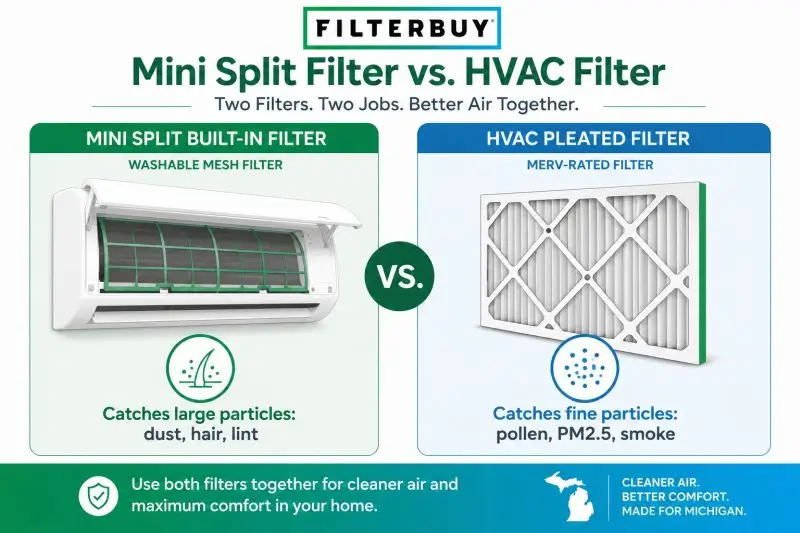
Here’s where we keep it straight, because most homeowners get this wrong: mini splits do not use the sized, pleated MERV filters you buy for a central system. Each indoor head has a built-in washable mesh filter you rinse roughly every 2–4 weeks. They don’t take a standard 1”–5” replacement filter, and there’s no subscription filter to swap.
Those mesh screens are great at catching large particles (dust, pet hair, lint), which mostly protects the equipment and keeps airflow strong. What they don’t do well is capture fine particles like PM2.5 and wildfire smoke. Some units accept optional carbon or anti-allergen inserts (replaced every 3–6 months) or add-on purifying modules, but a bare mesh filter alone is not a fine-particle solution.
So where does that leave your home’s air, and Filterbuy? Honestly:
If you’re adding a mini split to a few rooms but keeping your ducted furnace/AC for the rest of the house (the most common Michigan setup), that ducted system still needs a quality MERV-rated filter. This matters most in winter, when homes are sealed tight, and during summer smoke events. For everyday households, MERV 8–13 is the sweet spot, enough to catch common allergens and fine particles without choking airflow. The EPA’s Guide to Air Cleaners in the Home recommends MERV 13 (or the highest your system allows) for fine-particle and wildfire-smoke protection, and the American Lung Association gives the same guidance. Filterbuy makes those in 600+ standard and custom sizes, factory-direct, with auto-delivery so you’re never running on a clogged filter.
If you’re going fully ductless, clean the mesh filters on schedule and consider a standalone air purifier or optional carbon/HEPA-style insert for fine-particle and odor control. Filterbuy also sells ductless mini split units: 12,000 / 18,000 / 24,000 BTU R-32 heat pumps, built for projects exactly like this.
That’s the whole picture, with no overselling a filter that won’t fit your unit.
Want the deeper dive? See how mini splits affect your indoor air quality, and keep an eye on conditions with the live air quality map.
Check your air and your space. Look up your local AQI and note which rooms need help and whether they have ducts.
Check your income against AMI for your Michigan county. If you’re at or below 150% AMI, HEAR could cover much of the project, and it must be arranged before install.
Confirm your utility (DTE or Consumers) and your current heat source (electric vs. gas) to know which rebates you qualify for.
Apply for MiHER / rebates first through EGLE/CLEAResult or a participating contractor. Do not buy equipment yet.
Get 2–3 itemized quotes from licensed Michigan installers. Ask for the exact model, SEER2/HSPF2, refrigerant, 5°F capacity, and number of zones.
Choose a cold-climate model at 16+ SEER2 / 9.1+ HSPF2 or better, sized to your rooms (not oversized).
Install, commission, and keep your paperwork. Register the warranty; set a filter-cleaning reminder for the mini split and, if applicable, Filterbuy auto-delivery for your ducted system’s MERV filter.
Mini split (ductless mini split): A ductless heating-and-cooling system with an outdoor compressor connected to one or more indoor air handlers by a refrigerant line. Because it’s a heat pump, it both heats and cools.
Zone: One indoor air handler serving one area. Single-zone = one head; multi-zone = several heads on one outdoor unit, each independently controlled.
Heat pump: Equipment that moves heat rather than generating it, providing both heating and cooling. All mini splits are heat pumps.
Cold-climate heat pump: A model engineered to maintain heating capacity at low outdoor temperatures, with published capacity at 5°F, the right choice for Michigan.
SEER2 / HSPF2: SEER2 rates cooling efficiency; HSPF2 rates heating efficiency. Higher is more efficient. Roughly 16+ SEER2 / 9.1+ HSPF2 hits Michigan’s top rebate tiers.
Section 25C: The federal Energy Efficient Home Improvement Credit that paid up to $2,000 for heat pumps. Expired December 31, 2025 under the One Big Beautiful Bill Act.
HEAR (Home Electrification and Appliance Rebates): A federally funded, state-run rebate of up to $8,000 per heat pump for income-qualified households; in Michigan it’s delivered through the MiHER program.
MiHER (Michigan Home Energy Rebates): Michigan’s rebate program, run by EGLE through CLEAResult, that delivers HEAR and HOMES rebates.
HOMES: A whole-home efficiency rebate based on modeled energy savings; can’t be combined with HEAR on the same single upgrade.
AMI (Area Median Income): The income benchmark used to set HEAR/HOMES eligibility. Thresholds vary by Michigan county.
Michigan Saves: A nonprofit offering low-interest financing through authorized contractors that can stack on top of rebates.
A2L refrigerant (R-32 / R-454B): The lower-global-warming refrigerants that replaced R-410A in 2026 equipment under EPA rules; mildly flammable, requiring qualified installation.
MERV: A rating of how well a filter captures particles. MERV 8–13 suits most homes. This applies to ducted systems. Mini splits use washable mesh filters instead.
Placed in service: The date equipment is installed and operational, the date the IRS used to decide tax-credit eligibility.
Most single-zone installs run $2,500–$5,500 fully installed, while multi-zone systems for two or more rooms typically cost $5,000–$12,000+. Whole-home ductless projects reach $10,000–$15,000. Number of zones, efficiency rating, and installation complexity drive the price.
No. The federal Section 25C credit (up to $2,000) expired December 31, 2025 under the One Big Beautiful Bill Act. Systems placed in service in 2026 do not qualify. If yours was fully installed by December 31, 2025, you can still claim it on your 2025 return.
Michigan’s HEAR rebate pays up to $8,000 per qualifying heat pump for income-qualified households (at or below 150% AMI), plus HOMES whole-home rebates. DTE and Consumers Energy offer separate utility rebates, and Michigan Saves provides low-interest financing. Apply before installing.
Yes, but with conditions. DTE’s mini-split rebate (up to $1,200) is limited to electric customers replacing electric heat on individually metered single-family homes. Consumers Energy offers heat-pump incentives through participating contractors. Confirm current amounts with your utility.
A cold-climate model will keep heating well below freezing, with rated capacity down to about 5°F. On the coldest nights, especially in northern Michigan, plan for a backup heat source. Target 16+ SEER2 / 9.1+ HSPF2 for both performance and rebates.
In a home without ductwork, a multi-zone mini split can serve as the primary system. In a home with a good, newer central furnace, a mini split usually makes more sense as a supplement for problem rooms or additions.
Mini splits use built-in washable mesh filters you rinse every 2–4 weeks; they don’t take standard sized pleated filters. If you keep a ducted furnace or AC for the rest of your home, that system still needs a MERV 8–13 filter, and Filterbuy carries those in 600+ sizes with auto-delivery.
Three federal and state figures behind this guide:
≈90% indoors. Americans spend about 90% of their time indoors, where some pollutants run 2–5 times higher than outdoors.
Why it matters: your ducted system’s MERV filter does the fine-particle work a mini split’s mesh screen can’t.
Source: U.S. EPA: Indoor Air Quality
$211M / 15,000 homes. Michigan’s MiHER program has $211 million in federal funding to help up to 15,000 households, worth up to $34,000 per home.
Why it matters: it’s the pool behind the $8,000 HEAR heat-pump rebate, which is finite, so apply before you install.
30%+ lost to ducts. The U.S. Department of Energy says duct losses can top 30% of a home’s space-conditioning energy.
Why it matters: a ductless mini split has no ducts, so it skips those losses, ideal for additions and hard-to-heat rooms.
This guide is built on primary government and utility sources. Rebate funding and program rules change, so verify current figures before you commit.
U.S. IRS: FAQs on the One Big Beautiful Bill energy credits. Confirms the 25C and 25D credits ended for property placed in service after December 31, 2025.
Michigan EGLE: Home Energy Rebates (MiHER). The state’s HEAR and HOMES program details, eligibility, and how to apply.
DTE Energy: Heat pump & central-AC rebates. Current DTE rebate amounts and the electric-heat eligibility rules.
Consumers Energy: Heating & cooling rebates. Participating-contractor HVAC rebates for west and central Michigan.
U.S. EPA: Guide to Air Cleaners in the Home. Federal guidance to use a MERV 13 filter, or the highest your system allows.
U.S. EPA: Frequent Questions on the HFC Phasedown (AIM Act). The refrigerant transition from R-410A to R-32 and R-454B.
American Lung Association: Air Cleaning. Independent health guidance on HVAC filters and MERV ratings.
A mini split is one of the best ways to add comfort to a room ducts never reached. In 2026, Michigan’s rebates and financing can take a real bite out of the cost, even without the old federal credit. Match the equipment to our climate, apply for rebates before you install, and don’t forget the rest of your home’s air.
Next step: Check your local air quality → learn what’s in your air → find the right Filterbuy filter for your ducted system → set up auto-delivery so clean air shows up on schedule. Better Air For All.™