Mini Split Line Set Covers: How To Hide Refrigerant Lines For A Clean Look
AUTHOR Michelle Wan, Brand Manager and Air Quality Writer · REVIEWED BY David Clark, Licensed HVAC Technician · PUBLISHED September 1, 2026
Mini Split Line Set Covers: What They Are and What Size to Buy
A mini split line set cover is a rigid PVC channel that mounts to an exterior wall and encloses the refrigerant tubing, condensate drain, and control wiring running between the indoor air handler and the outdoor condenser. Size it by channel width, matched to your bundled line set with the insulation in place, not by your system's BTU rating. Residential energy code requires weather-exposed piping insulation to be protected and prohibits adhesive tape as that protection, so the cover is doing a job, not just tidying up.
Common channel widths and what each one holds:
- 3 in — one small line set plus drain and cable on a 9,000 to 12,000 BTU system
- 3.5 in — most single-zone residential runs, with clearance to spare
- 4 in — one line set with thicker insulation, drain, and cable
- 4.5 in — larger single sets, or two small sets in one channel
- 5.5 in — paired line sets, multi-zone risers, oversized insulation
Not sure which size fits your setup, or still choosing a system? Take the quick match quiz below, then see our ductless mini split systems.

Answer 3 quick questions and we'll match you to the right mini split system.
Ready to skip ahead? Filterbuy single-zone systems ship with a factory pre-charged line set rated for runs up to 25 feet.
What Is A Mini Split Line Set Cover?
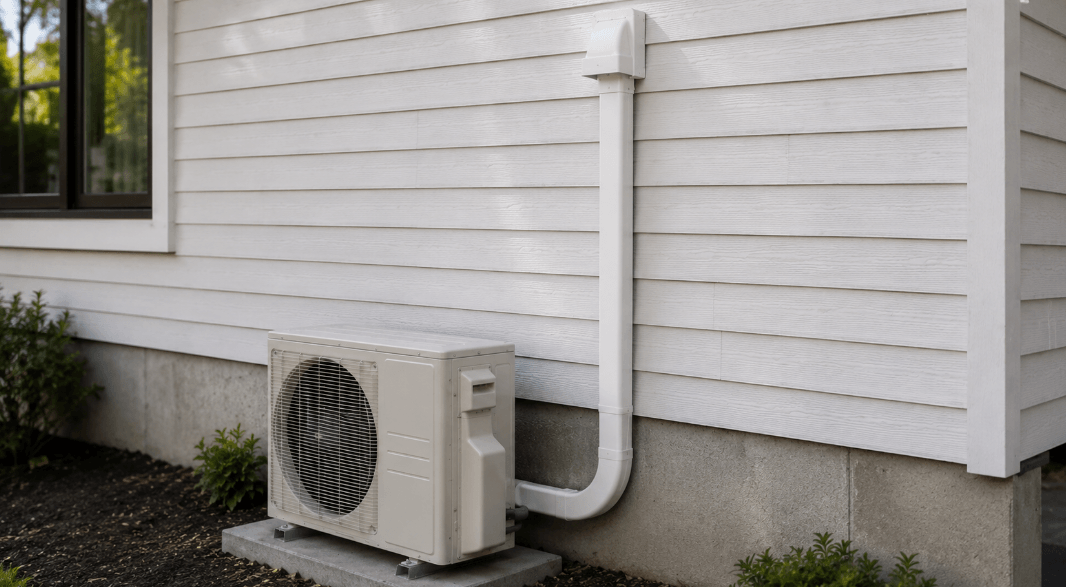
A mini split line set cover is a rigid PVC channel that mounts to an exterior wall and encloses the refrigerant tubing, condensate drain, and control wiring running between the indoor air handler and the outdoor condenser.
It is also sold as a lineset cover, a line hide kit, or a mini split raceway, and it snaps together over lines already in place.
The U.S. Department of Energy guidance on ductless minisplit heat pumps lists appearance among the drawbacks of going ductless, and the line set is usually what a homeowner notices first. Foam-wrapped copper taped to siding reads as unfinished from the moment the installer drives away, and within two summers the tape has gone chalky and started to lift. A cover solves how that looks, and it quietly solves a code problem the tape was creating all along.
TL;DR
A mini split line set cover is a snap-together PVC duct that conceals and protects the refrigerant lines running down an exterior wall. The sizing spec is channel width, most commonly 3 to 5.5 inches, matched to how many lines fit inside. A DIY kit runs $25 to $65, while professional systems from RectorSeal and Inaba Denko hold color and shape far longer. Installation is a weekend project, because the cover never touches the sealed refrigerant circuit.
Key Takeaways
Line set covers are functional, not decorative. Residential energy code requires weather-exposed piping insulation to be protected, and prohibits adhesive tape as that protection.
Channel width is the sizing spec that matters. A 3 inch channel handles one small line set, 4 to 4.5 inches fits most residential runs, and 5.5 inch handles paired sets.
Professional systems are two-piece. A base screws to the wall and a cover snaps onto it, so a technician can open the run later without cutting anything.
Installing a cover involves no refrigerant handling, so it carries none of the EPA certification requirements attached to line set work itself.
Most professional-grade covers are paintable. RectorSeal Fortress ships with a pre-paint matte finish and written painting instructions.
Filterbuy does not make line set covers. This page compares third-party systems on their published specifications and names the manufacturers that do make them.
Why A Line Set Cover Is More Than A Cosmetic Upgrade
Exposed refrigerant line insulation degrades in sunlight, and residential energy code treats protecting it as a requirement rather than a preference. A rigid cover is what satisfies that requirement, and the adhesive tape most installations finish with is specifically excluded from counting as protection.
Section R403.4.1, protection of piping insulation, of the residential energy code requires weather-exposed piping insulation to be protected from sunlight, moisture, physical damage, and wind, and prohibits adhesive tape. The Department of Energy code compliance brief for ductless mini split heat pumps adds that the conduit passing through the exterior wall brings wall-penetration provisions into play as well.
That distinction matters, because tape is exactly what a fast installation reaches for. On a ductless system the expansion valve sits in the outdoor unit, which means the narrow liquid line runs cold as well and both copper lines carry foam. Pacific Northwest National Laboratory has published photographs of refrigerant line set insulation that is still physically intact yet significantly degraded by ultraviolet exposure, and it notes that most pipe insulation sold in hardware stores is not UV rated to begin with.
The wall penetration is the second weak point, and it is the one nobody thinks to inspect. RectorSeal's 2024 line set cover patent, U.S. Patent 12,129,647, describes the failure plainly in its own background section, noting that installers commonly seal the opening with soft foam fillers and adhesive tapes, that outdoor exposure causes those closures to fail, and that inadequate protection at the penetration degrades HVAC efficiency and raises energy consumption.
A properly built cover run answers both problems, shielding the insulation from ultraviolet light and, paired with a wall inlet fitting, giving the penetration a weatherproof termination rather than a bead of caulk.
What Size Line Set Cover Do I Need?
Line set cover sizing is expressed as channel width, and the right number depends on how many lines and how much insulation must fit inside, not on your system's BTU rating.
Measure the bundled line set with its foam in place, then add room for the drain and the control cable. Cover width is a separate question from mini split line set length, which the manufacturer caps rather than the channel.
Channel width is a nominal duct dimension taken from manufacturer documentation. Fittings such as wall inlets measure wider than the duct they serve, and retail listings sometimes quote the fitting dimension instead. Confirm the internal clear dimension against your bundled line set, including insulation, before ordering.
Two facts are worth knowing before you order. RectorSeal Fortress lineset covers come in 3.5 inch and 4.5 inch channel only. Inaba Denko's Slimduct SD straight duct comes in 3 inch, 4 inch, and 5.5 inch. Retail kits split the difference at 3 and 4 inches, and the widest channels exist mainly for multi-zone systems running paired sets on one route. Fittings are not cross-compatible between brands, and mixing them voids warranty, so pick one system and stay inside it.
Before You Buy: Two Checks That Change What You Order
Two things decide whether the cover you order is the right one, and both take about five minutes with a tape measure.
Check One: Measure The Bundle, Not The Pipe
Press a straightedge across the face of the bundle and measure its width, then measure its depth from the wall outward. Depth is the number that gets people, because the channel has to close over it. Compare that depth against the internal clear dimension in the manufacturer table rather than the nominal size printed on the box. Inaba Denko lists the SD-77 as a 3 inch cover with an internal depth closer to 2.5 inches, so a bundle measuring 2.5 inches deep is at the limit before a fastener goes in.
If the equipment came from Filterbuy, the system shipped with a factory pre-charged line set rated for runs up to 25 feet, so the tubing is a known quantity and only the insulation around it has to be measured.
Check Two: Look At The Foam Before You Order Anything
Pull back any existing tape and look at the insulation underneath before you order anything. Pacific Northwest National Laboratory recommends checking exterior line insulation once a year and replacing it whenever it is cracked, chalky, or missing. A cover installed over foam that has already failed hides the problem instead of fixing it, and the run has to come apart again to put it right, so replace the insulation first and cover it afterward.
While the run is open, look at the penetration itself. Exposed insulation is nesting material and a gap there is an entry point, so seal it as part of the same job.
Which Line Set Cover Should You Buy?
The real choice is between a low-cost consumer kit and a professional component system, and the difference shows up in year three rather than on install day.
Consumer kits arrive as a sealed box with a fixed assortment of parts, while professional systems sell ducts and fittings individually so you buy exactly what the route needs.
RectorSeal and Inaba Denko are independent manufacturers. Filterbuy is not affiliated with or endorsed by either, and every figure below comes from their own published documentation, confirmed in August 2026.
Retail kit specifications vary by seller and are not standardized. Manufacturer figures are from RectorSeal and Inaba Denko America product documentation, verified August 2026.
A consumer kit is fine on a short, straight run in shade. Once the run gets long, faces the sun, or turns more than once, the professional system starts earning its price. Fittings are the reason, and Fortress alone offers seventeen of them.
How To Install A Mini Split Line Set Cover
You can install a line set cover yourself, because the cover never touches the sealed refrigerant circuit. No part of the job calls for refrigerant handling, certification, or a vacuum pump, which is what separates it from installing the system itself.
That distinction matters for your warranty. Filterbuy mini splits are single-zone systems requiring professional installation, and self-installing one voids the coverage. Fitting a cover afterward does not, because the cover sits outside the equipment.
Plan on two to four hours, with a drill, a level, a tape measure, a PVC cutter, exterior-rated fasteners, and UV-stable silicone on hand. This is a different job from a DIY mini split installation, and it comes after the how to install a mini split steps are finished.
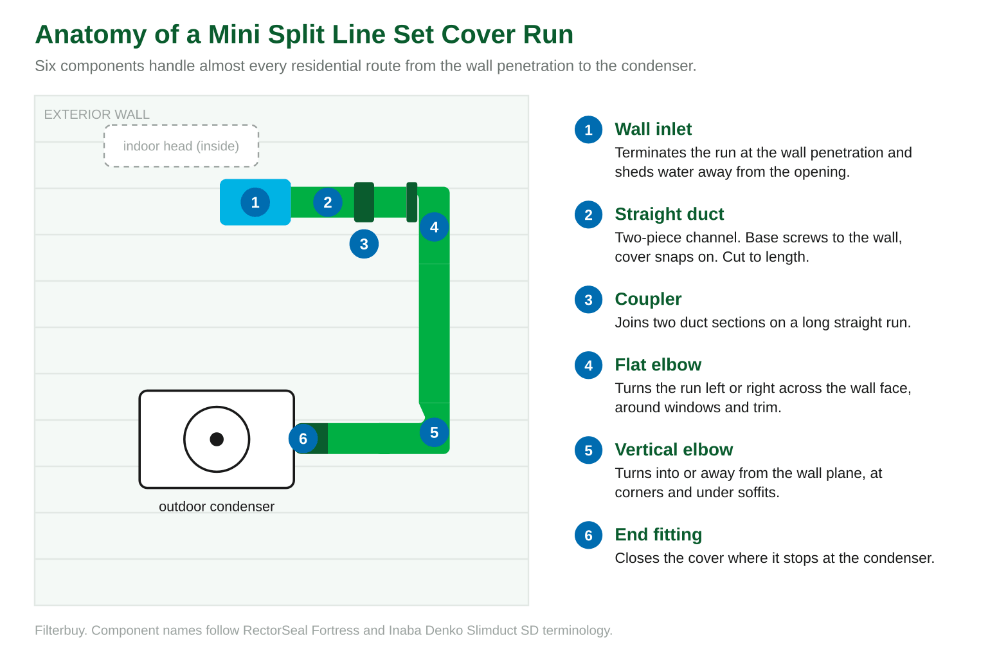
Map the route before buying. Walk the path from wall penetration to condenser and mark every direction change. Count elbows, couplers, and end fittings, then order.
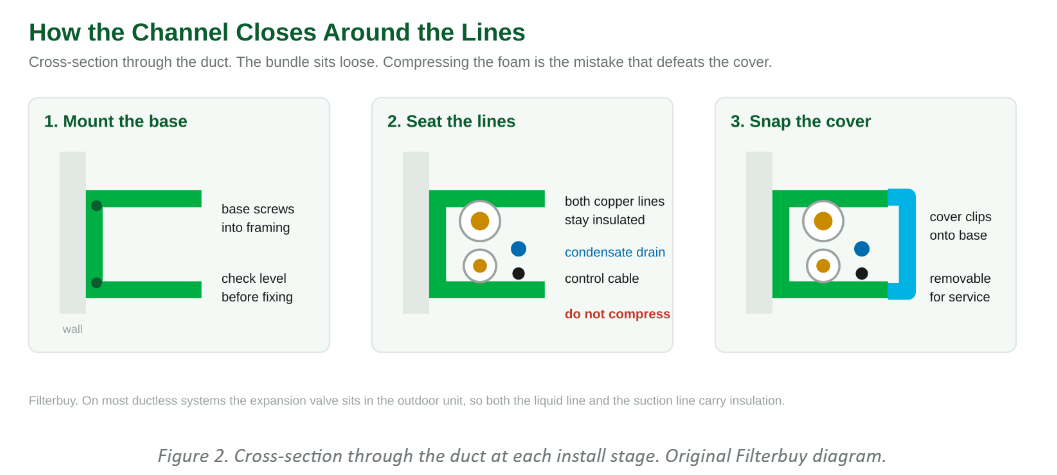
Measure and cut the base. Cut base sections, not assembled channel, and dry-fit the run before driving a screw.
Fasten the base to the wall. Anchor into framing or use fasteners rated for your siding, keeping the run level and the base from bowing.
Seat the lines without crushing them. Lay lines, drain, and cable into the base. Never compress the foam to make the bundle fit. If it will not sit loosely, the channel is too narrow.
Snap on covers and fittings. Work from the wall inlet downward so every joint sheds water away from the building.
Seal the penetration properly. Apply UV-resistant silicone at the wall inlet. Inaba Denko specifically recommends a silicone with strong UV resistance at this joint.
Terminate at the condenser. Fit an end socket where the cover stops, leaving a service loop a technician can reach.
How Much Does A Line Set Cover Cost?
A DIY line set cover kit costs $25 to $65 for 7 to 18 feet of finished run, and a professional-grade run costs roughly $150 to $400 in parts depending on length and fitting count.
Professional components are priced per piece, with Fortress fittings running $11 to $37 each at distributor pricing, so a route with four turns adds up.
When a contractor fits the cover inside a larger job, labor folds into the mini split installation cost rather than showing up as a separate line.
Our Take: Buy The Fittings, Not The Footage
Line set cover kits are sold by length, and length is the wrong unit. A route is defined by its turns, not its feet.
Every failure described above happens at the wall penetration, at a direction change, or inside a channel sized to a price rather than to the bundle, and none of those is a length problem. A 17-foot kit carrying two elbows will not finish a 9-foot run that turns three times, and the piece that ends up missing gets improvised with tape.
Filterbuy comes at this from filtration rather than installation, and that vantage point is why the pattern stands out. The components people leave out are the cheap ones, and the cheap ones keep the expensive ones alive.
Can You Paint A Mini Split Line Set Cover?
Yes. Most professional-grade PVC line set covers are built to be painted, and the better systems ship with a matte pre-paint finish and written instructions for doing it properly.
RectorSeal supplies Fortress with a pre-paint matte finish and written painting instructions, and offers it in white, ivory, brown, and gray for anyone who would rather match the wall without painting. Slimduct SD comes in gloss white, ivory, brown, and black.
Use an exterior acrylic latex over a bonding primer rated for PVC, and paint the components before assembly, since seated joints and screw heads are difficult to coat cleanly once the run is together.
"A line set cover is the cheapest line item on a ductless installation and the only one that decides whether the rest of the assembly survives a decade of sun. We would rather a homeowner spend forty dollars on the right fittings than four hundred replacing insulation that was never protected in the first place."
- David Heacock, Founder and CEO, Filterbuy
Supporting Statistics
Three U.S. government figures behind the case for a line set cover, all verified August 2026.
88 percent of U.S. households use air conditioning, and 50 percent of Northeast homes rely on individual units, a category that includes mini splits. That is the installed base with refrigerant lines running down an exterior wall. Source: EIA, Residential Energy Consumption Survey 2020
Residential code sets a minimum of R-4 on refrigerant vapor lines, and mini splits typically need the liquid line insulated too. Two insulated lines sit inside the channel, and crushing either one defeats a code-required assembly. Source: Seattle Department of Construction and Inspections, Refrigerant Line Insulation interpretation
Space heating and air conditioning account for 52 percent of annual home energy use. The equipment fed by that line set is the largest single load in the house. Source: EIA, Use Of Energy In Homes
Frequently Asked Questions
Glossary
Line set. The insulated copper tubes carrying refrigerant between the indoor and outdoor units.
Wall inlet. The fitting terminating the cover at the wall penetration.
End fitting. The trim piece closing the cover at the condenser.
Condensate drain. The tube carrying water from the evaporator coil, routed inside the same cover.
R403.4.1. The energy code section governing protection of weather-exposed piping insulation.