
Inverter vs. Non-Inverter Mini Split:
Which Technology Saves More?
Is An Inverter Mini Split Better Than A Non-Inverter Model?
Yes, for most homes an inverter mini split delivers steadier comfort and lower energy use than a non-inverter model. A non-inverter compressor runs at full power then shuts off completely, which causes temperature swings and a noisy restart. An inverter compressor ramps up and then holds a lower, steady speed, which can use up to 30 to 50 percent less electricity than a standard system.
- Non-Inverter: full-power blast, then shuts off completely
- Inverter: ramps up, then holds a steady, lower speed
Answer three quick questions below and we will match you to the right mini split for your space.

Answer 3 quick questions and we will match you to your perfect mini split.
TL;DR
Inverter mini splits use a variable-speed compressor that ramps to match demand, while non-inverter models run at one speed and switch fully on or off. Inverter units cost more upfront but use roughly 30% to 50% less energy, run quieter, and strain the compressor less. Non-inverter units remain reasonable for light, occasional-use spaces such as a garage or guest room.
Key Takeaways
Inverter compressors ramp between roughly 25% and 100% capacity instead of switching fully on and off, which is why they save energy and run quieter.
Inverter mini splits commonly carry SEER2 ratings of 16 to 30 or higher, versus roughly 13 to 18 for non-inverter systems.
Inverter indoor units typically run 19 to 26 decibels on low fan, quiet enough for a bedroom, while non-inverter units cycle louder at full power.
Fewer hard starts mean less mechanical wear, which is why inverter mini splits often reach 15 to 20-plus years of service.
Both technologies use the same filter housing, so upgrading to a higher MERV rating works the same way regardless of compressor type.
Non-inverter systems tolerate incorrect sizing far less than inverter systems, which also control humidity better since they run longer at lower speeds.
The federal 25C tax credit for qualifying heat pumps expired for equipment placed in service after December 31, 2025, and should not factor into a 2026 purchase.
Two mini splits can look identical on a spec sheet and still cost very different amounts every August. The difference comes down to the compressor, which sets the SEER2 rating, the noise at night, how long the system lasts, and what it costs to run.
Filterbuy manufactures the filters inside both technologies, and our HVAC Solutions technicians install and service these systems statewide.
What Is An Inverter Mini Split?
An inverter mini split uses a variable-speed compressor, controlled by an onboard drive, to continuously adjust output to match real-time demand. Rather than shutting off at target temperature, it slows and keeps running at a lower speed, operating anywhere from roughly a quarter of capacity up to 100%.
What Is A Non-Inverter (Standard-Cycle) Mini Split?
A non-inverter mini split uses a fixed-speed compressor that runs at one output level, fully on or fully off. It jumps to full power, runs until the room hits set temperature, shuts down, then repeats once the room drifts off again. This is cheaper to build, but the compressor takes a hard start every time it kicks on. See Filterbuy's complete mini split buying guide for more on ductless systems.
Inverter vs. Non-Inverter Mini Split: Efficiency And Energy Bills
Direct answer: Inverter mini splits typically carry SEER2 ratings from about 16 to 30 or higher, versus 13 to 18 for non-inverter models, translating to roughly 30% to 50% lower energy use.
SEER2 ranges reflect typical residential equipment as of 2026. Confirm the certified rating on the specific model's AHRI certificate before publishing exact figures.
Air conditioning is one of the largest single electricity end uses in U.S. homes, so this efficiency gap shows up directly on a monthly bill. Filterbuy's mini split energy efficiency guide breaks down how SEER2 translates into dollars, and ENERGY STAR's ductless program independently verifies manufacturer claims.
Which Mini Split Runs Quieter? Noise Levels Compared
Direct answer: Inverter mini splits run quieter because the compressor ramps gradually instead of slamming to full power. Indoor units commonly measure 19 to 26 decibels on low fan speed, versus louder full-power cycling from non-inverter models.
Decibel figures are manufacturer-published approximations and vary by brand, model, and installation. Reference scale adapted from OSHA's decibel guidance.
An inverter unit never produces the abrupt startup noise of a fixed-speed compressor jumping from off to full power. A federal reference scale places a quiet library around 30 to 40 decibels and normal conversation around 50 to 60, putting a 19 to 26 dB rating in perspective.
"Non-inverter systems are almost always the ones I get called out for. A customer hears the compressor kick on and off all night and assumes something's broken. That conversation usually ends with me recommending an inverter system for their next install." — David Clark, Licensed HVAC Technician, Technical Reviewer
Longevity And Wear: How Compressor Technology Affects Lifespan
Direct answer: Inverter mini splits often reach 15 to 20-plus years because the compressor ramps up gradually instead of hard-starting, while non-inverter models typically last 10 to 15 years since repeated full-power starts add mechanical stress over time.
A hard start sends a fixed-speed compressor from a dead stop to full power almost instantly, straining the motor and bearings across thousands of cycles. An inverter compressor ramps up gradually and settles into a steadier speed. Field validation of variable-speed cold-climate heat pumps found no widespread reliability issues across 22 monitored installations, and reliability also tracks by brand, covered in Filterbuy's mini split brand reliability comparison.
Inverter: commonly 15 to 20-plus years with routine filter and coil maintenance.
Non-inverter: commonly 10 to 15 years, with hard-start compressor failure the most frequent cause of early replacement.
A dirty filter shortens the life of either technology.
Sizing Tolerance And Humidity Control: The Factor Most Guides Skip
Direct answer: Non-inverter mini splits tolerate incorrect sizing poorly. An undersized unit runs full power nonstop without catching up. An oversized one cools fast, shuts off, and leaves the room humid. Inverter systems modulate output, so an imperfect BTU match still performs well.
Undersized non-inverter: runs nonstop at full power, driving up energy use and compressor wear.
Oversized non-inverter: cools fast, shuts off before dehumidifying finishes, and leaves the room cold but sticky.
Inverter systems: modulate to match the room, tolerating an imperfect size far better than a fixed-speed unit, though a proper Manual J load calculation still matters for either technology.
Runtime length, not just temperature drop, pulls moisture from the air. A non-inverter system that cools a room in ten minutes removes far less humidity than an inverter system running at low speed for an hour, which is why a room can read 72°F and still feel damp.
Upfront Cost vs. Long-Term Payback
Direct answer: Inverter mini splits cost more to buy and install, but the efficiency gap typically pays back the difference within roughly 3 to 7 years through lower energy bills. See Filterbuy's mini split cost breakdown for pricing by zone count, BTU size, and brand.
At $0.15 per kWh, a properly sized 12,000 BTU inverter unit runs roughly $36 a month cooling eight hours a day, versus $50 to $60 for a comparable non-inverter unit that cannot back off from full power. That gap turns a modest upfront price difference into a payback measured in years, not decades.
The federal Section 25C tax credit that once covered up to $2,000 of a qualifying heat pump expired for equipment placed in service after December 31, 2025, under Public Law 119-21, and does not apply to installations completed in 2026 or later.
Filter Compatibility And Air Quality: What Actually Changes
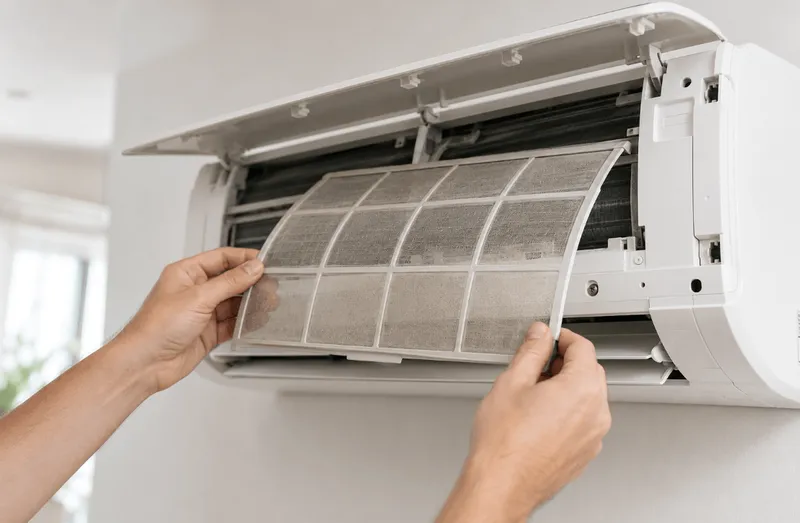
Direct answer: Compressor technology has no effect on filter compatibility. Both inverter and non-inverter mini splits use the same washable pre-filter behind the indoor unit's front panel, and both can typically be upgraded to a higher-MERV replacement filter using the same size and mounting method.
Filterbuy builds replacement filters in the sizes major mini split brands use. Every mini split pulls return air through a filter behind the front panel before it passes over the coil. Manufacturers generally ship a basic washable mesh filter that catches dust and larger particles rather than fine particulates, which is why many households upgrade to a MERV-rated filter, especially during allergy season or wildfire smoke events. Filter access depends on how the unit is mounted, covered in Filterbuy's mini split mounting options comparison.
Higher-MERV filters capture smaller particles but add airflow resistance, so decide upfront whether your air quality goals call for a standard or higher-MERV filter and set a replacement schedule.
Which Should You Choose? A Quick Decision Guide
We usually ask one question first: how many hours a day will this room actually be conditioned? That answer resolves most of the decision.
Choose inverter for a bedroom, living room, home office, or any room that runs most of the day and year, or where noise is a priority such as a nursery or shared wall.
Non-inverter can make sense for a garage, workshop, or seasonal guest room used only occasionally, where the lower price outweighs limited hours of use.
Confirm the SEER2, EER2, and HSPF2 ratings on the AHRI certificate before buying, since similarly priced units can carry different certified efficiency. Filterbuy's step-by-step guide to choosing a mini split system covers sizing, voltage, and other specs.
"After manufacturing filters for over a decade and serving more than two million households, we've found that the compressor matters just as much as the filter behind it. A properly sized, well-maintained inverter system will out-save and out-last a fixed-speed unit in almost every home we've studied." — David Heacock, Founder & CEO, Filterbuy
Frequently Asked Questions
7 Official Resources We Verified Before You Buy A Mini Split
ENERGY STAR's Ductless Heating & Cooling page confirms whether a model earned certification. Source: ENERGY STAR — Ductless Heating & Cooling
The DOE's guidance on residential air-source heat pumps explains how SEER2 and HSPF2 replaced older ratings in 2023. Source: U.S. Department of Energy — Purchasing Energy-Efficient Residential Air-Source Heat Pumps
The EPA's explainer on MERV ratings shows what each rating level captures. Source: EPA — What is a MERV Rating?
The IRS's guidance on home energy tax credits confirms Section 25C expired after December 31, 2025. Source: IRS — Home Energy Tax Credits
The AHRI Directory of Certified Product Performance verifies the efficiency certificate for a specific model. Source: AHRI Directory of Certified Product Performance
OSHA's technical guidance on noise puts everyday sounds on the same decibel scale as equipment ratings. Source: OSHA — Noise and the Decibel Scale
The EIA's data on electricity use in homes shows how much of a bill cooling and heating represent. Source: U.S. EIA — Electricity Use in Homes
Supporting Statistics: The Research Behind This Guide
Heating accounts for roughly one-third of total residential energy use in the U.S., per field research from the National Laboratory of the Rockies, formerly NREL. Source: National Laboratory of the Rockies — Field Validation of Air-Source Heat Pumps for Cold Climates
A Pacific Northwest National Laboratory field validation for the DOE, published January 2025, monitored 22 variable-speed cold-climate heat pumps and found a median heating COP of 1.6 to 2.7 below 30°F, with homeowner satisfaction rising from 3.61 to 3.88 out of 5. Source: PNNL — Field Validation Report (PNNL-37127)
Public Law 119-21, Sections 70505 and 70506, terminated two federal credits worth up to $2,000 each toward a qualifying heat pump for equipment placed in service through December 31, 2025. Source: Public Law 119-21 (govinfo.gov)
Glossary
Inverter Compressor: Adjusts output between roughly 25% and 100% capacity to match real-time demand.
Non-Inverter (Fixed-Speed) Compressor: Operates at one output level, fully on or off.
SEER2: The current DOE cooling-efficiency metric, adopted in 2023.
HSPF2: The current heat pump heating-efficiency metric.
Ductless Mini Split: An outdoor compressor linked by refrigerant lines to indoor air handlers, with no central ductwork.
MERV: A 1-to-16-plus scale rating how well a filter captures particles between 0.3 and 10 microns.
R-32 Refrigerant: A common mini split refrigerant with lower Global Warming Potential than older refrigerants.
Payback Period: The time for energy savings to equal the extra amount paid upfront.