A Florida mini-split runs about $1,500 to $14,500 installed in 2026, depending on how many rooms you cool and the BTU size each one needs. Florida utility rebates and PACE financing can lower that cost, but which programs apply depends on your utility and your unit — so confirm current eligibility before you buy.
The federal energy tax credit that older guides still cite ended after 2025, so plan around current Florida programs instead. Duke Energy Florida and JEA offer rebates on qualifying ductless systems. FPL's rebate covers central AC only, and the HEAR and HOMES programs aren't available in Florida right now.

Answer a few quick questions and we'll point you to the right mini-split system for your home.
Prefer to browse first? See our mini-split systems ›
A Florida home spends 28% of its energy on air conditioning. A home in Maine spends 2%.
That gap is why mini-splits pay back faster in Florida than almost anywhere else. It's also why installing one here follows a different playbook than up north. Humidity changes how you size the unit. Summer demand changes labor costs. And half the rebate content you'll find online gets the Florida part wrong — FPL's rebate doesn't cover mini-splits, the HEAR and HOMES programs aren't available here, and the federal Section 25C credit rules have shifted twice since the Inflation Reduction Act was signed.
We'll cover it all: what installs cost in 2026, which rebates and tax credits actually apply in Florida, how to size a unit for our heat and humidity, and the filter setup that keeps your new system running right.
Installed cost runs $1,500 to $14,500 in 2026, depending on how many rooms you're cooling and what BTU size each one needs. Stacked rebates and credits can cut that by 15 to 30% when you line them up right.
The rebates that actually apply in Florida:
Federal Section 25C tax credit: Expired December 31, 2025. Only eligible systems placed in service by that date can still be claimed through IRS Form 5695 on a 2025 tax return.
Duke Energy Florida Home Energy Improvement Program: up to $1,150 on qualifying systems (requires a free Home Energy Check first)
JEA (Jacksonville): $200 on ENERGY STAR-certified ductless mini-splits
Florida PACE programs: 100% financing repaid through your property tax bill (financing, not a rebate, but it removes the upfront cost barrier)
What trips people up:
FPL's residential HVAC rebate covers central AC only. It doesn't apply to mini-splits.
Florida returned its $346 million HEAR/HOMES allocation. Those federal-state rebates aren't available here right now.
Heat pump mini-splits previously qualified for a federal tax credit of up to $2,000, but that credit expired December 31, 2025. In Florida, heat pumps remain the preferred option for many homeowners because they provide both heating and cooling.
Florida's 10-to-12-month cooling season pays back an efficient mini-split 30 to 50% faster than the same unit installed up north.
Installed cost runs $1,500 to $14,500, driven mostly by zone count and BTU size.
The size of Florida units is about 25% higher in BTU than national calculators suggest. Humidity is a real load.
Duke Energy Florida has the most generous utility rebate for mini-splits. FPL's program doesn't cover them at all.
Heat pump beats cooling-only. The tax credit is $2,000 rather than $600, and Florida winters are mild enough that the heat pump runs at peak efficiency.
Florida attics hit 130°F in July. That's a problem if your AC relies on ducts running through the attic, because 30% or more of the cold air you paid for can be lost to duct leaks and thermal gain before it reaches your living room. A ductless mini-split skips that loss entirely.
It also handles humidity better than most central systems. The inverter-driven compressor modulates constantly instead of cycling fully on and off, which lets it pull moisture out of the air while it cools. That's the difference between a room that feels comfortably cool and one that feels clammy at the same temperature.
And it gives you zone control. Cool the bedroom at night, the living room during the day, and skip the guest room nobody's using. Rooms you're not in don't cost you anything extra.
Modern air conditioning systems have come a long way. Ten or fifteen years ago, a central AC was doing well to hit 14 SEER. Today's ductless mini-splits routinely deliver 22 to 33 SEER2. In a climate where the system runs almost year-round, that efficiency gap shows up on your electric bill every month.
Zone count and BTU size do most of the work here. Electrical panel condition is the wildcard that can add $300 to $1,500 on older homes.
Florida installs in 2026, fully installed:
Single-zone 9,000 BTU: $1,300 to $2,600 (bedroom or home office)
Single-zone 12,000 BTU: $1,600 to $3,300 (master bedroom or small living area)
Single-zone 18,000 BTU: $2,000 to $4,500 (large living area or open great room)
Single-zone 24,000 BTU: $2,400 to $5,700 (large open floor plan)
Multi-zone, 2 to 3 zones: $4,200 to $9,200
Multi-zone, 4 to 5 zones: $7,800 to $14,800
What makes Florida different:
Permit fees run from $150 to $500 by county. Miami-Dade and Broward typically sit at the top of that range.
Licensed HVAC technicians charge $85 to $165 an hour. Tampa, Orlando, and South Florida lean high.
Coastal wind-load brackets for the outdoor condenser add $75 to $200 in hurricane-exposed counties.
A2L refrigerants (R-32 and R-454B) are standard on 2026 systems. Markets where installer training is newer may tack on a small labor premium.
Older homes often need a new 240V circuit for the outdoor unit. Panel upgrades run $300 to $1,500.
One piece of advice we give every homeowner calling about an install: ask for three line-item quotes, not three total-cost quotes. Any contractor who won't break out unit cost, labor hours, line set length, electrical work, and permits separately is one you can't fairly evaluate on price.
Florida's rebate situation is straightforward once you strip out the programs that don't apply here. Here's how it sorts out in 2026.
The Energy Efficient Home Improvement Credit pays 30% of the installation cost up to $2,000 a year on ENERGY STAR-certified heat pump mini-splits. Your system has to meet the current-year SEER2, EER2, and HSPF2 thresholds, and you file IRS Form 5695 with your return. The rules have shifted a few times since the Inflation Reduction Act HVAC provisions were signed, and starting with the 2025 tax year, the IRS now requires a Qualified Manufacturer ID on eligible claims. Confirm current-year eligibility at energystar.gov before you buy, and work with a tax professional on your filing.
This is the strongest Florida utility rebate for mini-splits, paying up to $1,150 on qualifying installs. One prerequisite: Duke Energy requires a free Home Energy Check completed within 24 months before your install starts. Schedule that first, then line up the install.
FPL's $200 instant rebate covers full central AC replacement. It doesn't cover ductless mini-splits. Generic HVAC content online gets this wrong often. If you're an FPL customer adding a mini-split, focus on the federal tax credit instead. FPL isn't going to help with this one.
JEA pays $200 on ENERGY STAR-certified ductless mini-splits. The application window is 90 days from install, and the current program-year deadline is October 10, 2026.
Tampa Electric and Orlando Utilities Commission both run HVAC rebate programs. Amounts and eligibility change year to year, so confirm directly with each utility before buying.
Property Assessed Clean Energy programs — Ygrene, RenewFinancial, and the Florida PACE Funding Agency — offer 100% financing for qualifying HVAC, including mini-splits. You repay through your property tax assessment over 10 to 25 years. It's financing, not a rebate, but it takes the upfront cost barrier off the table for larger multi-zone projects.
You've likely seen coverage of the federal HEAR and HOMES rebate programs, which can pay up to $14,000 and $8,000 per household. Florida returned its $346 million allocation for those programs, so Florida homeowners cannot access those rebates right now. Any article that says otherwise is out of date.
National BTU calculators undersize for humid climates almost by default. A Florida home usually needs about 25% more BTU per square foot than those calculators suggest, because humidity is a genuine load the unit has to pull down.
Rough sizing, Florida-adjusted:
Bedroom or small office, 100 to 150 sq ft: 9,000 BTU
Medium room, 150 to 250 sq ft: 12,000 BTU
Large living area, 250 to 400 sq ft: 15,000 to 18,000 BTU
Open floor plan or great room, 400 to 700 sq ft: 18,000 to 24,000 BTU
Glass-walled Florida room or sunroom: add 30 to 50% for solar heat gain
For cooling a Florida room or sunroom specifically, that 30-to-50% bump is not optional. Glass-walled rooms act like greenhouses from noon to 4 p.m. Sizing on square footage alone gets you a unit that runs constantly and still can't keep up.
Have a licensed Florida HVAC contractor run a Manual J load calculation before you buy equipment. It's the industry-standard sizing method, and most Florida permit offices require it on residential HVAC work.
What to look for on the spec sheet:
SEER2 of 17 or higher. Florida's long cooling season makes the efficiency premium pay back in 4 to 6 years.
ENERGY STAR certification. Required for the federal tax credit and for every Florida utility rebate.
Heat pump function, not cooling-only. Tax credit is $2,000 versus $600, and the heat pump covers Florida's 2 to 4 annual cold snaps without resistance backup.
Corrosion-protected coils. Salt air eats standard copper. Essential within 5 miles of the coast.
Hurricane-rated outdoor bracket. Code requires this in many Florida counties anyway.
Parts warranty of 7+ years, compressor warranty of 10+ years. Shorter warranties signal a brand that won't be around in year eight.
Brand-wise, Florida homeowners do well with premium lines (Mitsubishi Electric, Daikin, Fujitsu), mid-tier options (LG, Gree, Samsung, Carrier), or established value brands (MRCOOL, Senville, Pioneer). Red flags to watch for regardless of brand name: no AHRI-certified performance ratings, warranties under 5 years, and no U.S. parts distribution network.
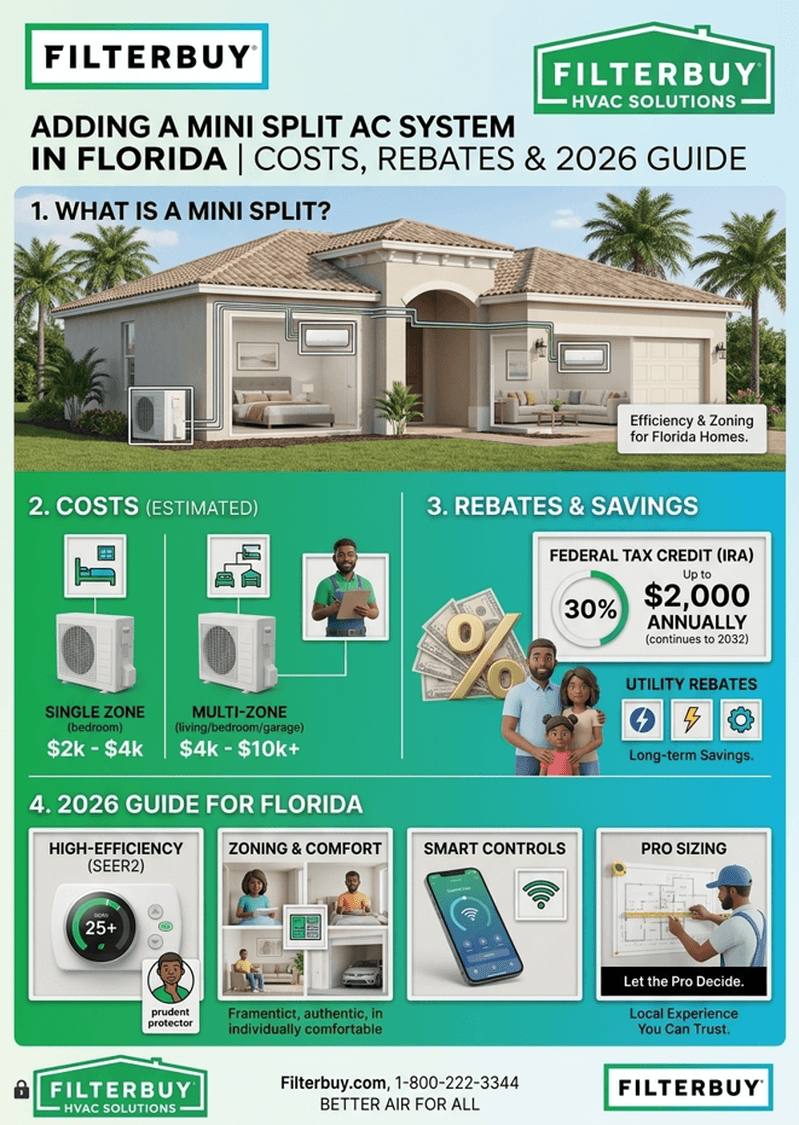
“The biggest install mistake we see in Florida isn't brand or budget. It's sizing. An undersized mini-split will cool a room to 72°F and leave the humidity at 65%, which feels clammy and grows mold. Size the unit 20 to 25% higher than the national BTU calculator tells you, and you avoid the problem entirely.”
— The Filterbuy Team
These seven sources are where we send every homeowner who wants to verify what's in this guide. Each one is a primary source — the original document, not someone else's summary of it.
The U.S. Department of Energy consumer page is the clearest explanation of how ductless mini-splits work, why they beat ducted systems on efficiency, and what to think about before installing one. Read this before you talk to a contractor.
Source: U.S. Department of Energy
ENERGY STAR maintains the current-year list of qualifying models, SEER2/HSPF2 thresholds, and credit caps for heat pump mini-splits. The list updates regularly, so don't assume last year's rules still apply.
Source: ENERGY STAR
IRS Form 5695 is the filing document for the Energy Efficient Home Improvement Credit. The 2025 tax year added the Qualified Manufacturer ID requirement, and the form instructions explain how to handle it.
Source: Internal Revenue Service
The EPA's Section 608 program governs how HVAC refrigerants are handled. 2026 systems use A2L refrigerants (R-32 and R-454B), which are mildly flammable and require updated technician certification. Verify your installer is Section 608 certified.
Source: U.S. Environmental Protection Agency
The Air-Conditioning, Heating, and Refrigeration Institute publishes the certified product directory that utilities and the IRS reference on rebate and tax-credit claims. A model that's not in the AHRI directory can't qualify for a credit, regardless of what the manufacturer's marketing claims.
Source: AHRI
ASHRAE writes the technical standards that separate a good HVAC install from a mediocre one — Standard 62.2 on residential ventilation, Standard 55 on indoor comfort, and Standard 15 on refrigerant safety. A contractor who references ASHRAE standards in conversation is one worth hiring.
Source: ASHRAE
The American Council for an Energy-Efficient Economy publishes independent research on residential heat pumps, state and utility incentive programs, and real-world efficiency gains. Good context if you're weighing whether the upgrade is worth the upfront spend.
Source: American Council for an Energy-Efficient Economy
Three data points that explain why a mini-split earns its keep faster in a Florida home than in most of the country:
Air conditioning accounts for 28% of total site energy in the average Florida home. The U.S. average is 9%. That lopsided share is why we see efficient mini-split upgrades pay back in 4 to 6 years in Florida, versus 10+ in cooler climates. The system does more work here, so the efficiency gain does more work for you.
Source: U.S. Energy Information Administration
NOAA's 2025 data puts Florida's cooling degree day total at 3,119 — roughly three times the national average and among the highest of any U.S. state. That's the thermal load your mini-split has to manage, year in and year out. It's also why features that might matter only marginally in mild climates (variable-speed compressors, high SEER2, serious dehumidification) are non-negotiable in Florida.
Source: NOAA Climate Prediction Center
NREL modeled 550,000 representative U.S. households and found that heat pump installs deliver $300 to $650 in median annual bill savings. 92 to 100% of homes currently running electric resistance or fossil-fuel heat see a net reduction. In Florida, where the system runs almost continuously, and resistance backup is common in older homes, savings at the top end of that range are common.
Source: National Renewable Energy Laboratory
Our take after installing ductless across Florida and Texas for years:
If you've got a Florida room, a garage conversion, a room addition, or a bedroom the central system can't properly reach, a mini-split is almost always the right answer. The dehumidification alone pays for the upgrade.
If you're replacing a whole-home system in a home with reasonable existing ductwork, the call is less clear-cut. Run the numbers on a 4-zone mini-split setup versus a high-SEER2 central AC replacement with sealed, insulated ducts. Either can be right, depending on what you're starting with.
Four things we tell every homeowner, plainly:
Heat pump beats cooling-only nine times out of ten in Florida. Our 2 to 4 annual cold snaps are easier to handle with a heat pump than with resistance backup, and the tax credit is three times higher ($2,000 vs. $600).
Don't let rebate paperwork hold up the install. If your AC dies in July, a 10-to-14-day rebate approval isn't worth two weeks of misery.
Don't shop on labor price alone. Cheap installation usually shows up later as short-cycling, humidity problems, or a voided warranty. In Florida humidity, a voided warranty gets expensive fast.
Set up filter auto-delivery the day the system is commissioned. The indoor air handler filters get forgotten, and forgotten filters drag down efficiency and air quality within a few months.
Mini-splits aren't right for every Florida home. For the right situation — and there are a lot of right situations in Florida — they're the most efficient, rebate-friendly, comfort-first HVAC upgrade on the market in 2026.
Here's the order of operations:
Walk through the house and list every room you want to cool. Jot down the approximate square footage for each.
Find out who your utility is. If it's Duke Energy Florida, schedule the free Home Energy Check now — it's required before your install starts.
Check tax credit eligibility at energystar.gov for the specific model you're considering.
Request three line-item quotes from Florida-licensed HVAC contractors. Each quote should itemize unit cost, labor, line set length, electrical, and permits separately.
Confirm the selected system is AHRI-certified and meets the SEER2 threshold for whatever rebate or credit you're claiming.
If you can, schedule the install for March, April, October, or November. Summer rates run 15 to 25% higher.
Submit rebate paperwork inside the program window — usually within 90 days of install.
Set up Filterbuy filter auto-delivery for the new unit's indoor air handler.
Request installation quotes from Florida-licensed HVAC contractors and compare equipment, labor, permits, and warranty details.
A: $1,500 to $14,500, fully installed. A single-zone for a one-bedroom runs $1,800 to $5,800. A three-zone setup runs $6,500 to $11,000. Florida pricing tends to sit a bit above the national average because of permit fees, coastal wind-load requirements, and peak summer labor demand.
A: Duke Energy Florida offers up to $1,150 through its Home Energy Improvement Program (requires a free Home Energy Check first). JEA offers $200 on ENERGY STAR-certified mini-splits. TECO and OUC run HVAC programs worth checking annually. FPL's rebate is central AC only. It doesn't cover mini-splits.
A: PACE (Property Assessed Clean Energy) programs in Florida — Ygrene, RenewFinancial, and the Florida PACE Funding Agency — finance 100% of qualifying HVAC upgrades, including mini-splits. Repayment runs 10 to 25 years through your property tax bill. It's financing, not a rebate, but it removes the upfront cost ceiling for larger multi-zone projects.
A: Size is about 25% higher in BTU than national calculators suggest. A 150 sq ft bedroom needs 9,000 BTU. A 400 sq ft living area needs 12,000 to 18,000 BTU. A 700 sq ft open floor plan needs 24,000 BTU. Glass-walled Florida rooms need 30 to 50% more for solar heat gain. Always have a licensed contractor run a Manual J load calculation before you buy.
A: Indoor head units are visible on the wall, which is an aesthetic tradeoff. Upfront cost runs higher than window or portable units. Multi-zone setups start to approach the central AC cost at four zones or more. The head unit filters need cleaning every 2 to 4 weeks during the heavy cooling season. Professional air filter installation and mini-split installs are strongly recommended — DIY voids most warranties, and most Florida counties require permits for any refrigerant work.
Filterbuy helps homeowners maintain HVAC performance with replacement filters and indoor air quality solutions designed for ductless mini-split systems. Explore filter options and learn how to keep your new system running efficiently.