Mini Split vs. Window AC Cost Comparison (2026)
Which Costs Less?
A window AC costs less up front, but a mini split usually costs less over time. The window unit wins for about the first three years; the mini split pulls ahead from year five on, with the break-even point landing somewhere in between.
Here is the short version:
- Day one: a window AC runs $300–$750 installed; a single-zone mini split runs $3,000–$6,500.
- Running cost: a mini split uses 30–40% less electricity to cool the same room.
- Lifespan: mini splits last 15–20 years; window units last 8–12.
- Filtration: a mini split’s indoor head accepts a wider MERV range, so it can capture finer particles than a window unit’s basic mesh filter.
Not sure which fits your space and timeline? Take the quick match below.

Answer a few quick questions and we’ll point you to the right mini split for your space.
Prefer to look around first? Browse Filterbuy mini split systems →
A $400 window AC and a $3,000 mini split installation look like very different purchases on day one. By summer eight, they often turn into roughly the same total spend, with one homeowner showing eight years of cleaner air and lower electricity bills for the trouble. Which side of that math you land on depends on a handful of cost variables most quick comparisons skip past.
Most homeowners running this comparison are looking at one room, one quote, and one summer. The number on the receipt feels like the whole story. We built this page to show the rest of it: the next ten electric bills, the lifespan gap, the filter difference, and the moment the cheaper option starts costing more.
TL;DR: Quick Answers
Mini Split vs. Window AC Cost Comparison (2026) | Which Costs Less?
Window AC wins on cost for the first 3 years. Mini split wins from year 5 onward. The break-even point usually lands between years 3 and 5, depending on local electricity rates and seasonal cooling hours.
At 12,000 BTU sizing, day-one cost is $300 to $750 installed for a window unit and $3,000 to $6,500 installed for a single-zone mini split covering roughly 500 to 600 sq ft. Operating cost favors the mini split by roughly $150 to $200 per cooling season at the U.S. average rate of 17 cents per kWh, and a mini split lasts 15 to 20 years versus 8 to 12 for a window AC.
For renters and short stays, window AC stays the right call. For owners planning to stay five years or longer, the mini split usually wins on total cost and on the air quality factor most cost comparisons skip past, especially in households with allergies, asthma, or wildfire smoke sensitivity.
Top Takeaways
Window AC wins on day one. The upfront gap runs $2,000 to $5,500 in favor of the window unit.
Mini split wins on operating cost and lifespan. Inverter-driven systems use 30% to 40% less electricity per cooled BTU and last 15 to 20 years versus 8 to 12 for window units.
The break-even point usually lands between years three and five. Local electricity rate and climate move that number up or down.
Federal tax credits for mini splits expired December 31, 2025. State and utility rebates are the current path to upfront cost relief.
Air filtration is meaningfully better on a mini split. The indoor head accepts a wider MERV range without choking the blower.
The right answer depends on time horizon, not brand. Renters and short-stays favor window units. Owners and long-stays favor mini splits.
How Mini Splits and Window ACs Actually Differ
Both systems are forms of air conditioning, refrigeration cycles that pull heat out of indoor air and push it outside. The mechanical execution is where they part ways, and that difference shapes almost every cost gap further down this page.
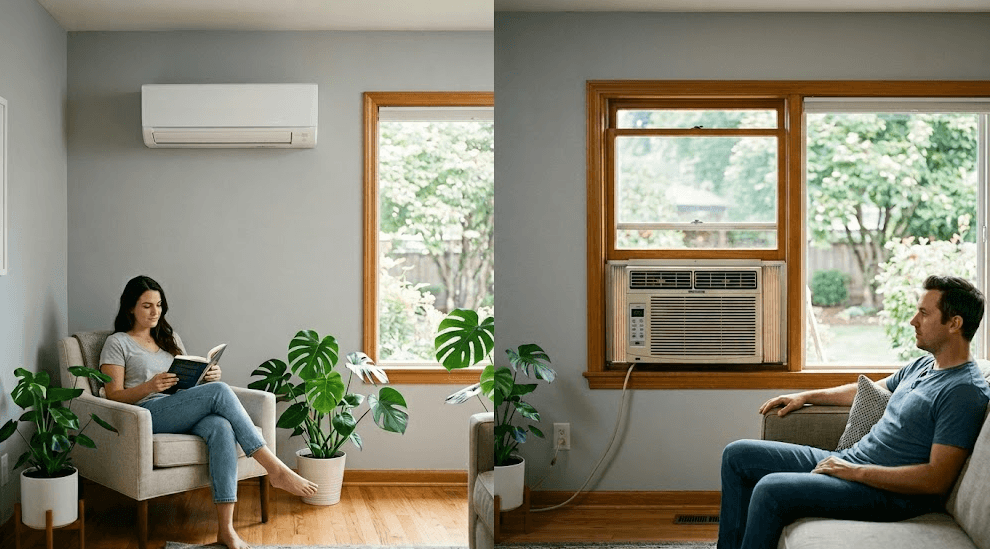
A mini split has two pieces. An outdoor compressor and condenser sits on a pad or wall bracket. An indoor head, usually wall-mounted, holds the evaporator and blower. A thin refrigerant line set connects the two through a three-inch hole in an exterior wall. The compressor is variable-speed (also called inverter-driven), which means it modulates output instead of cycling fully on and off.
A window AC packs the entire system into one box that sits in your window frame. Compressor, condenser, evaporator, and blower all share the same metal cabinet. The compressor is single-stage in most consumer units, running at full speed when cooling and shutting off when the room hits temperature.
From that one architectural choice, split versus self-contained, comes most of the operating cost difference for the rest of this page.
Upfront Cost: Window AC Wins by $2,000 to $5,500
Most homeowners stop comparing at the receipt. A window AC costs a fraction of a mini split, installs in about thirty minutes, and can be cooling your bedroom by tonight. Mini splits demand more money up front. They also require more lead time and a licensed professional, because handling refrigerant requires EPA Section 608 certification.
Window AC Equipment and Installation Cost
A 5,000 to 12,000 BTU window unit costs $150 to $400 at most big-box retailers. Larger 18,000 to 25,000 BTU models run $400 to $700. Installation is typically free if you can lift the unit and follow the bracket instructions. HOA buildings or upper-floor installations sometimes call for professional mounting, which adds $100 to $250.
Mini Split Equipment and Installation Cost
A single-zone 12,000 BTU mini split costs $1,500 to $3,500 for equipment, depending on brand, SEER2 rating, and whether it's a heat pump or cooling-only model. Professional installation adds $1,500 to $3,000 because the technician must be EPA Section 608 certified to handle refrigerant, vacuum the line set, and verify the charge. Total upfront lands at $3,000 to $6,500 for one zone, fully installed and warrantied.
Mini Split Cost Per Ton in 2026
For homeowners pricing a multi-zone or whole-home setup, the per-ton math is more useful. The Department of Energy estimates ductless mini splits cost about $1,500 to $2,000 per ton of cooling capacity for equipment alone, with whole-home installed prices running higher once labor, line sets, and any required electrical upgrades are factored in. A typical 3-ton whole-home mini split runs $12,000 to $25,000 installed before any state or utility rebates.
| Cost Element | 12,000 BTU Window AC | 12,000 BTU Single-Zone Mini Split |
|---|---|---|
| Equipment | $300 to $500 | $1,500 to $3,500 |
| Professional install | $0 to $250 | $1,500 to $3,000 |
| Total upfront | $300 to $750 | $3,000 to $6,500 |
| Upfront gap | Reference baseline | $2,250 to $5,750 more |
Energy Bills: Mini Split Wins by 30% to 40%
Once both systems are installed, the math flips. Cooling a room with a mini split costs less per hour, and the gap compounds across a full cooling season into a meaningful dollar figure.
SEER2 vs. CEER: How Each System Is Rated
The two systems use different efficiency standards because of how they're tested. Mini splits are rated by SEER2, the seasonal efficiency standard the Department of Energy updated in 2023. Window ACs are rated by CEER, the combined efficiency ratio specific to single-room units. Most modern mini splits hit SEER2 ratings between 18 and 30+. Most window ACs land between 11 and 15 CEER, with high-efficiency inverter window units pushing toward 15.
Real-World 12,000 BTU Cost Comparison
Take a 1,000-square-foot space cooling for 2,000 hours across a Florida or Texas summer at the U.S. average residential rate of about 17 cents per kilowatt-hour. A 22 SEER2 mini split uses roughly 1,090 kWh and costs about $185 to run for the season. A 12 CEER window unit uses roughly 2,000 kWh and costs about $340 for the same job. That's $155 in season-one savings, before any rate increases. Across ten summers, the difference compounds past $1,500 even without inflation.
Why Inverter Technology Drives the Gap
A standard window AC compressor has two settings, full power and off. It surges to 100% capacity when the thermostat calls for cooling, slams off when the setpoint is hit, then surges back on a few minutes later when the room warms a degree. Each restart wastes electricity and fights the comfort target.
A mini split's inverter compressor modulates from roughly 20% to 100% of capacity, holding a steady setpoint without the on/off cycle. That's the variable-speed difference, and it's the single biggest reason the operating-cost line on this page favors ductless.
Lifespan: Mini Splits Last Roughly Twice as Long
A mini split installed by a qualified technician and serviced annually lasts 15 to 20 years. A window AC lasts 8 to 12 years, and many fail earlier than the low end of that range. Across 20 years of cooling the same bedroom, you'll likely replace a window unit two or three times and the mini split zero times.
What our HVAC Solutions techs see on Florida service calls explains the early-failure pattern. Window units sit in a window frame exposed to humidity, UV, condensation runoff, and seasonal removal damage. Coastal salt accelerates coil corrosion. Tenants and homeowners often store the unit in a garage or attic over winter, where moisture and pests further degrade the components. Six to eight years in, the compressor seizes or the coil leaks.
A mini split's outdoor condenser sits on a pad with proper clearance, and the indoor head stays mounted year-round. Refrigerant lines are sealed at install and don't get disturbed. Annual coil cleaning and a refrigerant charge check is most of what the system needs. With correct sizing and a proper install, the twenty-year mark sits closer to median expected service life than to any best-case scenario.
Maintenance and Filter Costs: A Smaller Gap Than Most Homeowners Expect
Both systems need filter changes and coil cleaning, and the filter math is closer than the energy math. A window AC uses a thin washable mesh filter that traps lint and pet hair. Most owners rinse it under a faucet every month or two during cooling season. A mini split uses a similar washable pre-filter, plus often a higher-MERV cartridge that captures finer particles. Replacement cartridges run $15 to $40 every 6 to 12 months depending on model and use.
The bigger annual cost on either system is coil cleaning. A neglected window AC coil ices up, drips water indoors, and runs at 30% lower efficiency, which spikes the electric bill. A neglected mini split coil does the same, with the added risk of refrigerant pressure climbing past safe limits and damaging the compressor. Plan on $100 to $200 for a professional coil cleaning on the mini split annually, or DIY both systems with a coil cleaner spray and a fin comb.
The maintenance gap across ten years lands around $500 to $1,000 in favor of the window unit, depending on whether you DIY or pay for service. That's smaller than the energy savings on the mini split side, which usually clears $1,500 over the same window.
For homeowners weighing this decision against a ducted central system, our mini split vs central air comparison covers the third option in detail.
Air Quality: One System Gives You Real Filtration Control
Don't take the air your AC pushes through the room for granted. Both systems pull indoor air across an evaporator coil, cool it, and blow it back. What they don't do equally well is filter what's floating in it.
A typical window AC uses a low-MERV mesh filter that catches lint and large pet dander but misses most pollen, mold spores, and PM2.5. The filter housing usually doesn't accept a higher-MERV upgrade because the airflow path was designed around the original filter's pressure drop. You're locked into roughly MERV 1 to MERV 4 filtration regardless of what the indoor air actually needs.
A mini split's indoor head accepts a wider range of filtration. Many major brands ship with MERV 8 or higher cartridges, and the airflow path was engineered for higher-MERV use without choking the blower. For households with pets, allergies, asthma, or wildfire smoke exposure, that filtration ceiling matters as much as the cooling itself. The Environmental Protection Agency reports that indoor concentrations of certain pollutants can run two to five times higher than outdoor levels, which means the AC unit you choose helps decide how much of that gets caught instead of recirculated.
When a Window AC Is the Right Call (And When It Isn't)
One of these systems isn't always the better buy. The right choice depends on how long you plan to use the cooling, where the unit goes, and what the budget actually is.
A Window AC Is the Better Call If:
You're renting or planning to move within three years
You're cooling a single small room only
Your budget for cooling is genuinely tight ($300 to $700 ceiling)
You don't need year-round heating from the same equipment
The space already has a window suited to a unit (not a sliding window or sealed pane)
A Mini Split Is the Better Call If:
You own the home or expect to stay five years or longer
You want to cool multiple rooms or zones independently
You live in a hot, humid climate where the system runs most of the year
You want heating from the same equipment via heat pump mode
The room is a bedroom, home office, or any space where quiet operation matters
Existing windows are unsuitable for a unit (high-rise, fixed glass, no eligible opening)
Anyone in the household has allergies, asthma, or sensitivity to wildfire smoke
In the marginal cases, time horizon decides it. Window AC math wins under three years and mini split math wins past five. The middle band, three to five years, depends on local electricity rates, climate, and whether you can stack a state or utility rebate to close the upfront gap.
"In fifteen years of installing both systems across Florida and Texas, we've never had a homeowner call a year later asking to switch from a mini split back to a window AC."
-Filterbuy Team
7 Resources We Trust for Your Mini Split vs. Window AC Decision
Independent verification is how you avoid getting talked into the wrong cooling system. These seven sources are the ones we've come to trust when homeowners ask us this same question. We've grouped them by purpose: federal authorities for confirming the math, certified product portals for shopping smart, and regulatory pages that protect your warranty.
Confirm the Federal Authority on Mini Split Efficiency
When customers ask us how mini splits actually save energy, this is the page we send them to first. The DOE lays out the SEER2 ranges (15.2 to 35), the 30%+ duct-loss avoidance, and the inverter-driven efficiency claims in plain language. These are the same numbers we used in the cost math above, straight from the federal source.
Source: U.S. Department of Energy, Ductless Mini-Split Air Conditioners. https://www.energy.gov/energysaver/ductless-mini-split-air-conditioners
Validate Window AC Sizing With Federal Guidance
For homeowners pricing a window AC, this is the federal sizing reference we recommend before you walk into a big-box store. DOE's Room Air Conditioners page explains the EER2 standards in effect since 2023 and gives you the square-footage-to-BTU chart that prevents the most common buyer mistake we see, which is oversizing the unit and ending up with cold-clammy air.
Source: U.S. Department of Energy, Room Air Conditioners. https://www.energy.gov/energysaver/room-air-conditioners
Shop a Verified List of High-Efficiency Mini Splits
Once you've decided a mini split is the right call, this is the shopping list we point homeowners to before they read any reviews. ENERGY STAR's portal only includes models that pass independent third-party efficiency testing, so inflated marketing claims don't survive the cut. The built-in rebate finder also catches utility incentives that DSIRE sometimes misses.
Source: ENERGY STAR, Ductless Heating & Cooling. https://www.energystar.gov/products/ductless_heating_cooling
Find Inverter Window ACs That Close the Efficiency Gap
Window AC isn't what it was five years ago, and this portal proves it. ENERGY STAR lists the inverter and U-shaped window units that have closed most of the efficiency gap against mini splits. The portal also flags models using lower-GWP refrigerants like R-32 and R-454B, which are the ones that won't get hit hard by the AIM Act phasedown when you eventually need repair parts.
Source: ENERGY STAR, Room Air Conditioners. https://www.energystar.gov/products/room_air_conditioners
Plug Your Local Electricity Rate Into the Operating-Cost Math
The 17 cents per kWh figure we used above is the U.S. average. Your state's rate is probably different, and EIA's Electric Power Monthly publishes the current number by state. We'd encourage you to plug yours into the operating-cost math for a savings figure that matches your actual bill.
Source: U.S. Energy Information Administration, Electric Power Monthly. https://www.eia.gov/electricity/monthly/
Search Your Zip Code for Active 2026 HVAC Rebates
With the federal Section 25C credit expired on December 31, 2025, state and utility rebates are the only remaining path to closing the upfront gap on a mini split. DSIRE is the rebate database we recommend to every customer asking about incentives. The site is maintained by NC State University and updated continuously, with zip-code search that surfaces what's actually active in your area right now.
Source: DSIRE, Database of State Incentives for Renewables & Efficiency. https://www.dsireusa.org/
Verify Your Installer Is Federally Certified Before You Sign
This is the resource we wish more homeowners checked before signing an install contract. EPA Section 608 is the federal rule requiring HVAC technicians to be certified before handling refrigerant, and uncertified work voids most equipment warranties. Ask your installer for their Section 608 certification number before the deposit, not after.
Source: U.S. Environmental Protection Agency, Section 608 Technician Certification. https://www.epa.gov/section608/section-608-technician-certification
Three Statistics That Frame the Decision
We pulled the three numbers below from federal sources because they matter most when the cost math gets close.
More than 30% of cooling energy can be lost in central air ductwork. Mini splits sidestep this loss entirely because there's no duct run between the indoor head and the cooled air. Window units also avoid duct loss for the same reason. Both ductless system types have a structural efficiency advantage over conventional central AC.
Source: U.S. Department of Energy. https://www.energy.gov/energysaver/ductless-minisplit-heat-pumps
Indoor air pollutant levels run 2 to 5 times higher than outdoor levels. The filter on whichever AC you pick is doing more work than most homeowners realize, and the filtration ceiling on a mini split typically beats a window unit by several MERV grades.
Source: U.S. Environmental Protection Agency. https://www.epa.gov/indoor-air-quality-iaq/inside-story-guide-indoor-air-quality
U.S. average residential electricity rate hit roughly 17.65 cents per kWh in 2026, up from 14.92 cents in 2022. A 21% rate climb in four years means the operating-cost gap between a high-SEER2 mini split and a low-CEER window unit grows every year you own the equipment.
Source: U.S. Energy Information Administration, Electric Power Monthly. https://www.eia.gov/electricity/monthly/
The Honest Take After Running the Numbers
A window AC is not a bad product. It does what the box promises and costs a fraction of a mini split, which makes it the right call for renters, short stays, and very tight budgets. We'd never push someone who actually fits that profile into spending five times more on a system they won't be around long enough to amortize.
For everyone else, the mini split usually wins, and the math gets clearer the longer you stay. After manufacturing filters for over a decade and serving more than two million households, what we've learned is that homeowners regret the cheaper option most when the time horizon was longer than they admitted upfront. Run your own numbers using your local electricity rate, your actual cooling hours, and the time horizon you expect to stay in the home. Then make the call the math supports.
Price has the shortest tail of any variable that matters in this comparison. Day-one cost is settled in a single transaction. Lifespan, energy, filtration, and air quality compound for the next two decades.
Two systems, two trajectories
The mini split costs more on day one. It also runs quieter, lasts longer, accepts a higher-MERV filter, and can provide more consistent comfort over time.
The window AC costs less on day one. It can still be the right choice for renters, temporary spaces, or homeowners prioritizing the lowest upfront cost.
The opinion most cost pages skip
If anyone in your household has allergies, asthma, sensitivity to wildfire smoke, or a young child whose lungs are still developing, the air-quality factor turns a close cost call into a clear one.
After manufacturing filters for over a decade and serving more than two million households, we see which sleep-disturbing, allergy-flaring problems show up in customer service tickets after a long window-unit summer. Mini splits don't fix everything, but they don't lock you out of the filter ceiling that fixes a lot.
Where each one wins
Window AC stays the right call for renters and short-stays.
Mini split usually wins for everyone else, on both cost and air quality.
Three numbers to run before you decide
Your local electricity rate
Your actual cooling hours
Your honest time horizon in this home
Your Next Steps
Calculate your cooling load.
A rough rule is 20 BTU per square foot for a single room, adjusted up for sun exposure, ceiling height, and climate.
Decide your time horizon.
Under three years, lean window AC. Five years or longer, lean mini split. In between, run the kWh math against your actual electricity rate.
Get two to three installation quotes.
If you're leaning mini split, vet contractors for EPA Section 608 certification and verify they pull a permit.
Check your local rebates.
State and utility incentives can close $500 to $3,000 of the upfront gap. DSIRE is the cleanest way to find what's available in your zip code.
Confirm filter compatibility.
Whichever system you pick, the right filter at the right MERV is what keeps the efficiency claims honest year over year.
Frequently Asked Questions
Make the Cost Call That Holds Up Over Time
The math on this page only matters once you act on it. Browse Filterbuy's mini split options (single-zone for one bedroom or office, multi-zone for whole-home cooling, and heat pump for year-round heating and cooling), then use our sizing guide or contact Filterbuy for quick professional installation.