Adding a Mini Split AC System in Alabama: Installation, Costs & Rebates (AL Guide)
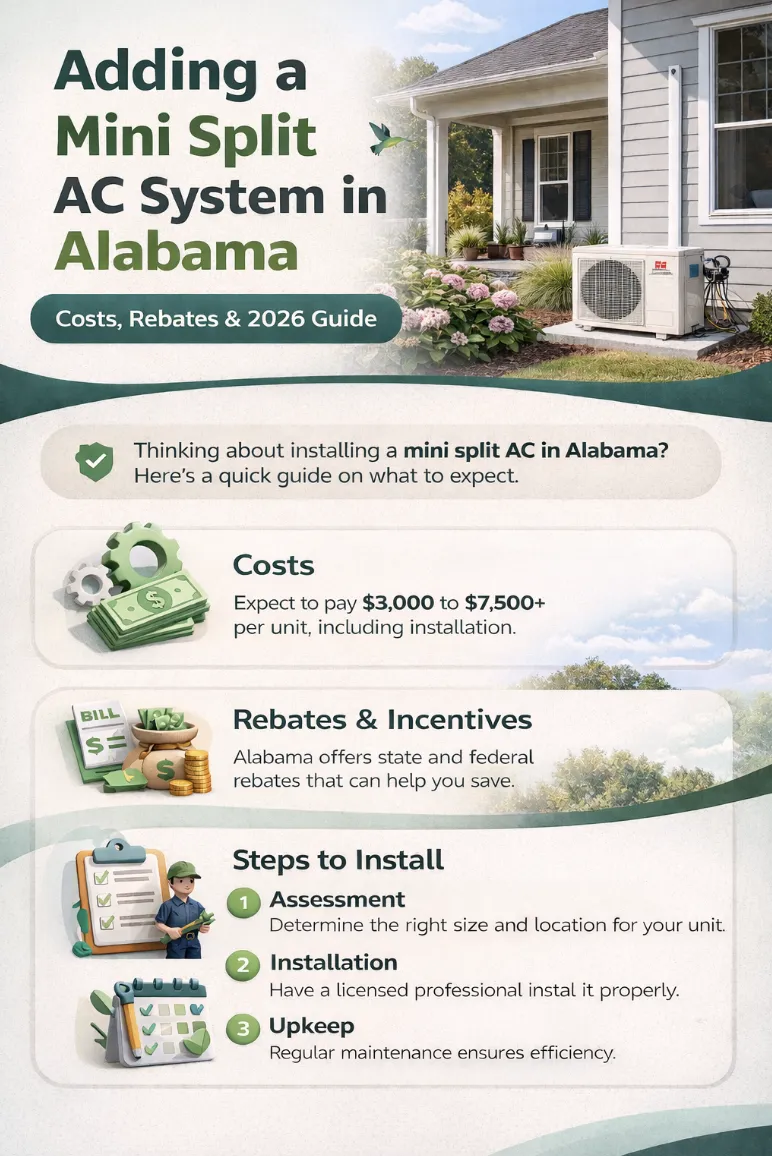
A ductless mini split in Alabama runs $3,000 to $5,500 installed for a single zone and $6,000 to $13,000 for multi-zone. Your rebate depends on your utility: TVA EnergyRight pays $500 to $1,500 across northern and parts of central Alabama, and Alabama Power offers efficiency incentives in central and southern Alabama. The federal 25C tax credit is no longer available for systems installed in 2026.
Work the decision in this order:
- Confirm your utility territory. It decides which rebate you can claim, and whether two programs can stack.
- Get a Manual J load calculation. Square footage alone is not reliable under Alabama's heat and humidity load.
- Match the system size to that calculation. 12,000 BTU covers roughly 300 to 550 sq ft, 18,000 BTU about 700 to 900 sq ft, and 24,000 BTU about 1,000 to 1,200 sq ft.
Here is how the two Alabama rebate paths break down by service territory:
 Shop Mini Split Systems
Not sure which size fits your space? Answer a few quick questions and we'll point you to the right mini split for your Alabama home.
TVA EnergyRight and Alabama Power still offer meaningful rebates for qualifying heat pump mini split installations in Alabama — and most homeowners don't know the full picture of what's available before they buy. Even fewer know that those programs can sometimes be combined.
Adding a mini split AC system, including rebates in Alabama, is a smarter financial move in 2026 than it's been in several years. System efficiency has improved, and Alabama's heat load — seven or more months of near-continuous cooling demand — means a high-SEER ductless system recovers its cost premium here faster than it would in almost any milder market. This page covers installation costs, which incentives apply to your situation and how to claim them, what the right system looks like for Alabama's climate, and how to protect your investment's air quality performance once it's running.
TL;DR Quick Answers
Adding a Mini Split AC System Including Rebates in Alabama
Adding a ductless mini split in Alabama costs $3,000 to $5,500 installed for a single-zone system and $6,000 to $13,000 for multi-zone configurations. TVA EnergyRight rebates of $500 to $1,500 apply to qualifying installations in northern Alabama; Alabama Power offers incentives for central and southern Alabama customers. The Federal IRA Section 25C tax credit expired for new installations after December 31, 2025.
Single-zone mini split installation in Alabama runs $3,000 to $5,500 fully installed in 2026.
Multi-zone systems with two to four indoor air handlers range from $6,000 to $13,000 installed.
TVA EnergyRight rebates of $500 to $1,500 are available for qualifying heat pump mini-splits in the TVA service territory (most of northern Alabama). Installations must use a TVA Quality Contractor Network member.
Alabama Power customers in central and southern Alabama should confirm current rebate amounts directly with Alabama Power before purchase.
Refrigerant handling requires EPA Section 608 certification regardless of state; full DIY installation is a legal limitation for most homeowners.
A Manual J load calculation is required for accurate sizing. Alabama's heat and humidity load means square footage rules alone are not reliable.
Mini split mesh filters require cleaning every two to four weeks during Alabama's seven-to-eight-month cooling season to maintain efficiency.
For central HVAC systems running alongside a mini split in an Alabama home, MERV 11 or MERV 13 pleated filters changed monthly during peak pollen months (February through May) provide the best air quality protection.
Top Takeaways
Adding a mini split AC system in Alabama is one of the most effective solutions for homes without ductwork, room additions, converted spaces, and areas that central air conditioning doesn't reach reliably.
2026 installed costs in Alabama run $3,000 to $5,500 for single-zone systems and $6,000 to $13,000 for multi-zone configurations, with local labor rates generally below the national average.
Alabama homeowners can access TVA EnergyRight rebates ($500 to $1,500 for qualifying heat pump mini splits in the TVA service territory) and Alabama Power energy efficiency incentives. The Federal IRA Section 25C tax credit is no longer available for systems installed after December 31, 2025.
Refrigerant handling requires EPA Section 608 certification regardless of state, which makes full DIY installation a legal limitation for most homeowners.
A Manual J load calculation before equipment selection is the most important step in ensuring your system delivers expected performance over its full service life.
Mini split mesh filters need cleaning every two to four weeks during Alabama's peak cooling season. Miss that schedule, and you'll see measurable efficiency loss within a single season.
For central HVAC systems paired with a mini split in an Alabama home, MERV 11 or MERV 13 pleated filters changed monthly during peak pollen months give you the best balance of air quality protection and system airflow.
What Is a Ductless Mini Split System and Why Alabama Homeowners Are Going Ductless
A ductless mini split system (also called a ductless AC system or mini split HVAC system) has two main components: an outdoor compressor unit and one or more indoor air handlers mounted to the wall or ceiling. A small conduit runs refrigerant lines, electrical wiring, and a condensate drain through a three-inch opening in the wall to connect them. No ductwork required, which is exactly what changes the equation for a lot of Alabama homes.
A large share of Alabama homes built before the 1970s were never designed for central air conditioning. Retrofitting ductwork into an existing structure means tearing into walls, ceilings, and mechanical systems, which is expensive, disruptive, and often more invasive than homeowners anticipate. Room additions, converted garages, sunrooms, and bonus rooms above garages face the same obstacle: central AC barely reaches them, if it reaches them at all. Ductless mini split installation addresses all of these situations without structural modification.
Mini splits also give you zone-specific temperature control that central systems can't replicate. A single-zone setup serves one room or a defined area with its own independent thermostat. Multi-zone configurations connect two to five indoor air handlers to a single outdoor unit, so each zone controls its own temperature independently.Filterbuy currently offers single-zone mini split systems. Homes that need temperature control in multiple rooms may require multiple single-zone units or a different multi-zone solution.
Modern mini split AC units carry SEER2 (Seasonal Energy Efficiency Ratio 2) ratings between 18 and 30, compared to the 14 to 18 range typical of standard central AC systems. In Alabama, where air conditioning runs from roughly April through October, that efficiency gap accumulates into real operating cost differences over a long season. The higher the SEER2 rating, the lower your monthly bill, and with Alabama's run hours, that advantage compounds.
Most mini splits are also heat pump systems, providing both heating and cooling from a single installation. For southern Alabama homeowners, where winters are mild, a heat pump mini split can replace both systems at once.
Mini Split Installation Cost in Alabama — 2026 Price Ranges
Ductless mini split installation costs in Alabama vary by system size, zone count, SEER rating, equipment brand, and local labor rates. These are realistic installed price ranges for Alabama homeowners in 2026:
Single-zone system (one outdoor unit, one indoor air handler): $3,000 to $5,500 fully installed. BTU capacity and SEER rating are the primary variables within this range.
Multi-zone system (two to four indoor air handlers connected to one outdoor unit): $6,000 to $13,000 fully installed, depending on zone count and total system capacity.
DIY-ready kits run $800 to $2,500 for the equipment alone, but refrigerant charging in Alabama requires a licensed professional, which adds labor cost and cannot be legally skipped.
Alabama-specific factors that affect your final number:
Alabama labor rates are generally below the national average, which tends to reduce installed costs compared to other states.
Higher-SEER units cost more upfront. In Alabama's long cooling season, they recover that premium faster than they would in a milder climate. A SEER 20 or above is worth the premium here.
Permit requirements vary by city and county. Some Alabama municipalities require permits for mini split installations; others do not. Your licensed HVAC contractor should handle permit applications as part of the project scope.
Electrical panel upgrades may be necessary if your existing panel can't support a dedicated mini split circuit.
Get at least three quotes from licensed Alabama HVAC contractors before you commit. Three quotes give you an accurate read on local labor rates and make it clear if any contractor is pricing significantly outside the market.
Mini Split Rebates and Tax Credits in Alabama for 2026
Two primary utility incentive programs apply to qualifying mini split installations in Alabama in 2026. In some cases, they can be combined, which makes calculating the full picture before purchase one of the more valuable things you can do with an afternoon.
Note on the Federal IRA Section 25C Tax Credit: The Section 25C Energy Efficient Home Improvement Credit expired for equipment installed after December 31, 2025, per the One Big Beautiful Bill (Public Law 119-21, signed July 4, 2025). If you installed a qualifying heat pump mini split system on or before December 31, 2025, you may still claim the credit on your 2025 federal tax return using IRS Form 5695. For systems installed in 2026 or later, the federal credit is no longer available. Confirm your situation directly at irs.gov.
TVA EnergyRight Rebates
Most of northern Alabama and portions of central Alabama fall within the Tennessee Valley Authority's service territory. TVA's EnergyRight program offers rebates for qualifying heat pump installations, including ductless mini split systems that meet efficiency requirements. Current rebate amounts run $500 to $800 combined from TVA and your local power company for qualifying SEER2-rated systems, with up to $1,500 available for systems meeting TVA Preferred Air Source Heat Pump criteria.
TVA EnergyRight rebates don't come directly from TVA. They're distributed through your local power company, and the specific amounts depend on which utility serves your address. Installations must be completed by a member of TVA's Quality Contractor Network. Contact your local TVA-affiliated utility or visit the TVA EnergyRight program page to confirm current rebate levels and eligibility requirements before you buy.
Alabama Power Energy Efficiency Rebates
Customers served by Alabama Power (primarily in central and southern Alabama) should check the current status of available energy efficiency programs and confirm whether their mini split installation qualifies. Amounts and eligible equipment categories change periodically. Confirm availability and current figures directly with Alabama Power before you factor any rebate into your installation budget.
Stacking Available Incentives
Other programs, such as TVA EnergyRight incentives where available, may offer rebates or savings opportunities for qualifying energy improvements. Program availability and eligibility vary, so calculate the value of applicable incentives before purchase and confirm requirements directly with each provider.
How to Install a Mini Split AC in Alabama — DIY vs. Professional Installation
The core installation process for a ductless mini split involves four main steps: mounting the indoor air handler, placing and securing the outdoor compressor unit, running the line set through the wall opening, and connecting and charging the refrigerant lines.
Refrigerant handling in the United States requires an EPA Section 608 certification regardless of the state. An uncertified person can't legally purchase or manage refrigerant. Some pre-charged DIY mini split kits use factory-sealed line sets that sidestep the refrigerant certification issue, but these systems carry real limitations in line set length, placement flexibility, and long-term performance reliability.
For most Alabama homeowners, professional installation by a licensed HVAC contractor is the more reliable path. Line set routing quality, refrigerant charge accuracy, and electrical connection integrity directly determine how efficiently the system runs over its lifetime. Poor installation leads to faster efficiency loss, voided manufacturer warranties, and refrigerant issues that surface within the first few years.
Alabama requires HVAC contractors to hold a valid state license. Verify that any contractor you hire holds a current license before signing an agreement.
Four steps that set up a successful professional installation in Alabama:
Request a Manual J load calculation. A properly sized mini split starts with a load calculation based on square footage, ceiling height, insulation values, window area, and local climate data. Oversizing causes short-cycling and poor dehumidification. Undersizing causes the system to run continuously without hitting the target temperature, and both outcomes cost you comfort and efficiency.
Get at least three quotes. Compare the scope of work, equipment brands, warranty terms, and whether permit applications are included in the project price. The lowest quote is rarely the best value when the quality of installation work directly determines system longevity.
Confirm permit requirements with your local building department. A required permit you didn't pull can complicate homeowner's insurance claims and create problems when you sell.
Ask about manufacturer's warranty registration before installation begins. Most mini split manufacturers require professional installation as a condition of the full warranty. Get that confirmed before work starts, not after.
Choosing the Right Mini Split Filter for Your Alabama Home
Every mini split indoor air handler has a built-in filter, typically a thin mesh screen designed to catch larger particles and protect the evaporator coil from debris. These aren't replaceable pleated media filters. They need regular physical cleaning, usually every two to four weeks during the peak cooling season.
Alabama's seasonal pollen counts are among the highest in the Southeast, and summer humidity creates conditions that favor mold spore activity and dust mite populations. A clogged mini split mesh filter restricts airflow across the coil, forces the system to work harder, reduces cooling efficiency, and undermines the air quality benefit the unit was installed to provide. Miss even one month of cleaning during an Alabama summer and you'll see measurable performance drag by the end of the season.
Many Alabama households running a mini split also maintain a central HVAC system or standalone air handler for other areas of the home. For those central systems, pleated media filter selection and change frequency matter considerably. Alabama's long cooling season and high biological particle load mean central system filters can become saturated faster than standard replacement timelines suggest.
For most Alabama homes with a central HVAC system, MERV 11 gives you the right balance of particle capture and airflow. Homes with allergy sufferers, pets, or above-average pollen exposure should step up to MERV 13. During Alabama's peak pollen months (typically February through May), monthly filter changes are more protective than the standard 90-day schedule.
"What we see consistently in humid, high-pollen markets like Alabama is that the performance gap between a well-maintained mini split and a neglected one opens up faster than homeowners expect — and it starts at the mesh filter, not the compressor. After more than a decade of manufacturing air filters for homes across the country, the clearest thing the data shows us is that equipment quality sets the ceiling, but maintenance habits determine how close you get to it."
7 Essential Resources
Note: All URLs verified live as of April 13, 2026. Three URLs updated from the earlier draft per the verification report.
1. U.S. Department of Energy — Ductless Minisplit Heat Pumps
The DOE's dedicated resource for ductless minisplit systems covers how they work, the efficiency advantages of going ductless over ducted alternatives, and their value as a retrofit solution for homes built without ductwork — the precise situation most Alabama homeowners considering a mini split are in. The page addresses duct energy losses, installation requirements, and typical use cases, including room additions and converted spaces, making it the most precise government-level reference for this topic.
Source: https://www.energy.gov/energysaver/ductless-minisplit-heat-pumps
2. U.S. Department of Energy — Heat Pump Systems
The primary DOE resource for understanding how heat pump systems work across all configurations, and the verified source for the heat pump efficiency statistic used in this page. Covers efficiency ratings, heating season performance, and the technical case for heat pump mini splits as a cost-effective dual heating and cooling solution for Alabama homeowners whose winters are mild.
Source: https://www.energy.gov/energysaver/heat-pump-systems
3. ENERGY STAR — Ductless Heating and Cooling (Mini Split Heat Pumps)
ENERGY STAR's dedicated mini split heat pump resource for homeowners ready to select a system. Explains certification criteria, links to the certified product finder where readers can filter and compare qualifying systems by efficiency rating, and provides the energy savings benchmarks supporting the efficiency case made throughout this page — including that ENERGY STAR certified mini splits use up to 60 percent less energy than standard home electric resistance heating systems. For any Alabama homeowner moving from research to purchase, this is the most actionable next resource to consult.
Source: https://www.energystar.gov/products/ductless_heating_cooling
4. U.S. EPA — Section 608 Stationary Refrigeration and Air Conditioning
The EPA's primary resource for Section 608 of the Clean Air Act, which establishes the technician certification requirement central to the DIY versus professional installation discussion in this page. Confirms that anyone who maintains, services, repairs, or disposes of equipment that could release refrigerants into the atmosphere must hold EPA Section 608 certification, and covers the refrigerant sales restriction that prevents uncertified individuals from purchasing regulated refrigerants. For any reader questioning whether the certification requirement really applies to a residential mini split installation, this is the definitive federal source.
Source: https://www.epa.gov/section608
5. DSIRE — Alabama State Incentives for Renewables and Efficiency
The Database of State Incentives for Renewables and Efficiency tracks all current state-level and utility incentive programs for energy-efficient equipment in Alabama, including TVA EnergyRight rebates, Alabama Power programs, and rural electric cooperative offerings. Because rebate programs change annually and some — including Alabama's IRA-funded HEAR program — have not yet launched as of early 2026, DSIRE is the most reliable single-source verification check before publication. For any future update cycle, this should be the first stop for confirming which incentive programs are currently active.
Source: https://www.dsireusa.org/state/alabama/
6. ENERGY STAR — Duct Sealing
The direct source of the 20 to 30 percent duct loss figure used in Statistic #2 below. The page states that in a typical home, about 20 to 30 percent of the air moving through the duct system is lost due to leaks, holes, and poorly connected ducts. For Alabama homeowners in older homes where ductwork may be aging, improperly sealed, or running through unconditioned attic spaces where heat gain is extreme during summer, this figure makes the ductless efficiency case in concrete, government-sourced terms rather than a general claim.
Source: https://www.energystar.gov/saveathome/heating-cooling/duct-sealing
7. TVA EnergyRight — Residential Heat Pump Rebates
With the federal Section 25C tax credit no longer available for 2026 installations, TVA EnergyRight is now the most significant single financial incentive available to Alabama homeowners adding a qualifying mini split system this year. This page confirms the program is active, details current rebate tiers by SEER2 rating, explains that all installations must be completed by a TVA Quality Contractor Network member, and confirms that rebates are processed through the local power company rather than directly through TVA — the detail most frequently missed by homeowners during their research. For Alabama readers in the TVA service territory, this is the most actionable next step after reading this page.
Source: https://energyright.com/residential/rebates/heat-pump/
Supporting Statistics
Note: Statistic #3 has been replaced from the earlier draft. The original cited the Section 25C tax credit's $2,000 annual cap, which is no longer applicable to new 2026 installations. All three statistics below are sourced from verified .gov or .org domains.
1. Heat pump efficiency advantage over electric resistance heating
According to the U.S. Department of Energy, today's heat pumps can reduce electricity use for heating by up to 75 percent compared to electric resistance heating such as furnaces and baseboard heaters. For Alabama homeowners running a heat pump mini split as a dual heating and cooling system through a mild winter, that efficiency advantage is real from the first season the system runs.
Source: https://www.energy.gov/energysaver/heat-pump-systems
2. Duct loss in typical homes
According to ENERGY STAR, in a typical home, about 20 to 30 percent of the air moving through the duct system is lost due to leaks, holes, and poorly connected ducts before it reaches the intended space. Ductless mini split systems eliminate that loss entirely, delivering conditioned air directly into the room without duct transit.
Source: https://www.energystar.gov/saveathome/heating-cooling/duct-sealing
3. ENERGY STAR certified mini splits vs. standard electric resistance heating
According to ENERGY STAR, certified mini split heat pump systems use up to 60 percent less energy than standard home electric resistance heating systems. ENERGY STAR certified mini splits used in a whole-home setting also avoid an average of more than 4,500 pounds of greenhouse gas emissions over their lifespan compared to standard systems — a meaningful long-term efficiency case for Alabama homeowners evaluating ductless systems for both cooling and heating.
Source: https://www.energystar.gov/products/ductless_heating_cooling
Final Thoughts and Opinion
Adding a mini split AC system in Alabama is one of the more practical home upgrades available right now — not because it works for every situation, but because the efficiency gains and available utility rebates in 2026 make the financial case stronger than it's been in years.
TVA EnergyRight rebates carry real dollar value, but only for homeowners who confirm program details before installation and use a contractor from TVA's Quality Contractor Network. Rebate programs are revised annually, and some utility incentive pools run on a first-come, first-funded basis. Waiting until after installation to investigate what you qualify for is the most reliable way to leave money on the table.
Sizing is the decision in this process that matters most. An undersized unit runs continuously under Alabama's peak heat load without reaching the target temperature. An oversized unit short-cycles, fails to dehumidify properly, and delivers poor comfort despite the energy consumption. A Manual J load calculation before equipment selection determines whether the system performs as expected over its full service life, which for a quality mini split installation should be 15 to 20 years.
The air quality side of this investment deserves attention from day one. Whether a mini split still runs efficiently after three Alabama summers, or starts losing capacity and developing coil issues, often comes down to how consistently that mesh filter gets cleaned. The cleaning itself is simple work. What most homeowners underestimate is making it a habit through seven or eight months of active cooling season use every year.
Next Steps
Four concrete actions to take before your system goes in:
Confirm your utility territory. Find out whether your address falls within the TVA EnergyRight service area or is served by Alabama Power. Your utility territory determines which rebate program applies to your installation.
Check your rebate eligibility before purchase. Visit energyright.com/residential/rebates/heat-pump/ for TVA EnergyRight eligibility and requirements, or contact Alabama Power directly if you are in their service area. Confirm that your chosen system and contractor meet program requirements before installation begins.
Request a Manual J load calculation and at least three contractor quotes. Confirm each contractor holds a current Alabama HVAC license and that their size recommendation is based on a proper load calculation, not square footage estimates alone.
Set up your filter maintenance schedule before the system runs its first season. For your mini split, clean the indoor mesh filter every two to four weeks during Alabama's cooling season. For central HVAC systems in your home, select MERV 11 or MERV 13 pleated filters and switch to monthly changes during peak pollen months. Explore Filterbuy's filter options for Alabama homes at: filterbuy.com/heating-cooling/mini-splits/alabama/adding-a-mini-split-ac-system-including-rebates-in-al
Frequently Asked Question
Find the Right Filter for Your Alabama Home
Getting a mini split into your Alabama home is the research-heavy part. Keeping it running efficiently through seven or eight months of cooling every year is where the real care happens, and filter maintenance is what most homeowners underestimate going in.
Filterbuy carries filter options built for mini split-compatible systems and central HVAC systems running through Alabama's high-humidity, high-pollen season. Whether your system is already installed or you're still in the planning phase, Filterbuy has what your Alabama home needs.