Adding a Mini Split AC System in Alaska: Installation, Costs & Rebates (AK Guide)
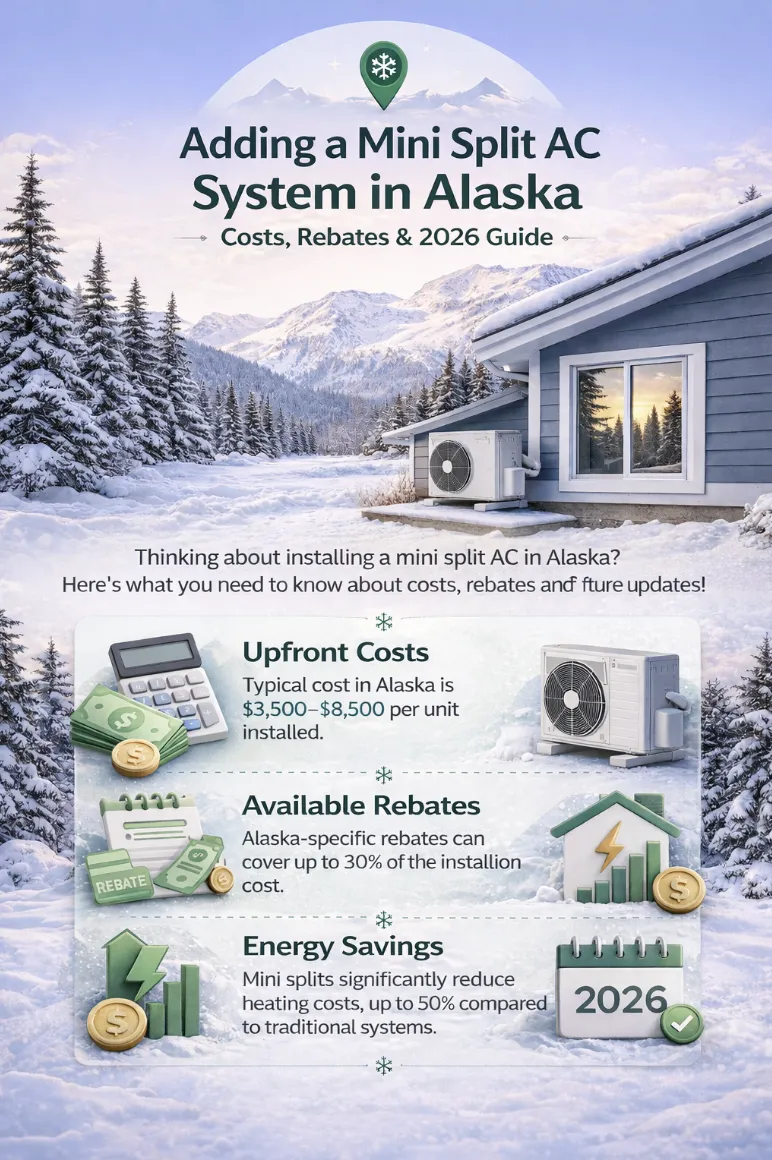
Cold-climate-rated mini splits work across most of Alaska, and several 2026 rebate programs can stack to lower what you pay to install one. Single-zone systems run $3,500 to $6,500 installed in Anchorage and coastal communities, and $5,500 to $10,000 or more in interior or remote areas.
The federal Section 25C tax credit expired December 31, 2025 and is not available for systems installed in 2026. These programs are still active and can often be combined on the same project:
- ACES: $4,000 to $8,500 for eligible homeowners in 43 coastal communities.
- AHFC: the Home Energy Rebate and income-qualified HEEHRA program.
- Utility rebates: from providers like Homer Electric and Petersburg MP&L.
A home energy assessment is required before most of these programs, so book that first. Use the quick match below to figure out the right mini split setup for your home.

Answer a few quick questions and we'll point you to the right mini split for your home.
Cold-climate mini splits now carry rated minimum operating temperatures of -22°F. That's a specification on systems you can buy today, not a projection — and it's the number that changes the conversation for Alaska homeowners who have spent years hearing that heat pumps don't work here.
They do. The right ones, spec'd correctly, installed by a contractor who understands the difference between a cold-climate system and a standard unit.
This page answers the questions Alaska homeowners ask before they sign a contract: what installation actually costs in 2026, which rebate programs are currently active and who qualifies, how to identify a system built for Alaska's specific conditions, and what air filter strategy keeps indoor air healthy alongside the heating upgrade.
TL;DR Quick Answers
Adding a Mini Split AC System Including Rebates in Alaska
Cold-climate mini splits rated to -13°F or below are the right call for most Alaska homes. Here's what to know before you start:
Cold-climate-rated ductless mini splits operate reliably down to -13°F — some to -22°F — using variable-speed DC inverter compressors built for Alaska's temperature range
Installation costs run $3,500 to $6,500 for a single-zone system in Anchorage and coastal communities, and $5,500 to $10,000 or more in interior or remote areas
The federal Section 25C heat pump tax credit expired December 31, 2025 and is not available for systems installed in 2026
The ACES program currently offers $4,000 to $8,500 in rebates for eligible homeowners in 43 coastal Alaska communities from Ketchikan to Kodiak — administered by Alaska Heat Smart at akheatsmart.org/aces
AHFC runs the Home Energy Rebate program and HEEHRA income-qualified rebates for heat pump installation — start at ahfc.us/efficiency
Several Alaska utilities including Homer Electric Association and Petersburg Municipal Power and Light offer independent heat pump rebates that can be combined with state programs
A home energy assessment by an AHFC-certified rater is required before most rebate programs can be accessed — schedule one before purchasing equipment
Homes with a secondary forced-air system benefit from a MERV 11 or MERV 13 filter to capture fine particulate matter from wood burning and wildfire smoke that a mini split's washable pre-filter does not address
Top Takeaways
Cold-climate-rated mini splits operate reliably at temperatures as low as -13°F to -22°F, making them a viable heating and cooling option for most Alaska communities, including much of interior Alaska.
Mini split installation costs in Alaska typically run $3,500 to $6,500 for a single-zone system in urban areas, and $5,500 to $10,000 or more in remote communities — before any rebates are applied.
The federal Section 25C heat pump tax credit expired December 31, 2025 under the One Big Beautiful Bill Act and is not available for systems installed in 2026. Active incentives include the ACES program ($4,000 to $8,500 for eligible coastal Alaska homeowners), AHFC programs, and utility-specific rebates.
A home energy assessment by an AHFC-certified rater is typically required before accessing Alaska state rebate programs and should be the first step in any Alaska mini split project.
Heat pumps can reduce electricity use for heating by up to 75% compared to electric resistance heating, per the U.S. Department of Energy.
Mini split air handlers use washable pre-filters, not replaceable cartridges. Homes with secondary forced-air systems benefit from MERV 11 or MERV 13 filters to capture fine particulate matter from combustion sources and wildfire smoke.
Utility rebate programs from Homer Electric Association and Petersburg Municipal Power and Light operate independently of state programs and can often be combined with ACES and AHFC incentives.
What Is a Ductless Mini Split — and Why Alaska Homeowners Are Choosing Them
Alaska homeowners without central ductwork have a short list of options for adding efficient, zone-by-zone climate control. A ductless mini split is, for most of them, the clearest answer — and often the only one that doesn't require tearing into walls to run duct.
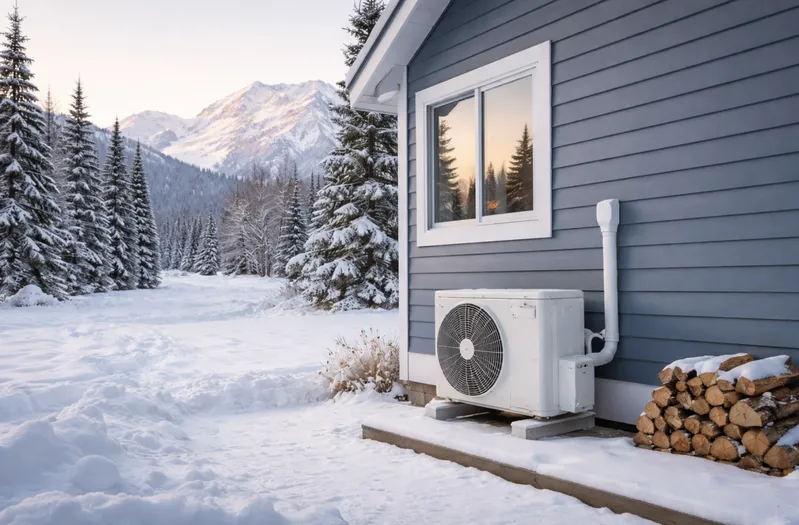
The system runs on two main components: an outdoor compressor unit and one or more indoor air handlers mounted to a wall or ceiling. A small conduit carries refrigerant lines, power, and drainage between the two through a single opening in the exterior wall, typically about three inches in diameter. That's the full installation footprint.
Many Alaska homes were built without central duct systems. They heat with electric baseboard heaters, oil-fired boilers, wood stoves, or some combination. Mini splits give those homes efficient, room-by-room climate control without the cost and disruption of a full duct retrofit.
How Mini Splits Work in Cold Climates
Standard mini split systems heat reliably down to about 17°F. That covers coastal Southeast Alaska on most winter days. It doesn't cover Fairbanks in January, or interior communities where -30°F is a routine winter night.
Cold-climate-rated systems address this with variable-speed DC inverter compressors built specifically to extract heat from outside air at much lower temperatures. Depending on the model, rated minimum operation drops to -13°F or below. Some systems are rated to -22°F.
The inverter compressor is what separates these systems from standard units. Older systems cycle fully on and off at fixed capacity. An inverter compressor modulates continuously, matching output to the actual heating load in real time. That continuous adjustment keeps efficiency steady even when outdoor temperatures fall well below zero.
Mini Split vs. Baseboard Heat in Alaska — Which Makes More Sense?
Electric baseboard heaters convert every unit of electricity directly into heat. One watt in, one watt of warmth out. That's their ceiling, not just their floor.
A heat pump moves heat rather than generating it. By pulling warmth from outside air and concentrating it indoors, a cold-climate mini split produces two, three, or even four units of heat for every unit of electricity it consumes. That ratio — the Coefficient of Performance, or COP — is where the efficiency case lives.
At mild temperatures, a well-rated cold-climate mini split holds a COP of 3.0 or higher. Even below zero, a properly spec'd system can stay above 1.5, which is still more efficient than resistance heating at any temperature. For Alaska homeowners paying elevated electricity rates or moving off heating oil, that gap shows up directly on the monthly bill.
Mini Split Installation Costs in Alaska — What to Expect in 2026
Expect to pay more in Alaska than national cost guides suggest. Labor rates in Anchorage and Fairbanks run above the national HVAC average. In remote and off-road communities, equipment shipping adds a separate line item to the quote — sometimes a few hundred dollars, sometimes considerably more.
Current Alaska installed cost ranges for 2026:
Single-zone system, Anchorage or Southeast coastal communities: $3,500 to $6,500 installed
Single-zone system, interior or remote Alaska communities: $5,500 to $10,000 or more installed
Multi-zone system (2 to 4 indoor handlers): $7,000 to $18,000 or more, depending on zones, electrical work, and site access
These ranges cover equipment, labor, refrigerant line sets, electrical work, and permits. They aren't guarantees — every home and installation is different. Get at least two quotes from licensed Alaska HVAC contractors before committing to a project.
Cost Factors Unique to Alaska
National cost guides don't account for what Alaska installations actually require. A few factors that contractors price into your quote:
Shipping surcharges for equipment delivery to off-road or remote communities can add $300 to $1,500 or more to the project total
Installer availability outside Anchorage and Fairbanks is limited, and demand has grown as interest in heat pump technology spreads across the state
Electrical panel upgrades are commonly required in older homes not currently wired for the dedicated 240-volt circuit most mini split systems need
Borough permitting requirements vary across Alaska, and permit fees in some areas run higher than what installers encounter in the contiguous 48 states
Equipment manufacturers specify minimum temperature conditions for refrigerant charging and startup, which affects installation scheduling in cold-weather months
How Many BTUs Does an Alaska Home Need?
Sizing a mini split comes down to heating load — how much BTU output a home needs to stay comfortable against Alaska's outdoor temperatures. Alaska homes need significantly more BTU capacity per square foot than homes in moderate climates.
HVAC professionals working in-state typically start at 30 to 50 BTUs per square foot as a planning benchmark, compared to 20 to 25 BTUs per square foot for warmer regions. A 1,000-square-foot home in Fairbanks might need 24,000 to 36,000 BTUs. The same footprint in Atlanta runs fine on 12,000 to 18,000.
The number that actually matters for your home is the one a licensed contractor calculates through a Manual J load analysis, not a square-footage estimate. Ask any installer whether they perform one. If they don't, find out why before moving forward.
Alaska Mini Split Rebates and Incentives Available in 2026
The rebate landscape for Alaska homeowners shifted significantly going into 2026. The federal Section 25C Energy Efficient Home Improvement Credit — which covered up to $2,000 for qualifying heat pump installations — expired on December 31, 2025, when the One Big Beautiful Bill Act was signed into law on July 4, 2025. If your system was installed and placed in service before that date, you can still claim the credit on your 2025 federal tax return using IRS Form 5695.
For systems installed in 2026 and beyond, the state-level and regional programs below cover the active incentives available to Alaska homeowners.
ACES — Accelerating Clean Energy Savings for Coastal Alaska
In 2024, Southeast Conference and Alaska Heat Smart received a $38.6 million federal EPA grant to fund the Accelerating Clean Energy Savings in Alaska's Coastal Communities program, known as ACES. The program covers 43 coastal communities from Ketchikan to Kodiak, including Juneau, Sitka, and communities throughout Southeast and Southcentral Alaska.
Eligible homeowners can receive $4,000 to $8,500 in rebates. Higher amounts go to households below 80% of Area Median Income. ACES was specifically designed to make heat pump installation financially viable in rural coastal communities, where heating costs hit hardest.
For current program status, eligibility by community, and application steps, visit Alaska Heat Smart at akheatsmart.org/aces.
Alaska Housing Finance Corporation (AHFC) Programs
AHFC runs several energy efficiency programs for Alaska homeowners. The Home Energy Rebate program pays cash rebates for qualifying energy upgrades, with rebate amounts scaling based on the energy improvement tier a home achieves. AHFC requires a home energy assessment by a certified rater before and after any improvements.
AHFC also administers the High-Efficiency Electric Home Rebate Act (HEEHRA) program for Alaska, the federal IRA-funded rebate track for home electrification. These rebates are income-qualified and can reach up to $8,000 for heat pump installation for eligible households.
Program availability depends on state funding and enrollment windows. Confirm current status at ahfc.us/efficiency before beginning any project.
Utility Rebate Programs in Alaska
Several Alaska utilities run their own rebate programs for heat pump and mini split installations, separate from state and federal programs:
Homer Electric Association runs a heat pump rebate program for member customers, with available incentives typically smaller than some larger state or regional programs. Visit homerelectric.com for current rebate amounts, eligibility details, and equipment efficiency requirements
Petersburg Municipal Power and Light offers rebates specifically for mini split heat pumps and heat pump water heaters
Other cooperative utilities across the state offer similar programs — check directly with your local electric provider for what's currently available
Can Rebate Programs Be Combined?
In most cases, yes. ACES rebates, AHFC programs, and utility rebates typically operate independently and can be layered on the same project. Stacking rules vary by program, so confirm with each administrator before assuming combinations are permitted.
A tax professional can clarify applicable tax treatment, particularly if you're also pursuing HEEHRA income-qualified rebates. Alaska Heat Smart at akheatsmart.org tracks which incentives can currently be combined.
Choosing the Right Mini Split for Alaska's Climate
The spec sheet is where Alaska homeowners have to pay close attention. Standard mini splits work reliably down to about 17°F — adequate for coastal Southeast Alaska, but not for interior communities that regularly see -20°F or colder. Selecting a cold-climate-rated system isn't a preference. It's the starting point for any Alaska installation decision.
What to look for in a mini split for Alaska conditions:
Minimum operating temperature rated at -13°F or below — confirm this on the manufacturer's specification sheet before purchasing.
DC inverter variable-speed compressor — provides continuous modulation rather than cycling on and off at full capacity
HSPF2 rating of 10 or higher — the Heating Seasonal Performance Factor measures heating efficiency and is the primary metric for cold-climate evaluation
Listing on the NEEP Cold Climate Air Source Heat Pump database at ashp.neep.org — this registry identifies systems verified for cold-climate performance
ENERGY STAR Most Efficient designation — indicates the system meets the highest efficiency tier established by the Consortium for Energy Efficiency
Single-Zone vs. Multi-Zone — What Works for Alaska Homes
A single-zone system pairs one outdoor compressor with one indoor air handler. It conditions a defined space efficiently — a large open-plan living area, a primary bedroom, a studio — and it's the most common starting point for Alaska homeowners adding their first mini split.
A multi-zone system connects one outdoor unit to two, three, or four indoor handlers in separate rooms. For homes with multiple isolated spaces, that setup provides whole-home coverage without ductwork. The Alaska-specific consideration: during extreme cold, the outdoor unit must deliver its full rated BTU output across every active zone at once. Size multi-zone systems with meaningful capacity above the calculated peak load. That buffer matters most in interior communities where heating demand peaks hardest.
Mini Split Air Filters — What Alaska Homeowners Need to Know
Mini split air handlers come with washable pre-filters, not replaceable cartridges. They catch larger airborne particles — dust, pet hair, debris — and should be cleaned monthly during heavy-use periods, at minimum every three months during lighter seasons. Your system's owner's manual has the manufacturer's specific schedule.
A mini split's built-in filter handles the air handler only, not the air throughout the home. In Alaska, that distinction carries real weight. Homes that supplement heat with wood burning push fine particulate matter and combustion byproducts into the indoor air year-round. Wildfire smoke across Interior and Southcentral Alaska has added a seasonal layer to that concern in recent years.
When Whole-Home Filtration Matters for Alaska Homes
In homes that pair a mini split with a secondary forced-air system, the central system's filter does the real work on whole-home air quality. Upgrading from a MERV 8 to a MERV 11 or MERV 13 captures a much wider range of airborne particles, including fine particulate matter tied to combustion smoke and respiratory irritants.
MERV 13 captures particles down to 0.3 microns. That's the size range for wood smoke, wildfire particulate, and the particles most associated with respiratory symptoms. For Alaska households with allergy sufferers, or anyone with sensitivity to combustion byproducts, the upgrade from a MERV 8 to a MERV 13 is one of the highest-return, lowest-cost improvements available.
Filterbuy's MERV 11 and MERV 13 filters fit most forced-air systems, with custom sizing for non-standard slots. For homes running entirely on a mini split without a central air system, a standalone HEPA purifier provides room-level filtration as an alternative.
"What we see consistently in Alaska homes — and what most air quality conversations miss — is how dramatically the heating source affects what people breathe every day. Homes that rely on combustion heating carry particulate loads that a mini split alone doesn't resolve. The move to a cold-climate heat pump is meaningful for energy efficiency. Pairing it with proper filtration for any remaining combustion sources is how you protect the air quality your family depends on for the long term."
7 Essential Resources
U.S. Department of Energy — Heat Pump Systems
The DOE's primary homeowner reference on heat pump technology. The page covers how air-source and ground-source heat pumps work, explains the difference between standard and cold-climate-rated systems, and details the efficiency metrics that Alaska homeowners need to evaluate before selecting a system — specifically HSPF2 ratings and Coefficient of Performance at low operating temperatures. The DOE states directly that today's heat pumps can reduce electricity use for heating by up to 75% compared to electric resistance heating. The page also explains variable-speed inverter compressor technology and dual-fuel hybrid configurations, giving Alaska homeowners the technical grounding to evaluate contractor quotes with confidence.
Source: energy.gov/energysaver/heat-pump-systems
IRS — Home Energy Tax Credits
The IRS's official reference for residential energy tax credits, including the complete history of the Section 25C Energy Efficient Home Improvement Credit. The One Big Beautiful Bill Act, signed July 4, 2025, terminated Section 25C for property placed in service after December 31, 2025. Alaska homeowners who installed a qualifying heat pump by that deadline can still claim the credit on their 2025 tax return using Form 5695, which the IRS page links directly. The credit covered 30% of qualifying costs up to $2,000 for heat pumps — a separate bucket from the $1,200 general cap, meaning combined claims up to $3,200 were possible in a single tax year. The page also hosts updated FAQs on the law change and instructions on Qualified Manufacturer Identification Numbers required on 2025 filings. For homeowners with installations completed before the deadline, this is the authoritative starting point for filing.
Source: irs.gov/credits-deductions/home-energy-tax-credits
Alaska Housing Finance Corporation — Energy Efficiency Hub
AHFC's central resource for Alaska homeowners seeking to lower energy costs. Currently active programs include the $10,000 New Home Construction Rebate for qualifying new builds rated 5-Star Plus or higher, the Weatherization program with income-based eligibility and a statewide service provider directory, and renovation loan programs for owner-occupied properties making energy improvements. The site also hosts AHFC's education resources, building science library, and the AHFC-certified energy rater directory — the essential first step for any homeowner who needs a home energy assessment before applying for state rebate programs. Because AHFC program availability and enrollment windows depend on state funding appropriations, the site's current-status information should be checked before beginning any project planning.
Source: ahfc.us/efficiency
Alaska Heat Smart — ACES Program
Alaska Heat Smart is the Juneau-based nonprofit administering the ACES program — the Accelerating Clean Energy Savings in Alaska's Coastal Communities initiative, backed by a $38.6 million federal EPA grant awarded in 2024. The ACES page is the most current and actionable resource for homeowners in eligible coastal communities, covering program eligibility by community (43 communities from Ketchikan to Kodiak), income-based rebate tiers ($4,000 to $8,500 depending on household income relative to Area Median Income), the qualified contractor list for ACES-approved installers, home energy assessment access, and the heat pump loan program for homeowners who need financing alongside rebates. Alaska Heat Smart also maintains guidance on which rebate programs can currently be combined, updated as program rules change. For coastal Alaska homeowners, this is the first stop before signing any installation contract.
Source: akheatsmart.org/aces
ENERGY STAR — Federal Tax Credits for Energy Efficiency
ENERGY STAR's reference page for federal tax credit information, Most Efficient product designation criteria, and the Consortium for Energy Efficiency (CEE) tier requirements that heat pumps must meet to qualify for both tax credits and most active rebate programs. The page hosts the ENERGY STAR Rebate Finder — a zip code-based tool that surfaces active utility and state rebates for certified products in your area — and links to the certified product database where Alaska homeowners can verify whether a specific heat pump model carries the Most Efficient designation before purchasing. Even with Section 25C expired for 2026 installations, ENERGY STAR Most Efficient certification remains the qualification standard for high-performance cold-climate systems and a requirement for equipment under active rebate programs including AHFC and ACES. The HSPF2 and CEE tier requirements on this page are the technical benchmarks Alaska homeowners should verify on any contractor quote.
Source: energystar.gov/about/federal-tax-credits
U.S. EPA — Indoor Air Quality
The EPA's hub for indoor air quality research, guidance, and homeowner resources. The EPA documents that Americans spend approximately 90% of their time indoors and that indoor pollutant concentrations can exceed outdoor levels — a finding with direct implications for Alaska homes that heat with wood or oil. Combustion byproducts documented by the EPA as primary indoor air concerns include carbon monoxide, nitrogen dioxide, and fine particulate matter (PM2.5 and PM10), all of which wood stoves, fireplaces, and oil-fired systems introduce into the indoor environment. The site also hosts the EPA's dedicated wildfire smoke guidance, which covers how to reduce smoke infiltration during smoke events — increasingly relevant for Interior and Southcentral Alaska during summer months. For homeowners upgrading to a mini split and evaluating a filtration strategy, the EPA's breakdown of indoor PM sources by activity type makes the case for why MERV-rated filtration in a secondary forced-air system addresses what a mini split's washable pre-filter cannot reach.
Source: epa.gov/indoor-air-quality-iaq
U.S. EPA — Guide to Air Cleaners in the Home
The EPA's dedicated consumer guide to air filtration for residential settings. The page covers how to select a furnace or HVAC filter by MERV rating, explains why the EPA recommends a minimum of MERV 13 for homeowners looking to capture smaller airborne particles of greatest health concern, and clarifies the difference between MERV-rated HVAC filters and true HEPA filters — a distinction that matters for Alaska homeowners evaluating standalone air purifiers for rooms without central ductwork. The guide also explains that filters with a MERV between 7 and 13 are likely to be nearly as effective as HEPA filters at controlling most airborne indoor particles, and that upgrading from a low-efficiency filter (MERV 1 to 4) to a medium-efficiency filter (MERV 5 to 13) can significantly reduce indoor particle concentrations. For any Alaska household choosing between a MERV 11 and MERV 13 filter — or deciding whether a standalone HEPA purifier is warranted alongside a mini split — this is the most authoritative practical reference available.
Source: epa.gov/indoor-air-quality-iaq/guide-air-cleaners-home
3 Supporting Statistics
Today's heat pump can reduce electricity use for heating by up to 75% compared to electric resistance heating such as furnaces and baseboard heaters — U.S. Department of Energy, Office of Energy Efficiency and Renewable Energy.
Source: energy.gov/energysaver/heat-pump-systems
Alaska was the coldest state in the nation based on 2020 Residential Energy Consumption Survey data, with households using an average of 125.1 MMBtu of site energy — the highest average household energy consumption of any state — U.S. Energy Information Administration.
Source: eia.gov/todayinenergy/detail.php?id=56380
Electricity prices in Alaska's rural areas can be three to five times higher than rates in the state's urban areas — U.S. Energy Information Administration, Alaska State Energy Profile.
Source: eia.gov/state/print.php?sid=AK
Final Thoughts and Opinion
Ten years ago, recommending a mini split for interior Alaska was genuinely complicated. The technology had real low-temperature limits, and homeowners who were skeptical had good reason. That's changed. Inverter-driven heat pumps rated to -13°F or below aren't niche products anymore — they're the correct specification for most Alaska climates.
What hasn't caught up is homeowner awareness of the rebate programs now on the table. ACES brings real funding to coastal communities. AHFC programs, when actively funded, return meaningful cash to homeowners who work through the energy assessment process. Utility-level programs add another layer on top of that. Qualifying households in eligible communities can cut the net installation cost by several thousand dollars in 2026.
Our honest recommendation: get the home energy assessment first. Knowing your home's actual heating load and insulation baseline before selecting equipment is what determines whether the system you install performs as expected for the next 15 to 20 years. That assessment also unlocks access to most of the rebate programs worth pursuing. The sequence — assessment first, equipment second — matters more than any brand preference.
Next Steps
Schedule a home energy assessment. Start at ahfc.us/efficiency to find an AHFC-certified rater in your area. The assessment establishes your home's current energy baseline, identifies the highest-impact improvements, and is required before most Alaska rebate programs can be accessed.
Contact Alaska Heat Smart. Visit akheatsmart.org/aces to confirm whether your community falls within the ACES program service area, check your income-based rebate tier, and connect with a participating installer before purchasing any equipment.
Get at least two quotes from licensed Alaska HVAC contractors. Ask each contractor to confirm the minimum rated operating temperature of the system they're proposing, verify it meets cold-climate specifications for your community, and confirm they'll pull the required permits.
Check with your local utility. Rebate programs from Homer Electric, Petersburg Municipal Power and Light, and other cooperative utilities operate independently of AHFC and ACES — and can be combined with them.
Evaluate your current air filtration. If your home has a secondary forced-air system, upgrading to a MERV 11 or MERV 13 filter costs a fraction of any HVAC upgrade. It's a change you can make today.
Frequently Asked Questions
Get the Right Filter for Your Alaska Home
Your mini split handles the heating. What it can't manage is the particulate matter from wood smoke, oil combustion, or wildfire season — and in Alaska, those are real, year-round sources.
A MERV 11 or MERV 13 filter in a secondary forced-air system is one of the most cost-effective air quality moves an Alaska homeowner can make, regardless of how you heat. Find the right filter by size and MERV rating at Filterbuy, or use the filter finder tool for a recommendation in under two minutes.