Adding a Mini Split AC System in California: Installation, Costs & Rebates (CA Guide)
For California Homeowners
Find The Filterbuy Mini Split That Fits Your California Home
California's electricity rates run close to double the national average, so a right-sized variable-speed system starts earning its keep the minute it switches on. Match your space below, or take the 60-second fit quiz and we will point you to the system that suits your square footage.
- SEER 17 variable speed
- Cools and heats year-round
- 7-year compressor warranty
- Mobile app control
- Free 2-day delivery

Not sure on size? Take the 60-second fit quiz.
California has one of the highest residential electricity rates in the country. That single number does more to make the case for a mini split than any rebate program ever could, because every kilowatt-hour a high-efficiency system saves is worth more here than in most of America. Add mild weather that's almost custom-built for variable-speed heat pumps, plus a big share of older homes that were never wired for central air, and the decision to add a ductless mini split tends to land in the yes column faster here than it would in Houston or Atlanta.
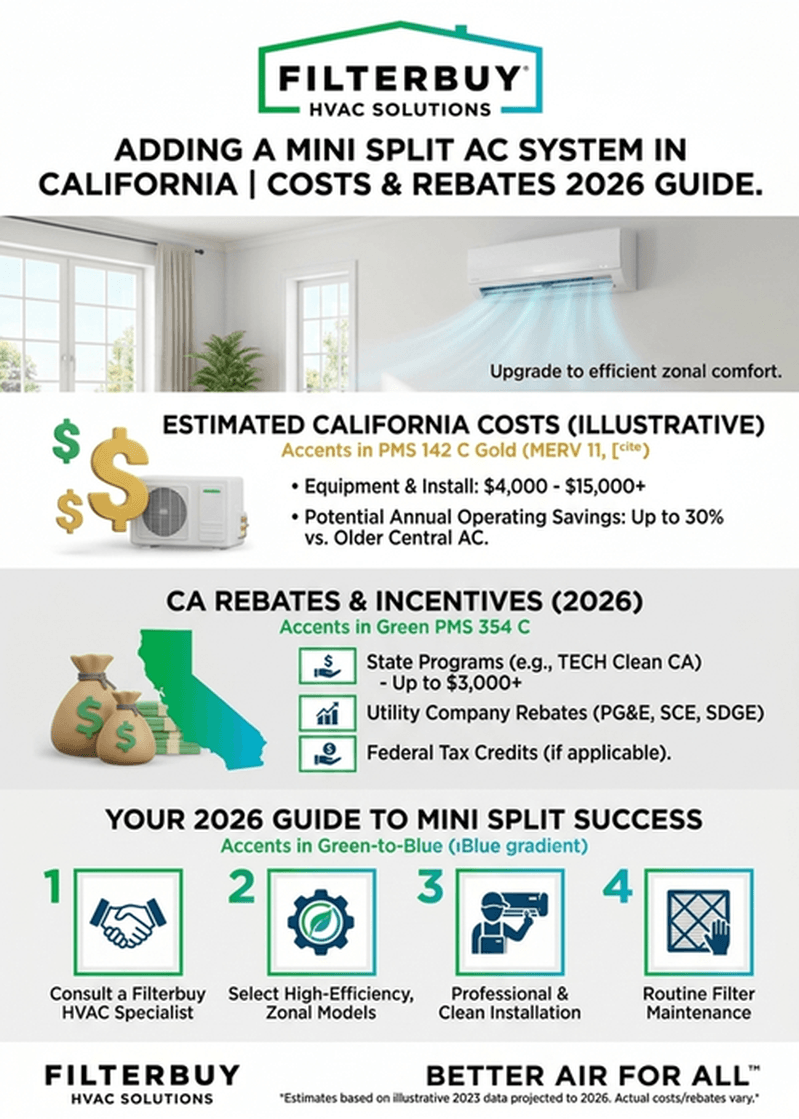
Installing one runs $3,500 to $14,500 in California in 2026. The federal tax credit that made the math easier through 2025 has expired, and the big statewide rebate programs are fully reserved. Utility-level rebates are still alive. And the electricity-rate math works without any of them.
TL;DR Quick Answers
Adding A Mini Split AC System, Including Rebates, in California
Installing a mini split AC system in California costs $3,500 to $14,500 in 2026, depending on zone count, BTU capacity, and local labor. Utility-level rebates are still paying out through LADWP, SMUD, Riverside Public Utilities, BayREN, and SoCalREN, at amounts from $150 per ton up to $2,500 per ton on heat pump HVAC systems. The federal 25C tax credit expired on December 31, 2025. Statewide programs like TECH Clean California and HEEHRA are fully reserved, with some regional waitlists. Mini splits are a strong fit for California's Mediterranean climate because variable-speed inverter compressors throttle down efficiently in mild weather, which is most of the year in most of the state.
Top 5 Takeaways
Installation costs $3,500 to $14,500 in California. Single-zone systems land on the low end. Whole-home multi-zone setups push the ceiling.
The federal 25C tax credit is gone. Heat pumps placed in service after December 31, 202,5 do not qualify for the $2,000 credit that was available through 2025.
Statewide rebates are oversubscribed. TECH Clean California and HEEHRA are fully reserved. Utility-level rebates at LADWP, SMUD, BayREN, and SoCalREN are the live path now.
California's climate is built for mini splits. Variable-speed inverters run most efficiently at part load. That's how most California homes operate for most of the year.
Plan filter maintenance on day one. Clean indoor pre-filters every two to four weeks. Upgrade any central-system filters to MERV 13 before wildfire season.
What A Mini Split Actually Is (And Why So Many California Homes Are Switching)
A ductless mini split is a type of air conditioning system that skips the ductwork entirely. You get an outdoor compressor connected to one or more indoor heads by a small refrigerant line and wiring. Usually, a three-inch wall penetration is all the construction it takes. Each indoor head conditions its own zone, so you can set the bedroom to 68 and the living room to 74 without anyone arguing.
Most modern mini-splits double as heat pumps. The same unit that cools your home in July heats it in January. Instead of burning gas like a furnace, the heat pump moves existing heat from one place to another, which is why it uses so much less energy.
Here's why California homeowners keep landing on mini splits:
No ductwork required. A huge portion of California's housing stock was never designed for central forced air, especially anything built before 1970. Mini splits retrofit cleanly.
Zone-by-zone control. You stop paying to cool empty rooms, which matters when California's electricity rates are among the highest in the country.
All-electric. California's Title 24 building code is pushing homes away from gas, and so are most utility incentive programs. A mini split heat pump is the clearest path there.
Quiet and low-profile. Modern indoor heads run around 19 to 24 decibels. That's roughly library-quiet.
The Real Cost Of Installing A Mini Split In California
Mini split installation in California runs $3,500 to $14,500 fully installed in 2026. The price moves based on zone count, BTU size, and where in the state you live.
Here's roughly how it breaks down:
Single-zone (one indoor head): $3,500 to $6,500 installed. Good for a garage, ADU, bonus room, or one stubborn bedroom.
Two-zone system: $5,500 to $9,500 installed. Often, the right call for a second-story retrofit.
Three-zone system: $7,500 to $12,000 installed. Handles most single-family homes.
Four-to-five-zone whole-home setup: $10,500 to $14,500+ installed. Full central-AC replacement territory.
California-specific factors push labor costs roughly 15 to 25 percent above the national average. A few things drive that:
Permits. Most CA jurisdictions require a mechanical permit, typically $250 to $400.
Licensed C-20 contractors. California requires an HVAC-licensed contractor for refrigerant work. Labor rates in LA, SF, and San Diego reflect that.
Title 24 compliance. Your installer has to file documentation showing that the system meets the state energy code.
Seismic bracketing. Some counties require the outdoor unit to be anchored against seismic movement.
Electrical upgrades. Older homes often need a dedicated circuit or even a subpanel addition. Budget $500 to $2,500 if your panel is already maxed out.
Every quote should include the unit, labor, refrigerant line set, electrical disconnect, and permit. Quotes usually don't include panel upgrades, condensate pumps for homes without a gravity drain path, or any asbestos remediation in pre-1978 homes.
California Rebates In 2026: What's Actually Available
This section changes month to month, so treat it as a map, not a guarantee. As of spring 2026, here's where things stand.
Federal 25C Tax Credit Has Expired.
The Energy Efficient Home Improvement Credit, which paid up to $2,000 for qualifying heat pumps, ran out on December 31, 2025. Any system installed and placed in service after that date does not qualify under the old rules. Confirm current status with a tax professional before you plan around it.
TECH Clean California Is Fully Reserved
The statewide program paid $1,000 per heat pump unit, up to two per home, and hit its cap in late 2025. Waitlists exist for additional funding rounds. Don't bank on one.
HEEHRA Is Fully Reserved
The income-qualified federal rebates of up to $8,000 are fully reserved statewide as of February 2026. Waitlists are open in some regions pending additional funding.
Utility And Regional Programs That Are Still Active
LADWP Consumer Rebate Program: up to $2,500 per ton on qualifying heat pump HVAC systems for LADWP customers.
SMUD Advanced Home Solutions: heat pump HVAC rebates for Sacramento-area customers on qualifying SEER2/HSPF2 equipment.
Riverside Public Utilities: $750 per ton on electric heat pumps meeting SEER 15.2+.
BayREN Home+: regional incentives for Bay Area homeowners converting to heat pumps.
SoCalREN: Southern California regional network offering similar conversion incentives.
SCE, PG&E, SoCalGas: amounts vary by utility and season. Check directly.
One honest note: incentive finders are your friend. The Switch Is On, and the DSIRE database consolidates active programs by ZIP code and updates faster than any secondary blog post.
Why Mini Splits Fit California's Climate So Well
California's climate is almost engineered for variable-speed inverter technology. That's the innovation that makes modern mini splits dramatically more efficient than the single-speed ACs of a decade ago.
Variable-speed inverters ramp up to hit your setpoint, then throttle down to maintain it, and the throttling is where the real efficiency gains come from. That matters more in California than almost anywhere else, because California's weather spends most of the year in the mild band where part-load efficiency dominates the equation.
A quick climate-zone breakdown:
Coastal and marine (Bay Area, SF, coastal LA). Short cooling season, mild heating demand. A single zone is often plenty.
Mediterranean (coastal strip and inner valleys). The sweet spot. Long mild shoulder seasons reward variable-speed throttling.
Hot-dry (Central Valley, Inland Empire, Palm Springs). Look for SEER2 18+ and size carefully. Heat is the limiting factor, and oversized units have a short cycle.
Mountain and high desert (Tahoe, high-elevation). Go with a cold-climate model rated for performance at 5°F and below. Standard mini-splits will struggle.
Keeping Your Mini Split Running Clean
Most installers won't tell you this, but a mini split's efficiency depends entirely on clean airflow. The indoor head's pre-filter is the single most overlooked maintenance item in the system.
A few rules of thumb:
Pre-filters. Clean them every two to four weeks during heavy-use months. Slide them out, vacuum or rinse, air-dry fully, reinstall.
Secondary filter media. If your unit has a catechin, carbon, or electrostatic layer, replace it every three to six months.
During the California wildfire season (May to October). If you also run a central system or whole-house fan, upgrade those filters to MERV 13. A standard MERV 8 rating lets fine PM2.5 smoke particles pass right through.
For homes with only mini splits. A portable HEPA air cleaner in the primary bedroom supplements the built-in filtration, especially during smoke events.
A mini split with dirty filters can lose 5 to 15 percent efficiency inside a single season. Put the maintenance on autopilot, and you protect both the air quality and the investment.
“Across the California installs we've watched over the past decade, the difference between a mini split that hits its efficiency claims and one that doesn't almost always comes down to two things nobody mentions: correct BTU sizing for the actual load, and a homeowner who actually cleans the filter every three weeks. Equipment brand matters less than most installers will suggest.”
— Filterbuy HVAC Specialist Team
Essential Resources For Adding A Mini Split AC System In California
Seven sources worth bookmarking before you start collecting quotes. They update more often than any secondary blog post, and they carry the authority to settle disputes about rebates, codes, and sizing.
1. Find Every Active Rebate In Your ZIP Code
The ENERGY STAR Rebate Finder pulls current utility, state, and manufacturer rebates by ZIP code. Best single starting point before you ever request a contractor quote.
Source: ENERGY STAR Product Rebate Finder
2. Verify The Status Of The Federal 25C Tax Credit
The IRS page on the Energy Efficient Home Improvement Credit is the authoritative source on 25C eligibility, expiration, and filing requirements. Check here before you make any tax assumptions.
Source: IRS Energy Efficient Home Improvement Credit
3. Confirm Your Home's Title 24 Compliance Path
The California Energy Commission keeps the current Title 24 building energy standards, including the documentation your HVAC installer has to file for any new mini split system.
Source: California Energy Commission Building Standards
4. Track TECH Clean California And Regional Incentives In Real Time
The Switch Is On is the statewide hub for heat pump incentives, including TECH Clean California program status, HEEHRA rebate availability, and a contractor directory. Updates faster than any third-party source.
Source: The Switch Is On Incentive Finder
5. Compare Every State Incentive In One Place
The Database of State Incentives for Renewables & Efficiency, maintained by NC State's Clean Energy Technology Center, consolidates state, local, and utility heat pump programs nationwide. Filter by ZIP for California-specific listings.
Source: DSIRE National Incentive Database
6. Access BayREN Home+ Rebates For Bay Area Homeowners
The Bay Area Regional Energy Network offers direct rebates for heat pump conversions, including ductless mini splits, covering Alameda, Contra Costa, Marin, Napa, San Francisco, San Mateo, Santa Clara, Solano, and Sonoma counties.
Source: BayREN Home+ Program
7. Size Your Mini Split The Way The DOE Recommends
The U.S. Department of Energy's ductless mini split heat pump guide covers proper BTU sizing, cold-climate performance, and energy savings calculations. The reference most careful installers actually trust.
Source: DOE Ductless Mini Split Heat Pumps Guide
Supporting Statistics
Three numbers that explain why the mini split case works especially well in California.
1. California Residential Electricity Costs Run Nearly Double The National Average
The U.S. Energy Information Administration reports California's average residential electricity price reached roughly 31 cents per kilowatt-hour in 2024, compared to a national average near 16 cents. That gap is exactly why a high-SEER2 mini split pays back faster in California than in almost any other state. You're saving against a higher cost per kilowatt-hour every minute the system runs.
Source: U.S. Energy Information Administration California State Electricity Profile
2. Americans Spend Roughly 90 Percent Of Their Time Indoors
The U.S. Environmental Protection Agency estimates Americans spend about 90 percent of their time indoors, where concentrations of some pollutants can run two to five times higher than typical outdoor levels. That's why mini split filter maintenance and supplemental filtration matter more than most homeowners realize. The air you breathe at home is the air you breathe most of the time.
Source: U.S. EPA Report on the Environment, Indoor Air Quality
3. Wildfire Smoke Drives PM2.5 Exposure Well Past Federal Healthy Thresholds
The Centers for Disease Control and Prevention warns that wildfire smoke contains PM2.5 particles small enough to penetrate deep into the lungs and enter the bloodstream. During California's peak fire seasons, PM2.5 readings have exceeded federal healthy thresholds across large portions of the state for weeks at a time. MERV 13 filtration is the practical minimum for capturing particles at this size.
Source: CDC How Wildfire Smoke Affects Your Body
Final Thoughts & Opinion
The take after watching a decade of California installs:
A mini split's case in California doesn't hinge on the federal tax credit or any one rebate. Electricity rates, climate fit, and the way variable-speed technology actually works in mild weather carry most of the weight. Even with every rebate door closed, the math still works for most California homeowners over a 12-to-15-year ownership window. Not as fast as it would be with full incentive stacking. But it still works.
Where homeowners get burned almost never involves the equipment. Three shortcuts do almost all the damage:
Oversized units short-cycle, waste energy, and wreck humidity control in coastal zones.
Unlicensed installers save you $1,500 upfront, then cost you the manufacturer's warranty plus any future rebate eligibility.
Skipping filter maintenance drops efficiency 10 to 15 percent within a single season, silently, with no obvious warning signs.
The honest recommendation: get three itemized quotes from TECH-enrolled, C-20 licensed contractors. Pick the one who actually explains their BTU sizing math. Put your filter replacement schedule on autopilot from day one.
Next Steps
Walk around your home and count the zones. List every room you want conditioned and measure the square footage. This is the foundation of every quote you'll get.
Check active rebates by ZIP code using The Switch Is On or the DSIRE database. Skip contractor marketing pages.
Request three itemized quotes from TECH-enrolled, C-20 licensed contractors. Each quote should break out equipment, labor, refrigerant line set, electrical work, and permit separately.
Verify any rebate reservation before you sign a contract. Your contractor handles the TECH or HEEHRA paperwork. Make sure the reservation is approved before installation starts.
Plan your filter maintenance before day one. Set calendar reminders every three weeks for pre-filter cleaning. If a central system is running alongside the mini split, set up MERV 13 auto-delivery.
Frequently Asked Questions
Ready To Add A Mini Split AC System To Your California Home?
Filterbuy's current mini split lineup is single-zone (12K, 18K, and 24K BTU). For multi-zone or whole-home setups, your licensed installer can recommend a multi-zone-capable system. Ship with variable-speed inverter compressors and built-in multi-layer filtration. Shop the lineup, and set your filter for auto-delivery from the same order.