
Waco Real-Time AQI Tracker


Get Alerts For Unhealthy AQI In Your Area
When air quality in your area reaches unhealthy levels, we'll send you a quick alert, along with expert tips on how to reduce your exposure.
What's Actually In Waco Air Today?
What High AQI Means for Your Lungs in Waco
How to Read AQI
The Air Quality Index (AQI) measures how polluted the air is and how it may affect your health.
0–50 (Good): Air quality is satisfactory.
51–100 (Moderate): Acceptable, but some pollutants may pose minor concerns.
101–150 (Unhealthy for Sensitive Groups)
151–200 (Unhealthy)
201–300 (Very Unhealthy)
301+ (Hazardous)
Moderate
Still okay for most, but if you have asthma or allergies, take it easy and avoid long outdoor workouts.
Shop MERV 11 filters→What's the Right Filter for Your AQI Level?
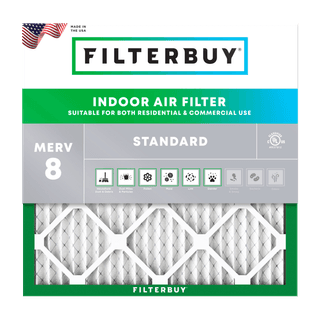
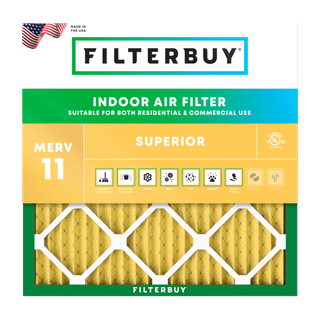
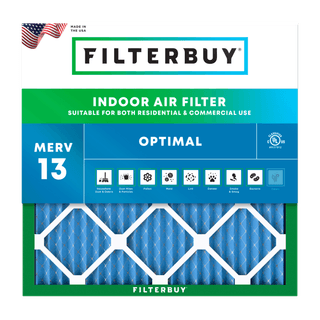

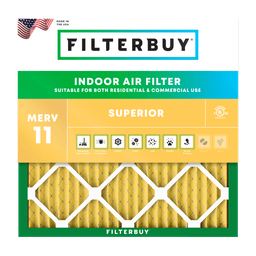
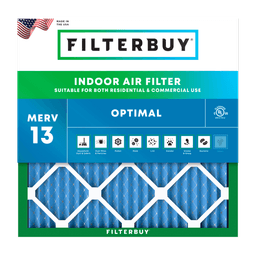


Check Today's Live Real-Time Air Quality Index AQI Map in Waco, Texas Now
TL;DR
Waco's live Air Quality Index is measured at the Waco Mazanec monitoring station (TCEQ site C1037) and reported through AirNow, the EPA's official air quality service. Ozone is most often the driver on hot summer afternoons, while fine particles (PM2.5) spike during winter cedar pollen surges and summer Saharan dust events. Check the live map below for right-now conditions, then use the seasonal table to know what is likely driving the number.
Live AQI Map: Waco, TX
The map below is the Filterbuy live AQI map, drawing Waco’s current reading from EPA and TCEQ monitoring data. Search by ZIP code to compare your part of town against the citywide number.
Key Takeaways
Waco's official AQI comes from one regulatory monitor: Waco Mazanec, TCEQ site C1037. The station measures ozone, fine particles, sulfur dioxide, and carbon monoxide, but AirNow builds the live AQI from ozone and particle pollution only.
Ozone is the pollutant most often named as Waco's summer driver. It forms when sunlight reacts with vehicle exhaust, so TCEQ forecasts its highest concentrations in the afternoon and early evening on hot, still days. Mornings run cleanest.
Waco's worst pollen season is winter, not spring. Mountain cedar (Ashe juniper) pollen surges from late December through February, peaking in January.
McLennan County currently meets federal air quality standards for every pollutant EPA tracks, per the EPA Green Book, which is why most Waco days land in the Good or Moderate range.
Different apps show different AQI numbers for Waco because they use different data sources and conversion methods. AirNow is the regulatory reference.
Outdoor air becomes indoor air. EPA estimates Americans spend about 90% of their time indoors, so what the map shows outside is what your HVAC system handles inside within hours.
What Is the Air Quality in Waco Today?
Waco's air quality today is reported as an AQI value from 0 to 500, drawn from the Waco Mazanec regulatory monitor and published through AirNow's Waco-Killeen reporting area. Most days here land in the Good (0–50) or Moderate (51–100) range. Alongside the number, the live map shows a color category and the pollutant driving the reading, and that last detail is the one most people scroll past, even though it decides what you should actually do about it.
The distinction is not academic. An AQI of 85 driven by afternoon ozone calls for a very different response than an AQI of 85 driven by cedar pollen or Saharan dust. Ozone is a gas, and it clears once the sun goes down. Fine particles linger, drift indoors, and settle into the rooms you sleep in.
Where Waco's air quality data comes from
The Texas Commission on Environmental Quality (TCEQ), the state environmental agency, operates the Waco Mazanec station and feeds its hourly readings to AirNow, the joint EPA and partner-agency service that publishes official U.S. air quality data. TCEQ also issues a daily regional air quality forecast that groups Waco with Killeen, so a forecast referencing the "Waco-Killeen area" is describing conditions here. For conditions elsewhere in the state, see our Texas AQI map.
Why Different Apps Show Different AQI Numbers for Waco
We check Waco against several public air quality sources before we publish anything about this city, and the readings rarely agree. Regulatory monitors like Waco Mazanec take direct physical measurements at a fixed location and report them to AirNow on EPA's standardized scale. Several popular apps instead use satellite-derived atmospheric modeling, or run raw sensor data through their own proprietary conversion. Those approaches estimate air quality across a grid rather than reading it at one certified instrument, and in a mid-sized metro like Waco with a single official monitor, the spread gets wide.
Two things about that reading rarely get explained anywhere else. AirNow builds its live AQI from ozone and particle pollution only, so the sulfur dioxide, carbon monoxide, and nitrogen dioxide measured at the station never reach the number on your screen. And the AirNow figure is a public reporting standard rather than the regulatory record, since EPA certifies attainment separately through its Air Quality System.
For anything that actually matters, like whether to hold outdoor practice or whether a kid with asthma should be outside, we go with the official AirNow value. It is what Texas agencies and physicians work from. The other apps are worth a glance as a second opinion, but when two sources disagree sharply, trust the one reading an actual monitor.
Waco AQI Levels and What They Mean
The AQI runs from 0 to 500 across six categories. Here is what each band means for an ordinary day in Waco, and what most people should do about it.
Categories and health guidance per U.S. EPA / AirNow.
Today's Driver, and What to Actually Do
The live map names the pollutant behind the number, and that single word shapes the right response more than the reading itself does.
Guidance follows EPA and AirNow activity recommendations, applied to Waco's seasonal pattern.
What Actually Drives Waco's Air Quality, Month by Month
This is where Waco parts ways with the rest of Texas, and it is the part national air quality apps leave out entirely.
Sources: Texas Commission on Environmental Quality, AirNow, Texas A&M Forest Service.
Cedar fever: Waco's winter air quality story
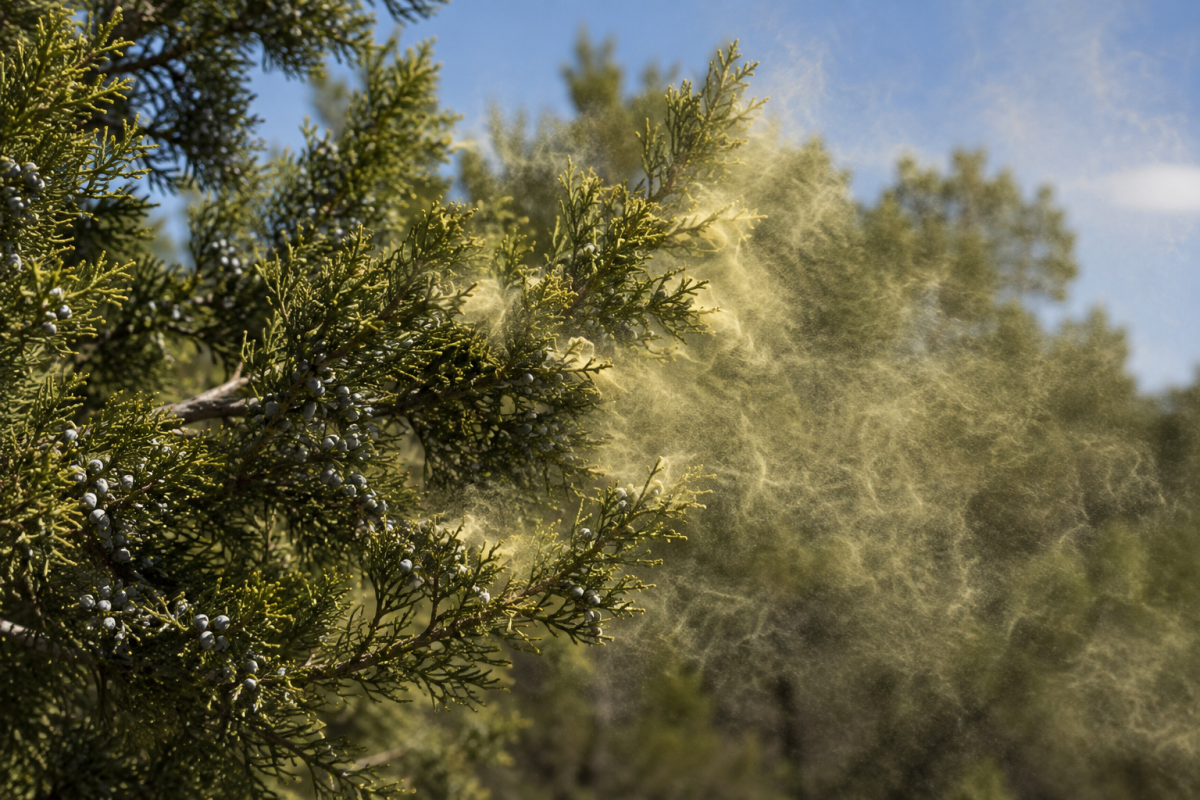
Mountain cedar, properly called Juniperus ashei or Ashe juniper, is the defining Central Texas allergen, and Waco sits near the northern edge of the cedar belt that runs through the Hill Country west of I-35. According to the Texas A&M Forest Service, cold fronts set the whole thing off. The air dries out, the wind picks up, and every pollen cone on a juniper opens at once until the trees look like they are smoking. Counts go from tolerable to overwhelming inside a few hours. The season usually starts after the first December freeze, peaks in January, and tails off through February.
The congestion, fatigue, headaches, and body aches that follow hit hard enough that Central Texans routinely mistake cedar fever for the flu. None of it registers on the AQI, so a Good reading in January is no promise of a comfortable day.
The Forest Service recommends keeping windows and doors closed on high-pollen days and changing the air filters in both your home and your car. Cedar country runs south from here, so our San Antonio AQI page follows the same seasonal pattern at the other end of the belt.
Summer ozone and Saharan dust
Ozone is the pollutant that shows up most often as Waco's primary driver. It is not emitted directly; it forms when sunlight reacts with vehicle exhaust and industrial emissions, which is why readings climb through the afternoon and fall after sunset. Morning is reliably the cleanest air of a Waco summer day, a pattern our Houston AQI page tracks across the same Texas ozone season.
Layered on top, from roughly June through August, is the Saharan Air Layer, fine mineral particles that ride the trade winds more than 5,000 miles across the Atlantic. NOAA tracks it on the way over. The dust arrives here as fine particle pollution, it produces the milky haze and vivid sunsets Texans associate with midsummer, and TCEQ logs the bigger episodes formally as exceptional events.
What Waco's AQI Does Not Tell You
If the map says Good and you still feel terrible, you are not imagining it. The AQI is a useful number with four real blind spots, and in Waco all four matter.
Pollen is not in it. Cedar, oak, and ragweed are tracked separately. January is the clearest example: the AQI can sit in the green while cedar counts are extreme.
One monitor covers the whole metro. Waco Mazanec is a single station. Air near I-35 at rush hour is not the same as air in a neighborhood two miles off the corridor, and the citywide number cannot show that difference.
It only counts ozone and particles. AirNow builds the live reading from those two. Sulfur dioxide, carbon monoxide, and nitrogen dioxide are measured but never shown.
It says nothing about the air inside your house. Cooking, candles, dust, pet dander, and mold are all indoor sources the AQI never sees.
None of that makes the number useless. It just means the AQI is where you start rather than where you stop. If the map says Good and your eyes are streaming in January, believe your symptoms and go check a Waco pollen count instead. We cover the difference in more depth across our Filterbuy air quality guides.
Why Waco Is a Two-Season Filter Market
One pattern keeps coming up whenever we look at Waco. Most U.S. cities have a single season that loads an air filter hard. Waco has two, and they sit at opposite ends of the calendar: cedar pollen from late December through February, then ozone and Saharan dust from June through August. Spring and fall are the quiet stretches in between.
So the usual advice does not quite fit here. A once-a-year filter habit works well enough in a single-peak city, but in Waco it leaves a house running loaded media through exactly the weeks that matter most. We would rather tell someone here to plan around January and July than hand them a generic 90-day rule.
Filterbuy has been manufacturing air filters in the United States for over a decade, in more than 600 standard sizes plus custom, shipped factory-direct. That shapes how we approach a page like this one. The number itself interests us less than what a household should do about it before the next bad-air week arrives.
Why Waco's Outdoor AQI Matters Inside Your Home
Outdoor air does not stop at your front door. It seeps in around windows and doors, drops through the attic, and rides in on clothes every time someone walks up from the driveway. EPA estimates Americans spend roughly 90% of their time indoors, where some pollutants run two to five times higher than outside. Most of what shows on today’s map is air you will end up breathing in your living room, and once it is inside, your HVAC filter is the main thing capturing it.
What to Do When Waco's AQI Reaches 100
AQI 100 is where Filterbuy tells customers to act. That is our line rather than an EPA category change, since 100 is still the top of the Moderate band on the EPA scale. We would rather move at the threshold than wait until it is crossed. At 100 and above, four things, in this order.
Put MERV 13 in the HVAC. EPA recommends a high-efficiency filter rated MERV 13 or higher in a central system during smoke events, and notes that most furnaces and HVAC systems accommodate MERV 13 without equipment problems as long as the filter is replaced often. Smoke, dust, and cedar pollen all map to MERV 13 on our ladder. Check the size the way you would for any replacement.
Set the thermostat fan to On. Auto only filters while the system is heating or cooling. On keeps air moving through the filter continuously.
Run a portable HEPA air cleaner in each occupied room, bedrooms first. This one is our recommendation rather than EPA’s. EPA’s clean-room guidance covers a single room, and we think each occupied room is the better call. For sizing, pick a unit whose smoke CADR is at least two-thirds of the room’s square footage, so a 300 square foot bedroom wants a smoke CADR of roughly 200. Skip anything that generates ozone, which EPA advises against.
Close the house up. Windows and doors shut, and do not add to the problem while the air is bad: no candles, no frying, no vacuuming without a sealed unit, no smoking indoors.
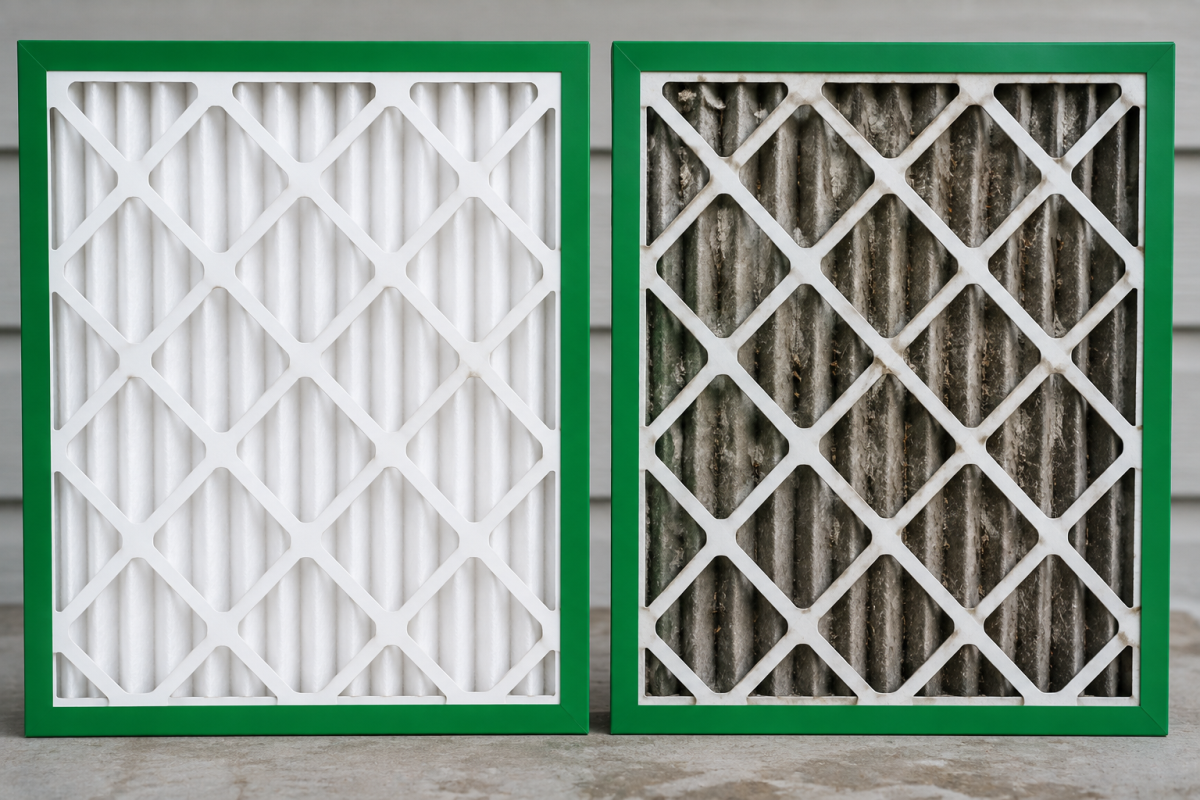
Check the filter, not the calendar. Cedar and dust load a filter far faster than a normal month does. EPA’s test is visual: replace it when it looks dirty, dark brown or black, which can be well before the interval printed on the frame. Keep spares on hand so you can swap it the day you notice, which is what Filterbuy auto-delivery is for.
If you live in an apartment, run window units, or your home has no ductwork, there is no whole-home layer to upgrade. Portable HEPA cleaners are your primary defense rather than a supplement, and the room where you sleep is the place to start.
Once the reading climbs into the red or purple bands, AirNow's Waco-Killeen reporting area and local McLennan County guidance come first, and filtration is one layer rather than the answer. Anyone with asthma, COPD, or a heart condition should take direction from their own clinician and from official guidance rather than from a filter recommendation.
Supporting Statistics
Three findings behind the guidance on this page. Each comes from a different organization.
Nearly 7% of Texas children have asthma.
That is more than 492,000 kids statewide.
Why it matters: the sensitive-group rows above describe a lot of Waco families.
Source: Texas Department of State Health Services (Texas BRFSS).
EPA recommends MERV 13 or higher during smoke events.
EPA also reports that most furnaces and HVAC systems accommodate MERV 13 without equipment problems when the filter is replaced often.
Why it matters: the tier we recommend is the tier the regulator recommends.
Source: U.S. EPA.
Cedar pollen gets inside.
Peak reading: 5,501 grains per cubic meter in one Austin season.
Indoor readings beat outdoor readings in 12 of 58 measured room-days.
Why it matters: a Good AQI in January says nothing about cedar. Waco sits on the same cedar belt.
Source: NIH National Library of Medicine, Int. Journal of Environmental Research and Public Health, 2022.
Figures as published by each source and verified August 31, 2026. Percentages describe measured or modeled averages, not guaranteed results in any individual home.
Frequently Asked Questions
Glossary
AQI (Air Quality Index): EPA's 0–500 scale for reporting daily air quality, divided into six color-coded health categories.
AirNow: The official U.S. government air quality reporting service, run by EPA with partner agencies, publishing data from regulatory monitors nationwide.
Ashe juniper (mountain cedar): Juniperus ashei, a Central Texas evergreen whose winter pollen release causes "cedar fever." Concentrated in the Hill Country west of I-35.
Attainment: EPA's designation for an area meeting National Ambient Air Quality Standards for a given pollutant. McLennan County is currently in attainment.
Filterbuy: A U.S. air filter manufacturer headquartered in Talladega, Alabama, producing MERV 8, 11, and 13 pleated HVAC filters in more than 600 standard sizes plus custom, and the publisher of this live Waco AQI map.
MERV: Minimum Efficiency Reporting Value, the 1–16 scale rating an air filter's ability to capture particles. EPA recommends MERV 13 or higher for fine particles.
Ozone (O3): A gas formed when sunlight reacts with vehicle and industrial emissions. Waco's most frequent primary pollutant, peaking on hot afternoons.
PM2.5: Fine particulate matter under 2.5 micrometers, small enough to reach deep into the lungs. Sources in Waco include traffic, dust, smoke, and pollen fragments.
Saharan dust (Saharan Air Layer): Mineral dust carried from North Africa across the Atlantic each summer, raising PM2.5 across Texas from June through August.
TCEQ: Texas Commission on Environmental Quality, the state agency operating Texas air monitors including Waco Mazanec (site C1037).
Sources
USA Live AQI Map · Texas AQI Map · San Antonio, TX AQI · Houston, TX AQI · AQI Scale Explained · AQI Color Chart · What Is PM2.5? · AQI by ZIP Code · MERV 13 Filters · Custom Air Filters · Air Filter Subscription