May 13, 2026
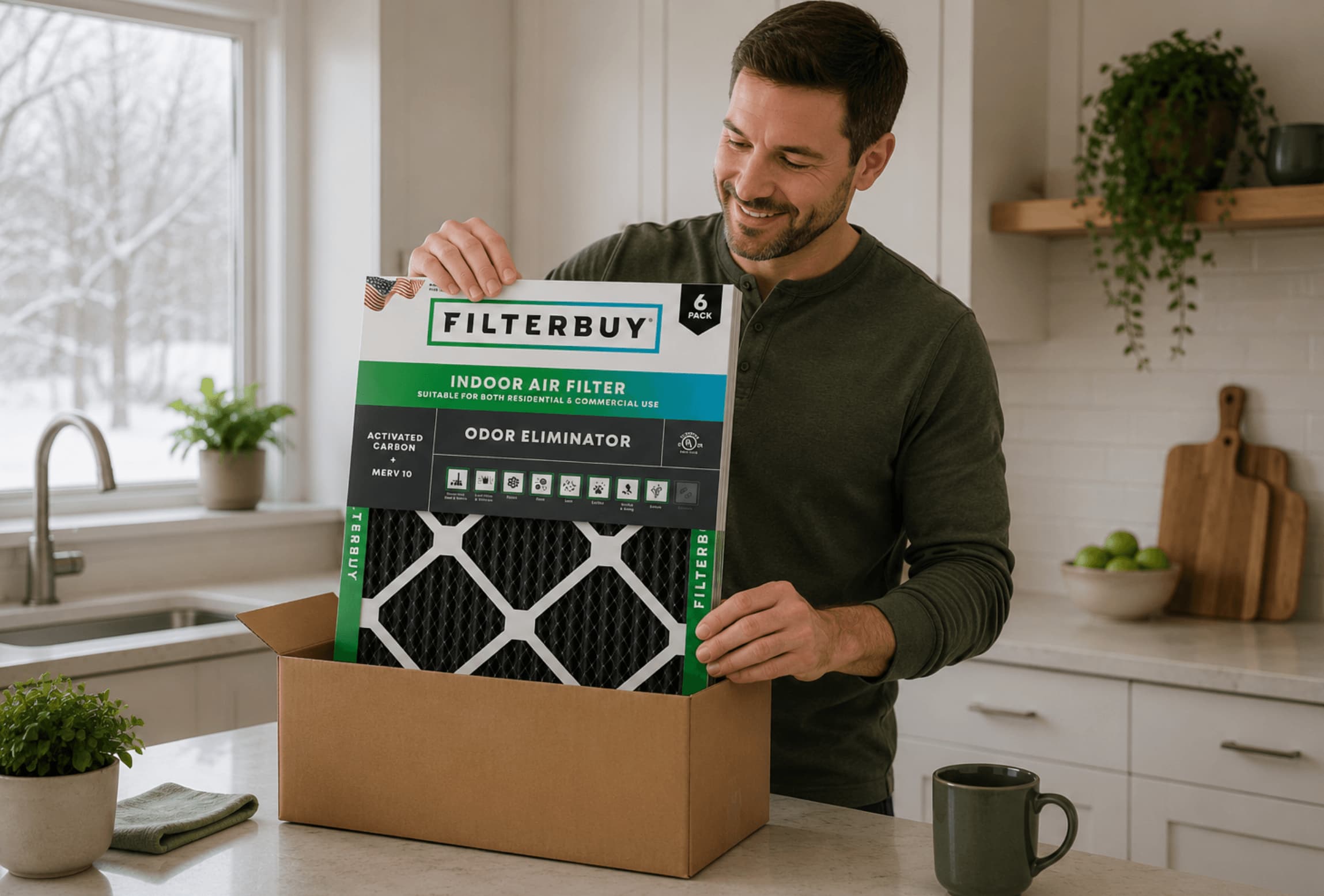
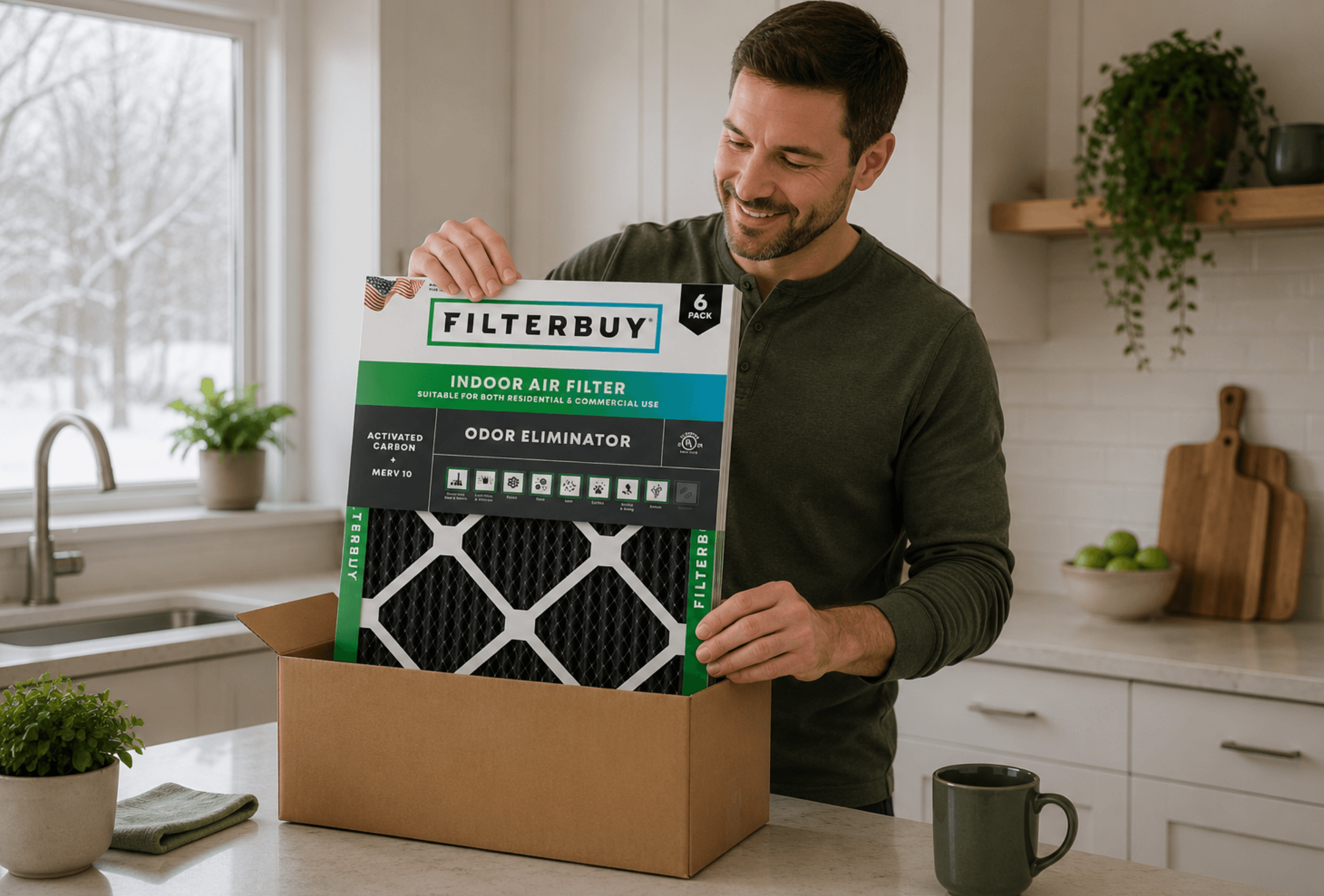
By February, your house has been recirculating the same air for months. That's why the kitchen still carries last Tuesday's salmon and the basement is begging for spring. Windows stay shut. The furnace runs daily. Odor molecules pile up because they have nowhere to escape, and they keep cycling through your ductwork until something physically grabs them and holds on.
That something is almost always a carbon filter in the return vent, doing quiet work most homeowners forget is even possible. We've been building those filters in the U.S. since 2013, and we've shipped millions of them to homes dealing with exactly this winter problem.
Carbon filters for odor-heavy winter trap the gas-phase smells your pleated filter can't catch (cooking, pet funk, fireplace smoke, off-gassing, basement mustiness) by holding those molecules on activated carbon as air cycles through your HVAC. After more than a decade of building these in our U.S. factories, here's what we tell every customer who calls us between October and March:
• Yes, they work. Activated carbon adsorbs gas-phase odors that standard pleated media passes straight through.
• Pair carbon with the right MERV rating. MERV 8 with carbon for general odors, MERV 11 for pet households, MERV 13 for allergies or wildfire regions.
• Swap every 60 days through heating season. Carbon saturates faster than non-carbon media. A saturated filter stops working even when the pleat still looks clean.
• They won't replace a CO detector. Carbon doesn't catch carbon monoxide. That's non-negotiable in any home with gas appliances or a fireplace.
• Run source control alongside them. The range hood, bathroom fan, and dry coats handle half the load before any filter sees the air.
• Winter is the worst season for indoor odors. Sealed windows and heating cycles trap smells inside, and the smells don't have anywhere to go.
• Activated carbon traps odor molecules through adsorption. Think Velcro: the molecules stick to the surface instead of soaking in like a sponge.
• Pair carbon with the right MERV rating for your home. General odor control calls for MERV 8 with carbon. Pet households and allergy concerns step up to MERV 11. Homes with respiratory sensitivities or wildfire exposure go to MERV 13. Carbon layers onto whichever rating fits.
• Source control still matters. Carbon filters help, and the range hood, the bathroom fan, and dry coats do half the work.
• Auto-delivery removes the guesswork. A fresh filter ships every 60 days, so you stop forgetting and the furnace stops working harder than it needs to.
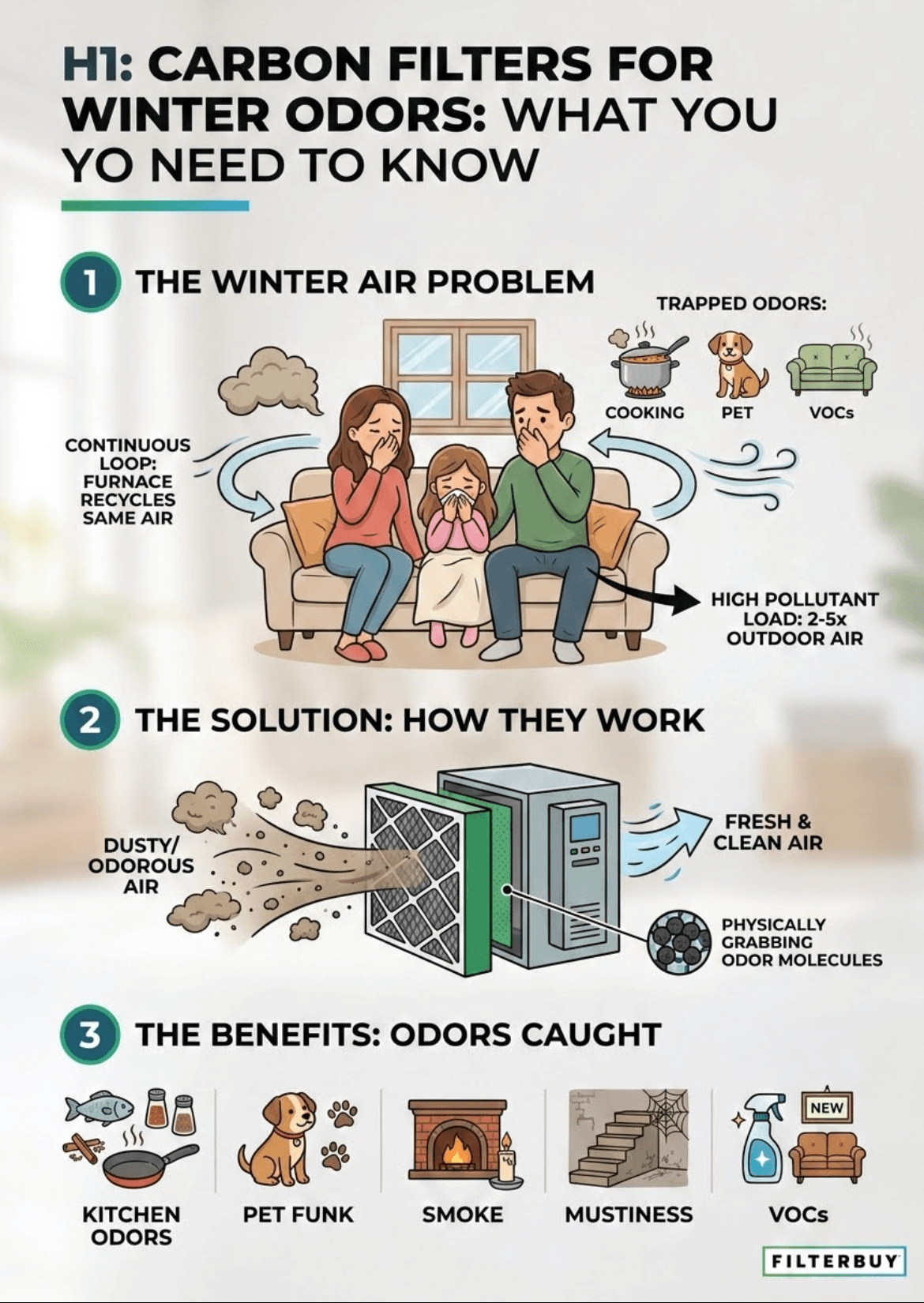
The temperature drops, the windows stay shut, and your home gets airtight. The furnace recycles the same air on a loop. Every smell-producing activity keeps adding to a pool that has no drain: cooking, pets, candles, off-gassing from the new throw pillows. EPA's research on indoor air quality shows that pollutant concentrations inside are often two to five times higher than outdoor concentrations, and that ratio gets worse during heating season when sealed building envelopes hold contaminants in. The musty smell from the basement isn't going outside. The fish dinner from Tuesday isn't either.
Plain charcoal has a little porosity. We build our Odor Eliminator filters around activated carbon, which gets its capacity from a steam-treatment process that opens up millions of microscopic pores inside the material. A single gram of high-grade activated carbon can carry between 500 and 1,500 square meters of internal surface area. Picture several tennis courts of grippy surface compressed into a teaspoon.
When air passes through the carbon layer, gas-phase molecules stick to those pore walls. The process is called adsorption: the molecules attach to the carbon's surface rather than soaking in. That's why carbon filters catch what pleated media misses. A pleated MERV filter pulls dust, dander, and pollen out of the air. Add carbon to that pleat, and now it grabs the gases too.
The winter complaints we hear most often from customers all map back to gas-phase pollutants:
• Cooking smells that hang around two days later, including fish, fried food, garlic, and takeout reheated for lunch
• Pet odors that build up in closed-window homes
• Fireplace and candle smoke that lingers after the fire's out
• Musty basement and laundry-room smells when the heat first kicks on each season
• VOCs from cleaners, fresh paint, new furniture, and holiday décor still off-gassing from the box
A carbon-layered HVAC filter handles all of that at once, every time your blower cycles air through the system. That's whole-home coverage with no extra outlet to plug in.
Customers deserve the full picture. Carbon doesn't capture:
• Carbon monoxide. A CO detector is required, not optional, in any home with gas appliances, a furnace, or a fireplace.
• Particles smaller than the carbon's pore size. Pair carbon with a MERV 11 or higher pleat for fine particulate.
• Mold or moisture itself. Carbon adsorbs the smell. To stop the source, you have to fix the moisture with a dehumidifier, a leak repair, or better ventilation.
Two questions to answer:
1. What size fits your system? Pull your current filter and read the dimensions stamped on the cardboard frame (depth × width × height). If a stock size doesn't fit, custom sizes are available.
2. What's your MERV and carbon combination? MERV 8 with carbon handles general odor control. MERV 11 with carbon works for pet households. MERV 13 with carbon is best for allergies, asthma, or wildfire-smoke regions.
Set replacement to every 60 days through heating season. Carbon saturates faster than non-carbon filters, and a saturated filter stops adsorbing even if the pleated media still looks fine. Auto-delivery handles the calendar for you.
"After more than a decade of building filters in our U.S. factories and helping homeowners troubleshoot the same winter complaints year after year, the biggest mistake we see is people spending money on single-room purifiers when the filter slot in their HVAC return is the highest-impact spot in the house. Every cubic foot of air your home breathes already passes through it."
— Filterbuy IAQ Team
The sources we keep coming back to for serious questions about indoor air, filtration, and what activated carbon actually does:
1. EPA — Guide to Air Cleaners in the Home. The agency's plain-language overview of HVAC filters and portable air cleaners, with specific guidance on activated carbon and gas-phase filtration. https://www.epa.gov/indoor-air-quality-iaq/guide-air-cleaners-home
2. EPA — The Inside Story: A Guide to Indoor Air Quality. Joint EPA and CPSC publication covering the most common indoor pollutants, where they come from, and what homeowners can do about them. https://www.epa.gov/indoor-air-quality-iaq/inside-story-guide-indoor-air-quality
3. EPA — Technical Overview of Volatile Organic Compounds. The technical definition of VOCs, indoor sources, and how they behave. Useful when you want to know what carbon is actually catching. https://www.epa.gov/indoor-air-quality-iaq/technical-overview-volatile-organic-compounds
4. EPA — Improving Your Indoor Environment. Practical guidance on the most common indoor air quality problems and which mitigation steps actually move the needle. https://www.epa.gov/indoor-air-quality-iaq/improving-your-indoor-environment
5. NIEHS — Indoor Air Quality. The National Institute of Environmental Health Sciences' research-backed overview of indoor air pollutants and the health effects tied to them. https://www.niehs.nih.gov/health/topics/agents/indoor-air
6. EPA — Indoor Air Quality Exposure and Characterization Research. Ongoing EPA research into indoor pollutants, measurement methods, and emerging concerns including PFAS, phthalates, and flame retardants. https://www.epa.gov/air-research/indoor-air-quality-exposure-and-characterization-research
7. California Air Resources Board — Effectiveness of Advanced Air Purifiers and Filtration for VOCs and Non-PM Pollutants. State-government research that specifically evaluates how activated carbon and chemisorbant technologies perform on odors and VOCs in real-world conditions. https://ww2.arb.ca.gov/resources/documents/effectiveness-advanced-air-purifiers-and-filtration-reducing-h2s-no2-vocs-and
"Americans, on average, spend approximately 90 percent of their time indoors, where the concentrations of some pollutants are often 2 to 5 times higher than typical outdoor concentrations."
Source: U.S. EPA, Indoor Air Quality (Report on the Environment). https://www.epa.gov/report-environment/indoor-air-quality
"Indoor concentrations of some pollutants have increased in recent decades due to such factors as energy-efficient building construction (when it lacks sufficient mechanical ventilation to ensure adequate air exchange) and increased use of synthetic building materials, furnishings, personal care products, pesticides, and household cleaners."
Source: U.S. EPA, Indoor Air Quality. https://www.epa.gov/report-environment/indoor-air-quality
"The World Health Organization estimates 3.8 million people worldwide die every year from illnesses attributable to harmful indoor air from dirty cookstoves and fuel."
Source: National Institute of Environmental Health Sciences, Indoor Air Quality. https://www.niehs.nih.gov/health/topics/agents/indoor-air
What we've come around to after more than a decade of this work: most homeowners overlook the most powerful air-cleaning tool already sitting in their house, which is the filter slot in the HVAC return vent. People buy a single-room purifier for the bedroom, plug it in, and call it done. Meanwhile a carbon-layered HVAC filter would clean every cubic foot of air the whole house breathes, all winter, often for less money than the purifier cost.
Carbon won't solve everything. It can't reach behind the couch where the dog rolled around, it won't pull smoke out of a wool sweater, and nothing about it replaces a CO detector. For the day-to-day winter funk (cooking, pets, candles, off-gassing, basement mustiness), carbon does the quiet, invisible work better than almost anything else you can install in your home.
One change before the cold really settles in. Make it this one.
1. Find your filter size. Pull your current filter and read the dimensions stamped on the cardboard frame (depth × width × height).
2. Pick your MERV and carbon combo. General odor control calls for MERV 8 with carbon. For pet households or allergy concerns, step up to MERV 11 with carbon. If anyone in the house has sensitive lungs or you live in a wildfire region, go with MERV 13 plus carbon.
3. Order before the cold snap. Buying ahead means you're not scrambling when the heat is already running daily.
4. Set up auto-delivery. A fresh filter ships every 60 days. No calendar reminders, no last-minute hardware-store runs.
5. Pair with source control. Run the range hood when you cook, vent the bathroom, keep litter boxes away from return vents, and dry damp coats away from heating registers.
Activated charcoal (the same material as activated carbon) traps gas-phase pollutants as air passes through your HVAC. The carbon's porous structure adsorbs odor molecules, smoke compounds, and VOCs onto its surface, holding them in place so they stop recirculating through your home.
For homes that cook often, have pets, use a fireplace, or struggle with musty smells when the heat runs, yes, carbon filters earn their keep in winter. Homes are sealed tighter through heating season, so odors and VOCs build up faster than they do in spring or summer. A carbon HVAC filter catches them at the return vent before they recirculate.
Most carbon furnace filters last 30 to 90 days, depending on home size, pets, cooking habits, and how hard your HVAC runs. Carbon saturates with odor molecules over time. Once the carbon is full, the filter stops adsorbing even if the pleated media still looks clean.
Carbon filters cut cooking odors and the gas-phase compounds in light smoke down by a meaningful margin. For heavy smoke from a fryer accident or a scorched pan, run the range hood at the same time. Source ventilation handles the bulk, and the carbon filter mops up what escapes into the rest of the house.
Yes. Pet odors come from skin oils, urine compounds, and dander funk, most of which are gas-phase pollutants that pleated filters alone can't capture. Pair a MERV 11 or MERV 13 carbon filter for the strongest combination. The pleats catch dander and hair particles, and the carbon adsorbs the smell.
Activated carbon filters reduce common indoor VOCs including formaldehyde, benzene, and paint or cleaner fumes, as long as the filter contains enough carbon to do the job. EPA guidance on this is clear: the filter needs a meaningful amount of carbon material, not a light dusting.
They solve different problems. An HVAC carbon filter treats every cubic foot of air that cycles through your system, which gives you whole-home coverage. A portable purifier covers a single room. For most homes the HVAC filter is the foundation, and you add a portable purifier in any room that needs extra help (a nursery, a smoker's den, a room with brand-new furniture).
Yes for the residual smell that lingers after a fire, and yes for combustion byproducts that escape into the living space. Carbon does not, however, replace a properly drafting chimney or a CO detector. Both of those are baseline requirements if you burn wood indoors.
Carbon adsorbs the moldy-mildew odor molecules circulating through your HVAC. But musty smells signal moisture. Fix that first with a dehumidifier, a leak repair, or better basement ventilation, or the smell keeps coming back faster than any filter can catch it.
For most homes, MERV 8 with activated carbon handles standard winter odors. For households with pets or allergies, MERV 11 with carbon is the sweet spot. If you have multiple pets, live in a wildfire region, or someone in the home has respiratory sensitivities, go with MERV 13 plus carbon.
Cleaner winter air starts with the filter slot you already have.
Filterbuy Odor Eliminator filters come in 600+ standard sizes, with custom sizes built to fit any system. Made in the USA at our factories in Alabama, Florida, Pennsylvania, and Utah. Shipped direct from us to you, with free shipping included and the option to auto-deliver every 60 days so it's one less thing to remember.
