
Winter Mold Problems: How Filtration Supports Prevention
April 28, 2026
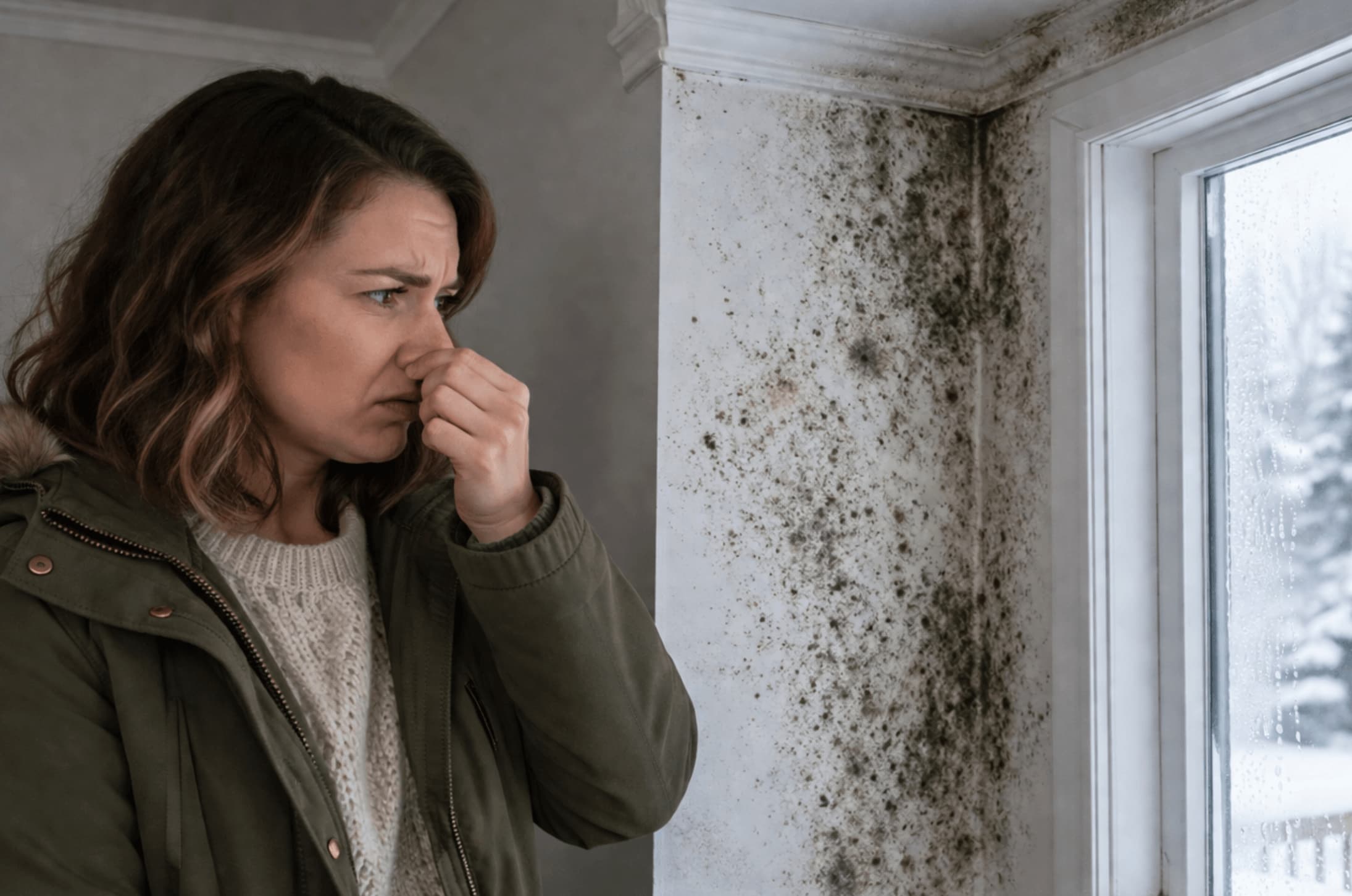
Winter Mold Problems: How Filtration Supports Prevention
Your filter is probably overdue. In winter, a furnace running 10-plus hours a day loads a filter in 30 days flat — not the 90 most homeowners assume. Swap it in October, forget it through January, and you've given mold spores three full months to pile up, settle on every moisture-prone surface in your home, and start a problem you won't see until it's already serious.
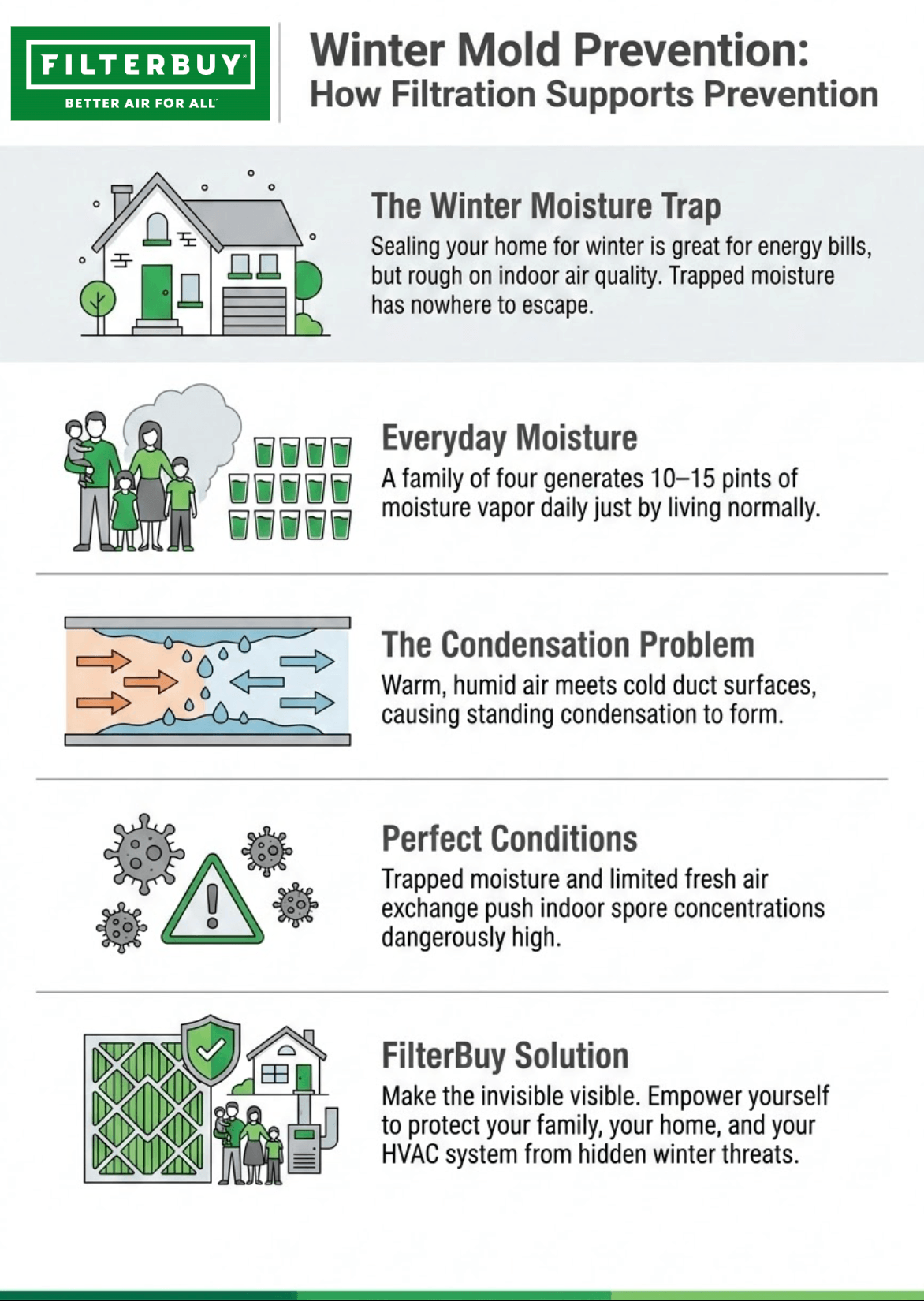
Sealing up your home for winter traps more than warmth. Every shower, every meal on the stove, every breath your family takes pushes moisture into the air. Without the natural outdoor exchange you get in summer, that moisture has nowhere to go. Your furnace then cycles it through every room, carrying whatever spores are already in circulation right along with it.
When it comes to winter mold risk, your HVAC filter is the one thing standing between those spores and your family's air. Choose the right rating, keep it on a winter schedule, and you cut that cycle before mold gets a foothold. Here's exactly how.
TL;DR Quick Answers: Winter Mold and Your HVAC Filter
• Winter traps what should escape. Sealed homes keep moisture indoors. Add cold duct surfaces and your furnace running all day, and you've got exactly where mold wants to be.
• Your filter is your first line of defense. It catches airborne mold spores before they circulate through every room. No other part of your HVAC system does this.
• MERV 11 is the minimum. It captures the majority of mold spores in the relevant size range. MERV 13 captures 90% or more and is the better call for allergy sufferers, high-humidity homes, or anyone who's dealt with mold before.
• Change it every 30 to 45 days in winter. Your furnace runs three to four times longer each day in January than it does in October. Filters load faster. The standard 90-day schedule doesn't hold up.
Top Takeaways
• Winter's sealed-home conditions stack the deck for mold: trapped moisture, limited fresh air, and temperature gaps between warm air and cold ductwork push indoor spore concentrations higher than any other season.
• Condensation on ducts and air handler components is one of the most overlooked mold risks in any home, and it gets worse with every cold snap.
• An overloaded filter doesn't protect you. When a filter runs past capacity, moisture builds in the media, airflow drops, and the filter itself can become a place where mold grows. That's the opposite of what you're paying for.
• Upgrading from MERV 8 to MERV 11 is the single most cost-effective step most homeowners can take to cut winter mold spore recirculation.
• Filtration and humidity control work together. Get one right without the other, and mold still has a path in.
Why Winter Creates a Mold-Friendly Environment in Your Home
Ask most people when mold season peaks and they'll say summer. They're right about outdoor mold. But indoor mold in winter runs on an entirely different engine, and your house provides everything it needs.
Closing up for winter is the right call for your energy bills. It's a rough deal for your air quality. The outdoor exchange that used to carry moisture and pollutants out of your home slows to almost nothing. What you cook, breathe, and steam from the shower stays inside. A family of four generates roughly 10 to 15 pints of moisture vapor every day just by living normally. In a drafty summer house, that moisture finds its way out. In a sealed winter house, it stacks up.
The Condensation Problem: Cold Ducts, Warm Air, and Moisture
Your furnace pushes warm, humid air through supply ducts that often run through uninsulated attic runs, exterior walls, or crawlspaces. The duct wall is cold. The air inside is warm and carrying moisture. Condensation forms on duct surfaces, around supply registers, and in the drain pan under your air handler.
That standing moisture is where mold moves from airborne to active. Without a meaningful spore load in your circulating air, those damp surfaces stay wet but harmless. Once spore concentrations climb — and they do climb in a sealed winter home — the math changes quickly. Spores land on wet surfaces, and colonization starts within hours.
Stopping condensation from turning into a mold problem takes two moves: reduce moisture where it forms through better duct insulation and clean drain pans, and cut the spore count in the air before it gets there. Your filter handles that second move.
How Sealed Winter Homes Trap Humidity and Spores
Your HVAC system cycles the full air volume of your home multiple times every hour. In summer, some of that gets replaced naturally through gaps and ventilation. In winter, infiltration drops sharply. You're recirculating the same air, over and over, and spore counts build with every pass.
One mold colony — under a bathroom sink, behind a baseboard, in a poorly sealed shower tile joint — can shed thousands of spores per hour. In a sealed winter home, those spores have nowhere to go except through your ductwork. Your filter is picking up evidence of what's living in your home's air, whether you know it or not.
How HVAC Filters Address Winter Mold Risk
Air filters aren't just sieves. They catch particles three different ways at once: physically blocking the larger ones, trapping mid-size particles when they hit the fibers, and pulling in the smallest particles through random contact as they move through the media. Those three mechanisms working together are why a MERV 11 or MERV 13 filter catches particles much smaller than the visible openings in the material would suggest.
Mold spores run between 2 and 20 microns across. That puts them squarely in the range where MERV 11 and MERV 13 filters perform well. Fungal fragments are smaller and more biologically active — they need MERV 13 to get captured reliably.
What Happens to Mold Spores Inside Your Air Filter
When return air pulls spores off surfaces and into the air stream, they travel toward your air handler. The filter is the only physical barrier between those spores and your supply vents.
In a clean MERV 11 or MERV 13 filter, spores contact the fiber media and stay there. They don't pass through. A properly loaded filter actually gets slightly more efficient over time as the material filling in creates a tighter barrier. The trouble starts when the filter gets overloaded. A saturated filter restricts airflow, traps moisture in the media, and creates the warm, damp conditions mold needs to grow directly inside the filter. At that point, the filter has become the problem.
That's why changing your filter on the right winter schedule matters as much as choosing the right rating.
Why Filter Replacement Frequency Matters for Mold Prevention
The 90-day replacement guide is built around average homes in mild-season conditions. Your furnace in January isn't operating under mild-season conditions.
In a cold climate, a furnace runs 10 to 14 hours a day at peak. That's three to four times the daily load of a shoulder month like October. Spores, dust, pet dander — all of it accumulates proportionally faster. A filter that holds up 90 days in fall can hit capacity in 30 days in January.
We've heard this from homeowners across the country for years: the filter is fine at Thanksgiving, overloaded by Christmas, and nobody checks it until the furnace starts struggling in February. Don't let that be your home this winter.
Choosing the Right Filter: MERV Ratings and Mold Spore Capture
The difference between a MERV 8 and a MERV 13 isn't small for anyone dealing with real winter mold risk. Here's what each level actually delivers:
MERV 8 — Partial mold spore capture (~35%) Best for lower-risk homes and newer construction. A good baseline, but upgrade if mold is any concern at all.
MERV 11 — Strong mold spore capture (65–75%) The recommended minimum for winter mold prevention. Right for most homes, pet owners, and older HVAC systems.
MERV 13 — Excellent mold spore capture (90%+) The best defense available for residential use. Captures bacteria and fine biological particles. The right choice for allergy sufferers, high-humidity homes, and basements.
For most homes, MERV 11 is the right starting point. It captures the majority of mold spores without creating the airflow restrictions that higher-rated filters can cause in older systems. If you have allergy sufferers at home, high indoor humidity, or any history of mold, go to MERV 13. Most modern residential HVAC systems handle it without any problem.
Additional Strategies That Support Filtration
Good filtration controls the spore load in your circulating air. It doesn't fix a condensate drain that's been sitting full since October or dry out a duct wall that stays damp all winter. These steps work alongside your filter, not instead of it:
• Keep indoor humidity between 30% and 50%. A basic digital hygrometer costs under $20 and gives you a real number to work with. Consistently above 55%? Add a dehumidifier in moisture-prone areas.
• Run bathroom exhaust fans during showers and for 15 minutes after. Removing moisture at the source is far easier than chasing it once it's spread through the house.
• Keep your air handler drain pan clean and the condensate line clear. Standing water in a drain pan is a mold incubation site right next to your air stream.
• Set your thermostat fan to Auto, not On. Continuous fan operation keeps air moving through a potentially damp filter around the clock, which spreads moisture throughout the duct system.
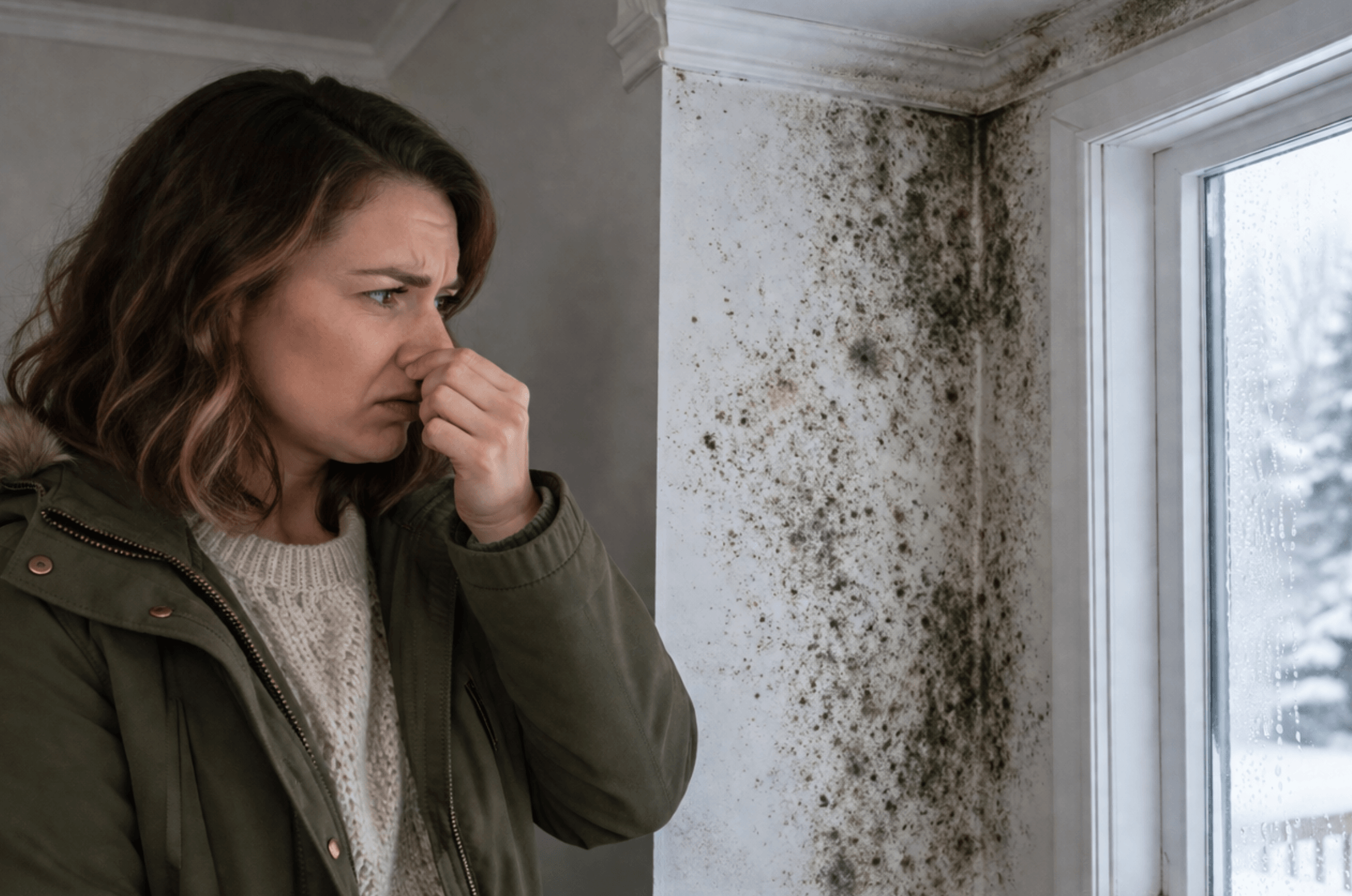
Warning Signs Your HVAC System May Already Have a Mold Problem
Sometimes filtration is prevention. Sometimes it's damage control — cutting spore circulation while you track down a source you haven't found yet. Here's what to look for:
• A musty smell from your vents. When the furnace kicks on after sitting idle, does the air smell earthy or stale? That's the clearest signal. Check the air handler coil, drain pan, duct walls near the handler, and the filter housing.
• Irregular dark spotting on the filter media. A dirty filter is uniformly gray or brown. A filter with mold growth shows greenish, black, or irregular dark patches that don't spread evenly. See it? Replace the filter today and check the housing for moisture.
• Dark streaking around supply registers. Spores moving through supply vents can settle on the dust ring around register grilles in a spidery, irregular pattern. Uniform gray dust is just dust. Dark, irregular spotting is worth investigating.
• Allergy symptoms that are consistently worse indoors in winter. Family members sneezing more, dealing with itchy eyes, or noticing their symptoms ease when they leave the house? Elevated indoor spore counts are a likely factor.
Two or more of these signals at once: replace your filter with a MERV 13, call an HVAC technician for a duct inspection, and don't sit on either.
What to Do Right Now: A Winter Mold Prevention Checklist
Start here. These steps take less than an hour total and address the highest-leverage points in your winter mold risk:
1. Check your current filter. If it's been more than 30 days, replace it today. Not next week.
2. Upgrade to MERV 11 minimum if you're running MERV 8 or lower. The cost difference is small. The protection difference is real.
3. Walk your supply registers and look for dark spotting or moisture streaks around the grilles.
4. Set your thermostat fan to Auto, not On.
5. Run bathroom exhaust fans during and 15 minutes after every shower.
6. Check your air handler drain pan. Standing water means you need to clear the condensate line and clean the pan.
7. Set up auto-delivery for your filters. The best filter in the world does nothing sitting in a box. Auto-delivery puts the right filter at your door before you need it.
"In my experience inspecting hundreds of residential HVAC systems, the homes with the worst winter mold outcomes almost always share two things: a filter that hasn't been changed since fall and humidity levels nobody has bothered to measure. Fix those two things first, and you've addressed the vast majority of your risk before spending a dollar on anything else."
— Licensed HVAC Technician and Indoor Air Quality Specialist
7 Essential Resources
These sources go deeper on the science, health implications, and practical guidance behind everything covered here:
1. EPA — An Introduction to Indoor Air Quality https://www.epa.gov/indoor-air-quality-iaq/introduction-indoor-air-quality
The U.S. Environmental Protection Agency's foundational overview of indoor air pollutants, biological contaminants, and what's actually in the air most families breathe every day.
2. CDC — Mold Prevention and Control https://www.cdc.gov/mold/
The Centers for Disease Control and Prevention's guide to mold health effects, prevention strategies, and when to call a professional instead of handling it yourself.
3. American Lung Association — Mold and Dampness https://www.lung.org/clean-air/indoor-air/indoor-air-pollutants/mold
A health-focused breakdown of how mold affects breathing, with extra attention to children and anyone with asthma or existing lung conditions.
4. Mayo Clinic — Mold Allergy Overview https://www.mayoclinic.org/diseases-conditions/mold-allergy/symptoms-causes/syc-20351519
Clinical guidance on mold allergy symptoms, how they differ from other allergen reactions, and when to get a medical evaluation.
5. ASHRAE — Indoor Air Quality Guide https://www.ashrae.org/technical-resources/bookstore/indoor-air-quality-guide
Professional standards for ventilation, humidity control, and biological contaminant thresholds in residential buildings, from the engineers who set those standards.
6. U.S. Department of Energy — Heating and Cooling Efficiency https://www.energy.gov/energysaver/heating-cooling
The DOE's practical guide to HVAC maintenance, filter care, and the direct link between filter condition and how much you're spending to heat your home.
7. National Institute of Environmental Health Sciences — Mold https://www.niehs.nih.gov/health/topics/agents/mold/index.cfm
Research-backed overview of mold exposure, its links to respiratory and immune conditions, and evidence-based recommendations for reducing exposure at home.
Key Statistics on Winter Indoor Air Quality
Statistic 1 The EPA reports that indoor pollutant concentrations are often 2 to 5 times higher than typical outdoor levels. In winter, when homes are sealed and outdoor air exchange drops to near zero, that gap gets wider. The air circulating through your vents in January is carrying a heavier load than your family breathes on a summer day with the windows open. Source: U.S. EPA — Indoor Air Quality (https://www.epa.gov/report-environment/indoor-air-quality)
Statistic 2 Mold can start growing on wet or damp materials within 24 to 48 hours. That's the window between a condensate overflow and the start of a new mold colony on your duct insulation. It's also why checking your drain pan and keeping your filter fresh aren't optional maintenance tasks in winter — they're time-sensitive ones. Source: FEMA — Mold Prevention and Control (https://www.fema.gov/sites/default/files/2020-07/fema_mold-prevention-control_brochure.pdf)
Statistic 3 Heating and cooling account for about 45% of the energy used in a typical U.S. home, according to the Department of Energy. A clogged filter forces your system to push air against restricted airflow, driving that number up at exactly the time of year your system is already running the hardest. A clean filter isn't just better for your air — it's better for your bill. Source: U.S. Department of Energy — Heating and Cooling (https://www.energy.gov/energysaver/heating-cooling)
Final Thoughts
Winter mold is a solvable problem. It's not mysterious, and for most households it doesn't require a contractor or a remediation company. It requires knowing where the risk actually comes from and addressing it at the right point.
Your filter is that point. Not because it's a cure-all, but because it sits at the center of every air movement cycle in your home. Choose the right rating, replace it on a winter schedule, and you cut the biological load in your circulating air to the point where mold has a much harder time taking hold on those moisture-prone surfaces. Add basic humidity management and a clean drain pan, and most families can dramatically reduce their winter mold risk without spending more than the cost of a good replacement filter.
Here's our honest read after years of hearing from homeowners across the country: the problems almost always trace back to the same two things. A filter running well past its useful life. Indoor humidity that nobody's tracking. Neither takes expertise to fix. Both take someone in the house deciding to pay attention. Check your filter this week. Grab a cheap hygrometer and see where your humidity stands. Those two moves will do more for your family's winter air quality than anything else on this page.
Next Steps
Five steps. Less than an hour total:
1. Pull your current filter out and look at it. Gray-to-black, thick with debris, or any discoloration that isn't uniform dust — replace it today, not at the end of the month.
2. Find your exact filter size. The dimensions are printed on the cardboard frame. Get them right. An undersized filter leaves gaps around the edges that let unfiltered air bypass the media entirely.
3. Pick the right MERV rating. MERV 11 is the right call for most homes. Allergy sufferers, pet owners, high-humidity homes, or anyone with a prior mold problem — go to MERV 13.
4. Set a 30-day phone reminder starting today. Check the filter every 30 days from now through March. Winter is the wrong season to rely on the 90-day habit.
5. Set up auto-delivery. The most effective filter in the world does nothing sitting in your shopping cart. Auto-delivery puts the right filter at your door before you need it, on a schedule matched to how your home actually runs.
Frequently Asked Questions
Can mold grow inside my HVAC filter?
Yes. A saturated or infrequently replaced filter creates exactly what mold needs: warmth, trapped moisture, and a surface to grow on. In winter, filters load faster because your system runs longer. A filter that stays clean for 90 days in a mild month can hit capacity in 30 days in January. Once it does, it stops protecting your air and starts contributing to the problem. Check yours now.
What MERV rating works best for preventing mold?
MERV 11 is the recommended starting point for most homes. It captures the majority of mold spores in the 2 to 10 micron range without causing airflow problems in most residential systems. If you have allergy sufferers at home, high indoor humidity, or any history of mold, use MERV 13. It captures 90% or more of biological particles including fungal fragments, and most modern systems run it without any issue.
How does HVAC condensation lead to mold growth?
When warm, humid air meets cold duct surfaces — especially in supply ducts running through uninsulated spaces — moisture condenses on the duct walls. That standing moisture is where spores settle and colonize. Keeping your filter fresh cuts the spore count in the air moving through those ducts, which limits what's available to land on those wet surfaces in the first place.
How often should I change my filter in winter to prevent mold?
Every 30 to 45 days during peak heating season. Winter pushes your system to run significantly more hours each day, which accelerates how fast the filter loads. A filter past its capacity traps moisture, restricts airflow, and can grow mold directly inside the media. Don't apply the 90-day rule to winter operation.
Does a better air filter stop mold on walls and ceilings?
Filtration targets airborne spores. It cuts the concentration of spores cycling through your home, which makes it harder for those spores to land on moist surfaces and colonize. It doesn't treat mold that's already growing on walls or ceilings. For visible surface mold, address the moisture source first — then keep the right filter running to stop spores from spreading through the rest of the house.
Protect Your Home. Protect Your Air. Start With the Right Filter.
Winter mold risk is real. So is your ability to do something about it today. Upgrade to a MERV 11 or MERV 13 pleated filter made right here in the USA, available in 600+ sizes with free shipping on every order.