
How Much Does It Cost to Run a Furnace? Gas vs. Electric, Hour by Hour
October 12, 2026

A gas furnace costs roughly $0.87 to $1.39 for every hour its burner runs at national average prices, while an electric furnace costs roughly $1.81 to $3.54 an hour. Over a full heating season, the U.S. Energy Information Administration expected gas-heated homes to spend about $642 last winter and electric-heated homes about $1,133. When Filterbuy ran those prices through six common furnace sizes, the factor that moved the bill most was runtime.
A gas furnace costs about $0.87 to $1.39 for every hour it runs, while an electric furnace costs about $1.81 to $3.54. Over a full winter, the EIA expected gas-heated homes to spend about $642 and electric-heated homes about $1,133.
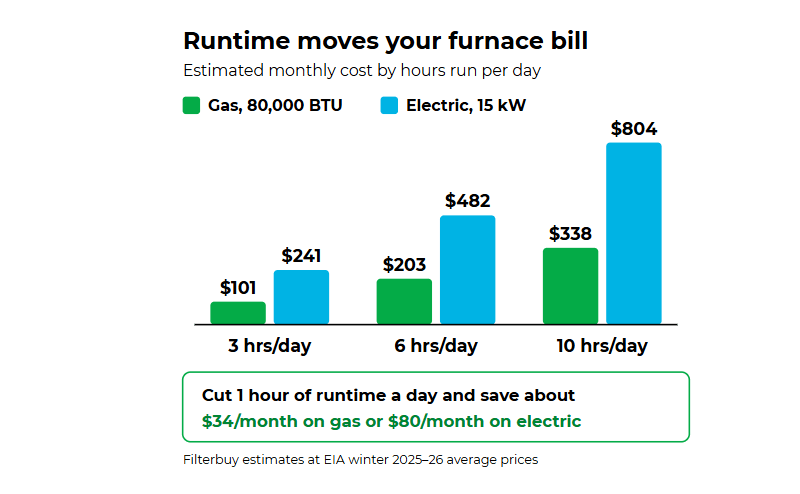
- Gas, 80,000 BTU: about $1.13 an hour, or $203 a month at 6 hours a day.
- Electric, 15 kW: about $2.68 an hour, or $482 a month at 6 hours a day.
Runtime moves your bill the most, and a clogged filter keeps your furnace running longer than it should. Take the quick quiz below to find the right filter for your furnace.
Answer a few quick questions and we'll match you to the right filter.
Already know your size? Shop air filters at Filterbuy with fast, free 2-day delivery to most U.S. states.
TL;DR
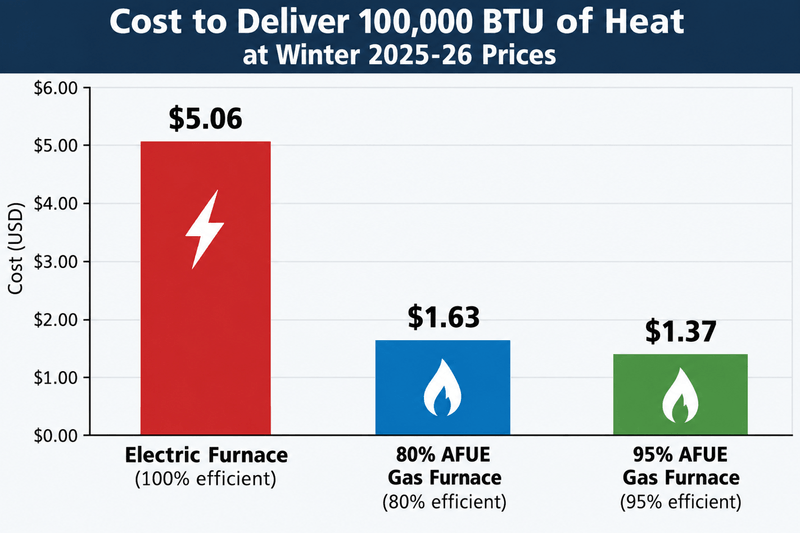
Gas furnaces cost far less to run than electric furnaces in most of the U.S. At last winter's average prices, 100,000 BTU of heat cost about $1.63 from an 80% AFUE gas furnace versus about $5.06 from an electric furnace.
Key Takeaways
At last winter's prices, an 80,000 BTU gas furnace costs about $1.13 per running hour, and a 15 kW electric furnace about $2.68.
Runtime can outweigh fuel type, so a gas furnace running 10 hours a day can cost more than an electric furnace running 3.
By Filterbuy's estimates, cutting one hour of daily runtime saves about $34 a month on an 80,000 BTU gas furnace and $80 on a 15 kW electric one.
A thermostat setback and a monthly filter check from November through March are the cheapest ways to cut runtime.
What Did It Cost to Heat a Home Last Winter?
For winter 2025–26, the U.S. Energy Information Administration (EIA) projected about $642 for homes heated mainly by natural gas, down 1% from the year before, and about $1,133 for homes heated mainly by electricity, up 4%, according to its Winter Fuels Outlook.
Natural gas is the main heating fuel in 46% of U.S. homes, more than any other fuel.
EIA raised its forecasts in December after a cold start to winter, but our tables use the October prices as the season baseline.
How Much Does a Furnace Cost per Hour?
A furnace's hourly cost is the energy it uses in an hour times your utility rate. At EIA's winter 2025–26 prices, Filterbuy estimates $0.87 to $1.39 per burner hour for 60,000 to 100,000 BTU gas furnaces and $1.81 to $3.54 for 10 to 20 kW electric furnaces.
Estimated Furnace Operating Cost by Size and Daily Runtime
| Furnace | Per Hour | 3 Hrs/Day (Month) | 6 Hrs/Day (Month) | 10 Hrs/Day (Month) |
|---|---|---|---|---|
| Gas, 60,000 BTU | $0.87 | $78 | $156 | $260 |
| Gas, 80,000 BTU | $1.13 | $101 | $203 | $338 |
| Gas, 100,000 BTU | $1.39 | $125 | $250 | $416 |
| Electric, 10 kW | $1.81 | $163 | $327 | $544 |
| Electric, 15 kW | $2.68 | $241 | $482 | $804 |
| Electric, 20 kW | $3.54 | $319 | $638 | $1,063 |
Runtime can matter more than fuel. An 80,000 BTU gas furnace running 10 hours a day costs about $338 a month, more than double a 10 kW electric furnace running 3 hours ($163).
Why Is Electric Heat More Expensive Than Gas Heat?
An electric furnace turns nearly all of its electricity into heat, yet electricity costs far more per unit of energy than gas. At last winter's prices, 100,000 BTU of delivered heat cost about $5.06 from an electric furnace versus $1.37 to $1.63 from a gas furnace.
Cost per 100,000 BTU of Delivered Heat
| Heating Equipment | Efficiency | Cost Per 100,000 BTU Delivered |
|---|---|---|
| Gas furnace, standard | 80% AFUE | $1.63 |
| Gas furnace, high efficiency | 95% AFUE | $1.37 |
| Electric furnace | 100% | $5.06 |
That price gap is why the Department of Energy's furnace efficiency guidance calls all-electric furnaces an uneconomic choice in most of the country.
Why, then, is the seasonal gap only $642 versus $1,133? Electric heat is most common in the milder South, and many electric-heated homes use heat pumps, which move heat instead of generating it. In the same cold climate, the gap grows wider. Filterbuy's electric furnace vs. gas furnace comparison covers climate fit.
How Can You Estimate Your Own Furnace Cost?
You can estimate your own furnace cost with the four-step math behind our tables. Start with your furnace's rating plate and a recent utility bill.
Find the input rating. The rating plate lists BTU per hour for gas or kilowatts for electric (see how electric furnaces work). Switch off the power before removing any panel.
Find your true rate. Divide your bill's total by the therms or kWh you used.
Calculate the hourly cost. For gas, divide the input BTU by 100,000 and multiply by your price per therm. For electric, multiply kilowatts by your price per kWh.
Multiply by runtime. Multiply the hourly cost by daily heating hours, then by 30.
For example, an 80,000 BTU gas furnace at $1.50 per therm costs $1.20 for each burner hour, so 6 hours a day comes to about $216 a month, blower excluded.
What Makes Furnace Costs Climb in Winter?
Furnace costs climb in winter because the furnace runs longer. Cold snaps, a clogged filter, aging equipment, and blocked vents are the main reasons.
Cold snaps. Heat loss rises as outdoor temperatures fall. The National Weather Service heating degree day definition counts the degrees a day's mean temperature falls below 65°F, and more degree days mean more runtime.
A clogged air filter. The ENERGY STAR maintenance checklist advises a monthly filter check and warns that a dirty filter can raise energy costs and lead to early equipment failure. As an air filter manufacturer, Filterbuy recommends treating winter as your shortest filter cycle, since filters load fastest when the furnace runs most.
Aging equipment. The Department of Energy rates older furnaces at 56% to 70% AFUE, which means 30 to 44 cents of every fuel dollar never becomes heat. See our natural gas furnace efficiency guide for replacement signs.
Snow-blocked vents. High-efficiency condensing furnaces vent through plastic pipes in a wall or roof, and snow or ice over them can trigger a safety shutdown.
What Is One Hour of Furnace Runtime Worth?
Every fix here works by cutting runtime, so Filterbuy priced one hour. At last winter's prices, trimming an hour a day saves about $34 a month on an 80,000 BTU gas furnace and about $80 on a 15 kW electric furnace. A cold-snap week that adds four hours a day costs about $32 and $75, respectively.
Monthly Value of One Hour of Runtime
| Furnace | 1 Hr/Day Less (Monthly Savings) | Cold-Snap Week (+4 Hrs/Day) |
|---|---|---|
| Gas, 80,000 BTU | $34 | $32 |
| Gas, 100,000 BTU | $42 | $39 |
| Electric, 10 kW | $54 | $51 |
| Electric, 15 kW | $80 | $75 |
Local rates matter too. Every 10 cents per therm above average adds about $14 a month to an 80,000 BTU gas furnace running 6 hours a day, and every extra cent per kWh adds about $28 to a 15 kW electric furnace on the same schedule.
How Can You Lower Your Furnace Bill This Winter?
The cheapest way to lower a furnace bill is to cut runtime with a thermostat setback and a clean filter, then book a tune-up before the first freeze. None of these steps require new equipment.
Set back the thermostat. Lower it overnight and when the house is empty.
Check the filter monthly from November through March. Our winter furnace filter guide covers sizing, and our guide on how often to change your furnace filter covers timing. Choose the MERV rating your furnace manual recommends.
Book a tune-up before the first freeze. EPA guidance on carbon monoxide indoors recommends a yearly professional inspection and tune-up of the furnace and its venting.
Seal drafts. Weatherstrip leaky doors and windows so heated air stays inside.
Ask about bill help. The federal Low Income Home Energy Assistance Program (LIHEAP) helps eligible households pay heating bills.
Test carbon monoxide alarms. CPSC carbon monoxide guidance calls for CO alarms on every level of the home and outside sleeping areas.
"On winter no-heat and high-bill calls, the first thing I pull is the air filter, because a packed filter keeps a furnace running longer than it should. A fresh filter and a sensible thermostat schedule are the cheapest fixes I recommend before anyone mentions new equipment."
David Clark, Licensed HVAC Technician
Supporting Statistics
1. Heating bills are rising again.
The National Energy Assistance Directors Association (NEADA) projects U.S. households will spend an average of $1,030 to heat their homes in winter 2026–27, up $82 (8.7%) from last winter. Filterbuy's take: cutting one runtime hour a day on an 80,000 BTU gas furnace ($34 a month) would offset that increase in under three months.
Source: NEADA Winter Heating Cost Projection 2026–27
2. Gas and electric rates are climbing.
The Bureau of Labor Statistics' Consumer Price Index for electricity rose 3.8% and for piped utility gas rose 4.4% in the 12 months ending August 2026. Filterbuy's take: our hourly estimates rise to about $1.18 (80,000 BTU gas) and $2.78 (15 kW electric).
Source: BLS Consumer Price Index Summary, August 2026
3. January is peak heating fire season.
U.S. residential buildings see an estimated 34,200 heating fires and 165 deaths a year, with fires peaking in January at 20% of the total. Filterbuy's take: the furnace's busiest month is also its riskiest, so book the tune-up early.
Source: USFA Heating Fires in Residential Buildings (2017–2019)
Frequently Asked Questions
How Much Does It Cost to Run a Propane or Oil Furnace?
EIA projected that homes heated mainly by propane would spend about $1,210 in winter 2025–26 and homes heated mainly by heating oil about $1,390. Both run well above gas ($642) and electric ($1,133) homes.
How Much Does It Cost to Run a Furnace for 24 Hours?
A full 24 hours nonstop at last winter's prices would cost about $27 for an 80,000 BTU gas furnace and $64 for a 15 kW electric furnace. Because furnaces cycle, a typical day costs much less.
How Much Does It Cost to Run a Furnace per Month in Winter?
At last winter's prices, an 80,000 BTU gas furnace costs about $101 to $338 a month when it runs 3 to 10 hours a day. A 15 kW electric furnace costs about $241 to $804.
Does Running the Furnace Fan Cost Much?
A 500-watt blower costs roughly 9 cents an hour at 17.28 cents per kWh, so leaving the fan on around the clock adds about $62 a month.
Get Your Furnace Ready for Winter
Before the first cold snap, shop air filters by size at Filterbuy for fast and free 2-day delivery to most US states, or set up auto-delivery so fresh filters arrive on schedule.
Glossary
AFUE (Annual Fuel Utilization Efficiency): The share of a furnace's yearly fuel energy that becomes usable heat.
BTU (British Thermal Unit): A unit of heat energy.
Therm: A natural gas billing unit equal to 100,000 BTU.
kW (Kilowatt): A unit of electric power used to size electric furnaces.
kWh (Kilowatt-hour): 1,000 watts used for one hour.
Filterbuy: A manufacturer of pleated HVAC air filters in MERV 8, 11, and 13, sold directly at filterbuy.com.
MERV (Minimum Efficiency Reporting Value): A 1–16 rating of how well an air filter captures airborne particles.
Carbon Monoxide (CO): A colorless, odorless gas from burning fuel, detected by CO alarms.