January 23, 2026
Electric and gas furnaces can both heat your home effectively. The right choice depends on which fuel you can use, what it costs in your area, and how cold your winters get. Those factors influence installation requirements, monthly bills, comfort in cold snaps, and safety considerations.
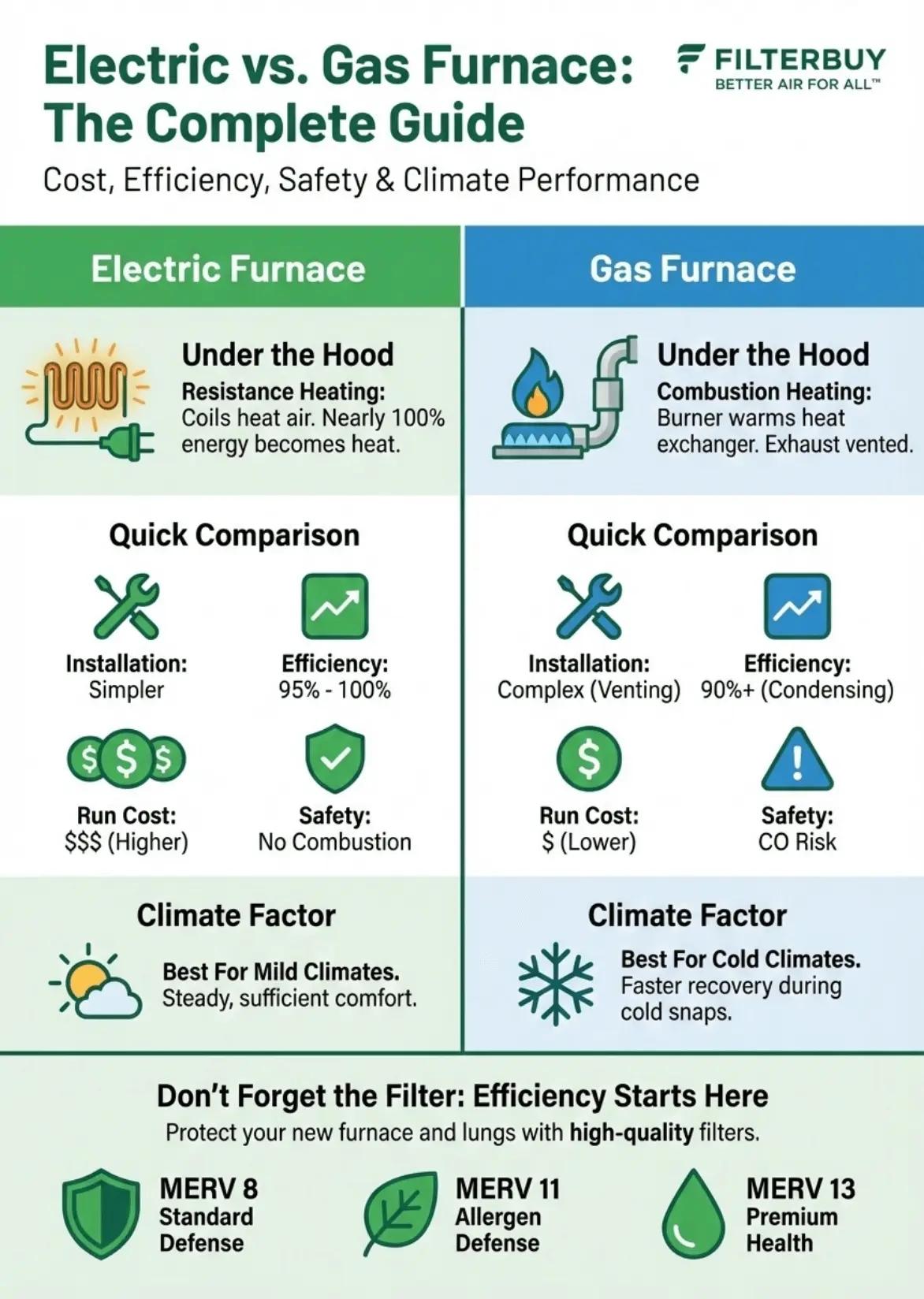
Gas furnaces heat faster, cost less to operate in most regions, and work well in colder climates—but require a gas line and produce combustion byproducts.
Electric furnaces have lower upfront costs, longer lifespans (20-30 years vs 15-20), zero emissions at point of use, and simpler installation—but typically cost more to run due to electricity rates.
Choose gas if: You have existing gas infrastructure, live in a cold climate, and want lower monthly bills.
Choose electric if: You lack gas access, prioritize safety and air quality, or plan to pair with solar panels.
Your best choice depends on fuel availability, local prices, and winter severity.
Electric furnaces can be highly efficient at the unit, but your bill depends on electricity rates.
Gas furnaces require venting and routine safety checks, and they often feel stronger in cold snaps.
Good insulation, sealed ducts, and the right filter can lower costs and support performance.
Filterbuy offers MERV 8/11/13 options, including hard-to-find sizes and Auto-Delivery.
| Category | Electric furnace (resistance heat) |
Gas furnace (natural gas) |
|---|---|---|
| Installation and cost | Often simpler if you already have adequate electrical service. | Often higher because it may involve a gas line, venting, and combustion setup. |
| Efficiency (at home) | Very high AFUE (Annual Fuel Utilization Efficiency), typically 95%–100%, because there is no flue loss. | High-efficiency models are commonly 90%+ AFUE (condensing), and some reach the high 90s. |
| Typical running cost | Often higher in many regions because electricity can cost more per unit of heat delivered. | Often lower where gas is affordable, but it depends on local gas prices and furnace efficiency. |
| Heat feel & recovery | Produces steady heat but may recover more slowly in very cold weather, depending on sizing. | Typically delivers hotter supply air and can recover faster in cold snaps. |
| Safety & risks | No combustion, no flue gases, and no carbon monoxide from the furnace itself. | Requires safe combustion, venting, and monitoring for CO risk and gas leaks. |
| Best fit | Homes without gas service, mild-to-moderate winters, or where electricity is relatively cheap. | Colder climates, homes already set up for gas, or where gas prices are favorable. |
A typical forced-air HVAC setup moves air through ducts using a blower. In winter, the furnace heats the air. In summer, the same ductwork can deliver cooled air from an AC coil or an air handler. That’s why people say an HVAC system ‘does heating and cooling’ as it often shares the same air distribution network.
The air filter, such as a Filterbuy replacement filter, sits in the return path (return grille, filter slot, or air handler cabinet). It helps capture particles before air reaches components like the blower and coil, and before that air recirculates through your home.
It uses electric heating elements (like heavy-duty toaster coils) to warm air.
It does not use combustion, so it does not create flue gases.
Because there is no flue loss, electric resistance heat is very efficient at the unit.
Burns natural gas in a burner assembly.
Transfers heat through a heat exchanger, then vents combustion gases outdoors.
High-efficiency (condensing) units extract more heat and reach 90%+ AFUE.
AFUE (Annual Fuel Utilization Efficiency) is the standard way to describe furnace efficiency. It tells you how much of the fuel’s energy becomes usable heat in your home over a typical year.
Electric furnaces often rate 95%–100% AFUE because they have no chimney or vent losses.
Gas furnaces vary more. Older or non-condensing models are lower; condensing gas furnaces are typically 90%+ AFUE.
One important note: AFUE does not automatically mean “cheaper to run.” The price you pay for each unit of electricity or gas matters just as much (sometimes more).
This is the section that gets messy online, so here’s the clean way to think about it.
Upfront pricing changes a lot by home because the “furnace price” is only part of the project.
An electric furnace install can be simpler if your electrical panel and wiring are already adequate.
A gas furnace install can involve gas piping, venting, condensate draining (for high-efficiency units), and combustion safety checks.
A professional quote should clearly separate:
Equipment (furnace + any accessories)
Labor
Required upgrades (electrical, gas line, venting, permits)
In short, installation cost depends on what your home already has in place, while your monthly cost depends more on local energy rates and how well your home holds heat than on the furnace alone.
Several factors drive operating costs, including:
Local energy prices: Electricity and natural gas rates vary a lot by region and even by plan.
Climate and run time: Colder climates and longer heating seasons increase usage, no matter what you choose.
Home’s heat loss: Insulation, air leaks, windows, and duct condition can raise costs more than people expect.
Furnace efficiency (AFUE): Higher efficiency reduces wasted energy, but it doesn’t automatically mean the lowest bill.
Thermostat habits: A few degrees and longer runtimes can noticeably change monthly costs.
In mild-to-moderate winter climates
Electric furnaces can work well, especially when winter lows are not extreme.
Homes may not need long “high demand” heating cycles, so comfort remains steady.
In colder winter climates
Gas furnaces often feel stronger during cold snaps.
They typically deliver warmer supply air and recover faster when it’s very cold outside.
One key home factor that matters in every climate
Ductwork condition and insulation matter a lot. Leaky ducts or poor insulation can erase the benefits of a more efficient furnace.
Both electric and gas furnaces can be safe when a qualified technician installs them correctly and you keep up with basic maintenance. Here’s what to know for each type:
Electric furnace safety
You avoid combustion risks such as carbon monoxide from the furnace itself.
The main concerns are electrical (proper wiring, correct breaker sizing, safe installation).
Gas furnace safety
Gas furnaces are safe when properly installed and maintained, but they do require attention to:
Correct venting and combustion
Heat exchanger integrity
Carbon monoxide monitoring (a CO alarm is a smart safeguard)
If safety is one of your top decision points, this is a fair summary:
Electric furnaces remove combustion from the home’s heating process.
Gas furnaces add combustion, so correct installation and annual check-ups matter more.
No matter which furnace you choose, it still relies on steady airflow through the return ducts. That airflow depends heavily on the filter, because the filter affects what moves through the system and how hard the blower has to work.
Filterbuy makes replacement HVAC and furnace filters, including MERV 8, MERV 11, and MERV 13 options.
A practical way to think about MERV:
MERV 8 is commonly used for basic, everyday filtration.
MERV 11 is a step up for finer particle capture.
MERV 13 is higher-efficiency and is often recommended when you want stronger particle filtration.
During wildfire smoke events, the U.S. EPA notes it highly recommends a MERV 13 filter for added protection (if your HVAC system can handle it).
A higher MERV filter can add airflow resistance in some systems. If your system is not designed for it, you can create comfort issues or strain the blower. If you are moving up to MERV 13, it is reasonable to ask an HVAC pro to confirm your system can support it.
Filterbuy offers HVAC replacement filters in common ratings like MERV 8, MERV 11, and MERV 13, so you can choose a level that matches your home and your system.
If wildfire smoke is a concern, the U.S. EPA notes that upgrading to MERV 13 or higher can improve removal of fine smoke particles indoors, if your HVAC system can safely accommodate the added resistance and you replace filters regularly.
If your size is hard to find, Filterbuy also provides a custom filter option so you can order a filter built to your measurements.
To stay consistent with replacements, Filterbuy offers a subscription (auto-delivery) service.
For homeowners who also want service support, Filterbuy operates Filterbuy HVAC Solutions, which advertises HVAC repair, replacement, maintenance, ductwork, and related services.
It depends on your local utility rates, but in many parts of the U.S., electric furnaces cost more to run because electricity often costs more per unit of heat than natural gas.
Electric furnaces are typically 95%–100% AFUE because they do not lose heat through a flue. High-efficiency (condensing) gas furnaces are often 90%+ AFUE, but they still vent combustion gases outdoors.
Yes. In a forced-air HVAC system, the ducts and blower move air year-round. The furnace heats the air in winter, and the AC coil cools it in summer.
Electric furnaces have no combustion, so they do not create carbon monoxide. Gas furnaces are safe when installed and maintained correctly, but they require proper venting and it is smart to use a working CO alarm.
Gas furnaces often feel stronger during cold snaps because they can deliver hotter supply air and recover faster. Electric furnaces can still work well if sized correctly, but comfort and cost depend heavily on your climate and energy rates.
MERV 8 is common for basic everyday filtration, MERV 11 is a step up, and MERV 13 provides higher particle capture. During smoke events, the EPA recommends using MERV 13 or higher when your HVAC system can accommodate it.
Filterbuy supports your HVAC system through replacement air filters (including MERV 8, 11, and 13) and offers an air filter subscription/auto-delivery option. Filterbuy also operates Filterbuy HVAC Solutions for services like repair, replacement, maintenance, and ductwork.
