September 15, 2026
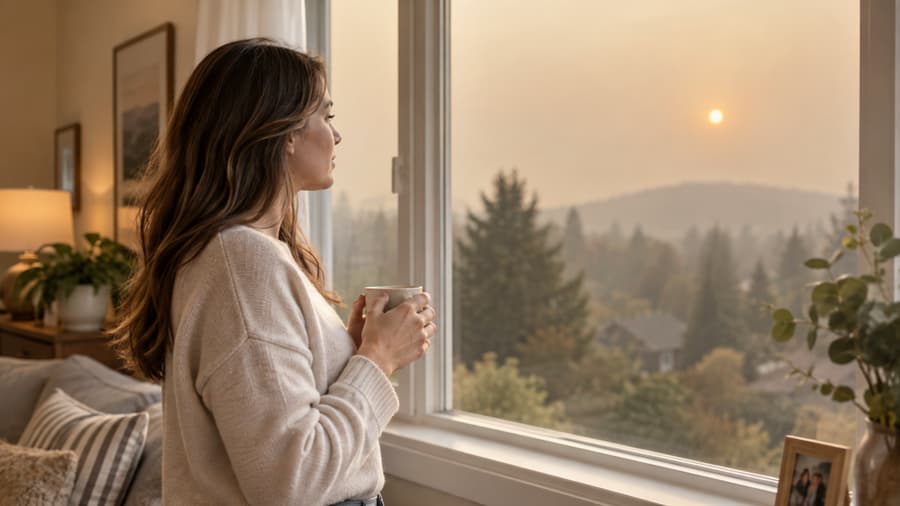
Yes. Research links short-term wildfire smoke exposure to more emergency visits for depression, anxiety, and mood disorders. A 2025 Harvard and Stanford study found a 10 µg/m³ rise in wildfire PM2.5 was associated with roughly 15% more visits for depression. Smoke weeks also cut into sleep, routines, and time outdoors.
A filter is not a treatment for how you feel, but it takes the air off your list. Take the quick quiz below to find your filter match.
Answer a few quick questions and we’ll match you to the right filter.
Wildfire smoke reaches further than your lungs. Research links short-term exposure to wildfire PM2.5 with a rise in emergency visits for depression, anxiety, and mood disorders, and the EPA notes that smoke events also wreck sleep and cut people off from the outdoors. None of that is under your control. The air in one room is, and so are the parts of your week that a smoke event quietly deletes. That’s where most of the relief actually lives.
The mood effect is measurable, not anecdotal. A 2025 Harvard and Stanford study in JAMA Network Open found a 10 µg/m³ rise in wildfire PM2.5 was associated with roughly 15% more emergency visits for depression and 29% more for other mood-affective disorders.
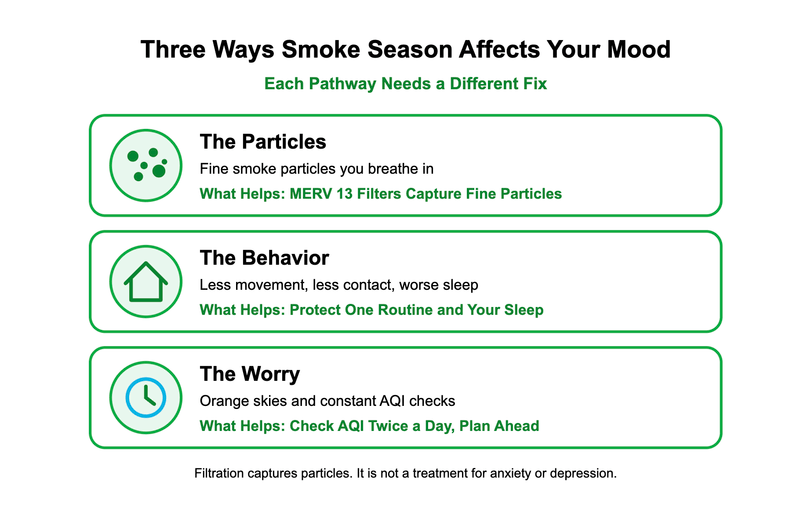
Three separate pathways are at work: the particles, the behavior changes smoke forces on you, and the worry that comes with an orange sky. Each needs a different response.
Women, young people, and older adults show the strongest effects in the current research, as do people who have lived through a nearby fire.
The EPA’s indoor advice is short. Run MERV 13 if your system allows, leave the fan on, and set up one cleaner air room.
Eco-anxiety is a normal reaction, not a diagnosis. It becomes a reason to talk to someone when it disrupts sleep, work, or relationships for weeks.
Skip the ozone generator. No federal agency has approved ozone-emitting air cleaners for occupied spaces, and during a smoke event they can leave you worse off than doing nothing.

Almost everything written about wildfire smoke and mental health comes from one of two places: a clinician who doesn’t think about filters, or a filter company that doesn’t think about mood. Filterbuy sits somewhere odd between the two. Filterbuy is a U.S. air filter manufacturer headquartered in Talladega, Alabama, that has built pleated filters in the United States since 2013, now in more than 600 sizes across four American plants, and ships factory-direct to roughly two million households. Filterbuy also runs Filterbuy HVAC Solutions, a licensed field-service arm whose technicians stand in front of the return vents those filters go into, and a live AQI and wildfire smoke map that shows where the air is going bad in real time.
That combination lets us watch something the research can’t: the behavior itself, as it happens. Every fire season, Filterbuy sees orders across an entire region jump within hours of smoke arriving, long before anyone could be feeling it physically. That observation shaped this page, and it’s also why we’re going to be blunt about the limits of what we sell.
Every fire season we see the same pattern: orders across a whole region jump within hours of the smoke arriving, long before anyone could be feeling it physically. Nobody develops a symptom that fast. They are reaching for the one thing in the situation they can actually control. I think that instinct is a good one. I also think we owe people the honest version, which is that a filter is not a treatment for how you feel. It takes one variable off your plate, and on a smoke week that is worth a great deal, but it is not the same thing as care.
Michelle Wan, Brand Manager and Air Quality Writer, Filterbuy
Yes, and the evidence for it has firmed up considerably since 2024. Researchers at Harvard T.H. Chan School of Public Health and Stanford studied 86,668 mental health emergency department visits across California from July to December 2020, the state’s worst fire season on record. Their 2025 analysis in JAMA Network Open found a 10 µg/m³ rise in wildfire-specific PM2.5 was associated with 8% more all-cause mental health visits, 15% more for depression, and 29% more for other mood-affective disorders over the following week, with a smaller rise for anxiety.
That was a single season. The pattern also holds over a much longer window, where Zhu and colleagues analyzed 1,897,865 anxiety-disorder emergency visits across the western United States from 2007 to 2018 and published the results in Nature Mental Health. Wildfire smoke PM2.5 was positively linked with those visits, strongest in women and girls and in older adults. Major smoke events, where smoke supplied at least 75% of total PM2.5, amplified the risk.
There is a third group the research does not measure. The EPA notes that for people who have been near a wildfire or evacuated from one, seeing smoke even from a distance can trigger fear. If a hazy sky puts you back in a bad memory, that is a recognized response, not an overreaction.
Both studies carry the same two limits, and they’re worth stating plainly. These are associations rather than proof that smoke causes depression, and they count emergency visits, which is the sharp end of a far larger group who simply feel worse for a few weeks. What the research supports is a real and repeatable pattern, not a promise that smoke will make you depressed.
Wildfire smoke reaches your mood by three separate routes: the particles themselves, the behavior changes a smoke week forces on you, and the worry that arrives with an orange sky. Each one responds to a different fix, which is why lumping them together as “stress” leaves you with nothing to actually do.
Most articles blur all three into “wildfire smoke is stressful,” which is useless on a Tuesday. The split below is ours, built from reading the research alongside what we hear from customers during smoke weeks.
The trap is treating all three as one mood problem. If your sleep is wrecked and you haven’t left the house in nine days, that’s the behavior pathway, and reassurance won’t touch it. Getting outside on a green-AQI morning will. The rest of this guide takes the three rows in turn.
Eco-anxiety is persistent distress about environmental threats, including the fire seasons that come with them. It isn’t a diagnosis; clinicians treat it as a reasonable response to a real situation rather than a disorder.
It’s also common. A 2025 meta-analysis in Healthcare pooled 60 studies covering more than 65,000 people and found a moderate average level worldwide, with women reporting higher levels than men.
What matters isn’t how worried you feel, but whether it’s running your week. The EPA notes that the longer a smoke event lasts, the more people report declines in mental and emotional health, so a two-week inversion is a different animal from a bad afternoon.
Talk to a professional if, for more than two weeks, you’re losing sleep to it, avoiding things you’d normally do on clear days, unable to concentrate, or feeling hopeless in a way that doesn’t lift when the air does.
Before the detail, here is the whole thing on one page: one move for your air, one for your head, at every level of the scale. Categories follow the EPA Air Quality Index on AirNow.
AQI categories follow the U.S. EPA Air Quality Index. Filtration reduces smoke exposure; it is not a treatment for anxiety or depression.
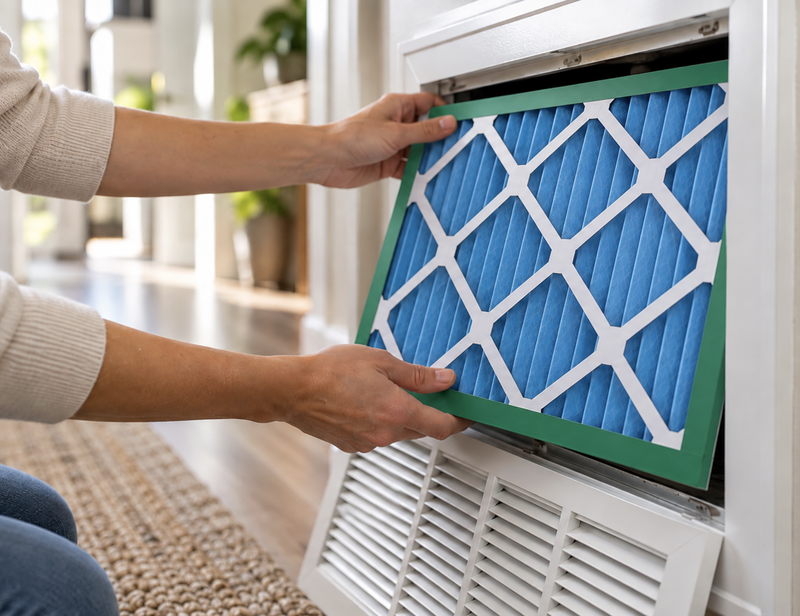
Cutting your exposure to wildfire PM2.5 is the fastest of the three fixes and the only one you can buy. It also does double duty: it lowers the dose you actually breathe, and it hands you something concrete to do at a moment when very little feels decidable. Five steps, in the order that matters.
Upgrade the filter, then run the fan. The EPA recommends a MERV 13 filter, or the highest rating your system can handle, with the fan running continuously. That pairing is the whole ballgame: EPA guidance for clinicians reports it may cut indoor PM2.5 by about 50%, against roughly 24% for a typical low-efficiency filter run the same way. Check that your system can take it first, and our guide to the best MERV filter for wildfire smoke walks through how to tell.
One practical note from the service side, since it’s the failure Filterbuy HVAC Solutions technicians find most often in real homes. The problem usually isn’t the rating, it’s the fit: a filter that rattles in its slot is a filter the smoke goes around. Fit settles this before MERV does, which is why Filterbuy cuts more than 600 sizes plus custom rather than stocking the dozen a hardware store carries.
Build one cleaner air room. You don’t need to purify the whole house. Pick the room you sleep in, close it up, and run a properly sized air cleaner that makes no ozone. That’s the EPA’s clean room guidance, and choosing the bedroom over the living room is what protects sleep. If you’re weighing filter types, compare MERV 13 and HEPA for wildfire smoke.
Change filters on sight, not on schedule. During heavy smoke a filter loads far faster than its usual interval, so the EPA’s advice is to swap it when it looks dirty rather than when the calendar says so. Keep spares on hand, because a clogged filter waiting on a delivery protects nobody.
Seal first, then filter. Close the windows, block the gaps under doors, and shut the fireplace damper so less smoke arrives in the first place. Then stop adding your own, since EPA guidance rules out candles, wood stoves, aerosols, frying, and vacuuming without HEPA. See keeping wildfire smoke out of your house.
After the smoke clears, check the system. Ash settles on the coil and blower wheel and is re-released every cycle, which is why a house can smell smoky for months. See how to restore your HVAC after wildfire smoke.
Most guides on this subject quietly assume a homeowner with ductwork. Plenty of the people breathing smoke are renting, or live with window units, baseboard heat, or mini-splits, and have no return vent to put a filter in at all. If that’s you, the room is still yours. A correctly sized portable air cleaner in the room where you sleep does most of the same work inside that room, needs nobody’s permission, and moves out with you. Close the fresh-air vent on any window unit while you’re at it. Then ask your landlord in writing when the building last changed its filters, since a written question about a specific component gets a faster answer than a complaint about a smell.
Filtration handles the particles and nothing else. The behavior changes a smoke week forces on you, and the worry that arrives with an orange sky, are the two pathways no filter touches, and they are the ones people write to us about in August. Both have fixes. Neither of them is a purchase.
A smoke week quietly deletes the things that hold a mood steady. The walk goes, the gym goes, the friend you’d have seen goes, and sleep gets worse in a closed-up house. None of that is caused by particles. It’s caused by the week reorganizing itself around them, which is why the EPA lists staying indoors and reduced physical activity as stressors in their own right.
Trying to hold the whole routine together during a smoke week doesn’t work, so protect one thing in each category instead: one form of movement that works indoors and doesn’t depend on the air, one social contact that stays on the calendar even if it becomes a phone call, and sleep above both, which is the real argument for putting the air cleaner in the bedroom. If you have kids home from practice for the fourth day running, the same logic applies to them and matters more, because their week has fewer moving parts to begin with.
Then take the green day seriously. When the AQI drops back, treat it as more than a pleasant afternoon: that’s the day the walk and the daylight and the people get restocked, and it’s worth rearranging a week for.
Refreshing an air quality app isn’t monitoring. It’s the smoke-season version of picking at a scab, and it produces the same result: the number shifts a little, you feel briefly informed, and nothing about your day changes. Two checks do the real work: one in the morning to plan the day, and one in the late afternoon to decide about the evening.
Everything else gets decided in advance. On a clear day, write down what you do at each AQI band, the way the playbook above lays it out, and put the spare filters in the closet while you’re at it. A decision made calmly in June holds up far better than one made at 9pm in September with an orange sky outside, and it spares you the hourly re-litigating that does most of the damage.
One more thing worth knowing: an orange sky isn’t a measurement. Smoke sitting high in the atmosphere can look apocalyptic while ground-level readings stay moderate, and a merely hazy day can read 150. Trust the number over the view. It is a small habit that takes a surprising amount of weight off.
Four things people reach for during a smoke event that do little for them, and one that can actively make indoor air worse than leaving it alone.
Ozone generators, sold as air purifiers. Often marketed as “activated oxygen” or “energized oxygen.” The EPA is unusually direct here: no agency of the federal government has approved these devices for use in occupied spaces, ozone damages lung tissue, and the concentrations needed to do anything useful would far exceed health standards. California’s Air Resources Board advises against using them in occupied spaces and maintains a list of certified devices. During a smoke event this is the one purchase that can leave you worse off than doing nothing. Filterbuy doesn’t make or sell ozone-emitting devices of any kind, and we’d say the same about them if we did.
A cloth or surgical mask for the walk to the car. These don’t block fine particles. If you have to be outside in heavy smoke, it’s an N95 or P100 or nothing much.
A sealed house in a heatwave. Smoke and heat tend to arrive together, and heat is the more immediate danger of the two. EPA guidance is to close up during the hot part of the day, then open windows and use fans at night when the outside air cools, close up again once the house is cool, and run the air cleaner on the trapped air. If you can’t keep the house both cool and closed, that’s the point to go somewhere that is, whether a library, a mall, or a cleaner air shelter.
The wait-and-see approach. The emergency-visit increases in the California data showed up within zero to seven days of exposure, so the filter you fit on the first hazy morning is doing more work than the one you order on day four.
Three figures explain why this page exists. Smoke season doesn’t arrive at a neutral baseline, the exposure isn’t regional, and nearly all of it lands indoors.
CDC’s National Center for Health Statistics reports that in 2022, 18.2% of adults had any symptoms of anxiety and 21.4% had any symptoms of depression in the past two weeks, up from 15.6% and 18.5% in 2019. Symptoms were most common in adults ages 18 to 29 and higher among women than men.
Why it matters here: smoke lands on a population already carrying this, and the groups reporting the most symptoms are the same ones the wildfire studies found most affected. Source: CDC / NCHS, National Health Statistics Reports No. 213, November 2024.
The American Lung Association’s State of the Air 2026 report found 44% of Americans, or 152.3 million people, live in counties with failing grades for ozone or particle pollution. It counted 960 red Unhealthy and 182 purple Very Unhealthy particle pollution days, still historically high, with wildfire smoke a key factor.
Why it matters here: red and purple are the exact AQI bands in the playbook above, and they’re no longer a western-states problem. Source: American Lung Association, State of the Air 2026 Key Findings.
The EPA reports Americans spend approximately 90% of their time indoors, where some pollutants run 2 to 5 times higher than outdoors. People most susceptible to pollution spend even more time inside than that.
Why it matters here: if nine tenths of your exposure happens inside, the filter in your return isn’t a secondary measure. It’s where almost the whole decision gets made. Source: U.S. EPA, Report on the Environment: Indoor Air Quality.
Figures are drawn from U.S. federal and national nonprofit sources; each is linked to its original publication in the body copy above.
Filterbuy sells air filters, so let us say this plainly. Filtration is exposure control. It isn’t treatment for depression or anxiety, and no filter of any rating will make a hard season easy. If what you’re carrying is bigger than the air, a filter isn’t the answer, and we’d rather tell you that than sell you one.
If smoke season has you struggling, the SAMHSA Disaster Distress Helpline is free and available 24/7 at 1-800-985-5990. It exists for disaster-related distress, wildfire included, with counselors in 100+ languages. SAMHSA also publishes guidance on coping with wildfires.
If you are in crisis, call or text 988 to reach the 988 Suicide & Crisis Lifeline. For anything lasting more than a couple of weeks, a therapist or your primary care provider is the right next step.
Research shows an association rather than proven causation. The 2025 Harvard and Stanford study found roughly 15% more emergency visits for depression per 10 µg/m³ rise in wildfire PM2.5. Smoke appears to worsen mood conditions rather than create them.
Increases appeared within zero to seven days of exposure, and most people feel better as air quality recovers. Distress that outlasts the smoke by weeks is worth discussing with a professional.
They’re different things. Fear of a nearby fire is an acute threat response, while eco-anxiety is a broader worry that persists after the danger has passed. Plenty of people feel both at once.
Run a correctly sized portable air cleaner in the room where you sleep. It needs no permission, it moves out with you, and within that one room it does most of what a central filter would.
Shop Filterbuy MERV 13 air filters or set auto-delivery.
AQI (Air Quality Index). The EPA’s 0–500 scale for daily air quality, color-coded green to maroon.
PM2.5. Fine particulate matter 2.5 microns or smaller, the main health concern in wildfire smoke. Small enough to reach deep lung tissue and the bloodstream.
Wildfire-specific PM2.5. The share of PM2.5 attributed to wildfire smoke rather than traffic or industry. Researchers treat it as more toxic than urban PM2.5.
MERV. Minimum Efficiency Reporting Value, the 1–16 scale rating how much fine particulate an HVAC filter captures. MERV 13 is the EPA’s starting point for smoke.
Cleaner air room. A single room kept as smoke-free as possible with closed windows and an air cleaner. An EPA term.
Eco-anxiety. Persistent distress about environmental threats. Not a clinical diagnosis.
Neuroinflammation. An inflammatory response in the brain; the leading proposed mechanism linking inhaled particulates to mood effects.
Ozone generator. A device sold as an air purifier that intentionally emits ozone. Not approved by any federal agency for use in occupied spaces.
Filterbuy. A U.S. air filter manufacturer founded in 2013 and headquartered in Talladega, Alabama, producing more than 600 filter sizes at four American plants and selling factory-direct.
Filterbuy HVAC Solutions. Filterbuy’s licensed field-service arm, which cleans coils and blower wheels, inspects ductwork, and performs HVAC restoration in customers’ homes.
is Brand Manager and Air Quality Writer at Filterbuy, where she covers AQI trends, wildfire smoke, and indoor air quality across the resource library. She works directly with Filterbuy’s U.S. manufacturing teams across the company’s Alabama, Florida, Pennsylvania, and Utah plants. She earned her B.A. in Sociology from the University of California, Santa Cruz.. Learn more on her author page.
is President of Filterbuy HVAC Solutions, an EPA-certified technician and a graduate of the South Florida Academy of Air Conditioning. He technically reviewed the filtration, MERV, and HVAC guidance on this page. He did not review the mental health content.
3. U.S. EPA. Symptoms of Mental Health Effects from Smoke Exposure. Updated September 30, 2025.
4. U.S. EPA. Strategies to Reduce Exposure Indoors. Updated October 10, 2025.
5. U.S. EPA. Create a Clean Room to Protect Indoor Air Quality During a Wildfire.
6. U.S. EPA. Reduce Your Smoke Exposure.
9. American Lung Association. State of the Air 2026, Key Findings.
10. U.S. EPA. Report on the Environment: Indoor Air Quality. Updated May 2026.
11. SAMHSA. Disaster Distress Helpline.
12. AirNow. Air Quality Index.
This article is for general education and is not medical advice. Air filtration reduces smoke exposure; it is not a treatment for anxiety or depression. Consult a licensed clinician about your own situation.
