July 8, 2026
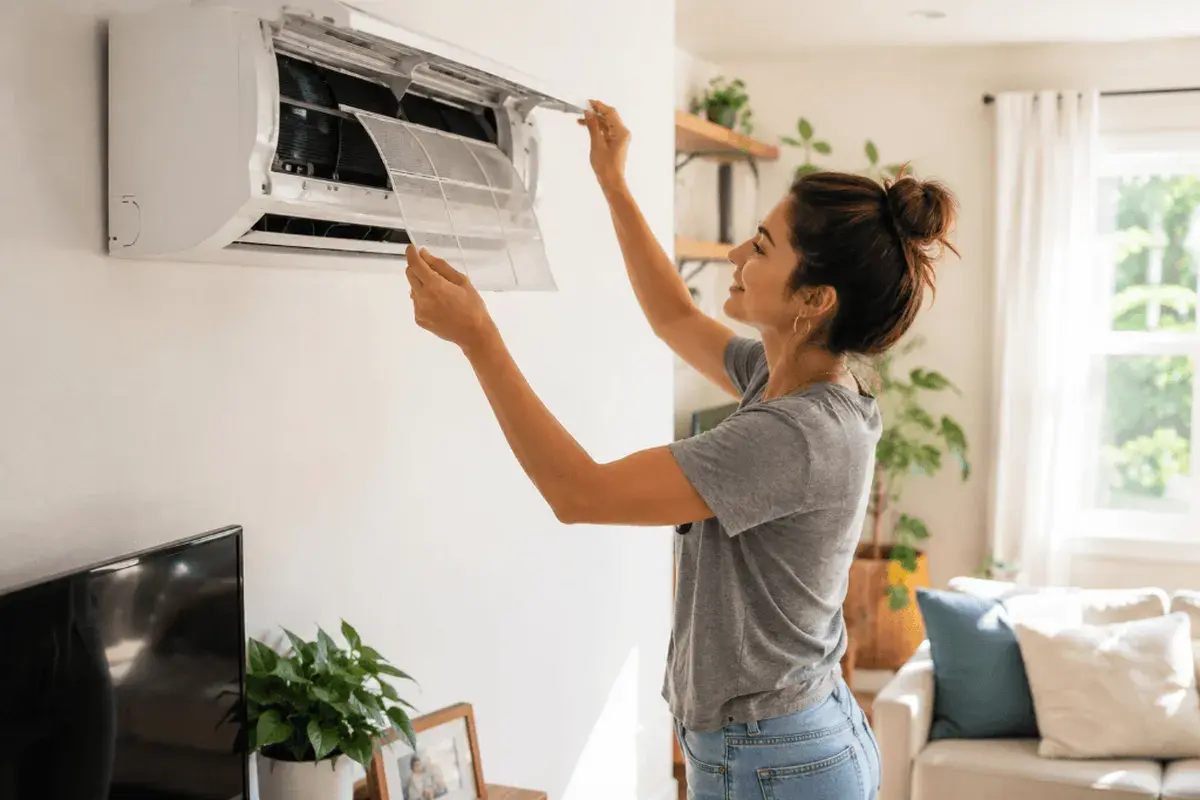
Yes. Every ductless mini split has at least one built-in air filter, and most indoor units use a flat, washable mesh filter you rinse rather than replace. Clean it every two to four weeks during heavy use to protect airflow, efficiency, and the unit itself. That standard mesh keeps dust and hair out of the machine, but it does little for fine particles like smoke or allergens. If cleaner air is the goal, you'll want a higher-rated filter on your ducted or central system.
Yes, mini splits have filters. Every ductless indoor head holds at least one filter, tucked behind the front panel.
Most are washable, not disposable. Standard mesh filters are reusable and, per manufacturers like Bryant, designed to last the life of the unit unless torn.
Clean every 2–4 weeks in peak season. Monthly year-round is the minimum. It takes about 10 minutes and costs nothing.
A dirty filter is expensive. Restricted filters can cut a mini split's efficiency by 5–30% and can freeze the coil, sending water dripping down your wall.
Standard mesh is not air purification. It traps dust and hair, not the fine particles behind smoke and allergies. For that, upgrade the filter on your central or ducted system.
Yes. Every ductless mini split has filters, usually at least one washable mesh filter inside each indoor head. As the unit runs, it pulls in the room's air, passes it across that filter, and recirculates it back into the same space. The filter is the system's first line of defense, catching dust, pet hair, and lint before they reach the delicate coil inside. Manufacturers including Trane, Bryant, and Carrier all confirm the same thing: mini splits have built-in filters, and sometimes more than one.
Here's the part that trips people up. In the years since Filterbuy shipped its first filter in 2013, we've fielded questions from millions of households, and this is the mini-split fact that surprises people most: a ductless system doesn't pull in fresh outdoor air. It recirculates the air already in your room. So that small filter is quietly working every time the unit runs, which is exactly why keeping it clean matters more than most homeowners realize.
“On a wall-mounted mini split, the filter is a washable screen most people don't even know is there. Rinse it every few weeks and you head off the airflow and frozen-coil problems that bring us the most service calls, with no new part required.”
David Clark, Licensed HVAC Technician
Mini split filters sit right behind the front panel of the indoor unit. On a wall-mounted head, you lift the hinged cover and the flat mesh filters slide out on tracks. Ceiling-cassette and floor-mounted units keep them behind the intake grille. Most models also have a filter-check indicator light that reminds you when it's time to clean. If you're ever unsure, hold the filter up to a light: if you can barely see through the mesh, it's due.
Turn the unit off at the remote or wall switch (and cut power at the breaker before any deep cleaning).
Gently lift the front panel of the indoor head until it clicks or holds open.
Look for one or two flat mesh screens sitting in tracks just inside the cover.
Slide each filter up and out. If a smaller colored insert is clipped to the mesh, that's a specialized filter (more on those below).
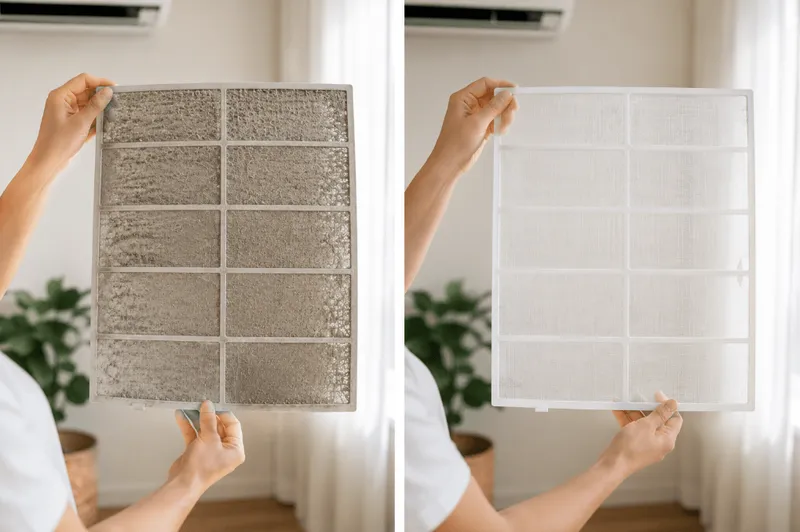
Mini splits use up to three kinds of filters, and knowing which you have decides whether you clean it or buy a replacement. Nearly every unit has a standard washable mesh filter. Many add a specialized insert (deodorizing, anti-allergen, or ionizing) that does get replaced periodically. And ducted (concealed) mini splits pull air through a separate return-air filter, which is the one type Filterbuy makes in hundreds of sizes.
Cleaning and replacement intervals vary by model. Always follow your owner's manual.
If your unit is a wall-mounted head, you almost certainly have the first type and possibly the second. If your mini split is hidden in a ceiling or closet and pushes air through short ducts, you likely also have the third, and that filter behaves like a central-AC filter.
Most mini split filters are washable, not disposable. The standard mesh pre-filter is reusable, and manufacturers such as Bryant note it's designed to last the life of the unit unless it tears. That's the honest answer a lot of pages skip: you're meant to rinse it, not keep re-buying it. The exceptions are specialized inserts (deodorizing or anti-allergen filters) that wear out and typically need replacing every three to six months, and the return-air filter on a ducted system, which you swap on a schedule like any central-AC filter.
The honest take, from a filter manufacturer: if someone's selling you constant replacements for a wall unit's main mesh screen, pause. That screen washes clean, and we'd rather tell you that than sell you a part you don't need. Save replacements for the specialized inserts and ducted-return filters that actually get used up, and swap the mesh only if it's warped, brittle, or torn.
Not sure which action your filter needs? Almost every mini split filter question comes down to one of three moves. Here's how to tell them apart at a glance.
Clean it (the default, ~9 times out of 10). Your standard mesh looks dusty but is intact. Rinse it, dry it fully, and reinstall. This covers the routine every-few-weeks maintenance every mini split needs.
Replace it (only when it's actually used up). Swap the part when the mesh is torn, warped, or brittle; when a specialized insert (deodorizing or anti-allergen) hits its 3–6 month mark; or when a ducted system's return filter is due every 1–3 months.
Upgrade it (when your goal is cleaner air, not just a working unit). The standard mesh can't capture fine particles, so if you're chasing allergy relief, smoke protection, or less dust, add specialized filtration to the unit or run a MERV 11–13 filter on your central or ducted system.
One rule cuts through the confusion: if the filter is just dirty, clean it; if it's damaged or genuinely spent, replace it; if the air itself isn't clean enough, upgrade the filtration. Cleaning is almost always the answer for a wall-mounted head.
Clean a mini split filter every two to four weeks during heavy heating or cooling season, and at least once a month year-round. Homes with pets, smokers, or allergies lean toward the two-week end; light, seasonal use can stretch toward monthly. The job takes about 10 minutes, and it's the highest-payoff maintenance task a mini split owner can do. Much like knowing how often to change your air filter on a central system, a simple rhythm keeps the whole unit healthy.
Power off the unit and cut the breaker for safety.
Lift the front panel and slide out the mesh filters.
Vacuum off loose dust, then rinse under lukewarm water. Skip the harsh chemicals.
Let the filters air-dry completely (never reinstall damp filters, since that invites mold).
Slide them back into their tracks until they click, close the panel, and restore power.
A neglected mini split filter quietly costs you money, comfort, and equipment life. In our experience, it's also the filter homeowners forget most. It sits high on the wall, out of sight and out of mind, and easily goes months without a rinse. As the mesh clogs, airflow drops and the compressor runs longer to deliver less cooling, and service data shows dirty filters can cut a mini split's efficiency by 5% to 30%. Starve the indoor coil of airflow long enough and it can freeze; when that ice melts, water can overflow the drain pan and run down your wall. Left unchecked, trapped moisture and dust also become a breeding surface for mold that the unit blows back into the room.
By the numbers
5%–30% drop in efficiency from a dirty, restricted filter (service data).
~10 min to clean it, the fix that prevents most of the above.
3–6 mo replacement window for specialized deodorizing or anti-allergen inserts.
As HVAC contractor David Fowler of Family Heating and Air puts it, "A dirty filter makes the system work a lot harder." That extra strain is what shows up on your next energy bill.
Before you book a service call, it's worth two minutes at the indoor unit. In our experience, a surprising share of mini-split complaints trace back to the one part homeowners rarely touch. Here's how common symptoms map to the filter, and what to do about each.
If a clean filter doesn't resolve the symptom, have a licensed technician check the coil, drain line, and refrigerant charge.
If a clean filter doesn't resolve the symptom, that's your cue to bring in a licensed technician, since the problem is likely deeper in the coil, drain line, or refrigerant charge.
Only partly, and this is the point we most want mini-split owners to hear. A standard mini split mesh filter is a low-efficiency pre-filter: it protects the machine by catching dust, hair, and lint, but it isn't built to capture the fine particles that affect your health. It won't meaningfully trap fine particles like PM2.5, the microscopic bits in wildfire smoke, or most of the allergens that trigger reactions. And because a mini split recirculates one room's air rather than pulling in fresh air, it can only clean what already passes through it.
So if your real goal is healthier air (fewer allergy flare-ups, protection during smoke season, less household dust), the built-in mesh alone won't get you there. You have two good options, and they're not mutually exclusive.
Add filtration to the mini split. Some systems accept specialized inserts or add-on purifying accessories that capture finer particles than the standard mesh.
Use a properly rated filter on your central or ducted system. If you also run central HVAC, or your mini split is ducted, a MERV 11 to MERV 13 filter is what actually captures fine particles and allergens. That's the range Filterbuy builds in over 600 standard sizes plus custom cuts. In fact, the EPA recommends at least a MERV 13 filter for finer particles. It helps to compare MERV ratings before you choose.
The core difference is washable vs. replaceable, and what each is built to catch. A wall-mounted mini split uses a reusable mesh pre-filter you rinse; a central (ducted) system uses a disposable, MERV-rated filter you swap out. The mesh mostly protects the equipment; a good central filter also cleans your air. That's why homeowners who care about air quality treat the two jobs differently.
MERV 11–13 filters capture fine particles like PM2.5; standard mini split mesh does not.
Filterbuy is built for that second job. American-made since 2013, we manufacture replacement filters in more than 600 standard sizes, plus a custom air filter in nearly any size for ducted mini-splits and central systems, shipped fast and free, factory-direct. If remembering the swap is the hard part, you can set up auto-delivery so a fresh filter shows up right on schedule.
We're a little obsessed with air around here, so we've done the digging for you. These are the sources we'd actually hand a neighbor — trusted federal and public-health research, plus a couple of our own guides — with the specific numbers that back up everything above. No filler, just what helps you keep your unit running and your air genuinely cleaner.
Before you sweat the filter, it helps to know what you're working with. Heating and cooling eat up nearly half of a typical home's roughly $2,000 yearly energy bill, according to ENERGY STAR — and a certified mini split can use up to 60% less energy than old electric baseboard heat. This rundown covers how ductless systems pull that off, in plain English.
Source: ENERGY STAR — Ductless Heating & Cooling
Ever wonder what's actually behind that front panel? Turns out your mini split has a fan, filter, and coil — the same core parts as a big central system, just shrunk down. This U.S. Department of Energy resource shows you why a clogged filter chokes the coil and drags down performance.
Source: DOE Building America Solution Center — Ductless (Mini-Split) Heat Pumps
That every-few-weeks rinse pays for itself. ENERGY STAR recommends inspecting and cleaning your filter monthly, and points out that airflow problems — exactly what a clogged filter causes — can cut a system's efficiency by up to 15%. Their maintenance checklist covers filter care plus the seasonal basics that keep a system running efficiently.
Source: ENERGY STAR — Heating & Cooling Maintenance Checklist
Here's the honest truth we wish more people knew: the standard mesh keeps dust out of the machine, but it won't do much for your lungs. The EPA explains MERV ratings in plain terms and recommends stepping up to at least MERV 13 to catch the fine particles the mesh lets slip through.
Source: EPA — What Is a MERV Rating?
This matters more than most people realize: the EPA notes we spend about 90% of our time indoors, where some pollutants run 2 to 5 times higher than outside. Since a mini split just recirculates that indoor air, this guide is the trusted starting point for actually filtering out PM2.5, smoke, and allergens.
Source: EPA — Guide to Air Cleaners in the Home
Once you know your central or ducted system is doing the heavy lifting on air quality, this makes picking a filter easy. We'll help you sort out MERV 8, 11, or 13 based on your pets, your allergies, and what your system can handle — no overthinking required.
Source: Filterbuy — Which MERV Rating Should I Use?
Got a ducted mini split or a central system? Then you've got a replaceable filter to swap, and odds are it's not a size you'll find at the hardware store. We make over 600 sizes plus custom cuts, American-made and shipped free to your door, so the fit's right the first time.
Source: Filterbuy — Custom & Standard Air Filters
Federal and public-health data back the case for cleaning your filter, and not trusting the mesh alone:
1. 30%+ of A/C energy
Ductwork wastes over 30% of central-AC energy, a loss ductless mini splits avoid (U.S. Department of Energy).
Why it matters: A clogged filter chokes that efficiency. The DOE also notes mini split mesh is low-MERV and misses fine particles.
Source: U.S. Dept. of Energy: Ductless Mini-Split Air Conditioners (energy.gov)
2. 90% of your time is indoors
Americans spend about 90% of their time indoors, where some pollutants run 2 to 5 times higher than outdoors (U.S. EPA).
Why it matters: A mini split recirculates that indoor air, so its filter works on the air you breathe most.
Source: U.S. EPA: Indoor Air Quality, Report on the Environment (epa.gov)
3. 156M people
156 million Americans (46%) live with failing-grade air; 77.2 million face particle-pollution spikes (American Lung Association, 2025).
Why it matters: Standard mesh misses PM2.5. A MERV 11–13 filter on a central or ducted system captures it.
Source: American Lung Association: "State of the Air" 2025 (lung.org)
Yes. Every ductless mini split indoor unit has at least one built-in filter behind the front panel, and some units use more than one. The air in each room passes through that filter every time the unit runs.
No, you shouldn't. The filter protects the coil from dust and debris. Running even briefly without it lets particles settle directly on the internal components, which hurts efficiency and can shorten the unit's life. If a filter is drying, wait until it's fully dry before reinstalling.
Hold it up to a light. If you can barely see through the mesh, it's time. Many units also have a filter-check indicator light that comes on after a set number of run hours. A drop in airflow or a musty smell are other common signs.
The standard mesh filter is not designed for that. It captures dust and hair, but fine particles from smoke, pollen, and dander mostly pass through. For allergen and smoke protection, add specialized filtration to the unit or use a MERV 11–13 filter on your central or ducted system.
The main mesh filter usually lasts the life of the unit and only needs replacing if it's torn or warped. Specialized deodorizing or anti-allergen inserts typically get replaced every three to six months, and a ducted system's return-air filter is replaced every one to three months.
Ductless mini split: A heating and cooling system with one outdoor compressor connected to one or more wall-, ceiling-, or floor-mounted indoor heads. It conditions air room by room without ductwork.
Mesh pre-filter: The standard washable, reusable filter inside a mini split indoor head. It traps large particles like dust and hair to protect the coil; it is rinsed, not replaced.
Specialized insert: An add-on mini split filter (deodorizing, anti-allergen, or ionizing) that targets odors or finer particles and is typically replaced every three to six months.
Evaporator coil: The indoor heat-exchange component that cools the air. Starved of airflow by a clogged filter, it can freeze and cause water leaks.
MERV rating: Minimum Efficiency Reporting Value, a 1–16 scale of how well a filter captures particles. Higher numbers capture finer particles; MERV 11–13 is common for allergens and fine dust.
PM2.5: Fine particulate matter 2.5 microns or smaller, the microscopic particles in smoke and pollution that a standard mesh filter does not capture.
Yes, mini splits have filters, and caring for them is refreshingly simple. Rinse the washable mesh every few weeks, replace the specialized inserts on schedule, and you'll protect your comfort, your energy bill, and the unit itself. Just remember what that mesh can and can't do: it keeps the machine healthy, but cleaner household air comes from a properly rated filter on your central or ducted system. Take care of both, and you're covered.
Ready for genuinely cleaner air?
For your ducted mini split or central system, Filterbuy makes American-made filters in 600+ sizes plus custom cuts, factory-direct, fast, and free to ship. Find your size or set up auto-delivery so you never forget a change. Better Air For All™.
Michelle Wan writes for Filterbuy on indoor air quality and home HVAC care, translating technical topics into plain, practical advice homeowners can act on. Filterbuy has manufactured air filters in the USA since 2013 and shipped them factory-direct to millions of households.
Reviewed for accuracy by David Clark, a Licensed HVAC Technician.
