April 16, 2026
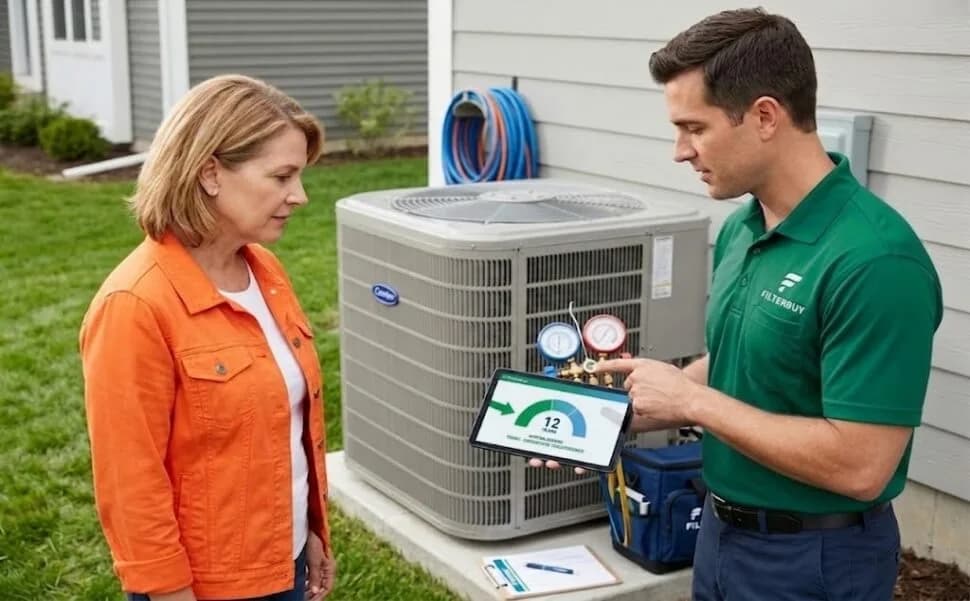
Most homeowners think their heat pump comes with a fixed expiration date. It does not. The same system that fails at nine years in one home quietly hits twenty in the house next door — same brand, similar climate, different maintenance habits.
Here's where the numbers actually land. Air-source heat pumps — the kind in most U.S. homes — average 10 to 15 years, though well-maintained modern ones are pushing 15 to 20. Ductless mini-splits typically reach 20 years. Geothermal systems last 20 to 25 years indoors, with buried ground loops rated to outlast the house at 50 years or more.
We've shipped filters to millions of homeowners, and the pattern holds: the ones who never face a surprise replacement bill aren't doing anything complicated. They change the filter on schedule. They get a professional inspection once a year. That's most of the playbook.
Below, we cover the heat pump average life by system type, what shortens it, what extends it, and the signals that tell you it's time to replace rather than repair. Want to understand how your system works first? Our guide to heat pumps for homes has you covered.
Most heat pumps last 10 to 15 years. With consistent filter changes and annual professional service, modern air-source units are reaching 15 to 20 years. Ductless mini-splits typically last 15 to 20 years. Geothermal systems last 20 to 25 years indoors, with buried ground loops rated to 50 years or more.
The biggest factor is not the brand or the model. It is maintenance. A heat pump that gets a fresh filter every one to three months and a professional tune-up once a year will almost always outlast one that does not — sometimes by five years or more.
Air-source heat pumps average 10 to 15 years. Well-maintained modern units are increasingly reaching 15 to 20, according to a 2024 HUD Cityscape study.
Mini-splits typically last 15 to 20 years. Geothermal indoor components reach 20 to 25, with ground loops rated to 50 years or more.
The DOE puts the maintenance gap at 10 to 25 percent in energy consumption between a well-maintained unit and a neglected one. That gap shows up on your monthly bill and in your system's service life.
Installation quality cannot be undone. An improperly sized system will underperform and age faster regardless of how well you maintain it. Correct load calculation matters more than brand.
Professional service once a year — before peak season if possible — prevents compressor failures that run $1,500 to $2,500 or more to fix.
If a repair quote tops 50 percent of replacement cost on a system older than 10 years, replace it. The math rarely favors waiting.
R-22 refrigerant systems have no real path forward. If yours uses it, start planning for replacement, not another repair.
Current heat pump technology is genuinely better than what was installed a decade ago. Replacing an aging unit is an upgrade, not just a maintenance swap.
Two heat pumps can come off the same assembly line and age very differently. What you own — and how you treat it — are the two biggest factors in where your system lands on that range.
| System Type | Avg Lifespan | Max with Maintenance | Top Lifespan Factor |
|---|---|---|---|
| Air-Source (Ducted) | 10 to 15 years | 15 to 20 years | Filter changes + annual pro service |
| Mini-Split (Ductless) | 15 to 20 years | 20+ years | Compressor protection from debris |
| Ground-Source (Geothermal) | 20 to 25 years | 25+ years (loop: 50+ yrs) | Shielded from outdoor elements |
Air-source units are the most common residential heat pumps in the country, and that 10-to-15-year average reflects how much they take on. They heat in winter and cool in summer — year-round work that racks up compressor cycles far faster than a system used only seasonally. In high-demand climates like Miami or Phoenix, expect to trend toward the lower end of that range unless maintenance stays tight. In mild-weather markets, 15 years is genuinely achievable.
Mini-splits outlast ducted systems for a straightforward mechanical reason: without ductwork, there's less airflow resistance and less strain on the blower. A properly installed unit in a moderate climate, serviced once a year, can reach 20 years without much drama. The one weak point is the outdoor compressor units near coastlines or in storm-prone areas accumulate wear faster from salt air and debris.
Geothermal systems are built to last longer than any other residential HVAC option, and the reason comes down to protection. The ground loop sits below the frost line, shielded from everything that wears out air-source units. The indoor heat pump unit typically reaches 20 to 25 years. The ground loop itself is rated for 50 years or more — some estimates push past 100. For homeowners who plan to stay long-term, geothermal delivers the strongest lifetime return on a higher upfront cost.
Two identical heat pumps on the same street can age very differently. Here's what tips the outcome one way or the other.
Climate and operating hours. A heat pump in Florida runs nearly year-round. One in Seattle doesn't. More cycles mean more compressor wear — and faster failure of the parts that cost the most to replace.
Installation quality. An undersized system runs almost constantly, trying to keep up. An oversized one short-cycles, switching on and off so frequently that the compressor never settles into an efficient rhythm. Correct load calculation at installation isn't optional. It's the foundation everything else rests on.
Filter maintenance — the highest-return habit you have. A clogged filter forces your system to work 10 to 25 percent harder to move the same volume of air. That extra load lands on the blower motor, the coils, and the compressor. Swapping your MERV-rated pleated filter every one to three months is the cheapest, most effective thing you can do for your heat pump's longevity.
Annual professional service. A qualified technician checking refrigerant charge, coil condition, electrical connections, and condensate drainage once a year catches worn components before they take down the whole system. That $75 to $200 visit is the most underused line item in residential maintenance.
Thermostat habits. Big, frequent temperature setbacks push your system to run flat-out for extended stretches. A programmable or smart thermostat set to hold steady temperatures cuts that compressor stress significantly over time.
Repair or replace is the hardest call a homeowner has to make. These signals consistently tip toward replacement.
The system is 15 years old or older. Even a well-cared-for unit is nearing the end at this point. Efficiency has dropped, and failure risk goes up sharply.
You have paid for major repairs more than once in two years. Compressor work, coil replacement, and reversing valve failure — if you have had more than one, the system is in decline. The next repair is rarely the last.
Your electric bills keep climbing with no change in how you use the system. That's a heat pump working harder and longer to do what it used to do without effort.
The system uses R-22 refrigerant. The EPA stopped production and import of R-22 in 2020. Servicing these systems now costs a premium that only grows, and bringing one into compliance is not possible. Replacement is the only financially sound path.
Rooms that used to be comfortable aren't anymore. Uneven heating and cooling is a reliable sign the system's capacity is degrading.
New noises — grinding, banging, rattling, or squealing. These don't show up out of nowhere, and they don't get better on their own.
Ice on the outdoor unit that is not clearing between defrost cycles. Some frost is normal. Persistent ice signals a refrigerant or airflow problem that usually comes before compressor failure.
The 50 Percent Rule: If any repair quote tops 50 percent of what a new unit costs — and your system is older than 10 years — replacement almost always makes more financial sense. Chasing repairs on an aging system rarely pencils out once you factor in efficiency losses and the next bill.
Most of what shortens a heat pump's life is preventable. Here's the maintenance routine that actually adds years.
Change your air filter every one to three months. Set up auto-delivery and take it off your to-do list permanently — it's the single habit most consistently linked to above-average system life.
Book a professional tune-up once a year, ideally in spring, before service schedules fill up for the summer cooling season.
Keep the outdoor unit clear — 18 to 24 inches on all sides, and clear debris after every significant storm.
Do not block or close supply and return vents. Restricted airflow does the same damage as a dirty filter.
Use a smart or programmable thermostat to hold steady temperatures. Avoid big swings that force the system to recover at full capacity.
Clean the outdoor coil once a year. Dirt buildup cuts heat transfer efficiency and raises operating temperature — both shorten component life.
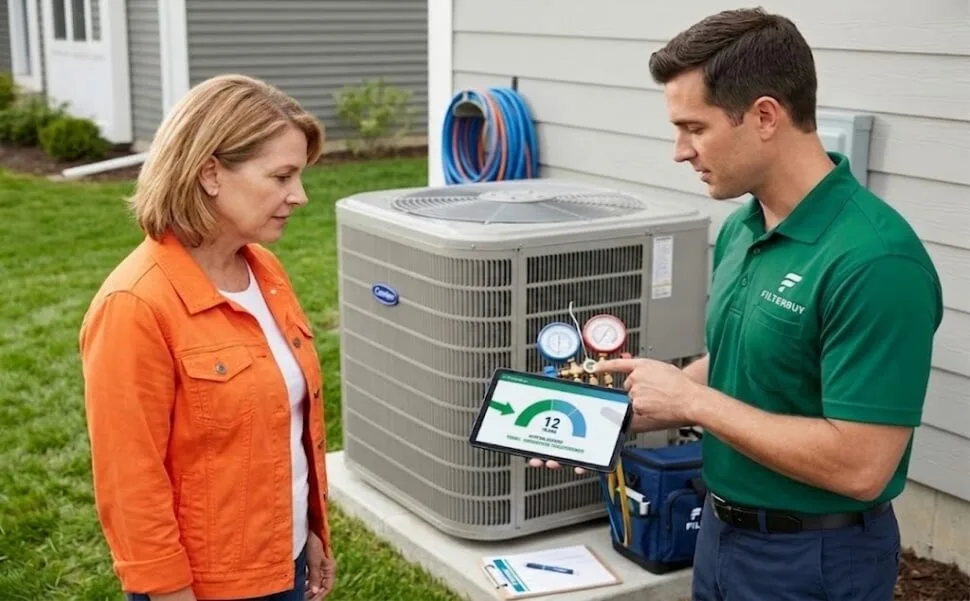
"Every heat pump I've opened at year nine or ten tells the same story: sporadic filter changes and professional service that never came until something broke. The homeowners who reach 18 or 20 years aren't lucky — they're just consistent about those two things."
— Filterbuy Team
We reviewed each of these for accuracy and authority before including them. We link only to government agencies, established industry bodies, and our own editorial guides.
U.S. Department of Energy — Heat Pump Systems — https://www.energy.gov/energysaver/heat-pump-systems
The DOE's overview of residential heat pump types, efficiency standards (SEER2/HSPF2), and operating guidance. A solid starting point for any homeowner evaluating a purchase or replacement.
U.S. Department of Energy — Operating and Maintaining Your Heat Pump — https://www.energy.gov/energysaver/operating-and-maintaining-your-heat-pump
The DOE's maintenance guidance for residential heat pumps includes the finding that a well-maintained unit uses 10 to 25 percent less energy than a neglected one. The authoritative source on the filter-lifespan connection.
U.S. Department of Energy — Air-Source Heat Pumps — https://www.energy.gov/energysaver/air-source-heat-pumps
A technical look at air-source systems: efficiency ratings, variable-speed compressors, expansion valves, and how to match a system to your climate. Useful for understanding why installation quality drives lifespan outcomes.
U.S. Department of Energy — Geothermal Heat Pumps — https://www.energy.gov/energysaver/geothermal-heat-pumps
The DOE's guide to ground-source systems, loop configurations, and what gives geothermal units their longer service life. Covers the 25-year indoor unit benchmark and the 50-year-rated ground loop.
Wikipedia — Heat Pump — https://en.wikipedia.org/wiki/Heat_pump
A well-cited, accessible overview of heat pump operating principles, system types, and efficiency classifications. A clear reference for understanding why the compressor is the most important component to protect.
HUD Cityscape (2024) — Heat Pumps: An Attractive Choice for Heating and Cooling Needs — https://www.huduser.gov/portal/periodicals/cityscape/vol26num3/ch15.pdf
A 2024 peer-reviewed study from the U.S. Department of Housing and Urban Development confirms that modern air-source heat pumps now typically reach 15 to 20 years, an upward revision from the older 10-to-15-year benchmark.
Filterbuy — Heat Pumps for Homes: Prices, Benefits, and What You Need to Know — https://filterbuy.com/resources/heat-pumps/heat-pumps-basics/heat-pumps-for-homes-prices-and-benefits/
Our own guide to how heat pumps work, what different system types cost, and how to protect your investment with the right MERV-rated filter from day one. Worth reading before or after any heat pump purchase decision.
Each of these comes directly from U.S. government research or peer-reviewed publication.
10 to 25 Percent — That's the energy gap between a well-maintained heat pump and a neglected one, according to the U.S. Department of Energy. It's the direct, measurable cost of skipping filter changes and annual service — and the clearest case for staying consistent. Source: U.S. DOE — Operating and Maintaining Your Heat Pump (https://www.energy.gov/energysaver/operating-and-maintaining-your-heat-pump)
50 Percent — Modern air-source heat pumps can cut electricity use for heating by up to 50 percent compared to electric resistance systems like furnaces and baseboard heaters, per the U.S. Department of Energy. That number holds only when the system is properly sized, installed, and maintained. A unit running on a clogged filter gives back those savings, quietly, month after month. Source: U.S. DOE — Pump Up Your Savings with Heat Pumps (https://www.energy.gov/articles/pump-your-savings-heat-pumps)
15 to 20 Years — A 2024 study from the U.S. Department of Housing and Urban Development found that modern energy-efficient air-source heat pumps now typically reach 15 to 20 years of service life — an upward revision from the older 10-to-15-year benchmark, driven by improvements in compressor technology and variable-speed drive systems. Source: HUD Cityscape 2024 — Heat Pumps: An Attractive Choice for Heating and Cooling Needs (https://www.huduser.gov/portal/periodicals/cityscape/vol26num3/ch15.pdf)
People hear "15 years" and treat it like a warranty. It is not. It is a national average that mixes the heat pump that got a filter change every quarter with the one that ran five years on a clogged filter until it quit. The average hides a wide range of outcomes that are almost entirely driven by what you do — or do not do — between now and then.
Here's our honest take, after years of working with homeowners across every kind of climate: the lifespan question is worth less than the maintenance question. Asking how long a heat pump lasts is fine. Asking what it takes to get to 18 or 20 years is better. The answer is not complicated. A filter changes every one to three months. A $75 to $200 tech visit once a year. Keeping the outdoor unit clear. That's the list.
We've watched air-source units reach 18 and 20 years in homes where maintenance ran like a utility bill — non-negotiable and on schedule. We've seen the identical model give out at nine years in a home where the filter was never changed. Same hardware. Different outcome.
On the replacement question: don't let a contractor push you into a new system you don't need yet, and don't let anyone talk you into patching a unit that's already past its useful life just to avoid the upfront cost. Apply the 50 percent rule. Get two quotes. If the system is over 12 years old and the repair runs more than half of what a replacement costs, waiting usually does not pay.
And if you are replacing a 15-year-old system, you're not just buying a new heat pump. Today's units run quieter, handle colder climates, and use variable-speed compressors that hold temperature more evenly and wear more slowly. It's a genuine upgrade — as long as you maintain it from day one.
Bottom line: A heat pump's lifespan is not decided at installation. It's built — or wasted — through years of small decisions. The most affordable one costs less than $30 and takes three minutes. It's a clean filter.
Knowing how long a heat pump should last is useful. Knowing what to do tomorrow is better. Here's the playbook — organized by urgency.
This Week (15 Minutes Total)
Find your install date. Check the sticker on the indoor air handler or outdoor condenser. If it's 10+ years old, that changes every repair decision from here on out.
Inspect your filter. Gray? Dusty? Can't remember the last change? Swap it today. Note the size on the frame.
Clear the outdoor unit. 18 to 24 inches of space on all sides. Trim shrubs. Remove debris. Done.
This Month
Set up filter auto-delivery. Every 1 to 3 months. Pick your MERV:
MERV 8 — basic filtration
MERV 11 — allergies and pets
MERV 13 — strongest protection
Book your annual tune-up. Aim for spring, before schedules fill up. Budget $75 to $200.
Dial in your thermostat. Steady temps. Setbacks of 2 to 4 degrees, not 10. Upgrade to programmable or smart if you haven't already.
This Year
Start a maintenance log. Filter changes, service visits, repairs. A note on your phone is enough.
Apply the 50 Percent Rule. Repair quote over half the cost of a new system + unit over 10 years old = get a replacement quote first.
Planning around R-22? Don't wait for failure. Get quotes now — prices keep climbing.
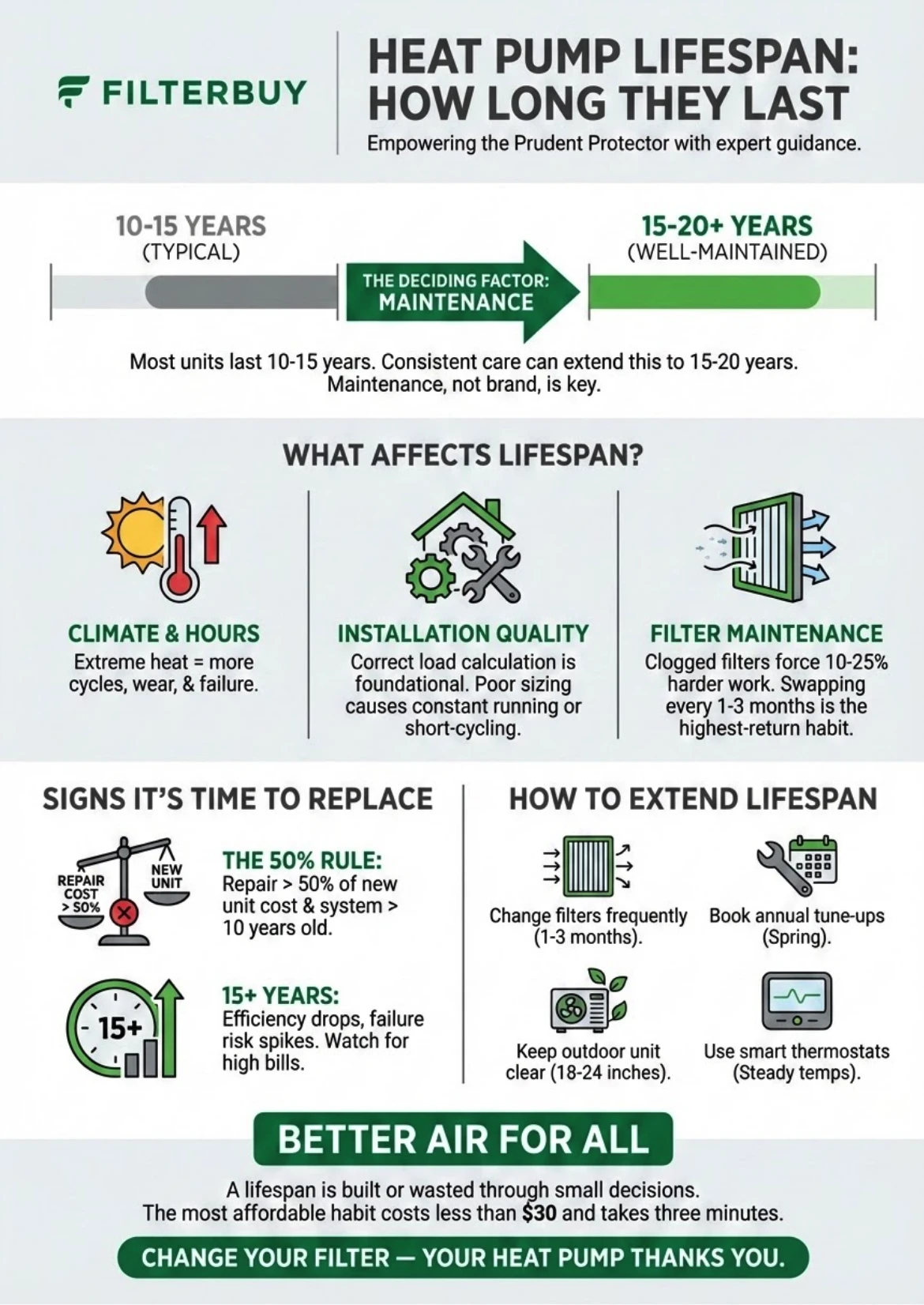
Air-source heat pumps average 10 to 15 years, with well-maintained modern units reaching 15 to 20. Mini-splits typically last 15 to 20 years, and geothermal systems last 20 to 25 years or longer. The national average across all types sits around 15 years — but that figure includes both the units that got regular filter changes and the ones that did not. With a consistent maintenance routine, reaching the upper end of your system's range is genuinely achievable.
Gas furnaces generally last 15 to 20 years, which is longer than air-source heat pumps in a direct comparison. But a heat pump covers both heating and cooling in one unit — compare it to a furnace plus a central air conditioner. That combination means two replacements, two maintenance contracts, and two chances for things to go wrong over the same period. On total lifetime cost, heat pumps frequently come out ahead.
Yes — and for well-maintained systems, it's not that unusual. Mini-splits and geothermal systems do it routinely. Air-source heat pumps can get there in mild climates with consistent maintenance, though the national average sits closer to 15 years. A 2024 HUD Cityscape study found that modern energy-efficient air-source units are increasingly reaching the 15-to-20-year range as compressor and variable-speed technology improve.
For most repairs on a system under 10 years old — yes, especially with a solid maintenance history behind it. Once a system is 12 to 15 years old, use the 50 Percent Rule: if the repair quote runs more than 50 percent of what a new unit costs, replacement makes more sense financially. That's especially true for systems on R-22 refrigerant, which hasn't been manufactured in the U.S. since 2020 and is getting harder and more expensive to source.
Yes, and the DOE has quantified it: a well-maintained heat pump uses 10 to 25 percent less energy than a neglected one. The filter is the most accessible maintenance point in the system. When it's clogged, the blower motor and compressor work harder to compensate, operating temperatures rise, and the components that cost the most to replace wear out faster. We pull failed systems apart regularly, and the filter history is almost always part of what we find.
The indoor heat pump unit in a geothermal system lasts 20 to 25 years on average. The buried ground loop — made from high-density polyethylene — is rated for 50 years or more, with some estimates going past 100. Geothermal systems also need less maintenance than air-source alternatives, since the indoor unit stays protected from outdoor weather exposure year-round.
Watch for combinations of these: the system is 15 or more years old; you have paid for multiple major repairs in the past two years; energy bills keep rising without any change in how you use the system; the system runs R-22 refrigerant; rooms that used to be comfortable are not anymore; grinding, banging, or rattling that is new; or ice on the outdoor unit that does not clear. Three or more of those together is a strong signal that it's time to start shopping.
Most heat pumps do not fail because they're old. They fail because maintenance slipped — and it usually starts with the filter. A clogged filter does not just hurt your air quality. It forces your blower motor and compressor to push against resistance they were not built for, wearing down the parts that cost the most to replace.
At Filterbuy, we make pleated MERV 8, 11, and 13 filters right here in the U.S. — no markups, no middlemen, in hundreds of sizes that fit your system exactly. Set up auto-delivery, and your filter shows up when it's time. You swap it in. Your system keeps running.
It's one of the smallest decisions you'll make for a system that costs thousands to replace. We make it easy to make the right call.
