
Heat Pump vs Air Conditioner: Which Is Better?
April 6, 2026

Here's what we've learned after helping millions of homeowners maintain their HVAC systems: the heat pump vs. air conditioner debate has no universal winner, but it almost always has a right answer for your home.
We see it constantly. A homeowner in Georgia replaces a perfectly good AC with a heat pump, chasing efficiency savings, only to discover their utility rates make the math work against them. Another in the Mid-Atlantic ditches their gas furnace-and-AC combo, switches to a heat pump, and cuts their annual energy costs by nearly a third. Same question, very different outcomes, because the climate zone, existing infrastructure, and local energy pricing change everything.
What most comparison guides won't tell you is that your air filter and duct system play a direct role in which setup actually performs as advertised. At Filterbuy, we've seen firsthand how the wrong filtration pairing quietly undermines heat pump efficiency, something we cover in detail below.
This guide cuts through the noise with real cost data, climate-specific guidance, and the unvarnished pros and cons of both systems, so you can make a confident, informed decision without second-guessing yourself later.
TL;DR: Quick Answers
Heat Pump vs Air Conditioner — What's the Difference and Which Is Better?
The short answer: A heat pump does everything an air conditioner does, plus it heats. An air conditioner only cools.
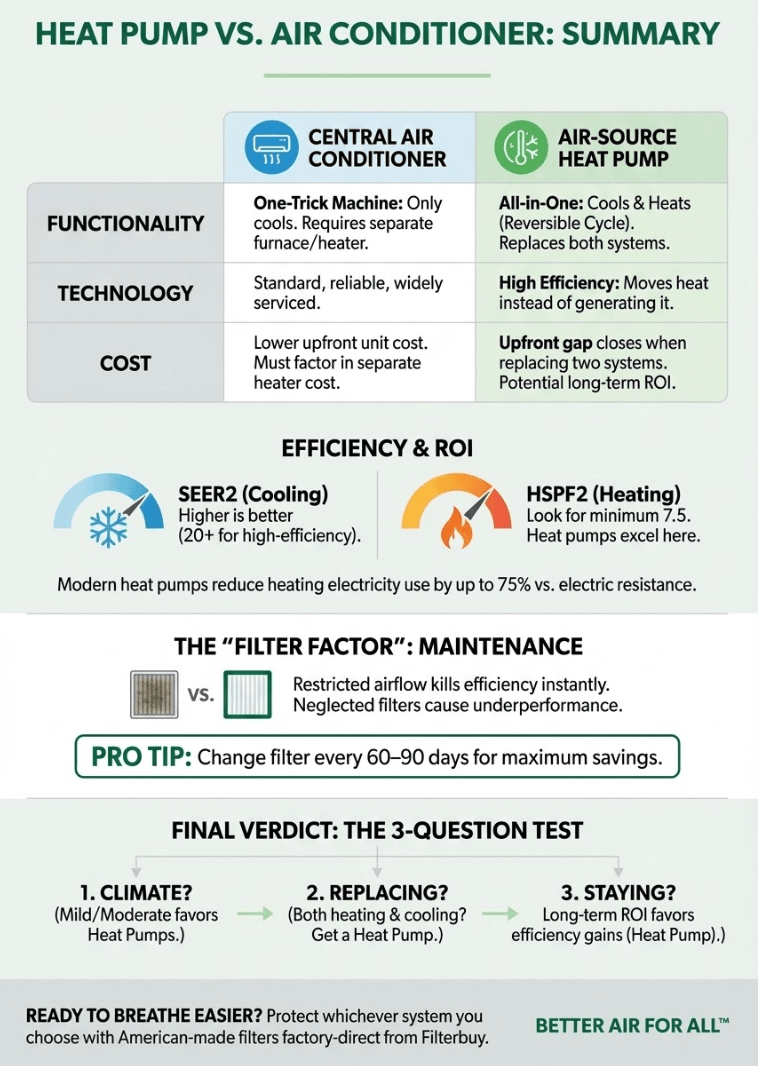
Heat Pump vs Air Conditioner: At a Glance
Heat Pump:
Cools your home
Heats your home
Only 1 system required
Best in mild to moderate winter climates
Higher upfront cost
Higher overall energy efficiency
Eligible for federal tax credits up to $2,000
Air Conditioner:
Cools your home
Does not heat your home
2 systems required (AC + separate heater)
Works in all climates
Lower upfront cost
Lower overall energy efficiency
Not eligible for federal tax credits
Which is better for your home? The 3-question test:
What climate zone do you live in? Mild to moderate winters → heat pump wins. Consistently below 20°F → evaluate cold-climate heat pumps or dual-fuel systems.
What are you replacing? Replacing both heating and cooling → the heat pump is the clear upgrade. Replacing AC only with a working furnace → standalone AC may be the smarter near-term call.
How long are you staying? Long-term home → heat pump's efficiency gains and incentives make a compelling case. Selling soon → the upfront cost premium may not fully recoup.
The bottom line from Filterbuy: After serving millions of HVAC households across every U.S. climate zone, here's what we know. Neither system automatically wins. Your climate zone, existing setup, and local energy costs determine the right answer for your specific home. What does apply to every home, every system, every time: the right air filter, changed on schedule, is what protects whichever investment you make.
Top Takeaways: 5 Things Worth Remembering From This Page
Short on time? Here's everything that matters, distilled into five points.
Your climate zone is the single deciding variable — look it up at the DOE's official tool before talking to any contractor, because everything else in this decision flows from there.
The true cost comparison is closer than it looks — heat pumps replace two systems, not one, and with federal tax credits of up to $2,000 available through December 31, 2025, plus annual energy savings of $500–$1,500, the upfront premium gap closes faster than most homeowners expect.
The market has already made its call — heat pumps have outsold gas furnaces three years running and now account for 45% of all new U.S. home builds, which means you're not betting on emerging technology — you're catching up to a decision the construction industry made years ago.
The system you choose matters less than whether you maintain it — we've seen brand-new premium heat pumps underperform within two years because nobody changed the filter, and aging AC systems deliver reliable comfort year after year simply because the homeowner stayed consistent with the basics.
Protecting your system starts with one simple, repeatable habit — match your MERV rating to your system and household needs, change your filter every 60–90 days, and set up auto-delivery so it never slips.
What's the Actual Difference Between a Heat Pump and an Air Conditioner?
At their core, both systems use refrigerant to move heat, but in fundamentally different ways. A traditional central air conditioner is a one-trick machine: it removes heat from inside your home and pushes it outside to cool your living space. Full stop. When temperatures drop, you need a separate heating system, typically a gas furnace or electric resistance heating, to take over.
A heat pump does both jobs with a single system. In summer, it works just like an AC, pulling heat out of your home. In winter, it reverses the process by extracting heat energy from the outdoor air (even in cold weather) and moving it inside. That reversal capability is what makes heat pumps so compelling from an efficiency standpoint, and also what makes the buying decision more nuanced than most people expect.
One thing we consistently see overlooked: both systems rely entirely on your ductwork and air filter to perform as designed. A heat pump running through a clogged or undersized filter loses efficiency fast, often faster than a standard AC because it's cycling air year-round, not just seasonally.
Cost Comparison: Upfront Installation vs. Long-Term Energy Savings
Upfront Installation Costs
This is where most homeowners get their first real sticker shock. Heat pumps typically cost more to install than a comparable central AC unit. Here's a realistic breakdown:
Central Air Conditioner: $3,800–$7,500 installed (system + labor)
Air-Source Heat Pump: $4,500–$10,000 installed (system + labor)
Dual-Fuel System (heat pump + gas backup): $6,000–$12,000+
The gap narrows significantly when you factor in that a heat pump replaces two systems, your AC and your primary heating source. If you're replacing both anyway, the true cost comparison changes dramatically.
Long-Term Energy Costs
Here's where heat pumps earn their reputation. Because they move heat rather than generate it, modern heat pumps can deliver 2–4 units of heating energy for every 1 unit of electricity consumed, a performance ratio no electric furnace or baseboard heater can touch.
In moderate climates, the annual energy savings from switching to a heat pump from an older gas or electric heating system can range from $500–$1,500 per year, depending on your home's size and local utility rates. However, in regions where natural gas prices are especially low, the savings advantage narrows, and in some markets, a high-efficiency gas furnace paired with a new AC unit still wins on total operating cost.
Federal Tax Credits & Rebates
One factor that's shifting the math in favor of heat pumps right now: federal incentives under the Inflation Reduction Act offer up to $2,000 in tax credits for qualifying heat pump installations, plus potential state and utility rebates that can add hundreds more. This can close most or all of the upfront cost gap versus a traditional AC + furnace setup.
Energy Efficiency: Understanding SEER2, HSPF2, and What the Numbers Actually Mean
Efficiency ratings can feel like alphabet soup, but two numbers matter most when comparing these systems:
SEER2 (Seasonal Energy Efficiency Ratio) measures cooling efficiency and applies to both heat pumps and air conditioners. Current federal minimums are 14.3 SEER2 in northern states and 15.2 SEER2 in southern states. High-efficiency units reach 20+ SEER2. The higher the number, the less electricity is consumed per unit of cooling.
HSPF2 (Heating Seasonal Performance Factor) is heat-pump-specific and measures heating efficiency over a full season. Look for a minimum of 7.5 HSPF2; top-tier units hit 10+. This number is irrelevant for a standard AC, which doesn't heat at all.
What does this mean practically? A heat pump rated at 18 SEER2 / 9 HSPF2 will outperform a standard AC in total annual energy consumption in most climates, because it's handling both heating and cooling loads more efficiently than two separate systems combined.
One thing we've observed in homes with high-efficiency heat pumps: filter maintenance becomes even more critical. These systems are calibrated to move precise volumes of air. A dirty filter creates static pressure that forces the system to work harder, directly reducing the SEER2 and HSPF2 performance you paid for. Checking and replacing your filter every 60–90 days isn't just good housekeeping; it's protecting your efficiency investment.
Climate Matters More Than Almost Anything Else
This is the factor that most online comparison guides under-explain, and it's often the deciding variable.
Heat Pumps Thrive In:
Mild to moderate winter climates (USDA Zones 4–7): Mid-Atlantic, Southeast, Pacific Northwest, and most of the Sun Belt. Heat pumps operate at peak efficiency when outdoor temperatures stay above 35–40°F.
All-electric homes without existing gas infrastructure. Adding a heat pump eliminates the need to install gas lines or maintain two separate systems.
Climates with high cooling loads and moderate heating needs, where maximizing cooling efficiency pays the biggest dividends.
Traditional AC + Separate Heating May Be Better In:
Cold climate zones (USDA Zones 1–3): Upper Midwest, Mountain West, New England. When outdoor temperatures drop below 25°F, standard air-source heat pumps lose efficiency rapidly. Cold-climate heat pumps (rated to -13°F) have closed this gap significantly, but at a higher price point.
Homes already on natural gas with a relatively new, high-efficiency furnace. In markets with low gas prices, the cost of replacing a functioning furnace with a heat pump rarely pencils out until the furnace needs replacement anyway.
Homes with duct systems sized for cooling only. Heat pumps move more air volume during heating mode than a furnace does, and undersized ducts can create comfort and noise issues.
Pros and Cons—The Honest Side-by-Side
Heat Pump: Pros
Heats and cools with a single system, simplifying HAc maintenance and service
Significantly more efficient than electric resistance heating
Eligible for substantial federal and state incentives right now
Lower carbon footprint, especially in regions with clean electricity grids
Consistent, even heating without the dry-air blast of gas furnaces
Heat Pump: Cons
Higher upfront installation cost than AC-only systems
Reduced heating efficiency in extreme cold (below 25–30°F) for standard models
Requires a compatible, properly sized duct system or mini-split configuration
More complex system with a reversing valve, an additional component that can require service
Central Air Conditioner: Pros
Lower upfront cost for cooling-only replacement
Simpler system, widely serviced by any HVAC contractor
Pairs seamlessly with an existing gas furnace for maximum heating performance in cold climates
Typically, lower refrigerant pressure, which can mean longer compressor life in extreme heat zones
Central Air Conditioner: Cons
Does not heat. Requires a separate system, adding cost and complexity
Higher overall energy use when paired with electric resistance heating
No access to heating-specific efficiency incentives
Two systems to maintain, service, and eventually replace
The Filter Factor—Why Your Air Filter Choice Affects Both Systems More Than You Think
Whether you go with a heat pump or a traditional AC, the air filter sitting in your return vent is doing critical work every hour the system runs. But the stakes are different depending on your setup.
With a standard AC, a clogged filter primarily hurts cooling efficiency and strains the compressor during peak summer months.
With a heat pump running year-round, a neglected filter affects both your heating and cooling performance, and the compressor is under load for a much larger portion of the year. We've seen heat pumps in homes with consistently dirty filters run 15–20% less efficiently than their rated specs, which quietly erodes the energy savings that made the system worth buying in the first place.
At Filterbuy, we recommend MERV 8 filters for most heat pump and AC systems, effective enough to protect your equipment and your air quality, without the airflow restriction that higher MERV filters can impose on systems not designed for them. If allergies or air quality are a priority, a MERV 11 is often the right step up—just verify your system's specs first.
So Which Is Better for Your Home? Here's How to Decide
No single answer fits every home, but the decision almost always comes down to three questions:
1. Where do you live?
If your winters are mild to moderate and you're replacing both a heating and cooling system, a heat pump is likely your most efficient and cost-effective long-term option. If you're in a cold-climate zone and already have gas heat, a new high-efficiency AC may be the smarter near-term move.
2. What does your existing setup look like?
Replacing an aging AC in an all-electric home? A heat pump is the obvious upgrade. Adding cooling to a home with a newer, high-efficiency gas furnace? A standalone AC unit may offer better value right now.
3. How long are you staying?
Heat pumps deliver their ROI over time. If you're planning to sell in the next two to three years, the upfront cost premium may not fully recoup. If this is your long-term home, the efficiency gains and available incentives make a compelling case.
When you've made your system decision, protecting it starts with something simple: the right air filter, changed on schedule. That's something we've helped millions of homeowners get right, and we're ready to help you do the same.
"After a decade shipping filters to millions of households across every U.S. climate zone, here's what we know for certain: the biggest factor in whether a heat pump or air conditioner delivers on its promise isn't the equipment you choose — it's whether you maintain it, and we've seen brand-new premium heat pumps quietly running at a fraction of their rated efficiency simply because no one changed the filter."
-Filterbuy Team
7 Resources Worth Bookmarking Before You Buy a Heat Pump or Air Conditioner
Look, there's a lot of noise out there when it comes to HVAC decisions. So we did the homework for you. These are the seven sources we'd point a friend to, all of them authoritative, all of them free, and none of them trying to sell you something.
1. Start Here: The Government's Plain-English Guide to How Heat Pumps Actually Work
Source: U.S. Department of Energy — Energy Saver
Best For: Getting the full, unbiased picture before you call a single contractor
Source: https://www.energy.gov/energysaver/heat-pump-systems
Before you talk to anyone trying to sell you equipment, read this. The DOE's heat pump overview explains how these systems work in real climates, when a hybrid setup makes sense, and what to watch out for — without any sales pitch attached. It's the kind of straightforward information every homeowner deserves before making a decision this size.
2. Don't Buy a Heat Pump Without Checking This Certified Product List First
Source: ENERGY STAR — U.S. Environmental Protection Agency
Best For: Comparing certified models side by side and knowing your ducted vs. ductless options
Source: https://www.energystar.gov/products/air_source_heat_pumps
ENERGY STAR's certified heat pump guide does something most contractor conversations don't: it gives you an independent benchmark to measure any equipment recommendation against. Use it to confirm that whatever unit you're being quoted actually meets current certification standards. It also covers year-round operation tips that most installers won't think to mention.
3. Still Fuzzy on How a Heat Pump Heats Your Home in Winter? This Clears It Up Fast
Source: ENERGY STAR — Ask the Experts
Best For: Homeowners who want to understand the technology in plain language,not engineer-speak
Source: https://www.energystar.gov/products/ask-the-experts/how-does-heat-pump-work
Here's a question we hear a lot: "If it's cold outside, how does a heat pump pull heat from the air?" This ENERGY STAR explainer answers exactly that — clearly, concisely, and without drowning you in technical jargon. Once you understand the basic mechanics, comparing system options and evaluating efficiency claims gets a whole lot easier.
4. Find Your U.S. Climate Zone — Because It Changes the Math on Everything
Source: U.S. Department of Energy — Building America Climate Zones
Best For: Any homeowner who hasn't confirmed their DOE climate zone before pricing out a system
Source: https://www.energy.gov/cmei/buildings/climate-zones
We can't stress this enough — your climate zone isn't a small detail, it's the deciding factor. This official DOE tool lets you look up your zone by county in about 30 seconds. HVAC contractors, equipment manufacturers, and energy codes all use this same framework. If you haven't checked yours yet, do it before you do anything else.
5. What SEER2 and HSPF2 Actually Mean for Your Monthly Energy Bill
Source: U.S. Energy Information Administration
Best For: Homeowners trying to decode the efficiency ratings on equipment quotes
Source: https://www.eia.gov/todayinenergy/detail.php?id=40232
SEER2. HSPF2. EER2. Contractor quotes are full of acronyms that look technical but aren't hard to understand once someone explains them properly. The EIA's breakdown of the 2023 efficiency standards cuts through the confusion and puts real dollar figures behind the difference between a baseline unit and a high-efficiency one. Worth five minutes of your time before you sign anything.
6. Federal Tax Credits for HVAC Upgrades — Here's What's Still on the Table
Source: ENERGY STAR — Federal Tax Credits for Energy Efficiency
Best For: Homeowners who want to know exactly how much the government will offset on a qualifying heat pump installation
Source: https://www.energystar.gov/about/federal-tax-credits
Good news: qualifying heat pump installations can still earn you up to $2,000 in federal tax credits, but the window is closing. ENERGY STAR's tax credit page keeps things clear and current, covering eligible equipment categories, credit amounts, and manufacturer certification requirements. Check this before you finalize your budget. It could change your numbers significantly.
7. How to Actually Claim Your Heat Pump Tax Credit When You File — Straight from the IRS
Source: Internal Revenue Service — Energy Efficient Home Improvement Credit (Section 25C)
Best For: Homeowners who've installed a qualifying heat pump and want to make sure they get every dollar they're owed
Source: https://www.irs.gov/credits-deductions/energy-efficient-home-improvement-credit
Installing a qualifying heat pump is step one. Claiming what you're owed at tax time is step two, and it's easier than most people expect. This IRS page walks you through Form 5695, product identification number (PIN) requirements, and eligibility rules without the legalese.
One important heads-up: Section 25C incentives are currently set to expire December 31, 2025. If a heat pump is on your radar, sooner is smarter. Talk to your tax advisor to confirm your eligibility before your install date.
What the Data Tells Us — And What We've Seen Firsthand
After more than a decade shipping filters to homeowners across every U.S. climate zone, we've watched these statistics play out in real homes with real systems. Here's what the research says and what we've actually observed.
Stat #1 — A Heat Pump Can Cut Heating Energy Use by Up to 75%. Here's Why That Number Is Real.
The Stat: Modern heat pumps reduce electricity use for heating by up to 75% compared to electric resistance systems.
Source: U.S. Department of Energy — Energy Saver
Source: https://www.energy.gov/energysaver/heat-pump-systems
Why it holds up:
A heat pump moves existing heat from outdoor air into your home. It doesn't generate heat from scratch
That fundamental difference in how the work gets done is exactly why the efficiency gap is this wide
This isn't a best-case lab number, is it's achievable in real homes under real conditions
What we've seen firsthand: The most common reason heat pump owners don't capture these savings isn't a bad unit or a faulty installation. It's a dirty filter. Heat pumps are calibrated to move a precise volume of air at a specific pressure. Restrict that airflow and efficiency drops quietly, consistently, and completely preventably. A filter changed on schedule is how you actually realize the savings you bought the system for.
Stat #2 — Heat Pumps Have Outsold Gas Furnaces Three Years Running. What That Really Signals.
The Stat: Heat pump sales have grown 70% over the past 20 years. Gas furnace sales have declined 7% over the same period. Heat pumps outsold gas furnaces for the third consecutive year in 2024.
Source: Rocky Mountain Institute (RMI) — Tracking the Heat Pump & Water Heater Market in the United States
Source: https://rmi.org/insight/tracking-the-heat-pump-water-heater-market-in-the-united-states/
The perspective most coverage misses:
This trend is consistently framed as an environmental story,ry but that's not what's actually driving it
Three straight years of heat pumps outselling furnaces reflect millions of independent cost-benefit decisions made by everyday homeowners
People ran the numbers, compared the systems, and chose the one that made more financial sense for their household
What we observe in our own customer base:
Heat pump households are the fastest-growing segment ordering filters on auto-delivery
Heat pump owners tend to be more engaged with HVAC maintenance than the average they researched their purchase, and they follow through
That pattern is consistent across climate zones and home types
The sales data reflects a market maturing. The maintenance habits we see in our customers reflect homeowners who understand that protecting the investment matters as much as making it.
Stat #3 — Nearly Half of All New U.S. Homes Are Now Built with Heat Pumps. Builders Don't Guess.
The Stat: Heat pumps as the primary heating system in new single-family homes have nearly doubled, rising from 23% of new builds in 2000 to 45% in 2023.
Source: Eye on Housing — National Association of Home Builders (NAHB), citing the U.S. Census Bureau Survey of Construction
Source: https://eyeonhousing.org/2024/08/hvac-in-new-construction-2023/
What this stat actually means for your decision:
Production homebuilders are among the most cost-disciplined decision-makers in housing
They don't spec premium systems out of preference; they spec what delivers the best performance and buyer value at the lowest viable installed cost
When nearly half of all new homes are built with heat pumps as standard, that's a hard-nosed business call made at scale, not a trend driven by incentives alone
The bottom line, from where we sit:
You're not betting on unproven technology. This equipment has been field-tested in tens of millions of homes across every U.S. climate zone
New build or retrofit, the filter is still the variable that determines how much of that investment you capture year after year
A well-chosen, properly maintained filter isn't a small detail, it's what stands between a high-performing system and one that quietly underdelivers
The Filterbuy Take — Our Honest Opinion After a Decade in the Business
We've manufactured filters in the U.S., shipped millions of them to homeowners coast to coast, and talked directly with the people who rely on their HVAC systems every day. That gives us a vantage point most publications covering this topic simply don't have. Here's our straight take.
The Heat Pump vs. AC Debate Is the Wrong Question for Most Homeowners
The conversation has become oddly polarized heat pump enthusiasts on one side, skeptics on the other. In our experience, both camps miss the point entirely.
What we actually believe:
There's no universally correct answer, but there's almost always a clearly better answer for your specific home
That answer depends on your climate zone, existing infrastructure, and local energy costs, not on what's trending
The homeowners who make the best decisions slow down, run the real numbers, and resist pressure to choose based on urgency alone
We've shipped filters to homes in Phoenix and homes in Minnesota. We've served customers on gas, propane, oil, and electricity. What stands out isn't which system people choose. It's whether they take care of the system they chose.
The Opinion No One in This Conversation Is Saying Out Loud
The heat pump vs. AC debate generates millions of words on which system wins. But in our experience, the single biggest driver of whether any HVAC system delivers on its promise has almost nothing to do with the equipment itself.
The system you ignore will fail you. The system you maintain will serve you.
We've seen brand-new premium heat pumps running at a fraction of their rated efficiency within two years of installation not because of the equipment, not because of the installation. Because nobody changed the filter. We've also seen aging AC systems in older homes quietly delivering reliable comfort year after year because the homeowner stayed on top of the basics.
Our honest opinion, stated plainly:
The choice between a heat pump and an AC is a decision you make once
The commitment to maintaining whichever system you choose is a decision you make every 60 to 90 days
The second decision has more impact on your comfort, energy bills, and system lifespan than the first
That's what we've observed across millions of customer households over more than a decade. We think you deserve to hear it straight.
What We'd Tell a Friend Who Asked Us Directly
Answer these three questions before anyone tries to sell you anything:
What climate zone do you live in?
Mild to moderate winters? A heat pump almost certainly makes more long-term sense. Regularly below 20°F? Research cold-climate heat pumps or dual-fuel systems before you commit.
What are you replacing?
Replacing both heating and cooling in an all-electric home? The heat pump is the clear upgrade. Have a newer high-efficiency gas furnace with years of life left? A standalone AC replacement may be the smarter near-term call.
How long are you staying?
Heat pumps earn their value over time. Long-term home? The efficiency gains and available incentives make a compelling case. Selling in two years? The math changes.
Then, regardless of which system you choose:
Buy a quality filter matched to your system's specs not the cheapest one on the shelf
Change it every 60 to 90 days more often with pets or allergy sensitivities
Set up auto-delivery so maintenance never slips and the decision becomes automatic
Your HVAC system is protecting your family's comfort and your home's air quality every single hour it runs. It deserves the support it needs to do that job well.
That's what we're here for and that's what Better Air For All actually means to us.
Your Next Steps — Here's Exactly What to Do From Here
You've done the research. Now it's time to move from informed to action. Here's your clear path forward no matter where you are in the process.
Step 1 — Confirm Your Climate Zone Before You Call a Single Contractor
Everything starts here. Don't let a contractor's preference or a promotional offer drive your decision before you know what your climate zone actually supports.
Do this now — it takes 60 seconds:
Visit the DOE climate zone lookup.
Enter your county or zip code
Note your zone number — then revisit the climate section of this guide to understand what it means for your system choice
Ready for Step 2 when you can answer:
Am I in a heat-pump-friendly zone, a cold climate zone, or on the line between them?
Step 2 — Run Your Real Numbers Before You Commit to Anything
General estimates are a starting point — not a decision. Your actual savings depend on your home's size, local utility rates, existing equipment, and usage patterns.
Three things to do before getting a quote:
Pull your last 12 months of energy bills. Know what you're actually spending — not what an average homeowner spends.
Check your current system's age and condition. A heat pump retrofit makes the most financial sense when you're replacing aging equipment anyway.
Use the DOE's savings estimator to compare projected costs for your state, home size, and existing fuel type.
Ready for Step 3 when you can answer:
What am I spending now and what would I realistically save by switching?
Step 3 — Check Available Incentives Before Your Install Date
Federal incentives are time-sensitive. Section 25C tax credits expire December 31, 2025. State and utility rebates vary and many are first-come, first-served.
Do these before signing any installation contract:
Check current federal credits at ENERGY STAR.
Search your state's rebate programs using the DSIRE database.
Consult your tax advisor to confirm eligibility and how to claim using IRS Form 5695
Ready for Step 4 when you can answer:
How much of my installation cost can I offset and by what deadline?
Step 4 — Choose and Vet Your HVAC Contractor Carefully
The best equipment in the wrong hands underperforms. Contractor quality is one of the most underestimated variables in this entire decision.
Ask every contractor these questions:
Are you licensed and insured in my state?
Do you perform a Manual J load calculation or are you sizing by guesswork?
Can you provide references from heat pump installs in my specific climate zone?
Do you pull permits for the installation?
Are you familiar with ENERGY STAR certification requirements for tax credit eligibility?
Green flags: Contractors who ask about your duct system, insulation levels, and current filter type before quoting a system.
Red flags: Contractors who lead with brand loyalty, skip the load calculation, or pressure you to decide same-day.
Ready for Step 5 when you have: At least two qualified, vetted quotes with itemized equipment and labor costs.
Step 5 — Protect Your New System From Day One
Most homeowners skip this step. It's the one that determines whether the system you just invested in actually performs the way it should.
Before installation is complete, have these sorted:
1. Confirm your filter size.
Ask your installer for the exact dimensions of your return air filter slot
Write it down, take a photo
Don't guess. Wrong sizes leave gaps that bypass filtration entirely
2. Choose the right MERV rating:
MERV 8 — Standard Protection
Recommended for most homes
MERV 11 — Superior Protection
Best for homes with pets, allergy sufferers, or higher air quality goals
Verify system compatibility before purchasing
MERV 13 — Optimal Protection
Best for asthma, severe allergies, or compromised immune systems
Confirm system specs before purchasing
3. Set your replacement schedule:
Every 60–90 days — most households
Every 30–60 days — homes with pets or allergy sensitivities
Every 90–120 days — vacation homes or low-occupancy spaces
4. Automate it. Set up auto-delivery so the filter arrives before you need it, not after you've been running a clogged one for two months.
You're done when: Your first filter is installed, your schedule is set, and your auto-delivery is active.
Still Not Sure Which System Is Right for You?
That's okay. This is a significant decision. Here's how to get unstuck:
Re-read the climate zone section of this guide with your DOE zone number in hand
Use the Essential Resources section to go deeper on whichever variable is creating the most uncertainty
Talk to two or three qualified local contractors not to get sold, but to get educated on what they're seeing in homes like yours
When you're ready to protect whichever system you choose, we'll be here.
FAQ on "Heat Pump vs Air Conditioner"
Q: What is the main difference between a heat pump and an air conditioner?
A: The core difference is the direction of heat flow.
Central Air Conditioner:
Moves heat in one direction only out of your home to cool it
Does not heat requires a completely separate heating system
One job, one season
Heat Pump:
Uses the same refrigerant technology as an AC
One added component, a reversing valve, lets it run the cycle in both directions
Cooling season → pulls heat out of your home, exactly like an AC
Heating season → extracts heat energy from outdoor air and moves it inside
Two jobs, one system, year-round
The Filterbuy firsthand perspective: We've explained this to homeowners for over a decade. The part that surprises people most: even on a 20°F day, there's still enough heat energy in outdoor air for a modern heat pump to capture and use. That's not marketing, that's thermodynamics. And it's the foundation of why heat pump efficiency numbers are as strong as they are.
Q: Is a heat pump more energy efficient than an air conditioner?
A: It depends on which function you're comparing.
On cooling efficiency, the gap is minimal:
Heat pumps and central ACs of the same efficiency tier perform nearly identically in cooling mode
Both are rated by SEER2
Anyone claiming a heat pump dramatically outperforms an AC on cooling alone is overstating it
On heating efficiency, the gap is significant:
Heat pumps move heat rather than generate it
The U.S. Department of Energy documents up to 75% less electricity use for heating vs. electric resistance systems
We've seen this show up directly in the energy bills of customers who switched from electric baseboard or older electric furnaces
Two factors that determine whether rated efficiency becomes real-world efficiency:
Climate — efficiency drops meaningfully below 25–30°F for standard models
Filter condition — a heat pump calibrated to move precise air volume at a specific static pressure can't perform to its rated specs with a clogged filter
What we've observed firsthand: The second factor, a dirty filter, undermines efficiency gains more quietly and more consistently than almost anything else. It's entirely preventable. It's why we talk about it every chance we get.
Q: Is a heat pump worth the extra cost compared to a traditional air conditioner?
A: The answer depends on which direction three key variables point.
Heat pump is worth it when:
You're replacing both heating and cooling not just a failed AC
Your winters are mild to moderate (DOE climate zones 3–5)
You're in an all-electric home this is where the 75% heating efficiency gap hits hardest
You're staying in the home long enough to recoup the upfront premium, typically 5–8 years, though current incentives are shortening that window
Traditional AC may be the better near-term call when:
You have a newer high-efficiency gas furnace with real useful life remaining
Local gas prices are significantly lower than electricity rates in your market
You're replacing only a failed cooling system, and heating isn't part of this decision
The perspective most comparison guides miss: The homeowners who come out ahead on a heat pump investment are rarely the ones who decided under urgency, a failed system on a hot July afternoon. They're the ones who planned the transition, compared real numbers, and chose equipment deliberately.
Important timing note:
Federal Section 25C tax credits of up to $2,000 for qualifying heat pump installations expire December 31, 2025
State and utility rebates vary, many are first-come, first-served
If a heat pump is already on your radar, that deadline is a real factor
Q: Can a heat pump replace both my air conditioner and furnace?
A: Yes, with important conditions depending on your climate zone.
In mild to moderate climates (zones 3–5):
A properly sized air-source heat pump handles the full heating and cooling load year-round
No backup system needed
This is the reality in tens of millions of U.S. homes today
In colder climates (zones 5–7), it gets conditional:
Standard heat pumps lose efficiency below 25–30°F
Two proven solutions:
Dual-fuel system — heat pump handles the primary load, gas furnace backup kicks in during extreme cold
Cold-climate heat pump — models now rated to perform efficiently at temperatures as low as -13°F
Three installation factors that determine success or failure:
Duct compatibility — most existing forced-air homes can accommodate a heat pump without major duct changes. Homes without ducts have a strong option in ductless mini-splits.
Red flag: any contractor who approves your ductwork without actually evaluating it.
System sizing — an undersized heat pump will struggle in winter regardless of efficiency rating. Always require a Manual J load calculation before any equipment is specified.
Filter match — confirm the correct filter size and MERV rating for your specific unit before the installer leaves. This is the step most homeowners miss and one of the most consistent patterns we see across service calls is a heat pump paired with the wrong filter from day one.
Q: How does climate affect whether I should choose a heat pump or an air conditioner?
A: Climate is the single most important variable in this decision more than brand, price, or any feature on a spec sheet.
Here's what we've observed across the full range of households we serve:
Hot-Humid Climates — Zones 1–2 (Florida, Gulf Coast, Deep South)
Heat pump is the clear choice
Long, intense cooling seasons maximize every efficiency advantage
Mild winters mean heating limitations of standard models are rarely a factor
These systems run hard, year-round, consistent filter maintenance is non-negotiable
Mixed Climates — Zones 3–4 (Mid-Atlantic, Southeast, Pacific Northwest, parts of Texas)
The sweet spot for heat pump performance
Both heating and cooling loads are substantial; one system handling both makes clear financial sense
Shortest payback periods and most consistent efficiency gains we observe
If you live here and are replacing both systems, a heat pump is very likely the right call
Cold Climates — Zones 5–6 (Midwest, New England, Mountain West)
Standard heat pumps work but need backup heating support during severe cold
Cold-climate models now perform well below 0°F. Verify specs before purchasing
Dual-fuel systems remain a practical, proven solution
Key caution: not every heat pump sold in these zones is rated as a cold-climate model, confirm before you commit
Very Cold Climates — Zones 7–8 (Upper Midwest, northern mountain states, most of Alaska)
Gas heating retains strong efficiency and reliability advantages
High-efficiency gas furnace + central AC remains the most practical setup for many households here
Cold-climate heat pump technology is advancing fast — but the right system for your home is always the right answer, regardless of what's trending
Find your DOE climate zone in 60 seconds:
Source: https://www.energy.gov/cmei/buildings/climate-zones
This is the same framework every HVAC contractor, equipment manufacturer, and energy code in the country uses. Look it up before you talk to anyone trying to sell you a system.
You've Compared the Cost, Efficiency, and Climate Differences — Now Protect Whichever System You Choose With the Right Filter From Filterbuy
Whether you're running a heat pump or a traditional air conditioner, the right air filter — changed on schedule — is the single most important step you can take to protect your investment, lower your energy bills, and keep your home's air clean. Find your exact filter size from over 600 American-made options, shipped free and factory-direct to your door.