January 21, 2026

After manufacturing millions of air filters in our American facilities, we've fielded one question more than any other: "How does Filterbuy compare to Filtrete?"
The honest answer? Both brands filter air effectively. The real differences show up in places most comparison articles miss—frame durability under humidity, pleat density that affects actual particle capture, and whether you can even find your exact size without settling for "close enough."
We built Filterbuy to solve problems we kept hearing from customers stuck between big-box options and filters that actually fit their systems. This guide shares what we've learned from over a decade of manufacturing, testing, and listening to homeowners describe what works in their homes—not just what looks good on a spec sheet.
Both brands filter air effectively. The real difference comes down to fit, sizing options, and value.
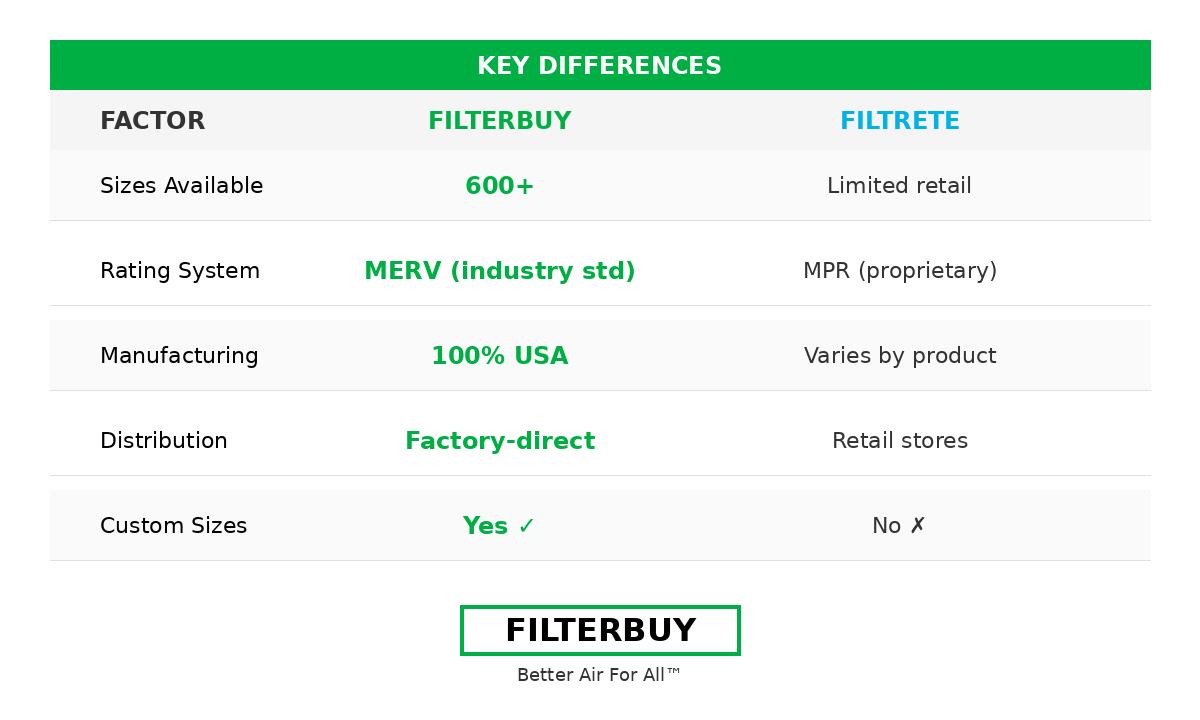
Bottom line: Filtrete works if your local store stocks your exact size. Filterbuy exists for everyone else—especially customers tired of "close enough" fits that leave gaps or filters that warp in humid climates.
After manufacturing millions of filters since 2013, we've learned: the best filter is the one that actually seals in your system.
Fit matters more than brand
Best-rated filter fails without proper seal
Air bypasses poorly fitting filters
Sign of poor fit: clean center, dirty edges
600+ sizes vs limited retail selection
Filterbuy manufactures 600+ sizes
Filtrete stocks standard retail sizes only
Biggest gaps exist in hard-to-find dimensions
MERV vs MPR ratings
MERV: industry standard (used by Filterbuy)
MPR: proprietary 3M system (used by Filtrete)
MERV requires no conversion charts
Lower price ≠ lower quality
Factory-direct eliminates middlemen
No shelf fees or retail markup
Typical savings: 15–30%
100% USA manufacturing
Four facilities: Alabama, Florida, Pennsylvania, Utah
Direct quality control
Faster response to customer feedback
Filtrete is 3M's consumer air filter line, available at major retailers nationwide. Their filters use proprietary electrostatic technology and focus on standard residential sizes commonly stocked in stores.
Filterbuy manufactures all filters in American facilities across Alabama, Florida, Pennsylvania, and Utah. We started in 2013 as a direct-to-consumer company after recognizing that homeowners needed more size options and straightforward quality without retail markup.
Both companies produce legitimate, effective air filters. The differences emerge in how each approaches manufacturing priorities and customer needs.
Filtrete uses its own rating system (MPR) alongside MERV ratings, which can create confusion when comparing products. Their popular filters range from basic fiberglass to MERV 12-equivalent options.
Filterbuy offers MERV 8, MERV 11, and MERV 13 filters with clear labeling. Customers tell us they appreciate knowing exactly what they're getting without converting between rating systems.
Quick comparison:
MERV 8 captures dust, pollen, and lint—suitable for homes without allergies or pets
MERV 11 adds protection against pet dander, mold spores, and finer dust particles
MERV 13 filters trap bacteria, smoke particles, and microscopic allergens down to 0.3 microns
From our testing and customer feedback, MERV 11 hits the sweet spot for most households. It delivers strong filtration without restricting airflow enough to strain your HVAC system.
This is where we hear the most frustration from customers switching to Filterbuy.
Filtrete stocks approximately 40-50 common sizes at major retailers. If your system requires 16x25x1 or 20x20x1, you'll find options easily. Anything outside standard dimensions means compromising with an ill-fitting filter or searching specialty suppliers.
Filterbuy offers over 600 sizes. We also manufacture custom filters in any dimension because we've learned that "close enough" creates gaps where unfiltered air bypasses your system entirely. Those gaps force your HVAC to work harder and allow pollutants through—defeating the filter's purpose.
Homes built before standardization or systems with unusual return vents benefit most from exact-fit options.
Retail filters optimize for shelf presence and price point. That's not criticism—it's business reality.
Manufacturing our own filters lets us prioritize different things. Filterbuy frames use beverage-board construction with moisture-resistant properties. In humid climates like Florida or coastal regions, we've seen standard cardboard frames warp within weeks, breaking the seal against your vent.
Our pleated media uses electrostatically charged synthetic material that maintains particle capture throughout the filter's lifespan. Higher pleat counts increase surface area, which improves both filtration efficiency and airflow—something we refined through years of production adjustments based on real performance data.
Filtrete prices reflect retail distribution costs. Store shelf space, packaging designed for browsing, and middleman margins all factor into what you pay.
Filterbuy ships factory-direct. We pass those savings along through lower per-filter pricing, especially on multi-packs. Subscription delivery adds additional discounts and eliminates the "forgot to buy filters" problem that leads to running dirty filters too long.
Typical savings range from 15-30% compared to equivalent retail filters, depending on size and quantity. The harder-to-find your size, the greater the savings gap tends to be.
Filtrete makes sense if:
You need a filter today and have a common size
A nearby store stocks your exact dimensions
You prefer buying household items during regular shopping trips
Filterbuy fits better when:
Your system requires uncommon or exact-fit sizes
You want consistent quality shipped on a schedule you control
Humidity or climate conditions demand sturdier frame construction
Price-per-filter matters across multiple systems or frequent changes
Both brands improve your indoor air quality over running no filter or neglecting changes. The "best" choice depends on your specific situation, system requirements, and how much the details matter to you.
"The most common problem we see isn't choosing the wrong MERV rating—it's homeowners running filters that don't quite fit, creating gaps where unfiltered air bypasses the media entirely. After manufacturing millions of filters, we've learned that a properly sealed MERV 8 outperforms a loose-fitting MERV 13 every time."
— Filterbuy Team
We believe informed customers make better decisions—for their homes and their families. Before comparing Filterbuy to Filtrete or any other brand, these trusted HVAC and Air Filter resources give you the knowledge to cut through marketing claims and focus on what actually matters.
MERV numbers get thrown around constantly, but what do they actually mean for your family's air? The EPA breaks down exactly what particle sizes each rating captures—and why the highest number isn't always the smartest choice for your system.
EPA: Guide to Air Cleaners in the Home
Here's what we wish every customer knew before buying: no filter eliminates all pollutants. This guide explains what HVAC filters can realistically accomplish—so you can make decisions based on facts, not marketing promises.
ASHRAE: Residential Ventilation Standards (62.2)
Every reputable filter manufacturer builds to ASHRAE standards. Knowing these benchmarks helps you spot the difference between genuine quality and inflated claims—whether you're looking at our filters or anyone else's.
Consumer Reports: Air Filter Buying Guide
We're confident in our filters, but we also believe you shouldn't take any manufacturer's word for it. Consumer Reports tests particle capture, airflow, and long-term costs under controlled conditions—giving you an objective baseline for comparison.
Department of Energy: Ventilation and Indoor Air Quality
Your filter does more than clean air—it affects how hard your system works, how long it lasts, and what you pay in energy bills. This federal resource explains the relationship most filter shoppers overlook until something breaks.
EPA: Improving Indoor Air Quality
After a decade in this industry, we've learned that filters are just one piece of the puzzle. Source control and ventilation matter too. This guide helps you understand where filtration fits—and where other strategies might serve your family better.
Carrier: How Often to Change Air Filters
Sticker price only tells part of the story. Replacement schedules vary based on filter type, pets, allergies, and how often your system runs. Use this guide to compare true annual filter costs—then you'll know which brand actually delivers better value.
The numbers tell a story most homeowners never hear. Here's what the research shows—and why your filter choice matters.
The EPA found indoor pollutant levels are often 2–5 times higher than outdoors. Sometimes over 100 times higher.
Key findings:
Americans spend approximately 90% of their time indoors
Indoor pollution sources include household products, building materials, and inadequate ventilation
People most vulnerable to poor air quality (children, elderly, those with respiratory conditions) spend even more time inside
This is why we built Filterbuy around one idea: indoor air deserves as much attention as outdoor air.
Source: U.S. Environmental Protection Agency
The American Lung Association connects indoor air quality directly to respiratory health outcomes.
The numbers:
27+ million Americans have asthma
~5 million are children
Indoor triggers include dust, pet dander, mold spores, and fine particulate matter
For families managing allergies or asthma, proper filtration isn't optional—it's protection.
Source: American Lung Association
ASHRAE testing confirms what we see in real-world performance.
MERV 13 capture rates:
85%+ of particles in the 1–3 micron range (bacteria, mold spores)
90%+ of particles in the 3–10 micron range (pollen, dust, respiratory droplets)
50%+ of particles down to 0.3 microns
After manufacturing millions of filters, we've watched these numbers translate to cleaner systems, fewer allergy flare-ups, and air that feels noticeably different.
Source: ASHRAE Standard 52.2
Here's what we've learned from over a decade of manufacturing air filters and listening to homeowners.
Both brands improve indoor air quality. The differences emerge where most comparisons don't look:
Size availability – Filtrete stocks ~50 sizes. We offer 600+ because "close enough" creates gaps.
Construction priorities – Retail filters optimize for shelf presence. We optimize for real-world performance.
True cost – Sticker price matters less than annual cost across multiple filter changes.
We're not going to pretend Filtrete is a bad product. It's not.
Need a 20x25x1 today? Filtrete from Home Depot will do the job.
But here's what we see constantly:
Homeowners are settling for filters that don't quite fit.
They fold corners. They assume small gaps don't matter. They do.
After producing millions of filters, we've reached one conclusion that surprises most people:
Filter fit matters more than filter rating.
A properly sealed MERV 8 outperforms a loose MERV 13—every time
Unfiltered air bypasses gaps regardless of specs
We've seen returned filters with clean centers and dirty edges prove this point
This isn't theory. It's what we observe daily.
Measure your filter slot. Don't guess.
Prioritize fit over rating. Snug MERV 11 beats loose MERV 13.
Change filters on schedule. Clogged filters underperform regardless of brand.
Consider your climate. Humidity warps standard cardboard frames.
Calculate annual cost. Factor in replacement frequency and convenience.
Filtrete works for:
Common sizes
Same-day, in-store purchases
Filterbuy works for:
Exact-fit sizing
Direct-from-manufacturer quality
Scheduled delivery before you run out
We're biased—we'll own that. But our bias comes from watching what works in real homes.
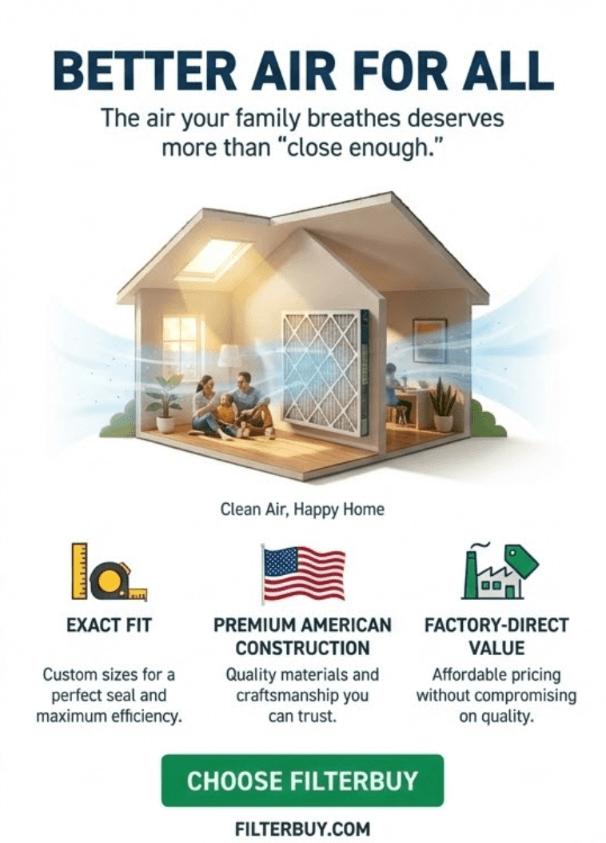
The air your family breathes deserves more than "close enough."
You've done the research. Here's how to act on it.
How to check:
Look for printed dimensions on your current filter's frame
No label? Measure length × width × depth in inches
Round to the nearest whole number
Remember: Actual filter should be ¼"–½" smaller than the slot. Snug fit, no gaps.
Match filtration to your needs—not the highest number.
MERV 8 – Basic dust control, no allergies
MERV 11 – Pets, mild allergies, average homes
MERV 13 – Severe allergies, asthma, respiratory concerns
Note: Confirm your HVAC system supports your chosen rating before purchasing.
Price-per-filter tells only part of the story.
Include:
Filters per change × changes per year × cost per filter
Shipping or store trip costs
Multi-pack or subscription discounts
In-store (Filtrete, store brands):
Common sizes available immediately
Limited uncommon dimensions
Requires remembering to repurchase
Direct-to-door (Filterbuy):
600+ sizes including custom
Subscription delivery on your schedule
Factory-direct pricing
A clogged filter helps no one.
Replacement schedule:
Every 30 days – Multiple pets or severe allergies
Every 60 days – One pet or moderate use
Every 90 days – Standard households
Tips:
Set a phone reminder
Use subscription delivery
Write install date on the filter frame
Know your size? → Browse by size at filterbuy.com
Need help measuring? → Use our sizing guide at filterbuy.com/resources
Non-standard size? → Request a custom filter built to your dimensions
Questions? We answer sizing and MERV questions daily. Reach out—we're happy to help.
Short answer: Both brands filter air effectively. The real question is proper fit.
Why fit matters more than brand:
The best-rated filter fails if it doesn't seal properly
Air bypasses poorly fitting filters entirely
Returned filters often show clean centers and dirty edges—proof of air leakage
Bottom line: Choose the brand that fits your system. Literally.
Short answer: You're not paying for retail shelf space.
What drives retail filter pricing:
Shelf space fees
Eye-catching packaging
Distributor cuts
Retailer profit margins
What Filterbuy eliminated:
Middlemen
Retail markup
Unnecessary packaging (filters arrive ready to install, not display)
Typical savings:
Standard sizes: 15–30% less than retail
Hard-to-find sizes: Even greater savings (retailers mark up specialty products more)
Key point: Lower price reflects a shorter supply chain—not lower quality.
Short answer: No. Filtrete uses MPR—a proprietary 3M rating system.
The confusion this creates:
Customers ask: "Is MPR 1500 better than MERV 13?"
MPR and MERV aren't directly comparable without conversion
Why Filterbuy uses MERV exclusively:
Industry standard developed by ASHRAE
Recognized by the EPA
Openly tested and published
No proprietary conversion needed
Key point: MERV ratings tell you exactly what particle sizes a filter captures—no decoder ring required.
Short answer: It depends on your specific frustrations.
Switching to Filterbuy makes sense if:
Your size isn't stocked locally
"Close enough" fits leave gaps in your system
You manage multiple systems and want a scheduled delivery
Humidity warps your current filters before replacement
Annual cost matters more than per-filter price
Staying with Filtrete makes sense if:
Your local store stocks your exact size
You prefer in-store shopping
You need a filter today (not in 2 days)
The problem Filterbuy solves: Customers who've squeezed oversized filters into return vents—or trimmed filters to fit—are exactly who we built this company for.
Short answer: Yes. Every single filter. Four American facilities.
Manufacturing locations:
Alabama
Florida
Pennsylvania
Utah
Real example: A Miami customer reported frames warping faster than expected. Within days, Filterbuy walked the Florida production floor. Result: moisture-resistant frame construction.
Filtrete comparison:
Made by 3M (American company)
Manufacturing locations vary by product—some domestic, some international
Key point: Filterbuy's supply chain starts and ends in the U.S.—by design.
Filterbuy has manufactured air filters in the USA since 2013, serving millions of customers with 600+ filter sizes.
Stop settling for filters that don't seal. Shop 600+ sizes and get factory-direct delivery to your door.
