
Coway Air Purifier Filters: What They Do and When to Replace Them
October 8, 2026
TL;DR
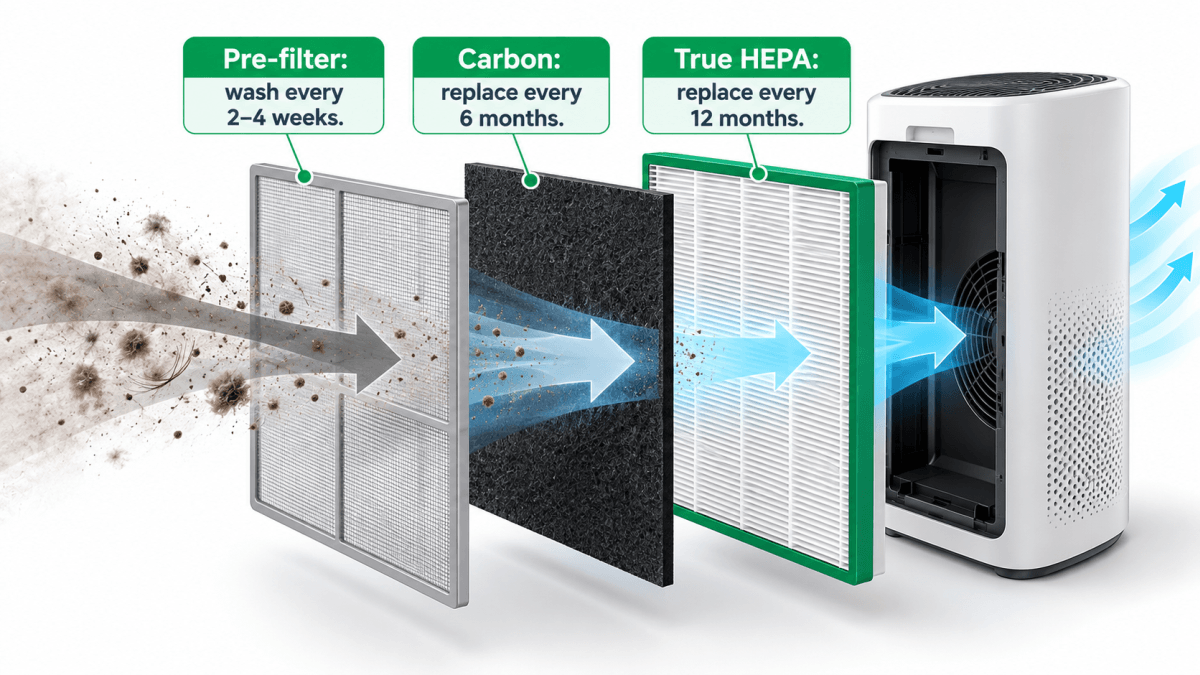
A Coway air purifier cleans the air in three stages. A washable pre-filter catches hair and dust, a carbon layer absorbs odors, and a True HEPA filter traps fine particles. On the Airmega Mighty AP-1512HH and the Airmega 200M, Coway rates the HEPA filter for 12 months and the carbon filter for six, while the Airmega 400 runs on two Max2 filters that combine both. Wash the pre-filter and replace everything else on schedule.
Key Takeaways
When outdoor AQI tops 100, double up. Use a MERV 13 HVAC filter and a HEPA purifier in each room.
The Mighty AP-1512HH and the 200M share one filter set. Its HEPA filter lasts 12 months; its carbon, six.
The Airmega 400 holds two Max2 filters, not one. Each lasts 6 to 12 months.
Only the pre-filter is washable. Clean it every 2 to 4 weeks.
One Coway set keeps a Mighty running for a year. At list price, that works out to roughly $5 a month.
What Does a Coway Air Purifier Filter Do?
A Coway air purifier filter pulls particles and odors out of the air the fan draws in. Coway, a South Korean appliance maker, builds its Airmega purifiers around three layers: a pre-filter for hair and dust, activated carbon for odors and VOCs, and True HEPA for fine particles.
At Filterbuy, we have cut, pleated and framed filters in our own U.S. plants since 2013, and today we build purifier filters as well. We judge a Coway by what each layer catches, how fast it loads and, most of all, how tightly it seals, since a filter that lets air slip around its edges cannot do its job. Our guide to what air purifier filters capture covers the basics.
The U.S. EPA defines HEPA as capturing at least 99.97% of particles at 0.3 microns, the size that is hardest to catch. HEPA cannot trap gases, though, and that is where carbon comes in. Our guides on how activated carbon removes VOCs and carbon vs. HEPA: what each layer does explain the split.
Coway Filter Types and Stages
Coway's two filter families split those three layers differently. The Mighty keeps each stage as a separate part, while the Airmega 400 combines HEPA and carbon in a single cartridge. Coway calls the Mighty four-stage because it counts the ionizer as a stage, too.
The ionizer is electronic, not a filter, and never needs replacing.
The EPA Guide to Air Cleaners in the Home warns that ionizers may emit ozone, a lung irritant, and the CARB certified list shows which units test low. The Mighty's ionizer can be switched off.
How Often Should You Replace a Coway Filter?
Coway rates the Mighty's HEPA filter for 12 months and its carbon filter for six, per the Mighty specs. The Airmega 400's Max2 filters last 6 to 12 months, and the Airmega 400 specs note that the unit tracks filter life by usage rather than by the calendar.
Airmega 400 carbon and HEPA share one Max2 cartridge, replaced as a unit. Pre-filter interval per RTINGS; other intervals per Coway.
Treat those numbers as a ceiling. Pets, a smoker, round-the-clock use or running an air purifier during wildfire season all push you toward the short end, as Filterbuy's air purifier filter replacement schedule explains. From the filter side, we also see carbon saturate faster than HEPA media loads. Because the Max2 bundles the two together, an odor-heavy home may replace it before the HEPA layer is spent.
A First-Year Filter Calendar for the Mighty and 200M
Each genuine Coway set comes with one HEPA filter and two carbon sheets, so save the second sheet for the month-six swap.
Every 2–4 weeks: rinse or vacuum the pre-filter.
Month 6: swap in the second carbon sheet and reset the light.
Month 12: install a new set; reset again.
At Coway's $59.79 list price (checked October 7, 2026), a full year of filters works out to roughly $5 a month, and Coway's filter subscription takes 15% off refills.
Room Size and Filter Life
Room size affects filter life, too. An undersized purifier runs on high more often and loads its filters faster. Filterbuy checked Coway's published CADR numbers against the EPA sizing chart, which calls for a smoke CADR of about two-thirds of the room's square footage.
EPA-sized room = smoke CADR / 0.65, the ratio in the EPA portable air cleaner sizing chart (8-ft ceilings). CADR from Coway spec pages, checked October 7, 2026.
The Mighty lines up with the EPA rule. The 400's larger rating assumes two air changes an hour, so in rooms well over 500 square feet, expect its filters to wear out sooner.
Signs a Coway Filter Needs Changing
The filter light tracks use, not the filter's actual condition, so watch for these signs too. Filterbuy's 10 signs it's time to replace your air purifier filter goes deeper.
The filter light is on. A clean or swap is due.
Odors linger or come back. The carbon layer is saturated and can no longer absorb smells.
Airflow feels weaker at the same fan setting.
Auto mode runs on high more often. The fan is working harder to push air through a loaded filter.
The HEPA filter looks grey or dark. Color can mislead, so Filterbuy's go-to check is simpler: hold the filter up to a light. If light no longer passes through the pleats, replace it.
More dust settles near the unit. Particles are slipping past a full filter.
Cleaning vs. Replacement: Which Coway Filters Can You Wash?
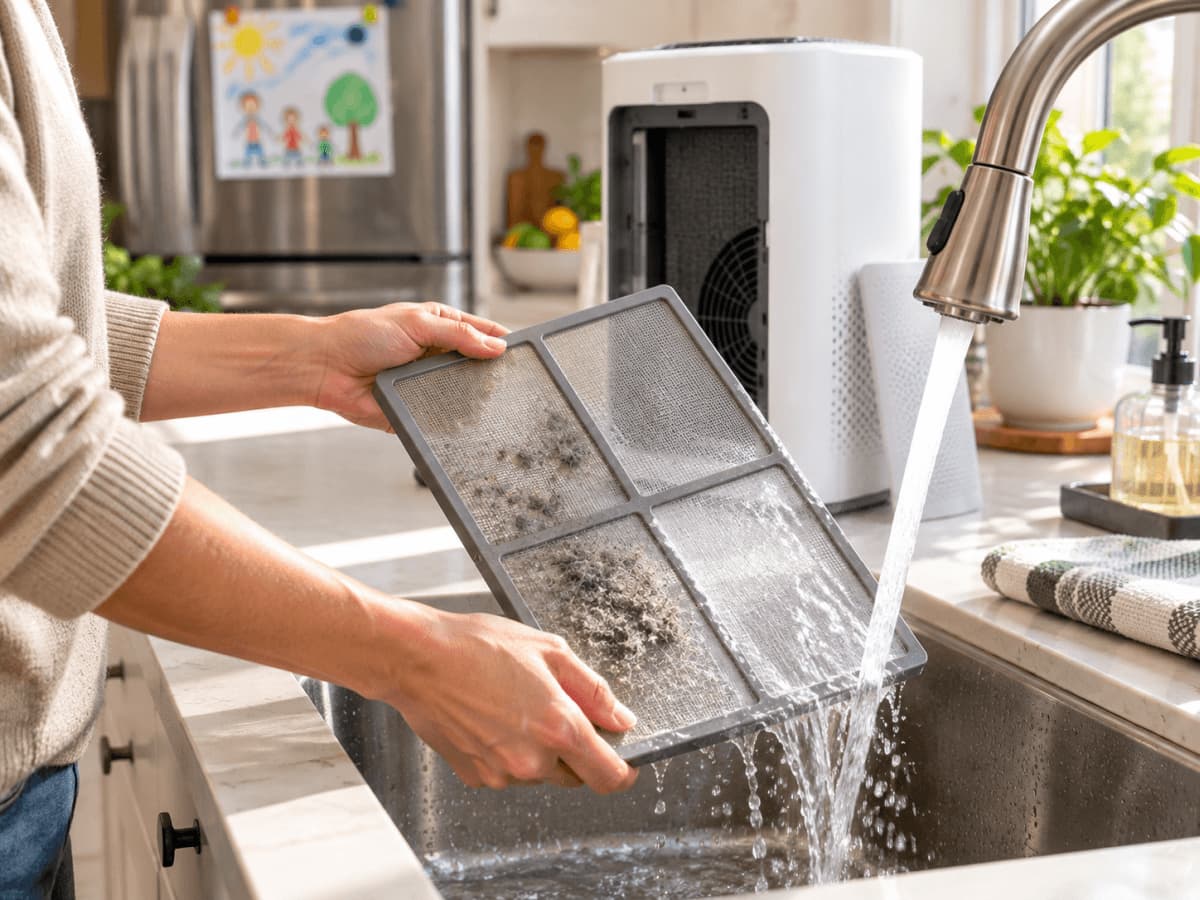
Only the pre-filter is meant to be cleaned and reused. Water breaks down HEPA fibers, and rinsing carbon does not bring back its ability to absorb odors. Filterbuy's guide to cleaning vs. replacing HEPA filters covers the details.
To clean a Mighty pre-filter and swap the inner filters, follow these steps:
Turn off and unplug the purifier.
Open the front cover and pull out the pre-filter.
Vacuum or rinse the pre-filter, then let it dry completely.
If they are due, remove the used carbon and HEPA filters and bag them.
Insert the new HEPA filter, then the new deodorization filter in front of it.
Refit the pre-filter, close the cover and plug the unit in.
Press the filter reset button for 2 seconds, per Coway's AP-1512HH care steps.
How to Identify the Correct Coway Replacement Filter
Coway filters are matched by model family, so start with the purifier, not a tape measure:
Find the model number on the label on the back or underside of the purifier.
Match it to a filter family using the table below.
Check the old filter or its box for a part number to confirm.
Count the filters. The Airmega 400 takes two Max2 filters, while the Mighty takes one HEPA and one carbon filter at a time.
Set 3304899
Whether you search for a "Coway Mighty replacement filter," a "Coway 200M filter" or an "AP-1512HH filter," you land on the same part: Coway's Airmega Mighty AP-1512HH & 200M filter set fits both models.
Under the Magnuson–Moss Warranty Act, using a third-party part does not by itself void your warranty, and in 2024 the FTC warned four air purifier sellers over terms that suggested otherwise. Fit matters most: we cut filters to size every day, and a filter a few millimeters short lets air slip around the media. Run any option through Filterbuy's five-check framework for compatible purifier filters.
“The pre-filter is the part people skip, and it is the one I find caked when someone tells me their purifier stopped moving air. A HEPA filter rated for a year gets thrown out at eight months because nothing was catching the dust in front of it.”
Filterbuy's Air Purifier Filter Line Is Growing
Filterbuy built its name on HVAC filters, and our purifier line has grown from there. We now make complete HEPA and carbon air purifier replacement filters for GermGuardian Filter B, C and E units, plus Cut Carbon pre-filters for Honeywell and GermGuardian models, all made in the USA and shipped free. We add a purifier model only when we can build its filter to fit, and more are on the way.
When the Outdoor AQI Climbs Above 100
An AQI above 100 means outdoor air is unhealthy for sensitive groups. On those days, Filterbuy recommends two steps:
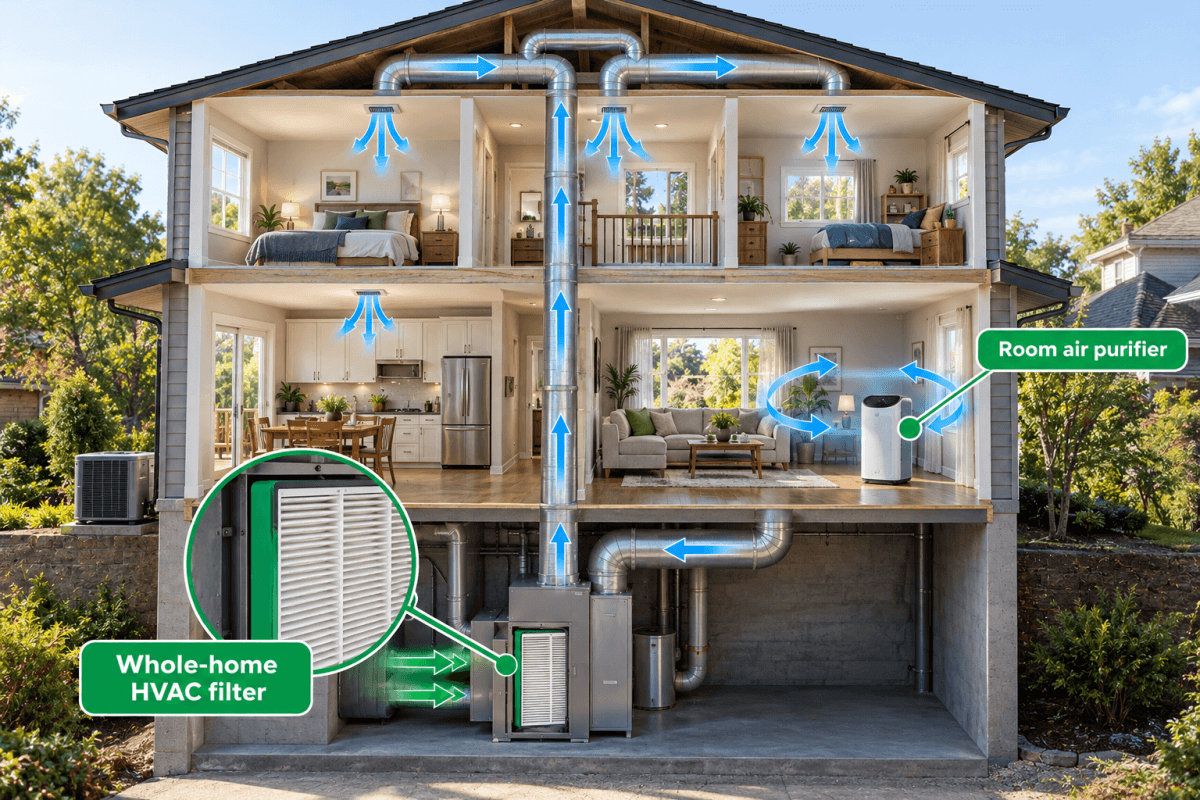
If your home has an HVAC system, switch to a MERV 13 air filter, the rating the EPA recommends, or the highest your system can handle.
Run a HEPA air purifier in each room you spend time in, with filters on schedule.
A purifier cleans only the room it sits in, while the HVAC filter treats air moving through the whole house; see how HVAC filters and portable purifiers differ. Check your local reading on Filterbuy's live AQI map.
Supporting Statistics
HEPA purifiers cut bedroom PM2.5 by 60%.
An NIH-funded randomized trial followed 71 Washington homes of children with asthma.
Living areas fell 42%, versus homes without purifiers.
Source: Riederer et al., Indoor Air (2021), NIH PubMed Central
Home HVAC systems run under 25% of the time in heating and cooling seasons.
HVAC filters clean air only while the system runs.
About 1 in 3 Americans has allergies.
More than 106 million people each year.
Over 82 million were diagnosed with seasonal allergies in 2024.
Source: Asthma and Allergy Foundation of America, Allergy Facts and Stats, using CDC data
Frequently Asked Questions
How often should I replace a Coway air purifier filter?
On the Mighty and 200M, replace the carbon filter every 6 months and the HEPA filter every 12. On the Airmega 400, replace both Max2 filters every 6 to 12 months.
Is the Coway Mighty filter the same as the Coway 200M filter?
Yes. The Coway Airmega Mighty AP-1512HH and the Airmega 200M (AP-1518R) both use Coway filter set 3304899.
Sources
Coway: Airmega Mighty specs, Mighty & 200M filter set, Airmega 400 specs
U.S. EPA: What is a HEPA filter?, Guide to Air Cleaners in the Home
Riederer et al., HEPA air cleaner randomized trial, Indoor Air, 2021
Asthma and Allergy Foundation of America, Allergy Facts and Stats
AirNow (EPA), AQI Basics
California Air Resources Board, certified air cleaners
FTC, right-to-repair warranty warning, July 2024
RTINGS.com, Coway Airmega Mighty review. All accessed October 7, 2026.
Glossary
Coway: South Korean appliance maker behind Airmega purifiers.
True HEPA: Captures at least 99.97% of particles at 0.3 microns (DOE standard).
Pre-filter: Washable mesh outer layer that catches hair, lint and dust.
Deodorization filter: Coway's carbon filter for the Mighty and 200M.
Max2 filter: Combined HEPA and carbon cartridge for the Airmega 400 and 400S.
Activated carbon: Porous carbon that absorbs odors and VOCs.
VOC: Volatile organic compound, a gas from paints, cleaners and cooking.
CADR: Clean air delivery rate, the filtered air a purifier delivers.
Air changes per hour: Times per hour a purifier filters a room's full air volume.
PM2.5: Fine particles 2.5 microns or smaller, as in smoke.
Ionizer: An electronic stage that charges particles so they clump; not a filter.
Filterbuy: Family-owned U.S. filter maker, founded in 2013.
Magnuson–Moss Warranty Act: U.S. law that bars voiding a warranty solely over third-party parts.
Coway® and Airmega® are trademarks of Coway Co., Ltd. Filterbuy is not affiliated with, authorized by, or endorsed by Coway. Model and part numbers are referenced solely to indicate compatibility.