
Blueair Air Purifier Filters: A Homeowner’s Guide
October 8, 2026
TL;DR:
Most Blueair air purifier filters need replacing about every six months of round-the-clock use, and sooner in homes with smoke, pets, or heavy dust. The main filter can't be washed, but the fabric pre-filter on Blue Pure models can. Always match a replacement to your exact model number, since look-alike Blueair models take different filters. Filterbuy's advice: check the filter itself, not just the light.
Your Blueair air purifier can only clean the air as well as its filter allows. At Filterbuy, we've built air filters in the U.S. for over a decade and shipped millions of them to homes like yours, and our support team hears the same story again and again: people trust the filter light more than the filter.
Filterbuy doesn't sell Blueair filters yet, so this guide has nothing to sell you. Think of it as advice from a neighbor who happens to build filters. A fresh filter is also one of the easiest ways to improve indoor air quality at home.
Key Takeaways
Blueair recommends changing the main filter about every 6 months of 24/7 use.
Blueair makes four main filter types: Particle, Particle + Carbon, SmokeBlock, and AllergenBlock.
Main filters can't be washed, but the fabric pre-filter on Blue Pure units can.
Filters are model-specific, so a Blue Pure 311 filter won't fit a Blue Pure 311 Auto.
When the AQI tops 100, switch your HVAC system to a MERV 13 filter and run a HEPA purifier in each room.
Filterbuy's take: treat six months as a check-in date, not an expiration date.
What Are the Different Types of Blueair Filters?
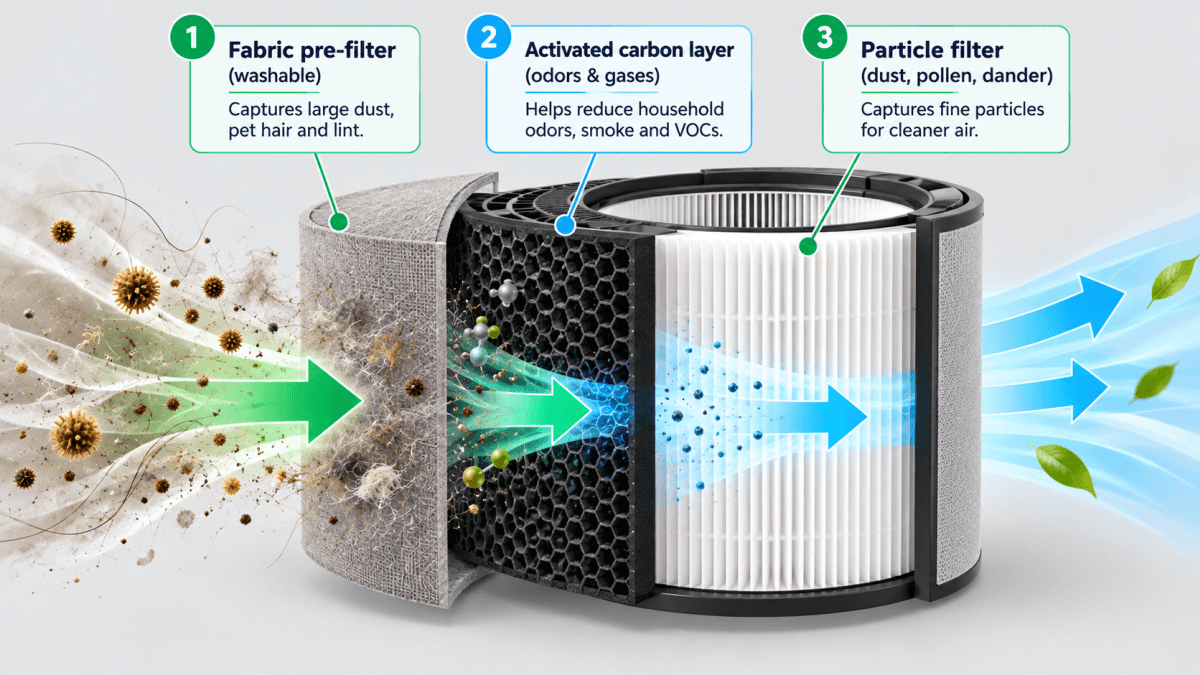
Blueair makes four main types of air purifier filters: Particle, Particle + Carbon, SmokeBlock, and AllergenBlock. Each one uses Blueair's HEPASilent technology, which pairs mechanical filtration with an electrostatic charge. Choose by what you want out of your air: dust, odors, smoke, or allergens.
Source: Blueair. Filter availability varies by model; check compatibility with your exact model number.
The Blueair carbon filter layer traps the odors and gases that particle media lets through. The Blueair pre-filter is a separate part: a washable fabric sleeve that catches pet hair and lint before they reach the main filter.
Which Blueair Filter Do I Need?
Your purifier's exact model number, not its size or shape, decides which filter fits. You'll find it on the label on the bottom or back of the unit. Similar names cause most Blueair filter compatibility mix-ups:
The Blue Pure 311 filter doesn't fit the look-alike Blue Pure 311 Auto.
The Blue Pure Fan and Blue Pure Fan Auto each take their own filter and pre-filter.
The Blue Pure 211+ Auto filter doesn't fit the standard 211+ or the Blue Pure MAX.
Shopping for a Blue Pure replacement filter? Write down the full model name, including any "Auto," "Max," "i," or "+," because those suffixes change the fit. Blueair's online filter finder can also match your serial number.
Fit matters as much as filter type. From years of building HVAC filters and carbon pre-filters for other purifier brands, Filterbuy has learned that the most common failure is air slipping around a filter that doesn't seat snugly.
Coming soon to Filterbuy: We're expanding our air purifier filter lineup. In the meantime, buy Blueair replacement filters listed for your exact model from Blueair or an authorized retailer.
Worried about your warranty? Under federal law, a company generally can't require its own brand of filters to keep coverage intact, and in 2024 the FTC warned Blueair and other air purifier sellers about warranty terms that did exactly that. Filterbuy's advice: judge any compatible filter by its fit, stated media, and return policy.
How Long Do Blueair Filters Last?
The typical Blueair filter lifespan is about six months of 24/7 use, or roughly 4,380 hours, and the indicator light is timed to match. Homes with heavy pollution, smoke, or pets may need a new filter sooner. (Blueair) Connected Blue Pure Max "i" models track actual wear with Blueair's RealTrack algorithm, with typical filter life of six to nine months.
Adjust that six-month baseline for your home:
Assumes 24/7 use. Blueair's standard recommendation is about 6 months (4,380 hours).
Filterbuy's take is that the timer counts fan hours, not dust, and that leaves two blind spots:
A purifier running on high through wildfire season can clog well before the light turns red.
A purifier on low in a guest room may still have life left when the light comes on.
That's why it pays to check the filter itself. During heavy smoke, the EPA even advises replacing filters more often than the manufacturer recommends. See our layer-by-layer replacement guide.
For year-round use, change the filter in early spring and late summer, just ahead of pollen season and peak wildfire smoke.
As for cost, a Blue Pure 211+ Auto filter lists at $69.99 at Abt (checked October 7, 2026), or about $140 a year. A clean pre-filter protects that investment.
When Should You Replace Your Blueair Air Purifier Filter?
Replace your Blueair air purifier filter when the filter replacement indicator turns red, which happens after about six months of operation. Some Blue models turn yellow at five months as an early warning.
The 30-Second Filter Check
The filter light shouldn't be your only guide. Before you swap a filter, run Filterbuy's quick check:
Look: Has the main filter turned gray or black compared with a new one?
Smell: Do you notice a dusty or musty odor when the fan kicks on? Blueair notes that a dirty filter can cause it. (More on why air purifiers smell.)
Listen: Is the fan louder, or the airflow weaker, on the same setting?
Notice: Are allergy symptoms creeping back, or is dust settling faster?
Check the date: Has it been six months since the date written on the frame?
Filterbuy's rule of thumb: if you answer yes to two or more, it's time for a new filter, whatever the light says. If only one applies, check again in two weeks.
How to Reset the Blueair Filter Indicator
For a Blueair filter reset on Blue Pure and Blue Auto models, turn the unit on and hold the main button until the light goes out. It usually takes 7–10 seconds, though some models need up to 30.
Classic 200/400/500/600: Hold the filter button for 10 seconds.
Classic E-series: Hold RESET or TIMER for 10 seconds.
Sense, Sense+, and Pro: Hold the red circle until it disappears.
How to Change a Blueair Filter
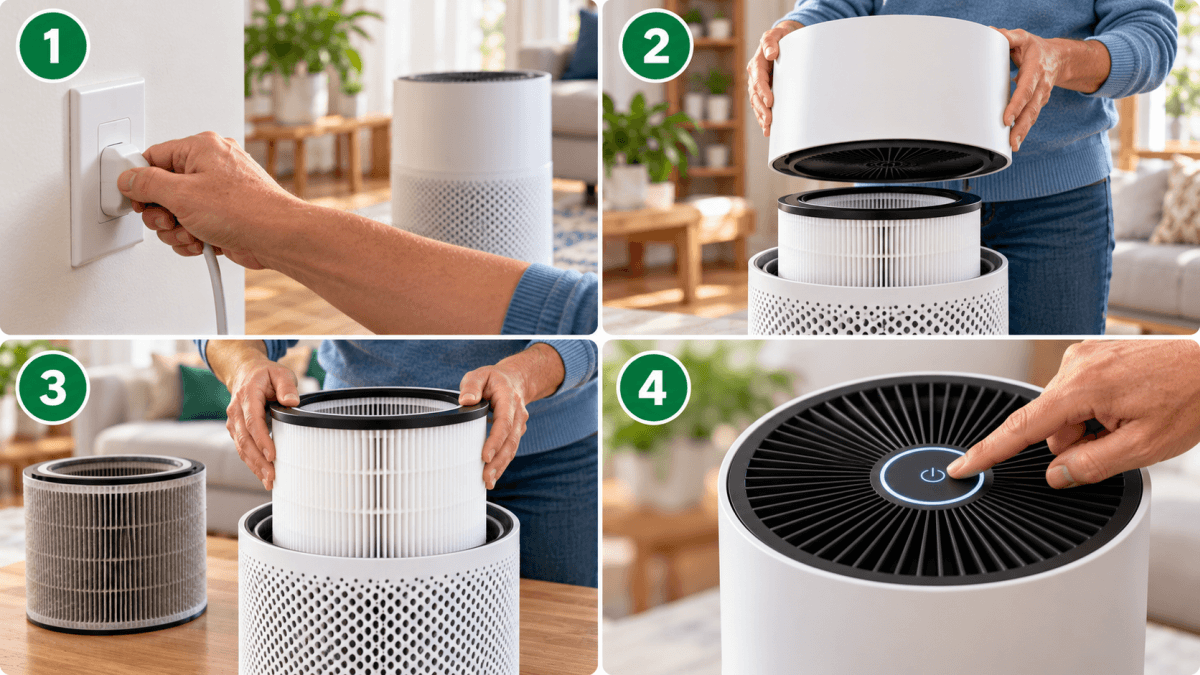
A Blueair filter change takes about two minutes and no tools. These steps follow Blueair's instructions for Blue Pure units:
Unplug the purifier before you open it.
Remove the fabric pre-filter and set it aside for cleaning.
Press the release buttons on both sides until they click, then lift off the top.
Bag the old filter right away so the dust it trapped stays put.
Unwrap the new filter and seat it evenly in the base.
Reattach the top, pressing until it clicks into place.
Slide the clean, dry pre-filter back over the base.
Plug the unit in and reset the filter light.
One more Filterbuy habit: write the install date on the frame with a marker.
Can You Clean a Blueair Filter?
You can't clean a Blueair main filter, but you should clean the pre-filter. Blueair states that its main filters need to be replaced rather than washed, while the fabric pre-filter can be vacuumed or machine-washed at up to 30–40°C (86–104°F).
In Filterbuy's view, the pre-filter is the cheapest part of your purifier and the one doing the most to protect the main filter. Our technical reviewer agrees:
A simple Blueair filter maintenance routine:
Every 2–4 weeks: Vacuum the pre-filter, or weekly if you have shedding pets.
Every 2–3 months: Machine-wash it on a gentle, low-temperature cycle, then let it air-dry fully.
Every 6 months: Check the main filter, replace it, and reset the light.
Just don't vacuum or rinse the main filter, since Blueair warns it can damage the media. See our guide to cleaning air purifier filters.
A purifier only cleans the room it's in. For everyday whole-home filtration, pair it with a fresh Filterbuy MERV 11 HVAC air filter, especially if seasonal allergies are why you run a purifier.
What to Do When the AQI Tops 100
An Air Quality Index (AQI) above 100 means outdoor air is unhealthy for sensitive groups. When your local AQI crosses that line, Filterbuy recommends a two-part upgrade:
If you have an HVAC system, switch to a MERV 13 filter. The EPA recommends at least MERV 13, or the highest rating your system can handle. Set the thermostat fan to On so it keeps filtering.
Run a HEPA air purifier in each room you use, with your Blueair covering its room, on the highest setting, as the EPA advises.
Check both filters more often until the AQI drops.
Supporting Statistics
Why Filterbuy puts filter care first, by the numbers:
Blueair Filter FAQs
Is A Blueair Smokeblock Filter Worth It?
Yes, if you live with smoke or strong odors, since it holds twice the standard carbon. For everyday dust, Particle + Carbon does the job.
Glossary
Blueair: A Swedish-founded air purifier brand known for its round Blue Pure purifiers.
Blue Pure: Blueair's line of cylindrical purifiers with washable pre-filters.
HEPASilent: Blueair's mix of mechanical and electrostatic filtration.
Activated carbon: A porous material that traps gases and odors.
SmokeBlock: A Blueair filter with twice the standard amount of activated carbon, built for smoke and odors.
AllergenBlock: A Blueair filter coated to deactivate captured allergens.
Pre-filter: The washable fabric sleeve that catches large particles like pet hair.
VOCs (volatile organic compounds): Gases released by paints, cleaners, and cooking.
Filterbuy: A U.S. air filter manufacturer that makes HVAC filters and air purifier replacement filters.
Keep Your Blueair Running Fresh
Looking for air purifier replacement filters? While Filterbuy doesn't currently carry Blueair-compatible filters, we offer replacement options for other popular air purifier brands. Explore our air purifier filters to find the right fit for your home.
Sources
Blueair: What are the differences and benefits between specialty filters?
Blueair: How often should I replace the filter on my Blue Pure Max?
Blueair: How do I reset the red light on my Blue Pure or Blue Auto purifier?
Blueair: Filter support (cleaning, washing, and reset by series)
Blueair: Blue Pure Fan Auto particle filter (compatibility, replacement steps, cleaning)
Abt: Blueair Blue Pure 211+ Auto Particle + Carbon filter (compatibility, replacement steps)
American Lung Association: State of the Air 2026, Key Findings