How Many BTUs Do You Need For A 300 Sq Ft Room? A Room-By-Room Sizing Guide
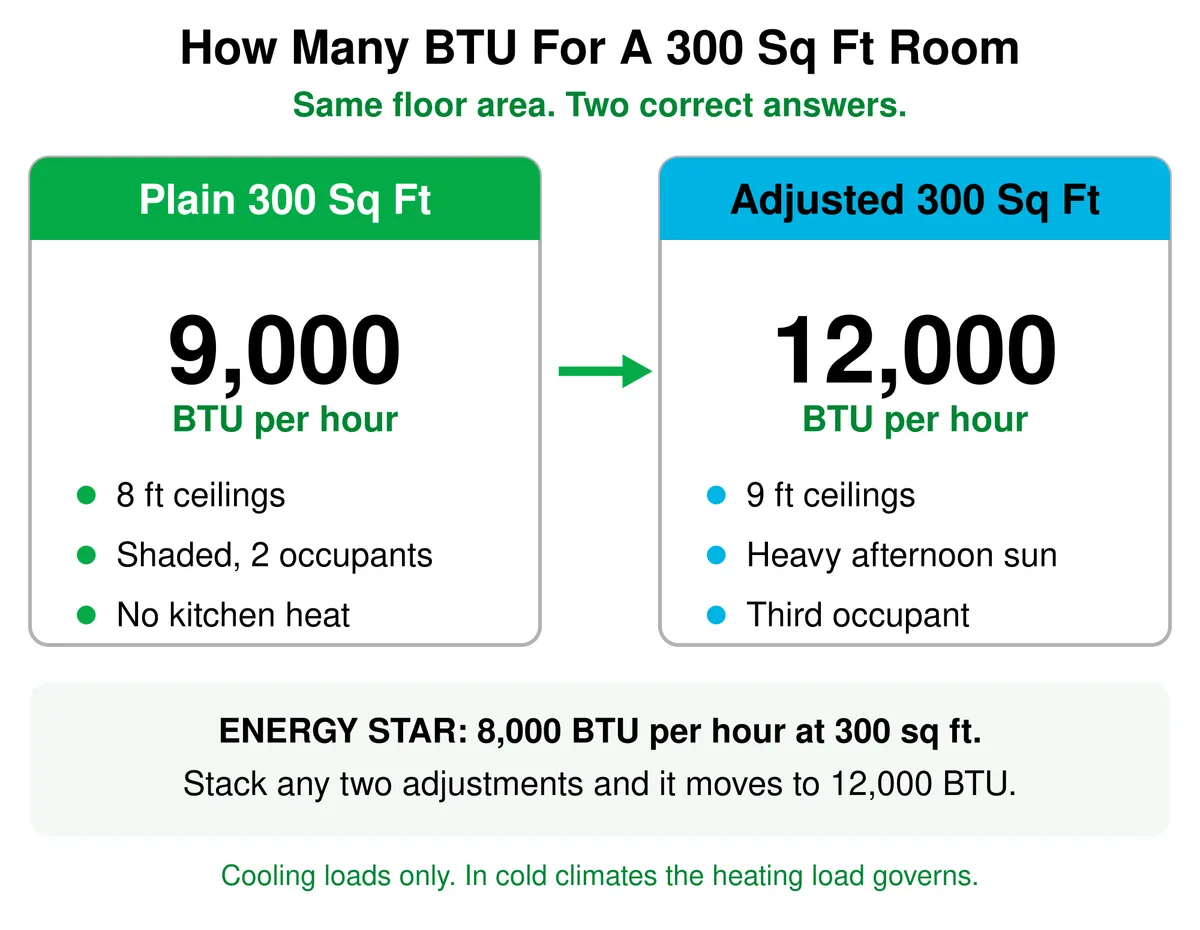
Most 300 square foot rooms need a 9,000 BTU mini split. ENERGY STAR puts the cooling load for a room that size at 8,000 BTU per hour, and 9,000 BTU is the nearest ductless capacity sold above it. Add capacity only when the room breaks from the standard: ceilings above eight feet, heavy sun, a third regular occupant, kitchen appliances, or weak insulation.
- 9,000 BTU fits a plain 300 square foot room with eight foot ceilings, shade, and two occupants.
- 12,000 BTU fits the same room once any two adjustments stack, such as nine foot ceilings plus heavy afternoon sun.
Every figure above is a cooling number. A mini split is a heat pump, so in a cold climate the heating load usually governs and you size on the larger of the two.
The Filterbuy single-zone line starts at 12,000 BTU for $799 with free 2-day delivery on in-stock systems and a 7-year compressor warranty. We do not build a 9,000 BTU unit, so if your room is plain, another brand has your size. Browse Filterbuy ductless mini split systems.
Answer a few quick questions and we will match your room to a mini split size.
TL;DR
Most 300 square foot rooms need a 9,000 BTU mini split. A BTU, or British Thermal Unit, measures how much heat a system moves per hour. The ENERGY STAR cooling capacity chart assumes eight foot ceilings and covers cooling only, so ceiling height, sun, occupancy, and winter heating all shift the answer. Once two of those stack, the room lands at 12,000 BTU.
Key Takeaways
ENERGY STAR puts the cooling load for a 300 square foot room at 8,000 BTU per hour, and the nearest ductless size sold above that is 9,000 BTU.
The familiar rule of 20 BTU per square foot gives 6,000 BTU for a 300 square foot room, 2,000 BTU below the ENERGY STAR figure for the same space.
Two stacked adjustments, such as heavy sun plus a third occupant, move a 300 square foot room from the 9,000 tier to the 12,000 BTU tier.
A mini split is a heat pump, so in cold climates the heating load usually governs and the cooling chart on its own will undersize the room.
Every 300 square foot sizing page I have read hands you one number and moves on. None mention that the number is not a size anyone sells. We sell the 12,000 BTU unit, which is why I want to be plain that a shaded 300 square foot bedroom does not need it.
— Michelle Wan, Brand Manager and Air Quality Writer, Filterbuy
How Many BTUs A 300 Square Foot Room Needs
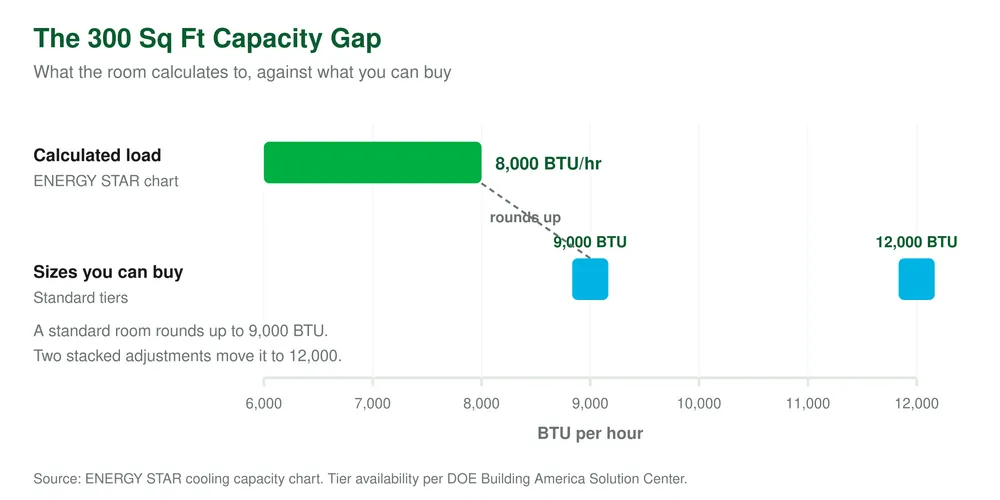
Under the ENERGY STAR chart, a 300 square foot room needs 8,000 BTU per hour, which in practice means a 9,000 BTU mini split. Ductless capacity sells in fixed steps of 9,000, 12,000, 18,000, and 24,000 BTU, so your calculated number rarely matches one you can buy.
What A 300 Square Foot Room Calculates To
The Department of Energy's Building America Solution Center puts it directly: even the smallest indoor heads may provide much more cooling than a single space needs. Single-zone 115-volt ductless heat pumps run from 6,000 to 12,000 BTU per hour, so a small room does have options below 12,000.
Why The 20 BTU Per Square Foot Rule Undersizes A 300 Square Foot Room
Filterbuy ran the arithmetic. The 20 BTU per square foot rule undersizes a 300 square foot room by 2,000 BTU. Divide each bracket in the ENERGY STAR room air conditioner sizing chart by its room size and the implied rate falls as rooms grow, from 30 BTU per square foot at 200 square feet to 19 at 1,100. Small rooms carry more wall, window, and ceiling area per square foot of floor.
Implied BTU Per Square Foot Across The ENERGY STAR Brackets
Implied rates calculated by Filterbuy from the ENERGY STAR capacity chart.
The Adjustments That Move A 300 Square Foot Room To 12,000 BTU
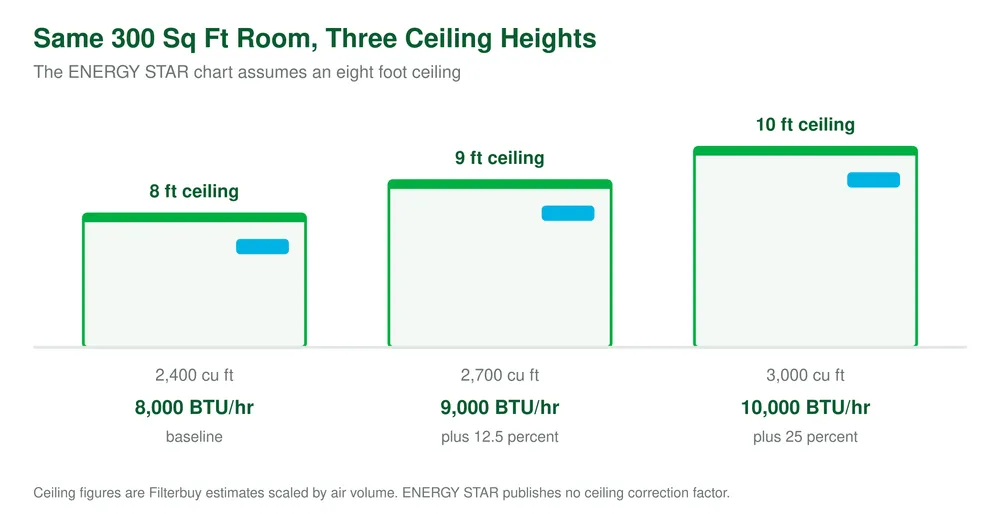
Five conditions raise the capacity a 300 square foot room needs: ceilings above eight feet, heavy sun, more than two occupants, kitchen heat, and weak insulation. ENERGY STAR publishes a correction for all but ceiling height, so Filterbuy scaled that one by air volume. Stack any two and the room moves into the 12,000 BTU tier.
Measure the load, not the room. If the space opens into another without a door, add that area. A room with a doorway you never close is not a 300 square foot load.
Adjustments For A 300 Square Foot Room
Sun, occupancy, and kitchen factors are published ENERGY STAR adjustments. Ceiling figures are Filterbuy estimates scaled by air volume.
A Worked Example At 300 Square Feet
Start at 8,000 BTU per hour, the ENERGY STAR figure.
Add 1,000 BTU for nine foot ceilings, about 12.5 percent more volume.
Add 800 BTU for heavy afternoon sun, 10 percent of the base.
Add 600 BTU for a third regular occupant.
That comes to 10,400 BTU per hour, which rounds up to 12,000. Run the same room shaded, with eight foot ceilings and two occupants, and it lands at 7,200. Same floor area, two correct answers.
What The Cooling Number Misses In A Cold Winter
Every BTU figure above is a cooling figure. A mini split is a heat pump, so the same box carries winter heating, and in cold climates the heating load often exceeds the cooling load. The Department of Energy tells installers to use alternative sizing methods there rather than the cooling chart alone.
Ask your installer for the manufacturer expanded performance table at your design temperature, not the AHRI certificate figure. That certificate rates capacity at fixed factory conditions, and a heat pump delivers less as the outdoor temperature falls. Size on the larger load.
What Goes Wrong When A 300 Square Foot Room Gets Too Much Capacity
An oversized unit cools the air before it removes the moisture, leaving the room cold and clammy. ENERGY STAR states it plainly: a unit that is too large will cool the room before it can remove the humidity. Short cycling wastes energy and shortens equipment life.
Ductless systems handle oversizing better than window units do. The Department of Energy reports an inverter compressor can ramp down to as little as 10 percent of rated capacity, while a single-stage unit runs only at full output and has to stop and start. A 12,000 BTU inverter head on a 10,400 BTU load will modulate and ride it. A 24,000 BTU head will not.
Inverter tolerance is not a license to size up two tiers. Ductless systems dehumidify less effectively than ducted equipment, and the most efficient models are often weakest at it. In a humid climate the room needs a low sensible heat ratio and a working dry mode more than capacity.
Which Mini Split Size Filterbuy Sells For A 300 Square Foot Room
The Filterbuy 12,000 BTU single-zone unit is $799 with free 2-day delivery on in-stock systems and a 7-year compressor and 3-year parts warranty. Our line starts there, so we have no 9,000 BTU unit. For a 300 square foot room it is correct once ceiling height, sun, occupancy, or a kitchen load pushes the requirement past 9,000 BTU.
It runs a variable-speed inverter on R32 refrigerant, is ETL and AHRI certified, and heats to 5 degrees F. At 17 SEER2 it clears the federal minimum and is built for value, not peak efficiency, so a cold winter or efficiency-first build should look elsewhere.
If your room is a shaded bedroom with eight foot ceilings and two occupants, 9,000 BTU is your size and another brand will have to supply it. We would rather say that than sell you too much equipment. Browse Filterbuy ductless mini split systems.
The 12,000 BTU ductless mini split on a 115V circuit runs on standard 110/120V power rather than a dedicated 230V line, though it still needs its own circuit and professional installation. Self-installing voids the warranty. In an older home with a full panel, that difference can decide the project.
Get a real load calculation rather than a chart lookup. Manual J from the Air Conditioning Contractors of America is the ANSI-recognized standard, required by building codes in most jurisdictions. For other room sizes, our mini split BTU sizing chart by room size covers each tier.
The Filter Inside A 300 Square Foot Mini Split
Filterbuy builds pleated filters and sells ductless systems, which is why this section is here. A mini split pulls room air through a washable mesh screen, not a pleated one. The Department of Energy calls these mesh filters very low in particulate capture efficiency and recommends cleaning every two weeks.
Filterbuy has manufactured pleated filters in the United States since 2013. Building both is why we can say plainly that the mesh in a ductless head is not a pleated filter and was never meant to be one. The mesh is sized so a small, low-pressure fan can move air freely.
A small room loads a head quickly. The Department of Energy notes dust and moisture collect on the blower wheel, and recommends a deep clean every one to three years. Our guide on how to maintain your mini split covers the process.
DOE Energy Saver guidance on ductless minisplits puts it plainly: minisplits carry lower MERV filters that do not capture small particles well, and a separate air cleaner may be needed. And if you also run a central system, MERV 13 air filters handle that at the return. EPA guidance is to match a higher MERV rating to the airflow your system can move. If the mesh in your head is torn, warped, or discolored, mini split replacement filters by part number are sourced by manufacturer code rather than nominal size.
Supporting Statistics On Sizing And Room Air Conditioning
Most U.S. air conditioners are oversized by 25 to 50 percent. A 2008 ACEEE Summer Study paper on properly sized air conditioners reported that figure, and that most contractors skip ACCA sizing guidelines.
Half of Northeast households cool with individual units rather than central systems. The 2020 EIA Residential Energy Consumption Survey puts household air conditioning use at 88 percent, mini splits included.
Americans spend about 90 percent of their time indoors. The EPA Report on the Environment puts indoor levels of some pollutants at 2 to 5 times outdoor levels.
Frequently Asked Questions
Glossary
BTU: British Thermal Unit, the unit used to rate capacity. Ratings such as 9,000 BTU are per hour figures.
Ductless Mini Split: An outdoor compressor and one or more indoor heads joined by refrigerant lines, installed without ductwork.
Heat Pump: A system that moves heat rather than generating it, reversing in winter to heat the space it cools.
Inverter Compressor: A variable-speed compressor that adjusts output continuously to match the load rather than switching between full and off.
Manual J: The ANSI-recognized residential load calculation standard from the Air Conditioning Contractors of America, used to determine a room actual heating and cooling load.
Sensible Heat Ratio: The share of cooling output that lowers air temperature rather than removing moisture. Lower means stronger dehumidification.
SEER2: Seasonal Energy Efficiency Ratio 2, the Department of Energy metric for seasonal cooling efficiency, in use since January 1, 2023. Our SEER and SEER2 rating chart compares them.
Short Cycling: When an oversized system reaches setpoint and shuts off before running long enough to remove humidity.