2026 Rebates, Costs & What Actually Qualifies
By Michelle Wan · Reviewed by David Clark, Licensed HVAC Technician · Published July 20, 2026 · Updated July 20, 2026
In 2026, most Pennsylvania mini split rebates are expired or paused, and the one form of help you can use right now is 1% financing. The federal $2,000 tax credit ended December 31, 2025, and the state's utility rebates are between phases.
Pennsylvania's big Penn Energy Savers rebates (up to $8,000) are not live yet, so a low-interest PHFA HEELP loan is the most dependable savings today.
The quick quiz below matches you to a mini split system that fits your home and budget.

Answer a few quick questions and we'll match you to the right mini split system.
Prefer to browse first? Shop mini split systems.
You can still add a ductless mini split in Pennsylvania in 2026, but the savings map has changed. The federal tax credit that paid up to $2,000 toward a qualifying heat pump ended December 31, 2025, so 2026 installs no longer qualify. Utility rebates through Act 129 are paused between program phases, and the state's big IRA-funded rebate program hasn't launched yet. Low-interest state loans are the most reliable help you can use right now.
The federal 25C credit is gone for 2026. The Energy Efficient Home Improvement Credit expired December 31, 2025; equipment installed in 2026 does not qualify.
Most rebates target heat pumps, not cooling-only AC. A ductless mini split heat pump (heats and cools) qualifies for far more programs than a cooling-only mini split AC.
Pennsylvania utility rebates are between phases. Act 129 Phase IV closed to new purchases May 31, 2026, and Phase V amounts were not yet published as of mid-2026.
Penn Energy Savers (HEAR/HOMES) is not live yet. As of mid-2026 the Pennsylvania DEP was still awaiting federal approval to launch it.
Financing you can use today: the PHFA HEELP loan lends at 1% APR for qualifying efficiency upgrades, including heat pumps.
At Filterbuy, we've tracked Pennsylvania's mini split incentives closely this year, and the 2026 picture looks very different from what most articles still tell you. Adding a ductless mini split here is still a smart comfort and efficiency upgrade, but if you're counting on rebates, most are paused or gone this year, and the amounts people quote online are usually out of date. Below is a current picture of what qualifies, what a system costs, and how to time your install, plus what these systems do (and don't do) for the air your family breathes.
A ductless mini split is a compact HVAC system with one outdoor compressor connected to one or more wall- or ceiling-mounted indoor “heads,” with no ductwork in between. The distinction that matters for rebates: a mini split heat pump both heats and cools, while a cooling-only mini split AC only cools. Nearly every incentive program (federal, state, and utility) is written around ENERGY STAR–certified heat pumps, because they replace fossil-fuel heating, so a cooling-only unit rarely qualifies for the same money.
Most ductless systems sold today are heat pumps, so many buyers qualify without realizing it. If your goal is cooling and lower heating bills, the heat-pump version keeps the door open to future rebates. Ask your installer to confirm the model is ENERGY STAR certified and AHRI-listed. That certification is the gatekeeper for almost every program.
“The most common mistake I see in the field is someone buying a cooling-only mini split to save a few hundred dollars up front, then finding out it disqualifies them from nearly every rebate and does nothing for their winter heating bill. Nine times out of ten in Pennsylvania, the heat-pump version is the smarter buy.”
David Clark, Licensed HVAC Technician, Filterbuy HVAC Solutions
Short answer: some help exists, but less than the internet suggests, and much of it is paused right now. As of July 2026, the biggest federal incentive has expired, Pennsylvania's utility rebates are between funding phases, and the state's large rebate program hasn't opened, so low-interest financing is the most dependable savings you can claim today. The table below breaks down where each program stands right now.
Program amounts and availability change often. Confirm current status with your utility and the Pennsylvania DEP before you count on any figure. Verified July 2026.
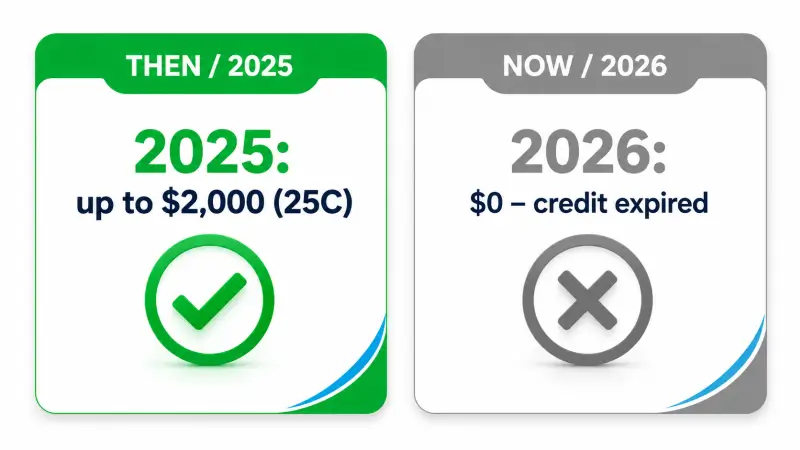
The federal Section 25C Energy Efficient Home Improvement Credit, which returned 30% of the cost (up to $2,000) for a qualifying heat pump, expired December 31, 2025 under the One Big Beautiful Bill Act, signed July 4, 2025. The IRS uses the “placed in service” date, the day your system is installed and running: if your mini split was operational by December 31, 2025, you can still claim it on your 2025 return using IRS Form 5695, but if it goes in during 2026, the federal credit is simply not available.
Many contractor sites and older guides still advertise the $2,000 credit as if it's active. It isn't. Treat any 2026 page still promising a federal heat pump tax credit as out of date, and verify incentives with your utility, the Pennsylvania DEP, and a tax professional before you sign anything.
Pennsylvania has no single statewide mini split rebate. Instead, each electric utility funds its own rebates under Act 129, a 2008 state law. Under the most recent phase, an ENERGY STAR mini split heat pump earned roughly $150–$450 depending on the utility. FirstEnergy's Pennsylvania companies (Met-Ed, Penelec, Penn Power, West Penn Power), PECO, PPL Electric, and Duquesne Light each set their own amount.
The catch in 2026: that phase (Phase IV) closed to new purchases on May 31, 2026, and utilities had not published their next-phase (Phase V) amounts as of mid-2026. So a summer install may fall into a gap where the old rebate has ended and the new one isn't set. Check your utility's rebate portal for current status; the rebate almost always requires an ENERGY STAR–certified heat pump and a submission window (often 90 days from purchase).
Pennsylvania's largest potential rebates come from two IRA-funded programs bundled under Penn Energy Savers and administered by the Pennsylvania Department of Environmental Protection: HEAR (Home Electrification and Appliance Rebate), a point-of-sale rebate up to $8,000 for income-qualified households installing a heat pump, and HOMES (Home Efficiency Rebates), which rewards whole-home energy savings.
As of mid-2026, DEP was still awaiting final federal approval to launch these programs, and new federal guidance issued June 1, 2026 sent the state back to revise its plans. So while HEAR and HOMES could eventually cover most or all of an income-qualified heat pump's cost, neither is claimable today. If your household is at or below 150% of your area median income, watch the Penn Energy Savers site and keep your timeline flexible. The wait could be worth thousands of dollars.
While rebates are paused, one program remains dependable: the HEELP loan (Homeowners Energy Efficiency Loan Program) from the Pennsylvania Housing Finance Agency, a 1% APR fixed-rate loan for qualifying efficiency upgrades, including heat pump installations. On a typical mini split project, that low rate saves well over a standard home-improvement loan across the repayment term. Income limits apply, with some exceptions. It won't hand you cash the way a rebate does, but it meaningfully lowers the cost of financing the work in a year when direct incentives are thin.
A ductless mini split's price depends mostly on how many rooms (zones) you condition and the system's capacity. As a rough planning range, a single-zone heat pump commonly runs about $3,500–$6,000 installed, while multi-zone systems land in the $8,000–$15,000 range. Higher-efficiency models (higher SEER2 and HSPF ratings) cost more up front but cut energy use year-round. Even without a rebate this year, a right-sized, efficient mini split pays back part of its cost through lower bills every month it runs. That's why the equipment decision usually matters more to your long-term wallet than chasing a one-time rebate.
Typical installed costs in Pennsylvania; actual price varies by home, brand, and efficiency tier. Higher SEER2/HSPF models cost more up front but lower monthly bills.
Short answer: yes, if you buy the right one. Older heat pumps struggled in the cold, but today's cold-climate models (look for the ENERGY STAR Cold Climate designation) hold most of their heating capacity well below freezing, which covers the vast majority of Pennsylvania winters. In the coldest corners of the state, ask your installer about a model rated for low-temperature performance and keep a backup heat source for the rare deep freeze. Sizing matters here too: an oversized unit short-cycles and struggles on the coldest days, which is one more reason to insist on a room-by-room load calculation.
Because the biggest rebate isn't live yet, timing is the real question in 2026. A quick way to weigh it:
Lean toward installing now if your current system has failed, you need cooling this summer, or your household income is above the HEAR limit (roughly 150% of your area median income). In that case the big rebate wouldn't apply to you anyway, and every month you wait is a month of lost energy savings.
Lean toward waiting if you're income-qualified for HEAR, your current setup is limping but functional, and your timeline is flexible. HEAR could cover up to $8,000 of a heat pump once it opens, which can be worth a short wait for that kind of money.
Either way, buy the ENERGY STAR heat-pump model, keep every receipt and the AHRI certificate, and check your utility's portal at the time of purchase in case a new Act 129 rebate has reopened. That keeps every door open, whichever way the programs move.
Not sure which bucket you're in? Check your income eligibility on the Penn Energy Savers site and have a qualified installer run the load calculation before you commit either way.
Three federal data points back the case for an efficient mini split:
52% of a typical home's annual energy use goes to heating and cooling. Your system's efficiency drives your single biggest energy expense.
Source: EIA, Residential Energy Consumption Survey (2020)
ENERGY STAR mini split heat pumps use up to 60% less energy than electric-resistance heat. They also cut cooling costs about 30% versus room air conditioners.
Source: ENERGY STAR (U.S. EPA)
Ducts can waste more than 30% of your heating and cooling energy. A ductless mini split skips that loss entirely.
Source: U.S. Department of Energy, Energy Saver
The part most mini split guides skip is the one we pay closest attention to, since filtration is Filterbuy's whole business. A ductless mini split heats and cools beautifully, but it isn't an air-cleaning system. In our years of testing filters and tracking local air quality, one pattern keeps surfacing: homeowners who add a mini split expecting cleaner air are surprised when their allergies don't budge. The reason is simple. Each indoor head pulls room air across a thin, washable mesh screen that catches lint, hair, and larger dust, not the fine particles like PM2.5, pollen, and smoke that trigger allergies and affect health. Those screens also need rinsing every few weeks, or airflow and efficiency drop.
So if cleaner air is part of why you're upgrading, treat the mini split as a comfort system and keep your filtration strong separately. That's where Filterbuy fits in: the mini split handles comfort, while a quality pleated filter like MERV 13 in your central HVAC does the heavy lifting on airborne particles, and changing it on schedule keeps that protection working. Curious what's in your local air? Check your local air quality on Filterbuy's live AQI map.
Choose the ENERGY STAR heat-pump version. It qualifies for far more programs than cooling-only AC and cuts heating bills too. Confirm it's AHRI-listed.
Right-size it. Have a professional installer calculate the load for each zone; an oversized unit costs more and runs less efficiently.
Check your utility's rebate portal now to see whether the next Act 129 phase has opened and what it pays.
Watch Penn Energy Savers if you're income-qualified. HEAR could cover most of the cost once it launches, which is worth a short wait.
Compare financing. If paying over time, price the PHFA HEELP 1% loan against a standard home-improvement loan.
Keep the paperwork: itemized invoice, model numbers, and AHRI certificate. Every rebate program asks for them.
No. The federal 25C Energy Efficient Home Improvement Credit expired December 31, 2025. Only systems placed in service on or before that date qualify, claimed on a 2025 tax return.
Usually not. Nearly all programs require an ENERGY STAR–certified mini split heat pump. If you want to keep rebate eligibility open, choose the heat-pump version.
They're in transition. Act 129 Phase IV closed to new purchases on May 31, 2026, and utilities had not published Phase V amounts as of mid-2026. Check your specific utility's rebate portal for current status.
As of mid-2026, the Pennsylvania DEP was still awaiting federal approval, so no firm public launch date was set. Watch the Penn Energy Savers website for updates.
We've spent over a decade obsessing over what's in people's air, so we know the rebate side of a mini split can feel like a maze. These are the seven places we point neighbors to next: all free and all straight from the source.
Before you spend a dime, let the U.S. Department of Energy's Energy Saver guide walk you through how ductless mini splits work, where they shine, and the sizing slip-ups that quietly run up your bill. It's the no-hype starting point worth reading first.
The catch most people miss: a rebate usually only counts if your system is ENERGY STAR certified. Their Ductless Heating & Cooling page shows you what makes the cut and points you to rebates in your ZIP code. No guesswork.
Chasing rebates across a dozen websites is a headache, so let DSIRE do the legwork. It pulls federal, state, and utility programs into one searchable list. Filter it to Pennsylvania and see exactly what's on the table for your project.
The state's HEAR and HOMES rebates could cover a real chunk of an income-qualified install once they open. The Pennsylvania DEP's Inflation Reduction Act page is the one place we trust for their true status, and it's worth bookmarking since it's changing fast.
Plenty of sites still promise a $2,000 federal credit that ended back in 2025. Go straight to the IRS page for the Energy Efficient Home Improvement Credit and you'll know exactly where things stand before you count on a dollar of it.
With rebates paused, how you finance the work matters. Pennsylvania's HEELP loan lends at 1% APR for qualifying heat pump installs, a lot kinder on your wallet than a typical home-improvement loan. Check the income limits here before you apply.
Almost every rebate requires an AHRI-certified system, so take two minutes to be sure. Punch the exact indoor and outdoor combo your installer quotes into the AHRI Directory to confirm it qualifies. A quick check now beats a denied rebate later.
Ductless mini split: An HVAC system with one outdoor compressor linked to one or more indoor “heads” that heat and/or cool rooms without ductwork.
Mini split heat pump: A ductless mini split that both heats and cools; it qualifies for most rebate programs because it can replace fossil-fuel heating.
25C (Energy Efficient Home Improvement Credit): A federal tax credit that returned up to $2,000 for a qualifying heat pump; expired December 31, 2025.
Act 129: A 2008 Pennsylvania law requiring each electric utility to fund energy-efficiency rebate programs; amounts reset in phases.
Penn Energy Savers (HEAR & HOMES): Pennsylvania's IRA-funded rebate programs. HEAR is an income-based point-of-sale rebate up to $8,000 for a heat pump; HOMES rewards whole-home energy savings. Not yet launched as of mid-2026.
HEELP loan: The Pennsylvania Housing Finance Agency's 1% APR loan for qualifying efficiency upgrades, including heat pumps.
ENERGY STAR: A federal certification for energy-efficient products; required for most HVAC rebates.
SEER2 / HSPF: Efficiency ratings for cooling (SEER2) and heating (HSPF); higher numbers mean lower energy use.
Michelle Wan writes about indoor air quality and home HVAC for Filterbuy, turning technical topics into clear, practical guidance for homeowners. For this guide, she checked each Pennsylvania utility and state program against its primary source in July 2026. Reviewed by David Clark, Licensed HVAC Technician of Filterbuy HVAC Solutions, who verified the technical and equipment details for accuracy.
Filterbuy has manufactured air filters in the USA for over a decade, shipping millions factory-direct to homes nationwide. This guide is educational, not tax, legal, or financial advice; verify all incentive details with your utility, the Pennsylvania DEP, and a tax professional before you buy.
U.S. Internal Revenue Service: Energy Efficient Home Improvement Credit (Section 25C)
EnergySavePA: FirstEnergy ductless mini split rebate (Act 129)
ENERGY STAR: ductless heating & cooling (mini split heat pumps)