Mini Split AC in Portland, OR
Installation, Costs & Filter Guide (OR Climate)
By Michelle Wan, Brand Manager and Air Quality Writer at Filterbuy. Technically reviewed by David Clark, Licensed HVAC Technician and head of Filterbuy HVAC Solutions. Published August 24, 2026. Updated August 24, 2026.
What Does a Mini Split Cost in Portland, OR, and Is One Right for Your Home?
A ductless mini split in Portland runs about $3,200 to $6,500 installed for a single zone, and $6,500 to $15,000 for multi-zone. Whether it is the right buy depends less on your budget than on how your house is heated today. That one fact also decides your Energy Trust rebate, which pays $800 in a detached house and $1,800 in a duplex, townhome, or rowhome, but only when the system replaces electric resistance heat.
Find your situation:
- Electric baseboard, no ducts. Ductless is the clear fit, and the full rebate applies.
- Gas furnace, no ducts. Ductless still works, but the standard rebate path fails.
- Gas furnace, ducts in good shape. A ducted heat pump usually beats ductless, and keeps a real filter slot.
- ADU, garage, or addition. Single zone, sized to the room. Check the main house first, since Energy Trust allows one incentive per residence.
Not sure which row is yours? The quiz below sorts it out in about a minute.

Answer a few quick questions and we will match you to the system that fits your Portland home.
Want to look at equipment first? Shop Filterbuy mini split systems. Our line is single zone only, 17 SEER2, rated for reliable heating down to 5°F, and it ships free in 2 days. If your answer above is a multi-zone system, buy another brand. Professional installation is required and the warranty is void if self-installed. Filterbuy manufactures air filters in the USA and sells its own ductless systems; our HVAC Solutions crews serve Florida and Texas, not Portland.
TL;DR
A ductless mini split in Portland costs about $3,200 to $6,500 installed for a single zone and $6,500 to $15,000 for multi-zone, plus a City of Portland permit. Energy Trust of Oregon pays $800, or $1,800 in a duplex or townhome, but only when the system replaces electric resistance heat. The federal 25C credit expired December 31, 2025.
Where this page comes from. Filterbuy manufactures air filters in the USA, builds replacement filters for every major mini split brand, and sells its own single-zone ductless line. Our HVAC Solutions crews service ductless systems in Florida and Texas, not Portland.
That combination is the point. We see these systems from two ends most writers never do: the filters that come out of them, and the coils our technicians open up. We also have no quote riding on your Portland decision, which is why this page says things a contractor site will not.
Key Takeaways
A single-zone mini split in Portland runs $3,200 to $6,500 installed. Labor is about $160/hr; permits add $150 to $400 plus a 12% state surcharge.
Energy Trust pays $800 for a standard ductless heat pump, $1,800 in a duplex, townhome, or rowhome. Either way it must replace electric resistance heat.
The federal Section 25C credit is gone for equipment placed in service after December 31, 2025. Any quote showing "$2,000 back from the IRS" is running an outdated script.
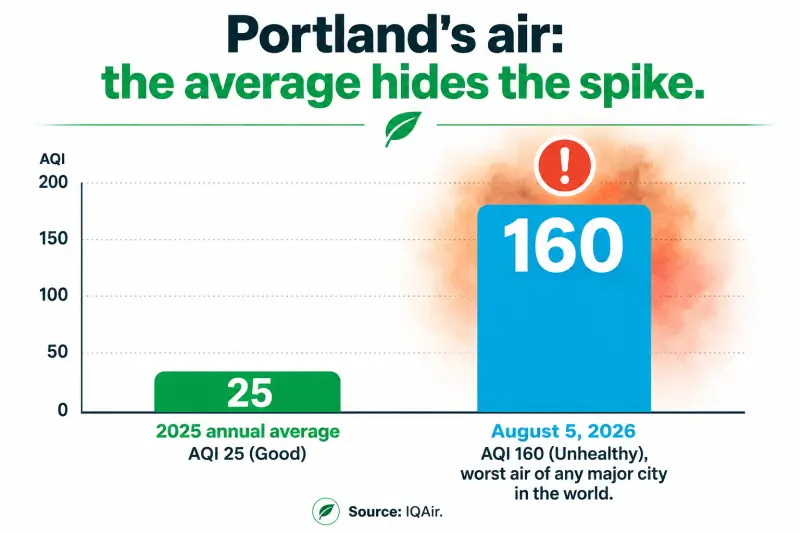
Portland’s air is clean on average and catastrophic in spikes. The metro is tied 23rd cleanest nationally for year-round particles, yet on August 5, 2026 it had the worst air of any major city on Earth.
A mini split head does almost nothing for wildfire smoke. Heads use washable mesh pre-filters; EPA credits MERV 13-16 with cutting indoor particles up to 95%.
What Does a Mini Split Cost in Portland, OR?
Angi puts the Portland average for a single-zone job at $3,162, inside the $3,200 to $6,500 band above. The first zone costs most, because it carries the outdoor condenser that later zones share.
Labor, not brand, is the swing factor. Portland pros charge about $160/hr per worker, above the $75 to $150 range in Filterbuy’s national mini split cost breakdown.
Equipment (single zone, 9k–24k BTU): $800–$2,500. Sizing (BTU) and efficiency rating drive cost.
Labor: $800–$2,000. Around $160/hr; second-story heads or difficult runs add labor hours.
BDS Mechanical Permit: $150–$400. Subject to Oregon's 12% state surcharge.
Electrical Permit + 240V Circuit: $300–$1,200. Separate permit; necessary for pre-1950 housing stock lacking 240V lines.
Line Set Beyond 25 ft: $50–$150 per 10 ft. Commonly required for detached garages, ADUs, or rear condenser placements.
Current as of August 2026. Sources: Angi (Portland) and the City of Portland fee schedule.
Get three line-item estimates. A ductless mini split installation quote that rolls permit and electrical into one number hides the two line items that actually move in Portland.
Will Energy Trust of Oregon Pay for a Mini Split in Portland?
Yes, and the amount turns on your building type. Energy Trust of Oregon pays $800 for a standard ductless heat pump in a detached house. In a duplex, triplex, fourplex, townhome, or rowhome it pays $1,800. In a city with this many plexes, that is worth $1,000.
Here is the inversion nobody puts in writing: every path requires the system to replace electric resistance heat as primary heat. The most common reason a Portlander buys a mini split, adding cooling to a gas-heated house after a heat wave, is the case least likely to qualify.
Standard, Detached or Manufactured Home: $800 rebate. Can be installed by any actively licensed CCB contractor.
Standard, Attached Residence (duplex, triplex, fourplex, townhome, rowhome): $1,800 rebate. Can be installed by any actively licensed CCB contractor.
Rental Property: $1,800 rebate. Requires installation by a program-approved trade ally.
Savings Within Reach (income-qualified): $1,800 rebate. Requires installation by a program-approved trade ally.
Manufactured Home Promotion (single-head 15k–18k only, ends Dec 31, 2026): $3,500 rebate. Requires installation by a participating trade ally.
Every path requires a PGE or Pacific Power account, an inverter-driven unit at HSPF2 8.10+, replacement of electric resistance heat, the highest-capacity head in the main living space, and one incentive per residence. Source: Energy Trust of Oregon, January 2026 sheet.
Buying your own equipment? The standard path allows it. Any licensed CCB contractor can install it, and the incentive can be paid to you directly. Other paths need an approved trade ally.
Check your model in the AHRI Directory before you buy, because HSPF2 8.10 is the gate. Filterbuy’s guide to the most efficient mini splits explains what the ratings mean.
Oregon’s HP3 program adds up to $2,000 and stacks with Energy Trust. But as of August 5, 2026 the owner-occupied pot is empty: $0 left, 0 of 2,000 incentives. Rental and new construction remain open. Check the live chart before a contractor builds it into your quote.
There is no federal tax credit in 2026. The IRS limits Section 25C to property placed in service before December 31, 2025, Oregon’s state credit ended in 2017, and HOMES and HEAR had not launched as of mid-2026. See our Oregon rebates guide.
Do You Need a Permit for a Mini Split in Portland?
Yes, and usually two. The City of Portland names mini-split systems by name among the projects requiring a residential mechanical permit, and most ductless AC installation work also needs a separate electrical permit for the 240V circuit. Fees sit on the City fee schedule, and Oregon adds a 12% state surcharge on top.
If a contractor tells you no permit is needed, that alone disqualifies them. One rule does surprise people, though: your contractor is not required to pull it, because Portland lets a recorded property owner do their own mechanical work. Anyone you hire must carry an Oregon CCB license.
Permitted does not mean DIY. Pulling your own permit is legal here. Installing the equipment yourself is a different question: mini split manufacturers, Filterbuy included, require professional installation, and the warranty is void if self-installed. Refrigerant work also needs EPA Section 608 certification.
Condenser placement derails more Portland installs than anything else. Outdoor equipment is not allowed in the required front setback. Side and rear are fine in most residential zones, but only under five feet and screened.
Settle placement before the quote. Filterbuy HVAC Solutions pulls the permit on every install our crews run in Florida and Texas, so none of this is theory for us.
Is a Mini Split Right for Your Portland Home?
The climate is not the hard part. Portland sits in IECC Climate Zone 4C, with winter design temperatures near 17°F, mild enough that a standard mini split heat pump handles the season without cold-climate equipment. The real driver is cooling: roughly 78% of Portland-area households had air conditioning as of 2019, up from 70% in 2015, and in June 2021 the city hit 116°F while 69 people died in Multnomah County, most at home without working AC.
The hard part is that most advice assumes you have already decided. In Portland, how your house is heated right now matters more than your budget. That one fact sets your equipment and your rebate, and often it settles whether the best mini split for your home is a ductless one at all.
No ductwork, electric baseboard or wall heaters: Ductless mini split is the clear answer—the exact case the equipment was designed for. Qualifies for the full $800 Energy Trust rebate ($1,800 for duplexes, townhomes, or rowhomes).
No ductwork, gas furnace, seeking cooling only: Ductless works well and is typically the most cost-effective path to add cooling. Standard Energy Trust rebate fails since electric resistance heat is not being replaced; check HP3 availability instead.
Sound ductwork, gas furnace: A ducted heat pump usually offers better value per ton and retains a proper filter slot for wildfire smoke season. Qualifies under a different Energy Trust program ($1,000 ducted at HSPF2 7.50).
ADU, garage, addition, or converted attic: A single-zone ductless system sized specifically to the room is ideal. Check primary house rebate status first, as Energy Trust allows only one incentive per residence.
Filterbuy built this table by reading the Energy Trust rules against Portland’s housing stock. Row two is the most common local situation. Row four quietly costs ADU builders a rebate they assumed was coming.
Where our own equipment fits on that table, plainly. The Filterbuy ductless line is single zone only, so rows one and four are where it belongs. If your answer is a multi-zone system, buy another brand. Our systems are 17 SEER2 and rated for reliable heating down to 5°F, which covers a Portland winter, and they ship free in 2 days when most HVAC equipment moves by freight.
One timing note our crews would give you anywhere. Every HVAC market gets crushed the week the first heat wave lands, and Portland has it worse because so much of the metro is buying cooling for the first time. Quotes get thinner in that window and nobody has time to run a load calculation, so move in the shoulder season if you can.
The Filter Gap: Mini Splits and Portland Smoke Season
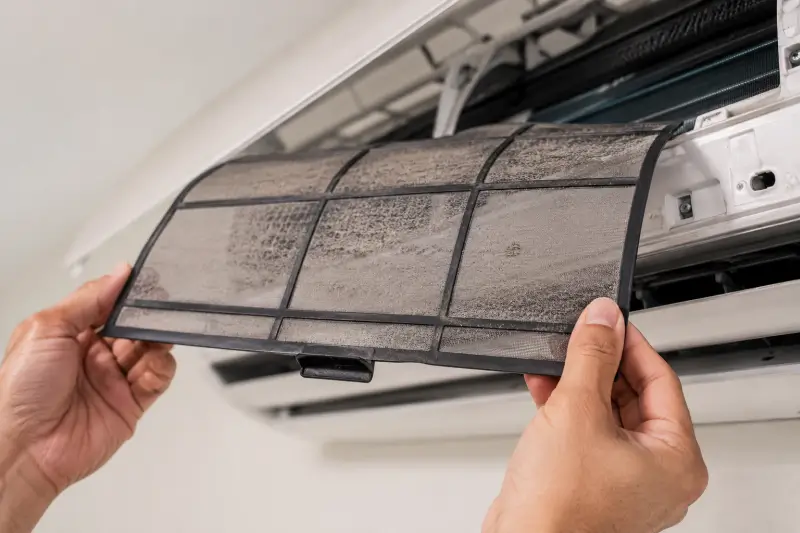
A mini split indoor head is not a filtration system, and that is the part of mini split air quality that surprises Portland owners most. Each head uses a washable mesh pre-filter sized to protect the coil from lint and hair. It carries no MERV rating and captures very little PM2.5, the fine particle that makes wildfire smoke dangerous.
Put that against Portland’s air. IQAir logged a 2025 average of 6 µg/m³ of PM2.5, an AQI of 25. The American Lung Association ranked the metro tied 23rd cleanest nationally for year-round particles. Then on August 5, 2026, smoke pushed Portland to an AQI of 160 and the worst air of any major city on Earth, under a DEQ advisory covering two-thirds of Oregon.
That is the trap. Those rankings run on 2022-2024 data; they do not contain this August. Portland’s air is clean enough most of the year that filtration feels optional, until heat and smoke land in the same week and overlapping advisories remove the one thing Portlanders rely on: opening the windows at night.
Here is what those two vantage points show. In Florida and Texas, where our crews service ductless daily, a failing mini split is a humidity story: biofilm on the coil, a swampy drain pan, a head that smells by August. Portland flips it. The marine climate is kind to the equipment, so the head runs beautifully through smoke season while the house behind it has no filtration layer at all. The unit is not what fails here. The air is.
What closes the gap, per the EPA’s wildfire smoke filtration factsheet:
Run the head on recirculate, windows shut. It moves and cools air. That is its job.
Put a MERV 13 filter in any ducted system you still have. EPA credits MERV 13-16 with cutting indoor particles as much as 95 percent. Check that your blower is rated for the higher-efficiency media first. Filterbuy makes MERV 13 in standard and custom sizes.
If fully ductless, add a portable HEPA cleaner where you sleep and work. EPA puts high-efficiency portable units at up to 85 percent reduction.
Buy filters in June, not August. Portland stores sell out during an advisory.
“People here buy a mini split the week it hits 100 degrees, and they buy it for the heat. Nobody is thinking about the smoke that shows up with it. The filter that protects you in August is the one you set up in June.”
Michelle Wan, Brand Manager and Air Quality Writer, Filterbuy
Mini Split Maintenance Calendar for Portland
March–May: Rinse the mesh pre-filter every 2–4 weeks (tree and grass pollen season).
June–September: Rinse mesh filters every 2 weeks; check portable HEPA filters (wildfire smoke and ozone season).
Late September: Schedule professional coil and blower-wheel cleaning to clear lingering smoke residue.
October–February: Rinse mesh filters every 4–6 weeks (lighter heating-mode dust load).
Any time: A musty smell indicates biofilm on the coil or drain pan—book a mini split repair service.
Mini split filter cleaning is the whole maintenance job in Portland. The mesh is washable, so there is no mini split filter replacement to buy for the head itself, and most mini split service calls here turn out to be about the coil rather than the filter.
Let it dry fully before it goes back in. Filterbuy supplies filters to more than two million households, and the ductless systems still running well at year three are almost always the ones rinsed on schedule. Step-by-step: how to clean a mini split filter.
How to Hire a Mini Split Contractor in Portland
Ask any Portland mini split installer these four questions before you sign. The first two decide whether a rebate is even possible. The last two decide whether the system performs the way the spec sheet promised.
What is your Oregon CCB number? Verify it on the Construction Contractors Board search before you sign.
Are you an Energy Trust trade ally? Not needed for the standard $800 path; required for the others.
Will you pull both permits as line items, and where will the condenser sit? Front setback is off limits; side and rear need screening and a five-foot cap.
Will you run a Manual J load calculation? Oversizing is the most common ductless mistake; an oversized head short-cycles through Portland’s long shoulder seasons.
Question four is the one David Clark, who reviewed this page, flags hardest. A load calculation is what separates a head that runs long and low from one that short-cycles and leaves the room clammy. Filterbuy’s guide to finding an installer covers the rest.
Supporting Statistics
Three government findings sit behind the guidance above, covering mini split efficiency, Portland’s combined heat and smoke exposure, and how much smoke gets indoors anyway. Filterbuy verified each one live on August 24, 2026.
ENERGY STAR certified mini splits use up to 60% less energy than standard electric radiators.
Why it matters: That gap is why Energy Trust pays for ductless, and why the rule targets the electric-resistance swap.
Source: U.S. EPA, ENERGY STAR
40% of Oregonians live in the 12 counties that logged 14 or more days of high heat and bad air on the same day, May to September 2023. That is 1.7 million people.
Why it matters: The state has measured the trap above. OHA notes heat and smoke together can produce effects greater than either alone.
Source: Oregon Health Authority, Climate and Health in Oregon 2023
Close the windows and indoor PM2.5 still reaches 55% to 60% of outdoor levels during a smoke event. In leaky homes it reaches 100%.
Why it matters: On an outdoor AQI of 160, sealing the house leaves roughly AQI 90 to 100 inside. Older homes without AC do worst.
Frequently Asked Questions
Does a mini split heat a Portland home in winter?
Yes. Nearly all modern mini splits are heat pumps, and Portland’s 17°F design temperature sits well inside a standard unit’s range. Filterbuy systems are rated to 5°F, which covers Portland but not Bend.
How much does mini split installation cost in Portland, OR?
A single zone runs about $3,200 to $6,500 installed in 2026; multi-zone runs $6,500 to $15,000. Portland labor near $160 an hour is why local pricing sits above the national range.
Can I still get a federal tax credit for a mini split in 2026?
No. Section 25C expired for property placed in service after December 31, 2025. A 2025 install remains claimable on your 2025 return using IRS Form 5695. Energy Trust of Oregon and HP3 are the live paths now.
Do I need a permit to install a mini split in Portland?
Yes, and usually two. Portland requires a mechanical permit, and most jobs need an electrical permit for the 240V circuit. Oregon adds a 12% surcharge on the fees.
How often should I clean a mini split filter in Portland?
Rinse the washable mesh every two to four weeks in spring, and every two weeks from June through September when smoke and pollen overlap. The filter is washable, so there is nothing to replace on the head itself.
Will a mini split protect me from wildfire smoke?
Only indirectly. It lets you stay cool with the windows shut, but the head’s mesh pre-filter captures very little PM2.5. Pair it with MERV 13 in any ducted system, or a portable HEPA unit if you are fully ductless.
Ready to Breathe Easier?
Whatever you install, the filter is what stands between your family and Portland’s air in August. Find your filter size and set up auto-delivery so smoke season never catches you short.
That is what Better Air For All™ means at the level of one Portland house: the right filter, showing up before you need it.
About the Author
Michelle Wan is Brand Manager and Air Quality Writer at Filterbuy, working with the company’s manufacturing team across plants in Alabama, Florida, Pennsylvania, and Utah.
David Clark is a Licensed HVAC Technician and heads Filterbuy HVAC Solutions. He reviewed the equipment, sizing, refrigerant, and permitting guidance here.
Sources
Energy Trust of Oregon, January 1, 2026 Ductless Heat Pump Incentive Information Sheet
Oregon Department of Energy, HP3 funding chart updated August 5, 2026; IRS, Section 25C
City of Portland, Residential Mechanical Permits and fee schedules; Oregon CCB
U.S. EPA ENERGY STAR; U.S. EPA Wildfire Smoke Factsheet and Wildfire Smoke course; Oregon Health Authority, Climate and Health in Oregon 2023
American Lung Association State of the Air 2026; IQAir Portland; Oregon DEQ advisory, August 2026; U.S. Census American Housing Survey; Angi Portland cost data
Glossary
Ductless mini split. A heat pump that heats and cools without ductwork, pairing an outdoor condenser with indoor heads.
HSPF2 and SEER2. AHRI-rated heating and cooling efficiency metrics. Energy Trust requires HSPF2 8.10 or higher for ductless.
MERV 13. A pleated filter rating on the ASHRAE 52.2 scale, and the grade EPA credits with cutting indoor particles up to 95%. PM2.5 is the fine smoke particle it captures.
AQI. EPA’s 0 to 500 Air Quality Index. Under 50 is good, 101 to 150 is unhealthy for sensitive groups, and above 150 is unhealthy for everyone.
CCB and BDS. Oregon’s Construction Contractors Board licenses contractors. Portland’s Bureau of Development Services issues both permits.