Adding A Mini Split AC System In Oregon
2026 Rebates, Costs, And How To Qualify
By Michelle Wan · Technically reviewed by David Clark, Licensed HVAC Technician
Published: July 20, 2026 · Updated: July 20, 2026
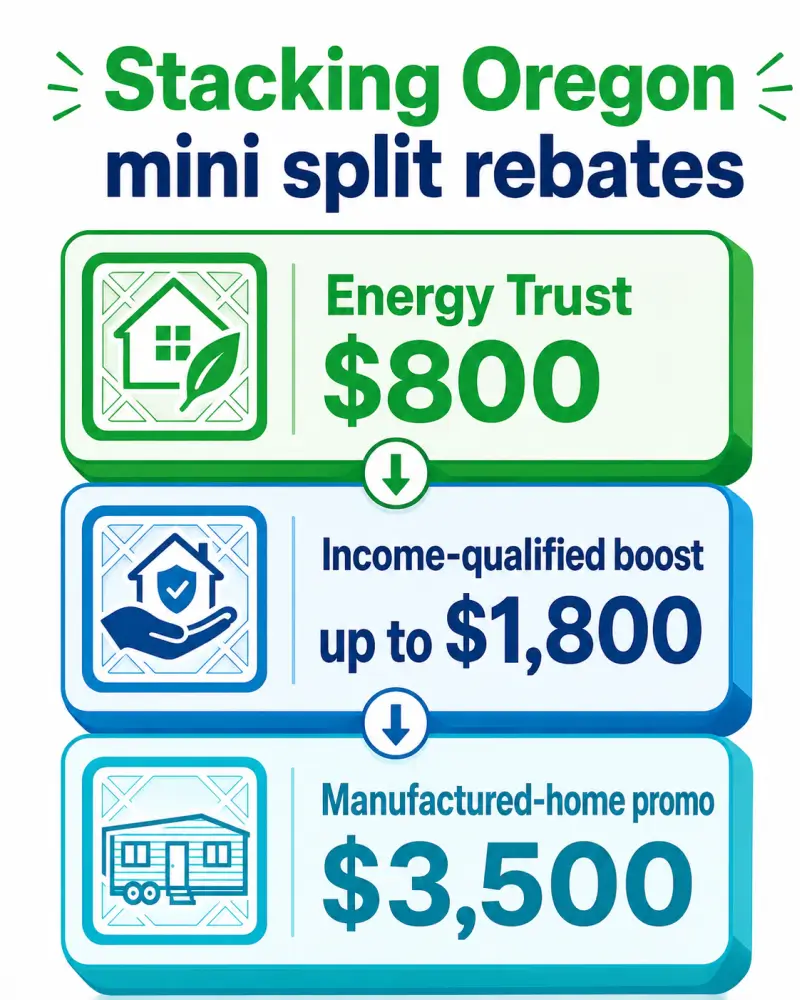
In Oregon, a ductless mini split usually earns an $800 Energy Trust of Oregon rebate, with up to $1,800 for income-qualified homes and $3,500 for manufactured homes. Oregon's HP3 program can add up to $2,000 more and stacks with Energy Trust, while the federal 25C tax credit expired at the end of 2025. Rebates run through your utility (Portland General Electric or Pacific Power) and require a CCB-licensed contractor. Not sure what your home qualifies for? The quick match below points you to the right system.

Answer 3 quick questions and we'll match you to the right mini split for your home.
TL;DR
Adding a ductless mini split in Oregon in 2026 typically qualifies for an $800 Energy Trust of Oregon rebate (up to $1,800 for income-qualified households), and manufactured-home residents can get $3,500 through a promotion running until December 31, 2026. The federal 25C tax credit expired December 31, 2025 and no longer applies. Rebates are paid through your utility (Portland General Electric or Pacific Power) and require a CCB-licensed contractor. Filterbuy, a U.S. air-filter manufacturer, makes the filters that keep your system's air clean and also sells ductless mini split systems.
Key Takeaways
Energy Trust of Oregon pays $800 for a standard single-head ductless mini split that replaces electric-resistance heat, for PGE and Pacific Power customers.
Income-qualified households can receive up to $1,800 (sometimes more) through Energy Trust's Savings Within Reach program.
Manufactured homes get $3,500 for a ductless mini split ($4,000 ducted) under a promotion that ends December 31, 2026.
The federal Energy Efficient Home Improvement Credit (25C) expired December 31, 2025 and does not apply to 2026 installs.
Oregon's HP3 program adds up to $2,000, and the larger HOMES/HEAR rebates are expected to open in 2026 but were not yet available as of this update.
A mini split has its own washable filter and does not filter your whole home, so plan your air-quality strategy with that in mind.
How Much Can You Save? Oregon Mini Split Rebates At A Glance
A standard ductless mini split installed in an Oregon home in 2026 most often earns an $800 Energy Trust of Oregon rebate, and stacking programs can push total support past $3,500 for eligible households. The table below combines every current path into one place, the piece most guides leave scattered across five different websites. We come at this from the air side, not the sales side: Filterbuy has built mini split and HVAC filters in the USA for over a decade, so this guide pairs the rebate math with something the paperwork never mentions: how the system treats the air once it's running.
Amounts and eligibility change often. Confirm current figures with Energy Trust of Oregon and the Oregon Department of Energy before you buy.
What You'd Actually Pay: A Worked Example
Rebate amounts only matter as the price you actually pay. Single-zone ductless installs in the Portland area commonly run about $3,000 to $7,000, depending on the unit, the wiring, and the wall work. Here is how the rebates tend to change that number. Treat it as an illustration, not a quote. Your figure depends on your home, your utility, and current funding, so get three bids.
Illustrative single-zone install: $6,000
Energy Trust standard ductless rebate: − $800
Oregon HP3, when funding is open for your category: − $2,000
Estimated net after rebates: about $3,200
What changes your number:
Stacking: Energy Trust incentives stack with HP3, but HP3 cannot be combined with the federal HOMES/HEAR rebates.
HP3 funding: as of mid-2026, owner-occupied HP3 money was fully reserved while rental and new-construction funds remained. Without HP3, the same install nets about $5,200, so confirm current status before you count on it.
Income-qualified: Energy Trust's Savings Within Reach can lift the ductless incentive toward $1,800, dropping your net further.
How it's paid: approved contractors deduct the incentive from your invoice, so you pay the balance rather than waiting on a check.
Is The Federal Tax Credit Still Available In 2026?
No. The federal Section 25C Energy Efficient Home Improvement Credit expired on December 31, 2025 under the One Big Beautiful Bill Act, so mini splits installed in 2026 do not qualify for the former 30%-of-cost, up-to-$2,000 heat-pump credit. Oregon also has no active state HVAC tax credit (the Residential Energy Tax Credit ended in 2017). That makes utility and state rebates, not tax credits, the real savings in 2026.
Energy Trust Of Oregon: The Main Rebate Source
Energy Trust of Oregon is the primary place most homeowners claim a mini split rebate. It pays $800 for a qualifying single-head ductless heat pump installed by an approved contractor. Energy Trust is funded by utility ratepayers, not the federal government, so its programs continued after the federal credit expired.
To qualify for the standard ductless incentive, according to Energy Trust's January 2026 program requirements:
Utility: you must be a Portland General Electric (PGE) or Pacific Power customer.
Heat source: the mini split must replace electric-resistance heat (like baseboard or an electric furnace) as your home's primary heat.
Equipment: the unit must be inverter-driven with an HSPF2 rating of 8.10 or higher.
Installer: work must be done by an actively licensed CCB contractor, and the incentive is limited to one per residence.
Income-qualified households can receive up to $1,800 (and sometimes more) through Energy Trust's Savings Within Reach program, which raises the incentive for eligible incomes. Your contractor typically deducts the rebate directly from your invoice, lowering your upfront cost.
Manufactured Homes: The Biggest Current Rebate
Manufactured-home residents in Oregon can get $3,500 for a ductless mini split (or $4,000 for a ducted heat pump) through an Energy Trust promotion running until December 31, 2026. To qualify, you must heat primarily with electric resistance, be a PGE or Pacific Power customer, and use one of the promotion's participating trade allies. A few counties (Coos, Gilliam, Morrow, Umatilla, and Wallowa) are excluded from this specific promotion but may have regional heat-pump incentives instead.
Oregon HP3 And The Upcoming HOMES/HEAR Rebates
Oregon's Heat Pump Purchase Program (HP3) adds up to $2,000 per eligible installation and can stack with Energy Trust incentives, though it cannot be combined with the federal IRA rebates. As of early 2026, owner-occupied HP3 funding was fully reserved, while rental-property and new-construction funding remained available, so check current HP3 status before counting on it.
The much larger HOMES and HEAR rebates, funded by the federal Inflation Reduction Act, were awarded to Oregon (roughly $113 million) but had not yet launched as of this update. The Oregon Department of Energy expects a phased 2026 rollout, pending final U.S. Department of Energy approval, with the deepest rebates reserved for income-qualified households. If you can wait and you qualify by income, these may eventually beat everything above, but they are not claimable yet.
How To Add A Mini Split And Claim Your Rebate: Step By Step
Adding a mini split and getting paid back follows a predictable path in Oregon. Confirm eligibility before you sign anything, because rebates generally can't be applied retroactively to work already done.
Confirm your utility. Verify you're served by PGE or Pacific Power for Energy Trust electric rebates. Use the Oregon Department of Energy "Find Your Utility" tool if you're unsure.
Check how you heat now. The standard ductless rebate requires you to currently use electric-resistance heat as your primary source.
Find an approved contractor. Choose a CCB-licensed contractor who is an Energy Trust trade ally (required for many promotions and for instant, invoice-deducted incentives).
Get the right equipment. Ask for an inverter-driven unit meeting the HSPF2 8.10+ requirement so it qualifies.
Let the contractor handle the paperwork. Trade allies usually file the incentive and deduct it from your bill; keep copies of your invoice and the AHRI certificate.
Layer additional programs. Ask whether HP3 or income-qualified Savings Within Reach applies, and confirm any manufactured-home or regional promotion.
One step contractors rarely mention: set your filter routine before the system's first season. Across the millions of homes Filterbuy supplies with filters, the mini splits still performing well after three years are almost always the ones whose mesh screen got rinsed on schedule, and whose central return filter never lapsed. Build that habit on day one, not after the first dusty summer.
Don't Forget The Filter: What A Mini Split Does (And Doesn't Do) For Your Air
This is the part we see homeowners underestimate most. Filterbuy has spent more than a decade building the replacement filters that go into virtually every major mini split brand, and across more than two million households the pattern is consistent: the built-in mesh filter is a comfort filter, not a health filter. A mini split does not clean your whole home the way a central HVAC system does. Each indoor head has one washable mesh screen that guards the coil and catches large dust from that room, not the fine particles that reach your lungs. That's the gap most rebate guides skip, and it's where indoor air quality quietly slips.
Two things matter once your mini split is in:
If you keep a central furnace or AC, you still need a properly sized furnace filter for whole-home filtration. A mini split in one room doesn't replace it. Filterbuy makes air filters in 600+ standard sizes plus custom sizes, shipped factory-direct.
If you go fully ductless, your mini split's built-in filter handles large particles only. For pollen, wildfire smoke, and fine PM2.5 (a real concern during Oregon's summer fire season), many homeowners add a portable air purifier with a true HEPA or high-MERV filter. Learn how filtration (MERV) ratings work before you choose.
Clean the mini split's washable filter about once a month during heavy use; a clogged filter drops efficiency and strains the system you just paid to install. If you're still comparing equipment, you can also explore Filterbuy mini split systems built around multi-stage filtration.
After more than a decade of building the filters these systems rely on, and shipping to over two million households, the clearest thing we've learned is simple: the equipment sets the ceiling, but the filter you maintain decides how close you get to it. In Oregon, where wildfire smoke rolls in every summer, that's the difference between a mini split that cools a room and one that actually protects the air in it.
The Filterbuy team
Essential Resources On Adding A Mini Split AC System Including Rebates In Oregon
These seven authoritative sources are the best next stops to confirm the details for your own home. Every link was verified live on July 20, 2026.
Energy Trust of Oregon: The nonprofit that runs Oregon's main mini split rebates. Confirm current ductless amounts and eligibility, and find an approved trade ally.
Oregon Department of Energy: Heat Pump Incentive Programs: The state hub for HP3, the upcoming HOMES and HEAR rebates, live funding status, and the find-your-utility tool.
U.S. Department of Energy: Home Upgrades: A plain-language guide to how heat pumps heat and cool, what you can expect to save, and which federal programs apply.
ENERGY STAR Rebate Finder: Enter your ZIP code to surface utility and state rebates for ductless heating and cooling in your area.
DSIRE (Database of State Incentives): Oregon: A searchable database of every federal, state, local, and utility incentive in Oregon, filterable by heat pumps and by county.
IRS: Energy Efficient Home Improvement Credit (25C): The official record of the federal credit's status and rules, currently expired for 2026 installations.
AHRI Directory of Certified Product Performance: Verify that a specific mini split model carries the certified HSPF2 and SEER2 ratings the rebates require, and get the AHRI reference number for your application.
Supporting Statistics
Federal data backs the case for a ductless mini split in Oregon. Every figure below is from a U.S. government (.gov) source, verified live on July 20, 2026.
Heat pumps cut heating electricity use by about 65%.
Compared with electric-resistance heat such as baseboards and electric furnaces (U.S. Department of Energy).
Why it matters: Energy Trust's ductless rebate requires replacing electric-resistance heat, so the savings and the rebate line up.
Source: U.S. Department of Energy: Home Upgrades
Ducted systems lose about 20–30% of their air to leaks.
Lost through leaks, holes, and poor connections in a typical home (ENERGY STAR, U.S. EPA).
Why it matters: A ductless mini split has no ducts, so it skips that loss entirely, which helps in older Oregon homes.
Source: ENERGY STAR (U.S. EPA): Duct Sealing
Indoor air is often 2–5 times more polluted than outdoor air.
Americans spend roughly 90% of their time indoors (U.S. EPA).
Why it matters: After install, the mesh filter protects the unit; a rated central filter or purifier handles fine particles like wildfire smoke.
Source: U.S. EPA, Report on the Environment: Indoor Air Quality
Frequently Asked Questions
Does adding a mini split in Oregon qualify for a rebate in 2026?
Yes. A qualifying ductless mini split typically earns an $800 Energy Trust of Oregon rebate for PGE or Pacific Power customers, with up to $1,800 for income-qualified households and $3,500 for eligible manufactured homes through December 31, 2026.
Can I still get the federal tax credit for a mini split?
No. The federal 25C Energy Efficient Home Improvement Credit expired December 31, 2025 and does not apply to systems installed in 2026.
Do I need a special contractor to get the rebate?
Usually yes. Energy Trust promotions require a CCB-licensed contractor who is an approved Energy Trust trade ally, which also lets them deduct the incentive from your invoice.
Will a single mini split cool my whole house?
One indoor head efficiently conditions one open living space. Whole-home coverage usually needs a multi-zone system with several heads, which your contractor can size for you.
Does a mini split clean my home's air?
Partly. Its washable mesh screen is a comfort filter, not a health filter. In our experience it protects the unit and catches large dust from that room, but not the fine particles that matter most. For whole-home or fine-particle protection (pollen, wildfire smoke, PM2.5), keep a rated central filter or add a portable air purifier.
Glossary
Ductless mini split: A heat pump with an outdoor compressor and one or more wall- or ceiling-mounted indoor "heads" that heat and cool without ductwork.
Heat pump: An electric system that moves heat rather than generating it, providing both heating and cooling; about twice as efficient as an electric furnace.
Energy Trust of Oregon: A nonprofit that administers energy-efficiency rebates for customers of Oregon utilities including PGE and Pacific Power.
HP3 (Heat Pump Purchase Program): An Oregon Department of Energy program that provides up to $2,000 per eligible heat pump installation.
HOMES / HEAR: Federal Inflation Reduction Act home-energy rebate programs administered by states; income-qualified and expected to launch in Oregon in 2026.
25C tax credit: The federal Energy Efficient Home Improvement Credit for heat pumps, which expired December 31, 2025.
HSPF2: A heating-efficiency rating for heat pumps; Energy Trust's standard ductless rebate requires 8.10 or higher.
CCB: Oregon's Construction Contractors Board, which licenses contractors; rebate-eligible work must be done by a CCB-licensed installer.
Savings Within Reach: Energy Trust's income-qualified program with higher rebate amounts.
PM2.5: Fine airborne particles 2.5 microns or smaller, common in wildfire smoke, that basic filters don't capture.
The rebate is a one-time win; clean air is the part that lasts. Whatever unit ends up on your wall, Filterbuy makes the filters behind it: U.S.-made central-system and mini split filters, with a size finder and optional auto-delivery so a fresh filter arrives right on schedule. Find your filter size.
About The Author And Reviewer
Michelle Wan writes about indoor air quality and home comfort for Filterbuy, drawing on the company's decade-plus of U.S. filter manufacturing and its work with more than two million households.
Reviewed by David Clark, Licensed HVAC Technician, who verified the heating, cooling, efficiency, and rebate-eligibility details in this article against current Oregon program requirements.
Sources
Energy Trust of Oregon: ductless/heat pump incentives and the manufactured-home promotion
Oregon Department of Energy: Heat Pump Purchase Program (HP3) and Home Energy Rebate Programs (HOMES/HEAR)
IRS: Energy Efficient Home Improvement Credit (25C).