Installation, Costs & Filter Guide (NM Climate)
By Michelle Wan · Reviewed by David Clark, Licensed HVAC Technician
Published August 26, 2026 · Updated August 26, 2026
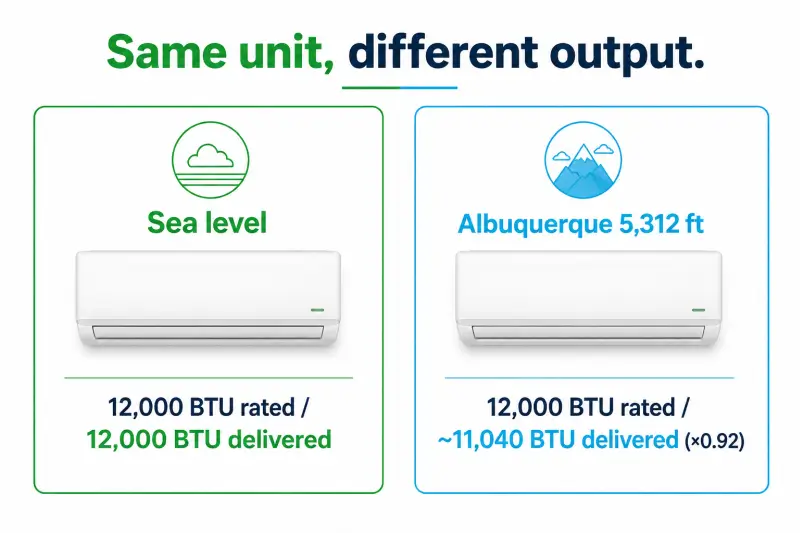
A single-zone mini split in Albuquerque runs about $2,000 to $6,000 installed, and a whole-home system runs $6,500 to $14,500. Size is where people get caught out. At 5,312 feet, thin air costs a mini split roughly 8% of its rated capacity, so the head that works at sea level is often one step too small here.
Divide your Manual J cooling load by 0.92 to get the size you actually need. Our single-zone systems come in three sizes:

Not sure which size your room lands on? Answer 3 quick questions and we will match you.
Already know your size?
Professional installation is required, and the warranty is void if you install it yourself. Our line is single-zone only.
A mini split in Albuquerque costs about $2,000–$6,000 for a single zone and $6,500–$14,500 for a whole home, installed in 2026. Albuquerque sits at 5,312 feet, and thin air costs a mini split roughly 8% of its rated cooling capacity, so the head size that works at sea level is often one step too small here. The federal tax credit ended in 2025, but PNM still pays $550 and New Mexico up to $10,000. Disclosure: Filterbuy manufactures air filters and sells single-zone mini split systems, so we have a stake in this. Every number below is sourced so you can check it.
Mini split installation in Albuquerque runs $2,000–$6,000 per zone and $6,500–$14,500 for a whole home in 2026, and about $20 a month to run a single bedroom zone at peak. At 5,312 feet, equipment loses roughly 8% of rated capacity to thin air, so an 8,800 Btu/h load needs a 12,000 BTU head here where a 9,000 would cover it at sea level. And because a mini split's mesh screen is a coil guard, not a health filter, Albuquerque's dust and juniper pollen still need whole-home filtration.
Installed cost (2026): $2,000–$6,000 per zone; $6,500–$14,500 whole home. Swamp cooler conversions add $2,000–$4,000.
Running cost: an estimated $20/month at peak for a single 12,000 BTU zone, or about $60 across a May–September season. A variable-speed inverter adjusts output to demand rather than cycling on and off, which uses less energy while holding temperature.
Altitude derate is real. ACCA's factor is 0.92 at 5,000 feet for a dry coil, which is Albuquerque's exact condition. Divide your Manual J load by 0.92.
PNM pays $550 for a split air-source heat pump, but only after a free Home Energy Checkup. Schedule that before you buy. Federal Section 25C expired December 31, 2025; New Mexico's programs still stack to as much as $10,000.
Rinse the pre-filter every 2 weeks in dust season and hose the outdoor coil each spring. Both recover capacity altitude took. Filterbuy makes the filters that catch what the mini split's own screen can't.
Most mini split guides come from people who sell installs, or from people who sell nothing at all. Filterbuy sits in a third position: we manufacture air filters in the United States, and we also sell ductless mini split systems. So we see both halves of a problem the industry splits down the middle. The contractor sizes your system. Someone else sells you the filter. Nobody connects the two. At 5,312 feet they are the same conversation.
"Altitude is the part nobody warns you about. A mini split at 5,312 feet is already giving up around 8% of what the label promises. Then the pre-filter loads up with juniper dust and you give away more. We build both sides of that equation, so we notice when a homeowner is paying for capacity they never actually receive."
Michelle Wan, Brand Manager & Air Quality Writer, Filterbuy
Mini split installation in Albuquerque costs $2,000–$6,000 for a single zone and $6,500–$14,500 for a whole home in 2026, installed. Zone count is the biggest lever. Local labor runs below Phoenix and Las Vegas, but the swamp cooler conversion market adds a cost category most cities lack.
What that looks like by project size. A single zone in the 9,000 to 12,000 BTU range, enough for a bedroom, office, casita, or garage, runs $2,000 to $4,500 installed. Step up to an 18,000 or 24,000 BTU head for an open living and kitchen area and expect $2,300 to $6,000. Two zones covering two problem rooms land between $4,500 and $8,500. Three zones, usually a living room plus two bedrooms, run $6,500 to $11,000. A four- or five-zone system covering most of a 2,000 to 3,000 sq ft house runs $8,000 to $14,500. Add $2,000 to $4,000 on top of any of these if a swamp cooler conversion means removing or modifying ductwork.
These are 2026 ranges, and local quotes land within 15 to 30 percent either side depending on wall construction and electrical scope. See our installation cost guide for a national breakdown.
Three things move an Albuquerque quote more than square footage. Wall type: adobe, double-wythe brick, and thick stucco take longer than frame construction. Electrical headroom: a 230V head needs a dedicated circuit, while Filterbuy's 12,000 BTU 115V mini split runs on a standard outlet. Condenser placement: the shaded north or east side is right here, but it means a longer line set.
Neighbor tip: Ask for three itemized quotes, not three totals.
Albuquerque sits at 5,312 feet, where thinner air carries less heat and every air conditioner underperforms its nameplate. ACCA Manual S and Technical Bulletin 2008-01 put it concretely: 1,200 CFM carries 36,000 Btuh at sea level, but roughly 1,430 CFM is needed at 5,000 feet.
ACCA's altitude adjustment factor is 0.92 at 5,000 feet for a dry coil, and Albuquerque qualifies. That factor applies above a 0.95 sensible heat ratio, and the local design SHR sits near 0.97. A 12,000 BTU head therefore delivers closer to 11,000 here. The fix is arithmetic: divide your Manual J cooling load by 0.92.
What your Manual J number becomes at 5,312 feet. A load of 8,000 Btu/h needs about 8,700 after the derate, so a 9,000 BTU head still covers it. A load of 11,000 Btu/h needs roughly 11,960, which pushes you to a 12,000 BTU head. A 16,000 Btu/h load becomes about 17,400 and takes an 18,000. And a 22,000 Btu/h load becomes roughly 23,900, calling for a 24,000.
Method: Manual J load divided by 0.92, the ACCA altitude adjustment factor at roughly 5,000 feet for a dry coil. ACCA is explicit that manufacturer data outranks any generic table, so ask your installer for the OEM altitude chart.
Where Filterbuy pushes back on standard advice. The usual guidance is "don't oversize." True enough, but the derate is not oversizing. Correcting for altitude gets you the capacity you were supposed to have. Skip it and the room stays warm in August, which usually gets blamed on a bad install rather than on the math.
The design day is unusually dry. Albuquerque's 1% summer cooling condition is 96°F dry-bulb with a mean coincident wet-bulb of just 60°F. Almost all the work is sensible cooling, not moisture removal. That is why an oversized system feels worse here, not better. It short-cycles, then can't dehumidify in monsoon season.
Winter still matters. Albuquerque is IECC Climate Zone 4B: hot-dry summers, cold nights. Confirm rated heating output at your design temperature, not just HSPF2. In the East Mountains, ask about a cold-climate model. Filterbuy's mini split sizing guide goes deeper.
Replace or supplement your swamp cooler with a mini split if you want winter heat, cooling through monsoon humidity, or zero water use. Albuquerque is one of the last major U.S. metros where evaporative cooling is still widespread, and this is the city's most common HVAC project.
A swamp cooler is cheaper to run in dry heat, using about a quarter of the energy of central AC per the DOE. But "a mini split costs more to run" is where most guides stop, and the actual number is what you need.
What a mini split costs to run here. A 12,000 BTU zone draws roughly 140 kWh in July, about $20, and around 425 kWh across a May to September season, about $60. An 18,000 BTU zone runs closer to 210 kWh in July, about $30, and 635 kWh for the season, about $89. A 24,000 BTU zone lands near 280 kWh in July, about $40, and 845 kWh seasonally, about $118.
Estimates, not measured results. The method, so you can redo it with your own numbers: BTU/h times run-hours, divided by SEER2, divided by 1,000, gives you kWh. This assumes a 17 SEER2 inverter, roughly 200 equivalent full-load hours in July and 600 across the season, at $0.14 per kWh. PNM residential rates run roughly $0.11 to $0.16 by plan, and your runtime depends on insulation, shading, and setpoint.
One bedroom zone is a $20 month at peak, not a budget event; the cost argument only gets serious at whole-home multi-zone. Filterbuy sells mini splits, so check that number rather than take it. Meanwhile DOE Building America puts annual evaporative water use for a 1,500 sq ft Albuquerque home at roughly 7,261 gallons, 50% higher with a bleed-off valve. A mini split uses none. Staying evaporative? PNM pays up to $400 on qualifying advanced coolers.
An Albuquerque homeowner can stack three programs in 2026, but not the one most pages still advertise. The federal Section 25C credit expired December 31, 2025 under the One Big Beautiful Bill Act (P.L. 119-21). The IRS confirms it, so any page promising a $2,000 federal check on a 2026 install is out of date. Three programs still pay here, though amounts and eligibility move. Confirm current terms with each program, and your tax professional, before you budget around them:
PNM: $550 for a split air-source heat pump. Order matters. Complete the free PNM Home Energy Checkup first, then buy within six months using an authorized contractor. PNM also pays $50 each for a smart thermostat and an ENERGY STAR air purifier.
NM HEAR rebate, up to $8,000. For households under 80% of Bernalillo County AMI. ECAM lists unducted mini splits as eligible. Get approved before you buy.
NM Sustainable Building Tax Credit, $1,000–$2,000. Covers equipment and labor, via EMNRD. The $2,000 tier is for lower-income filers.
Stacked, an income-qualified household can pull $8,000 from HEAR, $2,000 from the state credit, and $550 from PNM. For the full sequence and a worked example, see our New Mexico mini split rebate guide.
Every mini split installation in Albuquerque needs a mechanical permit and a final inspection, pulled by your licensed contractor. Under NMAC 14.5.5.13, that's a $37.50 administrative inspection fee plus $6.00 per refrigeration system; confirm current amounts with the NM Construction Industries Division.
Finding an installer: PNM publishes an authorized contractor list for its rebate program. Starting there narrows the field to installers already cleared for the $550, which is the constraint most homeowners discover too late.
Ask every bidder:
Will you run a Manual J load calculation and apply an altitude correction for 5,312 feet? If they can't answer the second half, keep looking.
Are you certified for A2L refrigerants (R-32 or R-454B), and PNM- and HEAR-approved? The first is safety and warranty; the others decide whether you get the rebates.
Does the quote itemize equipment and labor, and can I see the AHRI certificate? Both are needed to claim the money.
Most mini split "repairs" in the high desert are not repairs. They are airflow problems that got expensive. Airflow is Filterbuy's home turf, because filter design is really airflow design. Here's the failure chain behind most "it stopped keeping up" calls:
Fine dust loads the outdoor condenser coil. Spring wind season drives it deep into the fins.
A dirty coil can't reject heat, so head pressure climbs and capacity drops.
That loss stacks on the 8% already lost to altitude.
The compressor and capacitor run hot through a 96°F afternoon. That is how a 15-minute task becomes a service call.
Your Albuquerque maintenance year:
Rinse the outdoor coil in April or May. Kill power, then hose the fins gently from the inside out. After wind season, before real heat.
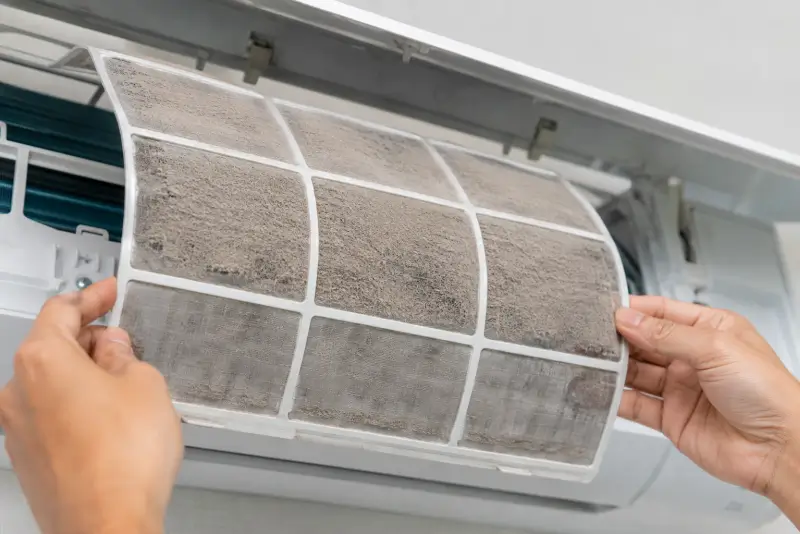
Rinse the indoor pre-filter every 2 weeks from May to September. The cheapest capacity you will ever recover.
Check the condensate drain through monsoon season. Debris and algae block it, and a backed-up drain shows up as water on your wall.
Clear the coil again in October, after chamisa and tumbleweed season.
Book service in April or May, not July, when Albuquerque contractors are triaging no-cool emergencies. Call a pro for ice on the line set, short-cycling, or oily residue near a fitting. Those are refrigerant or electrical faults, and R-32 requires certified handling.
This is the part Filterbuy knows best, because we make the filters that go inside these systems.
A mini split's built-in mesh screen is a pre-filter, not a health filter. It does not capture juniper pollen, fine desert dust, or wildfire smoke the way a pleated filter does, and it serves only the room it's in. Manufacturers rarely say this plainly, because the screen is marketed as a feature. It is a coil guard.
The Albuquerque air calendar. January through March belongs to juniper, which starts pollinating around mid-February, with elm close behind. Rinse pre-filters every two weeks and run MERV 11 or higher in central HVAC. March through May brings peak wind and blowing dust, plus cottonwood along the Rio Grande in April, so hold the two-week rinse and check central filters monthly. June through September is monsoon humidity and wildfire smoke, when MERV 13 handles fine particulate and windows are better closed. October through December brings chenopods and sage along with drier indoor air, so return to a monthly rinse and refresh central filters before heating season.
If your home runs central HVAC, a furnace, or converted swamp cooler ducts, that filter is your whole-home defense. Shop Filterbuy air filters by size, made in the USA in over 600 sizes, and set up auto-delivery.
Shopping the system itself? Filterbuy's mini splits are single-zone 17 SEER2 variable-speed R-32 heat pumps in 12,000 BTU (up to 550 sq ft), 18,000 BTU (up to 850 sq ft), and 24,000 BTU (up to 1,200 sq ft), with a 7-year compressor and 3-year parts warranty and free 2-day delivery on in-stock systems.
Two things to be straight about before you buy ours. Professional installation is required, and the warranty is void if you install it yourself. And our line is single-zone only. If you're doing a whole-home multi-zone project, that's another brand's job. For heating, our units are rated down to 5°F, which covers Albuquerque proper. In the East Mountains, look at a cold-climate model instead. Comparing options? See our ranking of the most reliable mini split brands.
1. Ducts leak 20–30% of the air moving through them.
ENERGY STAR (U.S. EPA / U.S. DOE). Thin air already forces ~19% more airflow at 5,312 feet, and duct loss stacks on top. Ductless has no duct to leak through.
2. The EPA recommends MERV 13 or higher during smoky periods.
U.S. EPA. The EPA notes most residential systems can accommodate MERV 13, though not all can. Check your equipment's documentation or ask an HVAC technician before upgrading, since a filter your blower can't pull through restricts airflow. The condition most guides drop: replace it more often than the manufacturer says.
3. Albuquerque legislates landscaping to control pollen.
City of Albuquerque Environmental Health Dept.. A municipal Pollen Control Ordinance restricts which trees residents may plant, and the city counts pollen every weekday. Use that free count to time filter checks.
Often yes. At 5,312 feet, equipment loses roughly 8% of rated capacity. An 8,800 Btu/h load needs 9,565 Btu/h here, which means a 12,000 BTU head, not a 9,000.
No. Section 25C was terminated for systems placed in service after December 31, 2025. Systems running by the end of 2025 can still be claimed on IRS Form 5695. Confirm your eligibility with a tax professional.
Schedule a free PNM Home Energy Checkup before you purchase, then install within six months using an authorized contractor. Buying first disqualifies you.
About $20 a month at peak for a single 12,000 BTU bedroom zone, or ~$60 across a May–September season at $0.14/kWh. Filterbuy's mini splits are 17 SEER2, the efficiency those estimates assume.
Michelle Wan is Brand Manager and Air Quality Writer at Filterbuy. She works directly with the company's U.S. manufacturing teams and writes from how filters are built and used rather than from spec sheets. Filterbuy manufactures air filters in the United States and also sells ductless mini split systems.
Reviewed for technical accuracy by David Clark, Licensed HVAC Technician.
ACCA altitude adjustment factors (ACHR News) · DOE Building America · DOE Energy Saver · IRS · PNM Home Energy Checkup · PNM Cooling Rebates · NM ECAM · NM EMNRD · NMAC 14.5.5 · UNM Health Sciences Center · ENERGY STAR
Mini split (ductless heat pump): An outdoor condenser paired with indoor wall-mounted heads by a slim refrigerant line. No ductwork required.
Altitude derate: Lost capacity from thinner air at elevation. At Albuquerque's 5,312 feet, ACCA's factor is 0.92 for a dry coil.
Mesh pre-filter: The washable screen inside a mini split's indoor head. A coil guard, not a MERV-rated pleated filter.
MERV: Minimum Efficiency Reporting Value, a 1–16 particle-capture scale. MERV 11 handles pollen and dust; MERV 13 adds smoke and fine PM2.5.
SEER2: Seasonal cooling efficiency. Higher means fewer kWh for the same cooling.