Installation, Costs & Rebates (NM Guide)
By Michelle Wan · Reviewed by David Clark, Licensed HVAC Technician
Published July 16, 2026 · Updated July 16, 2026
A mini split in New Mexico costs about $2,000–$6,000 for a single zone, or $6,500–$14,500 for a whole home, installed. The federal tax credit ended December 31, 2025. Three New Mexico programs still stack on top:
Not sure which size fits your home? Take the quick match quiz below, or browse Filterbuy mini split systems.

Answer 3 quick questions and we’ll match you to the right mini split for your space.
Prefer to browse first? Shop mini split systems
Adding a mini split in New Mexico runs about $2,000–$6,000 for a single zone and $6,500–$14,500 for a whole-home multi-zone system in 2026, installed. The federal $2,000 heat-pump tax credit (Section 25C) ended December 31, 2025, so 2026 installs no longer qualify, but New Mexico still stacks real money on top: up to $8,000 from the state HEAR rebate for income-qualified homes, a $1,000–$2,000 state tax credit for everyone, and utility rebates from PNM or El Paso Electric. A mini split heats and cools, which fits the high desert well. Just spec it for the rebate and keep the filters clean, the two things Filterbuy helps New Mexico homeowners get right.
Installed cost (2026): single-zone mini splits average $2,000–$6,000; multi-zone whole-home systems run $6,500–$14,500, driven by zone count, BTU size, efficiency, and any electrical work.
The federal credit is gone for 2026: the $2,000 Section 25C heat-pump credit expired Dec 31, 2025 under the One Big Beautiful Bill Act. Systems placed in service in 2025 can still be claimed on IRS Form 5695 with a 2025 return.
New Mexico’s HEAR rebate pays up to $8,000 for an ENERGY STAR mini split, but only for income-qualified households (under 80% of Area Median Income). Apply before you buy and use an approved contractor.
Every income level gets a state tax credit: New Mexico’s Sustainable Building Tax Credit gives $1,000 (or $2,000 for lower-income filers) toward a qualifying air-source heat pump, covering equipment and labor.
Utility rebates stack on top: PNM and El Paso Electric offer their own heat-pump and cooling rebates. Check current amounts before you install.
Spec the system for the rebate, not the code minimum: most programs want ENERGY STAR certification, a low-GWP refrigerant like R-32, and a variable-speed inverter, the same specs Filterbuy’s mini splits are built to.
Adding a ductless mini split in New Mexico means installing a heat pump system that both cools in summer and heats in winter, with no ductwork required. In 2026 a single-zone install typically costs $2,000–$6,000 and a whole-home multi-zone system $6,500–$14,500. The federal tax credit ended after 2025, but New Mexico’s HEAR rebate (up to $8,000, income-qualified), the state Sustainable Building Tax Credit ($1,000–$2,000 for everyone), and PNM or El Paso Electric utility rebates can still take a real bite out of the price.
Here’s our angle, and why this guide reads differently from most. Filterbuy has built air filters in the U.S. for over a decade and shipped them to more than two million households, and we now make ductless mini splits too. That gives us a manufacturer’s-eye view most buying guides don’t have: we see what the spec sheet leaves out, and we hear from customers across dry, dusty climates about what happens after the install.
So here’s the honest version, without the sales pitch. A mini split is a great fit for the high desert: dry heat, big temperature swings, and a lot of older homes that never had ductwork. But the rebate rules changed this year, and plenty of pages still quote a federal credit that no longer exists. Below is what it costs, which New Mexico programs still pay out in 2026, how to stack them, and how to pick a system that qualifies, plus the part most guides skip: keeping the air clean once it’s installed.
“We make the filters that go inside these systems, so we see what the spec sheet doesn’t. In New Mexico’s high desert, the dust is relentless. A mini split will keep you comfortable, but it only cleans the room it’s in. Pair it with a fresh whole-home filter, and the whole house breathes cleaner while the mini split keeps you cool.”
Michelle Wan, Brand Manager & Air Quality Writer, Filterbuy
A mini split in New Mexico costs $2,000–$6,000 for a single zone and $6,500–$14,500 for a multi-zone whole-home system in 2026, fully installed. The single biggest price lever is the number of zones (indoor heads). BTU size, efficiency tier, refrigerant handling, and any electrical panel work move the rest.
| System size | Best for | Typical installed cost (2026) |
|---|---|---|
| Single zone (9k–12k BTU) | One bedroom, office, or casita | $2,000 – $4,500 |
| Single zone (18k–24k BTU) | Open living/kitchen area | $2,300 – $6,000 |
| 2-zone | Two rooms or a small home | $4,500 – $8,500 |
| 3-zone | Living room + two bedrooms | $6,500 – $11,000 |
| 4–5 zone (whole home) | Most of a 2,000–3,000 sq ft house | $8,000 – $14,500 |
Zones. Each indoor head adds an air handler, refrigerant lines, and labor, usually $1,800–$3,500 more per zone. Planning two zones up front is cheaper than adding one later.
BTU and efficiency. Bigger and higher-SEER2 systems cost more up front but run cheaper, and they’re the ones that qualify for rebates.
Electrical. Many New Mexico homes need a dedicated circuit; some need a panel upgrade. If you already have 100–200 amps of headroom, you may avoid the biggest surprise line item.
Labor and access. Long line-set runs, second-story mounts, and adobe or stucco wall penetrations add hours. Labor is roughly 30–50% of the total.
Refrigerant. 2026 systems use low-GWP A2L refrigerants (R-32 or R-454B), which require updated installer handling, another reason to use a licensed pro.
Neighbor tip: Get three itemized quotes and ask each contractor for a Manual J load calculation. A quote that “right-sizes” by eyeballing your square footage usually oversizes the system. You pay more, and it short-cycles in our dry climate. For a deeper cost breakdown, see Filterbuy’s
mini split installation cost guide and full mini split cost breakdown.
In 2026, a New Mexico homeowner can combine up to three kinds of help on one mini split: the state HEAR rebate (up to $8,000, income-qualified), the state Sustainable Building Tax Credit ($1,000–$2,000, all incomes), and a utility rebate from PNM or El Paso Electric. The federal $2,000 heat-pump tax credit is no longer available for systems installed this year. Filterbuy tracks these programs closely, because spec’ing a system to qualify is half the battle. Here’s where things stand.
| Program | What it pays | Who qualifies |
|---|---|---|
| Federal Section 25C (expired) | $0 for 2026 installs | Ended Dec 31, 2025 (2025 installs only) |
| NM HEAR rebate | Up to $8,000 for an ENERGY STAR heat pump | Income-qualified (under 80% AMI) |
| NM Sustainable Building Tax Credit | $1,000 standard / $2,000 lower-income | All New Mexico homeowners |
| PNM rebate (central/north NM) | Typically a few hundred dollars per system* | PNM electric customers |
| El Paso Electric rebate (southern NM) | Heat pump & thermostat rebates* | EPE electric customers |
The federal Section 25C Energy Efficient Home Improvement Credit, the one that paid 30% of a heat pump’s cost up to $2,000, expired on December 31, 2025. The One Big Beautiful Bill Act (signed July 2025) moved the cutoff up by seven years. The IRS confirms the credit is only allowed for qualifying property placed in service before that date, so a mini split installed in 2026 does not qualify. If your system was installed and running by the end of 2025, you can still claim it: file IRS Form 5695 with your 2025 return and keep your AHRI certificate and manufacturer records. If a website is still promising you a $2,000 federal check on a 2026 install, it’s out of date.
New Mexico’s Home Electrification and Appliance Rebates (HEAR) program is the biggest single incentive: up to $8,000 toward an ENERGY STAR-certified heat pump, including ductless mini splits, with a $14,000 total household cap across all upgrades. It’s funded through the federal Inflation Reduction Act and administered by the state’s Energy Conservation and Management (ECAM) division. The rebate arrives as a point-of-sale coupon that can cover both equipment and installation labor, up to your rebate amount.
Income limit: your household must earn under 80% of your county’s Area Median Income (AMI), or take part in a program like Medicaid, SNAP, LIHEAP, or WIC. New Mexico’s example AMI is about $78,000; for a family of four, the 80% line sits near $63,100 (it varies by county). For 2026, these heat-pump rebates go to income-qualified households, not middle- or higher-income homes.
Apply first: you apply and get approved before you purchase. This isn’t a file-it-at-tax-time credit.
Use an approved contractor: heat-pump installs must be done by a contractor registered and trained through the program. The state’s authorized-contractor list is expected in fall 2026, so confirm your installer is program-approved before work begins.
Related rebates: up to $4,000 for an electrical panel upgrade and $2,500 for wiring if your home needs it to support the new system. These come out of the same $14,000 cap.
Act early: the program runs through roughly summer 2028, but the money is finite and spends down over time.
Where to apply: Start at New Mexico’s clean energy portal (clean.energy.nm.gov) or call the program at 888-290-9337 to confirm you qualify and get on the list before you buy.
If your household doesn’t qualify for HEAR, this is your main state incentive, and it’s open to everyone. New Mexico’s Sustainable Building Tax Credit: Energy Conserving Products (ECP) gives a state income-tax credit of up to $1,000 for a qualifying ENERGY STAR air-source heat pump, or up to $2,000 for lower-income filers. It covers both the equipment and the installation labor.
How to get it: apply to the Energy, Minerals and Natural Resources Department (EMNRD) for a Certificate of Eligibility after installation, then submit that certificate with your New Mexico tax return.
Refundable for lower incomes: if you earn under 200% of the federal poverty level it’s refundable (you get it even if you owe no state tax). Otherwise it’s non-refundable but carries forward up to 7 years.
Keep your paperwork: you’ll need an itemized invoice showing equipment and labor costs, plus the ENERGY STAR spec sheet with the full model number.
Going geothermal instead? New Mexico has a separate ground-source (geothermal) heat-pump tax credit worth 30% up to $9,000. It’s only for ground-coupled systems, not ductless mini splits, and you can’t combine it with the Sustainable Building Tax Credit on the same project. Weighing your options? See air-source vs. ground-source vs. mini split heat pumps.
Your electric utility likely adds its own rebate on top of the state programs. In central and northern New Mexico, PNM (Public Service Company of New Mexico) offers residential rebates on efficient heating and cooling equipment; ductless heat-pump rebates generally run in the low hundreds of dollars per unit, and higher-efficiency air-source heat pumps can qualify for more. In southern New Mexico, El Paso Electric offers rebates on heat pumps, duct sealing, and smart thermostats.
Confirm the current amount first. Utility rebates change and are first-come, first-served on an annual budget. For rebates over a few hundred dollars, you often need pre-approval before installation.
Have your model number and AHRI certificate ready. Your contractor should provide these; the utility uses them to confirm your unit qualifies. You can verify a matched system in the AHRI Directory.
Gas heat? New Mexico Gas Company rebates apply to high-efficiency gas furnaces and boilers, not electric mini splits, so they usually don’t apply to this project.
Not sure who serves your area or what’s on offer? Search the free ENERGY STAR Rebate Finder by ZIP code to see current mini-split rebates near you.
You can generally combine the state HEAR rebate, the state tax credit, and a utility rebate on the same mini split. You just can’t claim two programs for the exact same measure where a program forbids it. Here’s what a realistic 18,000 BTU single-zone install (about $4,500 before incentives) might look like for two different Albuquerque households. Treat these as illustrations, not quotes.
| Cost / incentive | Income-qualified home | Middle-income home |
|---|---|---|
| Installed price (18k single zone) | $4,500 | $4,500 |
| NM HEAR rebate | Up to $8,000 (covers install) | Not eligible |
| PNM utility rebate | ≈ $300 | ≈ $300 |
| NM state tax credit (at tax time) | $2,000 (refundable) | $1,000 (carries forward) |
| Estimated net after incentives | ≈ $0 upfront* | ≈ $4,200 upfront, then ≈ $3,200 after the $1,000 credit |
How to Claim Your New Mexico Incentives, in the Right Order
The order matters more than the paperwork. The most expensive mistake in New Mexico is buying your mini split before you’re approved for HEAR. Do that and you can forfeit up to $8,000. Here’s the sequence we walk New Mexico homeowners through, so every dollar stays on the table.
Check your income first. If your household is under 80% of your county’s AMI (or on Medicaid, SNAP, LIHEAP, or WIC), HEAR is likely your biggest lever, so start there. If not, your path is the state tax credit plus a utility rebate.
If HEAR applies, get approved before you buy. Apply through the state portal and wait for approval. HEAR is a point-of-sale coupon, not a refund. Purchasing early usually disqualifies the item.
Line up an eligible contractor. HEAR heat-pump installs must use a program-approved contractor. Confirm this in writing before work starts.
Confirm utility pre-approval. PNM and El Paso Electric often require pre-approval for larger rebates. Check before installation, not after.
Get a right-sized, rebate-qualifying quote. Insist on a Manual J calculation and a specific ENERGY STAR model that clears your rebate’s efficiency tier. Ask for the AHRI certificate up front.
Install, inspect, and keep every document. You’ll need the itemized invoice (equipment and labor listed separately), the AHRI certificate, and the model spec sheet for the next steps.
Submit the utility rebate. File with your model number and AHRI certificate after the install passes inspection.
Claim the state tax credit last. Apply to EMNRD for your Certificate of Eligibility, then file it with your New Mexico return. This one lands at tax time, after everything else is done.
Buying before HEAR approval. The single most common way people lose the biggest rebate.
Missing the efficiency tier by a hair. A unit that’s ENERGY STAR but a notch below the required SEER2/HSPF2 can be denied. Confirm the tier itself, not the logo.
Using the wrong contractor. A non-approved installer can void HEAR eligibility even if the equipment qualifies.
Tossing the paperwork. No AHRI certificate or itemized invoice usually means no state tax credit.
Assuming the federal credit still exists. It ended December 31, 2025. Budgeting for a $2,000 federal check on a 2026 install will leave a hole in your math.
Waiting until late in the year. Rebate funds are finite and first-come, first-served. The pot is fullest early.
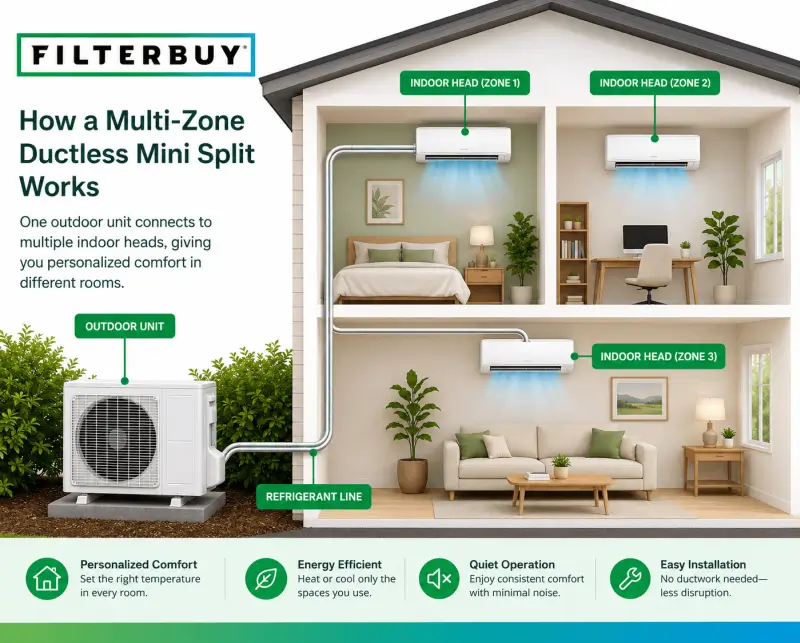
Mini splits are a strong match for New Mexico because they heat and cool from one system, run efficiently in dry air, and don’t need ductwork, which matters in the many older adobe, pueblo-style, and add-on homes that never had ducts. As the U.S. Department of Energy notes, a single outdoor unit can feed several indoor heads, so you condition the rooms you use most instead of the whole house.
Two seasons, one system. A heat-pump mini split cools through our hot, dry summers and heats through cold high-desert nights, often replacing both a swamp cooler and an aging furnace.
Zoning saves money. Set the bedroom cool at night and leave the guest room off. In a climate with big day-to-night swings, that control adds up.
Cold-climate models exist. If you’re at higher elevation (think Santa Fe, Taos, or the mountains), ask about cold-climate/hyper-heat models rated to hold output well below freezing, or a backup heat strip.
Dry-climate note. Unlike a swamp cooler, a mini split doesn’t add humidity, a plus for comfort and for your home, though you may want a small humidifier in the driest months.
What we see in dry climates. Serving customers across arid regions, we’ve learned that high-desert dust loads filters faster than most owners expect. Plan to check the mini-split’s washable pre-filter every couple of weeks in dusty months, not once a season.
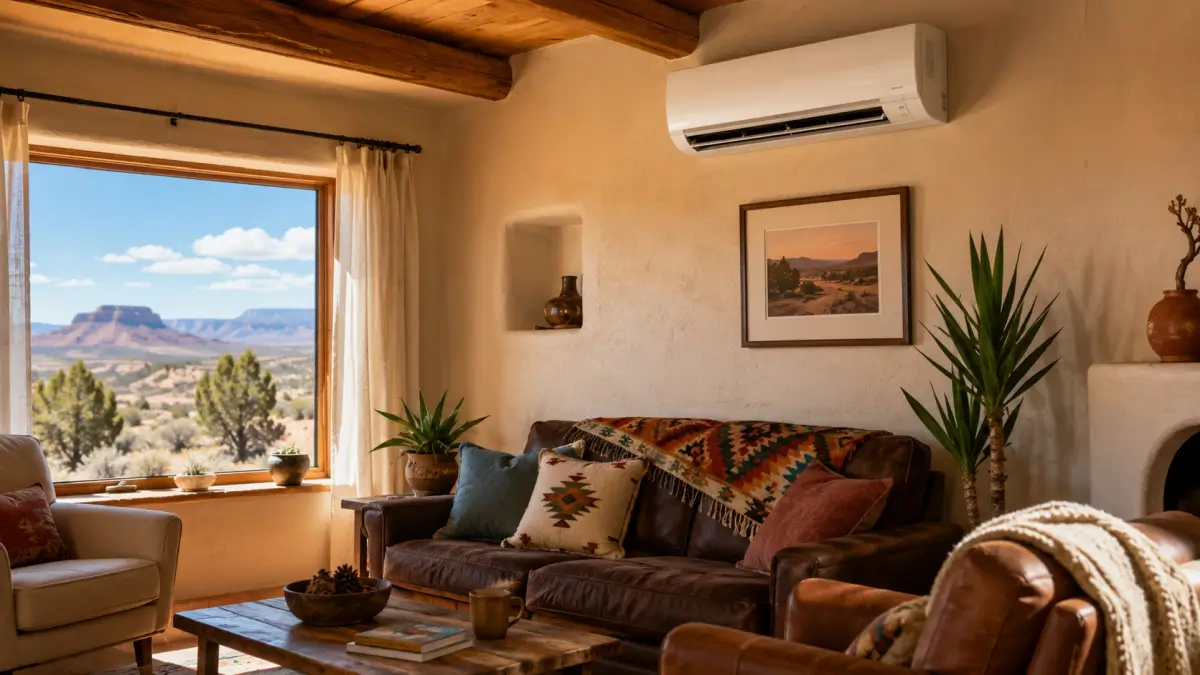
Replace a swamp cooler with a mini split if you want winter heat, reliable cooling through monsoon humidity, or lower water use. Keep the swamp cooler if your summers stay bone-dry and you only need cooling. Most New Mexico homes cool with an evaporative “swamp” cooler, and a mini split is the most common upgrade. A swamp cooler is cheap to run in dry heat and uses about a quarter of the energy of central air conditioning. A mini split costs more to run for cooling, but it uses no water, works through monsoon humidity and wildfire-smoke season, and heats your home in winter. The trade-off is a higher upfront cost, which is where the rebates above come in.
| Factor | Swamp cooler (evaporative) | Ductless mini split |
|---|---|---|
| Upfront cost | Lower | Higher, but rebate-eligible |
| Cooling energy | Very low (~¼ of central AC) | Low for a heat pump; more than a swamp cooler |
| Heats, too? | No | Yes, both seasons |
| Monsoon / humid days | Struggles as humidity climbs | Works in any humidity |
| Water use | High (hundreds to thousands of gallons a season) | None |
| Windows | Must stay open (lets in dust, pollen, smoke) | Stay closed; filters the room |
| Upkeep & lifespan | Twice-a-year setup/winterize; ~10–15 yrs | Rinse the pre-filter; ~15–20 yrs |
The water math, in New Mexico terms. A swamp cooler’s running cost adds up beyond electricity. It also uses water. For a 1,500 sq ft home, U.S. Department of Energy figures put a season of evaporative cooling at roughly 2,980 gallons in Santa Fe, 7,261 gallons in Albuquerque, and 12,457 gallons in Las Cruces. In a drought-prone state with watering restrictions, that’s worth weighing. A mini split uses none. (DOE Building America)
Keep the swamp cooler if your summers stay dry, water isn’t a worry, and you only need cooling. It’s hard to beat on running cost in pure dry heat.
Lean mini split if you want heating too, you run through the summer monsoon (roughly July through September, when humidity spikes and swamp coolers fade), you want windows-closed comfort on wildfire-smoke days, or you’re on a well or water restrictions.
The common New Mexico move: run both. Many homes cool with the swamp cooler through the dry early summer, then switch to the mini split for the humid monsoon weeks and winter heat. Adding a mini split doesn’t mean ripping out what works. It covers the days a swamp cooler can’t, including smoke days when you want windows closed and a fresh Filterbuy filter doing the work in your central system.
One practical note from the field. Reusing an old cooler’s electrical circuit can sometimes trim install cost, but have your contractor confirm the circuit and breaker match the mini split’s requirements before you count on the savings.
New Mexico isn’t one climate. Elevation drives how cold your winters get, and that decides whether you need a standard or a cold-climate (hyper-heat) model. Use this as a starting point, then confirm the model’s rated heating output at your area’s coldest design temperature.
| Area (approx. elevation) | Winter profile | What to choose |
|---|---|---|
| Las Cruces / Roswell (~3,500–4,000 ft) | Mild winters | Standard heat-pump mini split is usually plenty |
| Albuquerque / Rio Rancho (~5,000–5,300 ft) | Cool, occasional freezes | Standard model; confirm rated low-temp output |
| Farmington / Gallup (~5,300–6,500 ft) | Real cold snaps | Cold-climate model or a backup heat source |
| Santa Fe / Taos (~7,000–7,200 ft) | Cold winters, snow | Cold-climate/hyper-heat model, sized for heating |
The right size comes from a Manual J load calculation, not a rule of thumb. As a rough starting point, a single 9k–12k BTU head suits one bedroom or office, an 18k–24k head suits an open living area, and a 2,000–2,500 sq ft home usually needs a 3–4 zone system. New Mexico’s dry air, sun exposure, insulation, and ceiling height all change the math, so have a contractor run the numbers before you buy.
One room or a casita: single zone, 9k–18k BTU.
A couple of problem rooms (that hot west-facing bedroom): 2 zones.
Most of the house: 3–5 zones on one or two outdoor units.
Oversizing is the common mistake. An oversized mini split short-cycles, which wastes energy and wears the compressor, and in our dry climate you rarely need the extra capacity. Right-sizing also keeps you inside the efficiency specs the rebates require.
A professional single-zone mini split install usually takes 4–8 hours; multi-zone systems take a day or more. Your installer mounts the indoor head, sets the outdoor condenser on a pad or bracket, runs the refrigerant line set and condensate drain, makes the electrical connection, pulls a vacuum on the lines, charges the system, and tests it. Permits and a final inspection are typically required.
Load calculation & quote. Manual J sizing and an itemized bid listing model numbers, capacities, and scope.
Rebate paperwork first. If you’re going for HEAR, get approved before purchase. Confirm utility pre-approval if needed.
Electrical prep. Dedicated circuit, disconnect, and any panel work.
Mount & connect. Indoor heads, outdoor unit, line set, drain, and wiring.
Vacuum, charge & commission. The step that separates a quiet, long-lasting system from a leaky one. Don’t skip it.
Inspection & rebate submission. Pass inspection, then submit your utility rebate and apply for the state tax-credit certificate.
Can you DIY? You’ll find pre-charged DIY mini splits online, and a handy homeowner can install one. But the major New Mexico rebates (HEAR) and most utility rebates require a licensed, approved contractor, and the state tax credit needs an itemized invoice showing installation labor. If the incentives matter to you, a pro install usually pays for itself.
The right questions up front are what separate a smooth, rebate-qualifying install from an expensive surprise. Bring this list to every bid.
Will you run a Manual J load calculation? A real sizing, not a square-footage guess.
Which rebate and efficiency tier does this exact model qualify for, and can I see the AHRI certificate? This ties the equipment directly to the money.
Are you a HEAR-approved contractor? Essential if you’re income-qualified and going for the $8,000 rebate.
Will you handle the utility rebate paperwork and any pre-approval? Saves you the back-and-forth and protects the timing.
Is your team certified to handle A2L refrigerants (R-32 / R-454B)? It’s the 2026 standard and affects both safety and your warranty.
Does the quote itemize equipment and labor separately? Required to claim the New Mexico state tax credit.
Are permits and final inspection included? Usually required, and some rebates hinge on passing inspection.
What’s the warranty on parts, compressor, and labor? Compare the whole picture, not the sticker price alone.
To qualify for 2026 rebates, spec the system for the rebate, not the code minimum. Nearly every program requires ENERGY STAR certification, a low-GWP refrigerant (R-32 or R-454B), and a variable-speed inverter compressor. Match those three things first, then compare price and warranty. It’s a common mistake we watch homeowners make: buying to code, then finding the unit misses the rebate’s efficiency tier by a hair. We build ours to clear these programs, and we’d tell you to hold any brand to the same bar.
ENERGY STAR certified: the baseline for HEAR, the state tax credit, and most utility rebates.
Low-GWP refrigerant (R-32): the current standard; older R-410A systems are being phased out.
Variable-speed inverter: modulates like a dimmer instead of blasting on and off, which is what earns the higher efficiency tiers.
Right SEER2 / HSPF2 tier: ask your contractor which efficiency tier your chosen rebate requires, and get the AHRI certificate.
Filterbuy’s mini splits are built to exactly this spec: R-32 refrigerant, a 17-SEER2 variable-speed inverter, ENERGY STAR-aligned performance, and a 7-year compressor and 3-year parts warranty, available in 12,000 BTU (115V and 230V), 18,000 BTU, and 24,000 BTU heat-pump models. If you’re shopping a single zone or a problem room, they’re a straightforward, rebate-ready starting point. Comparing options first? See our guide to the most reliable mini split brands.
Compare current federal, state, and utility rules any time on Filterbuy’s 2026 mini split tax credit & rebate guide.
A ductless mini split only cleans the air in the room it serves. Its washable pre-filter needs a rinse every 2 to 4 weeks, and skipping that costs you efficiency, airflow, and comfort. That pre-filter is a comfort filter, not a health filter: it does not protect the whole home the way a central HVAC system with a quality filter does. This is the part we know best, because we make the filters that go inside these systems.
Rinse the mini-split filters monthly. Pop the front cover, take out the mesh pre-filters, rinse, dry, and reinstall. It’s a two-minute job that protects the compressor.
Still have central HVAC or a furnace? Keep the right-sized, quality filter fresh. That’s what captures dust, pollen, and wildfire smoke across the whole house. Filterbuy’s heat pump replacement air filters are built for exactly this year-round duty.
Dusty, high-desert air is hard on filters. New Mexico’s fine dust and spring pollen mean filters load up faster than the national average. Auto-delivery means you never run one too long.
If your home runs both a mini split and central HVAC, shop Filterbuy filters by size (over 600 sizes, made in the USA, shipped fast and free), and set up auto-delivery so a fresh filter shows up right when it’s due.
Three quick, sourced facts behind the advice above:
52% of a typical U.S. home’s energy use is heating and cooling. Source: EIA, RECS 2020
Up to 60% less energy: ductless mini splits vs. electric resistance heat. Source: ENERGY STAR (EPA/DOE)
2–5× more polluted: indoor air vs. outdoor air. Source: U.S. EPA
What this means for your New Mexico home:
Heating and cooling is your biggest energy cost. An efficient mini split targets it directly.
A rebate-ready heat pump trims that cost through New Mexico’s long seasons.
A mini split filters only one room. Keep its filter and your HVAC filter clean for whole-home air.
Yes. An ENERGY STAR ductless mini split can qualify for New Mexico’s HEAR rebate (up to $8,000 for income-qualified homes), the state Sustainable Building Tax Credit ($1,000–$2,000 for all incomes), and a utility rebate from PNM or El Paso Electric. The system must meet each program’s efficiency specs.
No. The federal Section 25C heat-pump credit (up to $2,000) expired December 31, 2025. Mini splits installed in 2026 don’t qualify. If yours was installed by the end of 2025, you can still claim it on IRS Form 5695 with your 2025 return.
About $2,000–$6,000 for a single zone and $6,500–$14,500 for a whole-home multi-zone system in 2026, installed. Zone count, BTU size, efficiency, and any electrical panel work drive the price.
Households earning under 80% of their county’s Area Median Income, or those enrolled in programs like SNAP, LIHEAP, or WIC. You must apply and be approved before you buy, and use a program-approved contractor.
Generally yes. HEAR, the state tax credit, and a utility rebate can combine on the same install. You can’t double-claim the exact same measure where a program prohibits it (for example, the geothermal credit can’t be combined with the Sustainable Building Tax Credit).
For most of the state, yes. A heat-pump mini split heats efficiently down to cold temperatures. At higher elevations, choose a cold-climate/hyper-heat model or add a backup heat source.
You can DIY-install some pre-charged units, but the major rebates (HEAR and most utility programs) require a licensed, approved contractor, and the state tax credit needs an itemized invoice showing labor. DIY usually forfeits the biggest savings.
It’s the most common New Mexico upgrade. A mini split uses no water, works through monsoon humidity, and also heats in winter, where a swamp cooler adds moisture, uses water, and only cools. The catch is a higher upfront cost, which the rebates above help offset. If your summers stay bone-dry and you don’t need heat, keeping the cooler (and adding a mini split in key rooms) is a reasonable middle path.
Buying your mini split before you’re approved for HEAR. Because HEAR is a point-of-sale rebate, purchasing early can forfeit up to $8,000. Get approved first, use an approved contractor, and keep your AHRI certificate and itemized invoice for the utility rebate and state tax credit.
Yes. A mini split only cleans the air in the room it serves, so if your home still runs central HVAC or a furnace, keep that filter fresh for whole-home air. The mini split’s own washable pre-filter also needs a rinse every few weeks. Filters are Filterbuy’s home turf. We make them in the U.S. in over 600 sizes, so matching the right one (and setting up auto-delivery) is simple.
Mini split (ductless heat pump): A heating and cooling system with an outdoor condenser connected to one or more indoor “heads” by a slim refrigerant line, with no ductwork required.
Heat pump: Equipment that moves heat rather than burning fuel, so it can both heat and cool. All mini splits in this guide are heat pumps.
Zone: One indoor head serving one room or area. Each zone has its own temperature control.
HEAR: Home Electrification and Appliance Rebates, New Mexico’s income-qualified rebate program (up to $8,000 for a heat pump), funded by the federal Inflation Reduction Act and run by the state’s ECAM division.
Sustainable Building Tax Credit (SBTC / ECP): A New Mexico state income-tax credit of $1,000–$2,000 toward a qualifying air-source heat pump, covering equipment and labor. Open to all income levels.
Section 25C: The federal Energy Efficient Home Improvement Credit for heat pumps (up to $2,000). Expired December 31, 2025; unavailable for 2026 installs.
AMI (Area Median Income): The midpoint household income for your county. HEAR eligibility is capped at 80% of AMI.
SEER2 / HSPF2: Efficiency ratings for cooling (SEER2) and heating (HSPF2). Higher numbers mean lower energy bills; rebates require minimum tiers.
BTU: British Thermal Unit, a measure of heating/cooling capacity. More BTUs cover more square footage.
R-32: A low-GWP (lower-emission) refrigerant that most 2026 rebate programs require. It’s an A2L refrigerant, mildly flammable, needing trained handling.
Manual J: The industry-standard calculation that sizes a system to your specific home, preventing costly oversizing.
AHRI certificate: Third-party proof that a specific equipment combination meets its rated efficiency, required for many rebates and credits.
ENERGY STAR: The EPA certification most New Mexico incentives use as their baseline efficiency requirement.
ECAM / EMNRD: The New Mexico state offices that run the rebate and tax-credit programs (Energy Conservation and Management; Energy, Minerals and Natural Resources Department).
Michelle Wan is Brand Manager and copywriter at Filterbuy, where she translates the technical side of indoor air quality (MERV ratings, filtration, HVAC efficiency, and pressure drop) into plain-English guidance for busy homeowners. She earned her B.A. in Sociology from the University of California, Santa Cruz, works directly with Filterbuy’s U.S.-based manufacturing team, and appears in the brand’s educational videos and social content.
This guide was reviewed for technical accuracy by David Clark, a Licensed HVAC Technician.
Cost, credit, and rebate figures in this guide are drawn from the primary government and program sources below.
New Mexico ECAM: Home Electrification and Appliance Rebates (HEAR)
New Mexico EMNRD: Sustainable Building Tax Credit (Energy Conserving Products)
New Mexico EMNRD: Geothermal Ground-Coupled Heat Pump Tax Credit
El Paso Electric: New Mexico Residential Comprehensive Program
U.S. DOE Building America Solution Center: Evaporative Cooling Systems
U.S. Energy Information Administration: Use of Energy in Homes (RECS 2020)