Installation, Costs & Rebates (MT Guide)
By Michelle Wan · Reviewed by David Clark, Licensed HVAC Technician
Published July 5, 2026 · Last updated July 5, 2026
Yes. One ductless mini split can cool your Montana home in summer and heat it through a sub-zero winter, with no ductwork. A single zone runs about $3,000 to $6,200 installed; a whole home runs about $5,000 to $14,000. The federal tax credit ended in 2025, but NorthWestern Energy still pays a $450 rebate through June 30, 2026, and many electric co-ops add more. Take the 30-second match quiz below to find the system that fits your home.

Answer 3 quick questions and we'll match you to your mini split system.
Prefer to browse first? See all Filterbuy mini split systems.
Yes, you can add a mini split in Montana, and a cold-climate model will both cool your home in summer and heat it through a sub-zero winter. Expect roughly $3,000–$6,200 installed for one zone and $5,000–$14,000 for a whole home. The federal heat-pump tax credit expired December 31, 2025, but NorthWestern Energy still pays a $450 rebate through June 30, 2026, and several Montana electric co-ops add more on top.
A mini split is a ductless heat pump that both heats and cools; in Montana you need a cold-climate model rated to at least -13°F, not a generic one.
Montana is IECC Climate Zone 6B (Cold-Dry), with winter design temperatures around -10°F to 5°F, so cold-climate certification is essential.
A single-zone mini split runs about $3,000–$6,200 installed; a whole-home air-source heat pump runs about $5,000–$14,000.
The federal Section 25C tax credit (up to $2,000) expired December 31, 2025; 2025 installs can still file IRS Form 5695 with a 2025 return.
NorthWestern Energy pays a $450 rebate per qualifying heat pump for existing homes through June 30, 2026; co-ops such as Flathead Electric add up to about $1,000.
Keep the right filter in any backup furnace, a MERV 13 filter matters most during Montana wildfire-smoke season.
Adding a mini split in Montana solves two problems at once: hot, smoky summers in homes that were never built with central AC, and winters that make an aging furnace expensive to feed. One compact, ductless system handles both. The decision that matters most here is choosing a cold-climate unit engineered for Zone 6B, and this guide walks through cost, rebates, and installation.
Here is the vantage point behind this guide. Filterbuy has manufactured air filters in the U.S. since 2013, and we also run a licensed HVAC install business, Filterbuy HVAC Solutions. Sitting on both sides of the wall is why this guide connects two things most Montana mini-split articles treat separately: the heat pump that keeps you comfortable, and the filter that keeps your air clean when the smoke rolls in. In our experience, the buyers who get it right make two decisions well: the cold-climate spec and the filtration plan.
“A mini split is only half of a Montana comfort system. The other half is the filter in whatever you keep for backup heat, and that is the half people forget until the smoke arrives. Because we both build the filters and install the equipment, it is the part we make sure our customers get right.”
David Clark, Certified HVAC Professional & President, Filterbuy HVAC Solutions
Three quick figures from U.S. government agencies show why the right mini split and the right filter both matter in Montana:
Up to 3× more heat energy than the electricity it uses.
Heat pumps move heat instead of burning fuel.
That efficiency lets a mini split serve as a Montana home's primary heat, not just summer AC.
Source: ENERGY STAR (U.S. EPA/DOE) – Air-Source Heat Pumps
34 Montana counties under air-quality alerts in one 2023 smoke event.
Summer wildfire smoke is statewide and recurring.
Your backup furnace filter matters as much as the mini split itself.
Source: Montana DEQ – Air Quality Alerts press release
MERV 13 is the EPA-recommended filter rating for wildfire smoke.
It captures the fine PM2.5 that cheap filters miss.
Most furnaces handle MERV 13 with frequent changes.
Source: U.S. EPA – Preparing for Smoke and Heat
A cold-climate mini split will heat and cool a Montana home year-round; a generic one will not. Montana sits in IECC Climate Zone 6B (Cold-Dry), with winter design temperatures near -10°F to 5°F, so the unit must keep producing heat well below zero. Modern cold-climate heat pumps are built for exactly this.
Modern cold-climate heat pumps hold much of their heating capacity well below freezing. Both ENERGY STAR's Cold Climate program and the U.S. Department of Energy document ductless heat pumps engineered for low-temperature performance. Montana State University Extension confirms heat pumps are now installed regularly across Montana to heat and cool entire homes, while noting some may struggle in the coldest snaps, so a backup heat source is worth planning.
One thing our HVAC technicians see repeatedly: the most expensive Montana mistake is buying on price alone and ending up with a unit that fades right when you need it most. The fix is boring but reliable: match the spec below to Zone 6B before you compare prices, and cross-check any model against the NEEP Cold Climate Air Source Heat Pump database. Each spec here also clears NorthWestern Energy's rebate bar.
Before you price anything, a gut-check. A mini split is a great answer for many Montana homes and the wrong first move for a few. Here is how we help homeowners tell the difference.
It is likely a strong fit if you:
Have no ductwork, or you are conditioning an addition, garage, shop, or finished basement.
Heat now with pricey propane, fuel oil, or electric baseboard. A heat pump usually undercuts all three.
Want summer cooling (and smoke-season filtration) that your home has never had.
Have a reasonably tight, insulated home, or you are willing to weatherize first.
Think it through first if you:
Live in a very leaky, under-insulated house. Seal and insulate before you size, or the system will fight the cold.
Need whole-home heat through deep sub-zero snaps with no backup: plan to keep a furnace or add electric-resistance backup.
Have an electrical panel already near capacity: budget for a possible upgrade before you commit.
Rule of thumb from our technicians: in Montana, the envelope decides whether a mini split feels effortless or overworked. Fix insulation and air leaks first, and a right-sized cold-climate unit does the rest.
Adding a mini split in Montana costs about $3,000–$6,200 installed for a single zone and $5,000–$14,000 for a whole-home system, depending on the number of indoor heads, the unit's cold-climate rating, and install difficulty. Cold-climate models cost more than bargain units but are the ones that keep working below zero. One pattern we consistently see: the homeowners happiest with what they paid are the ones who compared itemized bids line by line, not a single bottom-line number.
Montana-specific cost drivers: long refrigerant line-set runs over ~25 ft and cold-climate line-set insulation; ceiling-cassette heads versus simpler wall heads; an electrical panel upgrade (common in older homes); and difficult second-story access. On that panel-upgrade line, one option worth knowing about: Filterbuy's own ductless mini splits include the only 18,000 and 24,000 BTU models that run on standard 115V household power, which can let some homes skip $500 to $2,000 in new 230V wiring.
This is where the 2026 math surprises people, and where many competing articles are wrong, still citing an expired federal credit. Here is the verified, current picture for Montana.
The federal Section 25C Energy Efficient Home Improvement Credit, up to $2,000 on a qualifying heat pump, expired December 31, 2025 under the One Big Beautiful Bill Act (Public Law 119-21). Systems installed in 2026 do not qualify. If your mini split was placed in service on or before December 31, 2025, you can still claim it on your 2025 federal return using IRS Form 5695. (Not tax advice; confirm with a CPA.)
NorthWestern Energy, Montana's largest electric utility, pays a $450 rebate per qualifying ductless or ducted heat pump through its Montana Residential Electric – Existing Home program. The unit must be ENERGY STAR rated, or meet SEER2 at or above 15.2 and HSPF2 at or above 8.5. It applies to existing homes only, runs August 1, 2025 through June 30, 2026, and is first-come, first-served while funds last.
Many Montanans are served by an electric cooperative instead. Montana co-op rebate programs include roughly $1,000 from Flathead Electric and about $200/ton from Yellowstone Valley, and Missoula Electric Cooperative offers members its own. The income-qualified federal HEAR rebate (up to $8,000) is administered by the Montana DEQ Energy Bureau, which had not fully launched the program as of mid-2026.
Incentives change without notice and are not always stackable. Verify eligibility with each program administrator before purchasing.
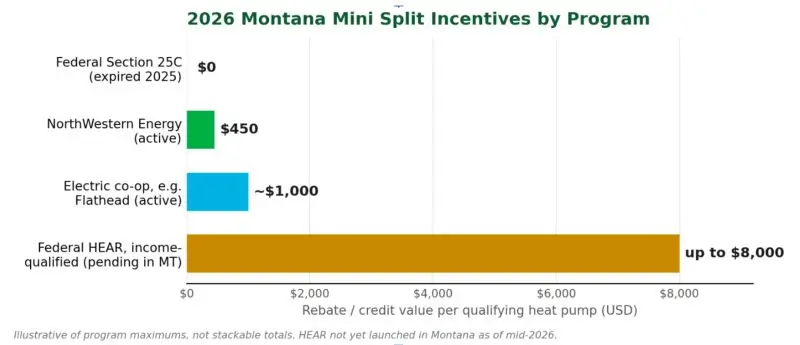
Chart: 2026 Montana mini split incentives at a glance. Program maximums shown; incentives are not always stackable.
Sources: NorthWestern Energy, Montana DEQ, IRS.
What the Numbers Actually Add Up To: An Illustrative Montana Example
Ranges are useful, but most people want to see it total up. Take a common Montana project: a 1970s home outside Bozeman heating a chilly addition with electric baseboard, adding one cold-climate head to cut that bill and get summer cooling. This is a composite of the projects we see, not a single customer's invoice, and your real quote will vary, but every figure below comes from the verified 2026 ranges and rebates above:
Cold-climate 12,000 BTU ductless heat pump, professionally installed (one zone): about $5,200
Less the NorthWestern Energy rebate: −$450
Federal tax credit in 2026: $0 (the credit expired at the end of 2025)
Estimated net cost in NorthWestern Energy territory: about $4,750.
In a Flathead Electric co-op home instead, the same install less a roughly $1,000 co-op rebate lands near $4,200 net.
The people-first takeaway: because no 2026 federal credit applies, your utility or co-op rebate is the real lever. Get itemized bids, confirm the unit clears SEER2 15.2 / HSPF2 8.5 so it qualifies, and file before the June 30, 2026 deadline. Installing in spring or fall (not mid-heatwave or cold snap) also tends to get you a better-scheduled, better-priced job.
Adding a mini split in Montana follows six steps: size the system, spec it for both the climate and your rebate, line up that rebate, compare bids, plan backup heat, then install and file.
Right-size the system. Have a contractor run a Manual J load calculation. Oversized units short-cycle and dehumidify poorly.
Spec it for the climate and the rebate. Choose a cold-climate, ENERGY STAR-certified, variable-speed inverter model that clears both Zone 6B reality and your utility's threshold.
Line up your rebate before you buy. Confirm your utility or co-op program, and if income-qualified, check HEAR status. Some programs require pre-approval.
Get multiple bids. Compare on price, performance, and warranty. Ask specifically about local cold-climate install experience.
Plan for backup heat. Keep the furnace or add electric-resistance backup for the coldest stretches, and ask whether your panel needs an upgrade.
Install, verify, and file. Submit rebate paperwork (a recent utility bill plus the itemized invoice) and keep all model and AHRI documentation.
This next part is the one we care most about, because filters are what we build. A mini split keeps its own air clean with a washable pre-filter inside each indoor head, rinse it every 2–4 weeks during heavy use. But your home's bigger air-quality workhorse is usually the central furnace most Montana homes keep for backup heat, and that is where filter choice matters most. It is also the question we hear most from customers once smoke season starts.
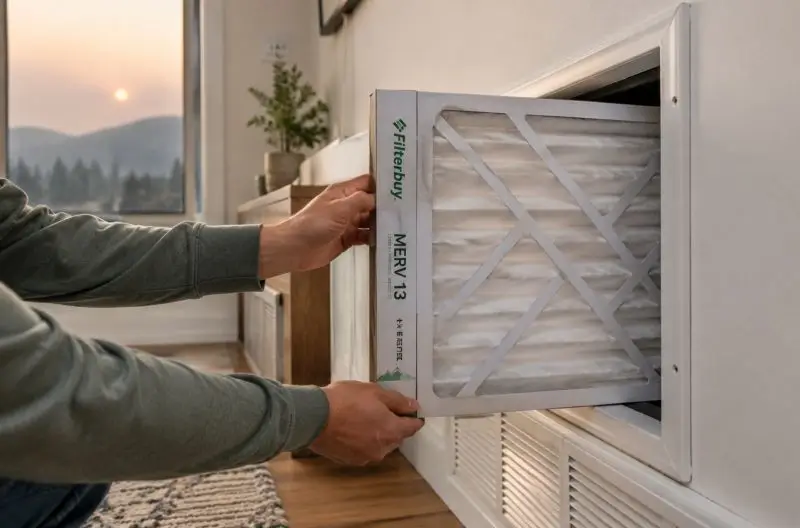
Wildfire-smoke season: fine particulate (PM2.5) slips through cheap fiberglass filters. A MERV 13 filter captures far more of it.
Dry-winter dust and allergens: tightly closed winter homes recirculate dust and dander; a pleated MERV 11–13 filter keeps it off your lungs and coils.
Never running out: Filterbuy makes 600+ sizes in the USA, ships factory-direct, and offers auto-delivery. Shop MERV 13 furnace filters.
Find your furnace filter size and set up auto-delivery, so your backup system is smoke-season ready. You can also check your local air quality on the live USA AQI map.
Yes, but only cold-climate models. Montana is Climate Zone 6B with winter design temps near -10°F to 5°F, so choose a unit certified ENERGY STAR Cold Climate with a minimum operating temperature of -13°F or colder. In the deepest cold, a backup heat source is still recommended.
About $3,000–$6,200 installed for a single zone and $5,000–$14,000 for a whole-home system, depending on the number of heads, cold-climate rating, and install difficulty.
No. The federal Section 25C credit expired December 31, 2025. Systems installed in 2026 do not qualify. If yours was installed on or before that date, you can still claim it on your 2025 return using IRS Form 5695.
NorthWestern Energy pays $450 per qualifying heat pump for existing homes through June 30, 2026. Co-ops (Flathead, YVEC, Missoula) offer their own. The federal HEAR program (up to $8,000, income-qualified) is administered by Montana DEQ but had not fully launched as of mid-2026.
Yes. Each indoor head has a washable pre-filter to rinse every few weeks. If you also run a central furnace for backup heat, keep a quality MERV 11–13 filter in it, especially during wildfire-smoke season.
Both. Filterbuy is a U.S. air-filter manufacturer (600+ sizes, made in the USA since 2013) and also sells ductless mini split heat pumps from 12,000 to 24,000 BTU, all on low-GWP R-32 refrigerant. Filterbuy is the only brand offering 18,000 and 24,000 BTU units on standard 115V power, which can avoid a costly 230V circuit. These units heat down to about 5°F, so for a Montana home's coldest nights, pair one with a backup heat source, exactly as this guide recommends.
Mini split (ductless heat pump): An electric heating and cooling system with an outdoor compressor and one or more indoor heads, connected by a refrigerant line through the wall, with no ductwork.
Cold-climate heat pump: A heat pump engineered to maintain heating output at low outdoor temperatures; certified by ENERGY STAR's Cold Climate designation and listed in the NEEP database.
IECC Climate Zone 6B: The cold-dry classification covering Montana, with winter design temperatures near -10°F to 5°F.
SEER2: The 2023 metric for cooling efficiency; higher is more efficient. NorthWestern Energy's rebate requires SEER2 at or above 15.2.
HSPF2: The 2023 metric for heating efficiency; higher is more efficient. Top mini splits reach 10–14.
Section 25C: The federal Energy Efficient Home Improvement Credit (up to $2,000 for heat pumps), which expired December 31, 2025.
HEAR: The Home Electrification and Appliance Rebates program (up to $8,000, income-qualified), administered by state energy offices; pending full launch in Montana as of mid-2026.
MERV: Minimum Efficiency Reporting Value, a 1–16 scale rating how well a filter captures particles; MERV 13 captures fine wildfire-smoke particulate.
Manual J: The standardized load calculation contractors use to size a system to a specific home.
Ready to move forward? Here is the order we would follow:
Match your unit to the cold-climate checklist above, then get two or three itemized bids from local installers.
Shop Filterbuy's ductless mini splits: 12,000 to 24,000 BTU, including the 115V models that skip a 230V upgrade. For primary heat in Montana's coldest zones, confirm the model's cold-climate rating and plan for backup heat below about 5°F.
Find your furnace filter size and turn on auto-delivery, so a fresh MERV 13 arrives before wildfire-smoke season.
Check Montana conditions on Filterbuy's live USA air quality map before you plan a smoke-season upgrade.
Filterbuy has manufactured air filters in the USA since 2013 and served more than two million households. This guide is part of how we help Montanans get the whole comfort system right: the mini split and the filter behind it.
How we verified this guide: every cost range, rebate amount, and tax-credit detail here was checked against the primary sources below, and against NorthWestern Energy's published rebate document, in 2026. Rebate programs and deadlines change, so we update this page as they do. If you spot a figure that has shifted, confirm it with the program administrator before you rely on it.
Montana State University Extension – Heat Pumps and Mini-Splits
NorthWestern Energy – Montana Residential Electric Existing Home rebate (PDF)
IRS – Energy Efficient Home Improvement Credit (Section 25C)
U.S. Department of Energy – Ductless Mini-Split Air Conditioners