Installation, Costs & Filter Guide (IN Climate)
Author: Michelle Wan, Brand Manager & Air Quality Writer, Filterbuy
Reviewed by: David Clark, CEO of Filterbuy HVAC Solutions and Licensed HVAC Technician
Published: August 25, 2026 · Updated: August 25, 2026
A mini split in Indianapolis costs $4,000 to $19,500 installed in 2026. What you pay comes down mostly to how many rooms you want to condition. Marion County labor runs 10 to 15% above the Indiana average. Cold-climate equipment adds $800 to $2,000, and it is the right specification for a city that designs to 0°F.
Pricing your own equipment? Filterbuy mini split systems are single zone, list their prices online, and ship free in 2 days on in-stock units. Multi-zone setups come from other brands, and either way a licensed contractor handles the install.
Not sure how many zones your home needs? Take the quick match quiz below.

Answer 3 quick questions and we'll match you to the right mini split setup.
A mini split installation in Indianapolis costs $4,000 to $19,500 in 2026, set mainly by zone count, with Marion County labor 10–15% above the Indiana average. The federal 25C credit expired December 31, 2025, so Indiana Energy Saver and AES Indiana rebates are where the savings now sit. Indianapolis sits in IECC Climate Zone 5A with a 0°F winter design temperature, so cold-climate equipment is the right specification. Your contractor also needs an Indianapolis BNS license, because Indiana issues no statewide one.
• Indianapolis is IECC Zone 5A; ASHRAE winter design temperature 0°F. ENERGY STAR certifies cold-climate heat pumps at 5°F. Ask what your unit delivers below that.
• Indiana issues no statewide HVAC license. Indianapolis licenses through the Department of Business and Neighborhood Services (BNS).
• Federal Section 25C expired December 31, 2025. 2026 installs don't qualify.
• Marion County failed all three American Lung Association measures in 2026.
• One install can require three permits: mechanical, electrical, and building.
• The mesh pre-filter is washed, not replaced. Per EPA, ductless units filter to keep the equipment clean, not your air.
Where this comes from, and what we sell. Filterbuy manufactures air filters in the United States and also sells ductless mini split systems, including units a reader of this page might buy. Take the recommendations accordingly. The limits of our own line are stated plainly further down, not buried. Filterbuy HVAC Solutions technicians service ductless systems in Florida and Texas. Not Indiana. So this is a buyer's guide, not a sales call: we speak first-hand to equipment and filters, and point you to a local contractor for the rest.
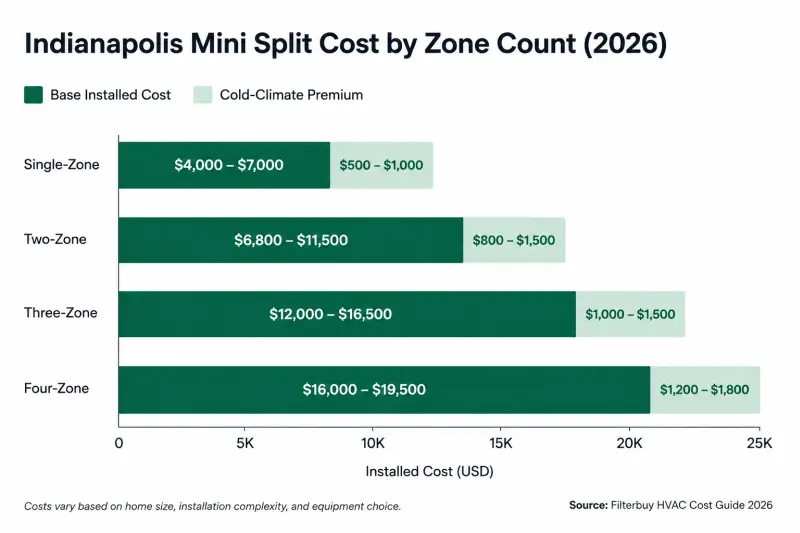
Mini split installation in Indianapolis costs $4,000 for a single zone and up to $19,500 for a four-zone whole-home system. Ductless AC installation is priced the same way, since a ductless AC and a mini split heat pump are the same box. Zone count drives price more than anything else, and Marion County labor runs 10 to 15% above the Indiana average, which is why local quotes land at the top of the state range. We built the Indianapolis column by applying that premium to Filterbuy's statewide Indiana cost data rather than a national average, so you can see where the local number comes from and check the math.
A single-zone system, 9,000 to 18,000 BTU, is the size that handles a bonus room over a garage. Statewide it runs $3,500 to $6,500. In Indianapolis, budget $4,000 to $7,000.
Two zones, enough for a finished basement plus a home office, run $6,000 to $10,500 across Indiana and $6,800 to $11,500 in Marion County.
Three zones is the common answer for an older bungalow with no ductwork anywhere. Statewide that lands at $11,000 to $15,000, and locally at $12,000 to $16,500.
A four-zone whole-home conversion runs $15,000 to $18,000 statewide and $16,000 to $19,500 in Indianapolis.
Cold-climate equipment adds $800 to $2,000 at any zone count. In Zone 5A it is the right spec, not an upgrade.
Three line items push quotes past these ranges: panel upgrades, common in the pre-1980 stock across Irvington, Fountain Square, and the near-east side ($800–$1,500); line sets over 25 feet; and condensate pumps when a basement can't drain by gravity ($200–$400). Marion County permit fees run roughly $85 to $150. Still choosing equipment? Filterbuy's best mini split guide compares the units local contractors quote most.
Filterbuy sells mini splits, so read this section as what it is. The published limits first:
• Single zone only. For the two-, three-, and four-zone configurations in the table above, look at Mitsubishi, Daikin, Fujitsu, or MRCOOL. We don't make one.
• Rated to 5°F. If a Filterbuy unit would be the primary winter heat for a Marion County room, a unit rated well below zero is the better buy.
• 17 SEER2. That clears the federal minimum. It is built for value, not maximum efficiency.
• Professional installation required. The warranty is void if self-installed.
Where it does fit is the supplemental zone this page keeps describing: the bonus room over the garage, the finished basement, the addition the trunk line never reached. Published pricing runs $799 for 12,000 BTU (up to 550 sq ft), $899 for 18,000 BTU (up to 850 sq ft), and $1,349 for 24,000 BTU (up to 1,200 sq ft). Each is ETL and AHRI certified, ships free in 2 days on in-stock systems, and carries a 7-year compressor and 3-year parts warranty. HVAC equipment normally moves by freight on a multi-week lead time.
A hot bonus room is not always an equipment problem. Three things are worth checking first, because each costs a fraction of a mini split:
1. A closed or crushed damper in the duct run feeding that room. Free to check.
2. Attic insulation. Zone 5A calls for R-49. Nationally, 27% of pre-1970 Midwest homes report poor or no insulation (see Supporting Statistics), and Indianapolis has plenty of pre-1970 housing.
3. Return air. A room with a supply vent and no return can't circulate conditioned air, whatever equipment you hang on the wall.
If all three check out and the room still swings eight degrees off the rest of the house, a mini split is the right answer. If they don't, you'd be paying five figures to fight a few hundred dollars' worth of problem. Filterbuy sells mini splits, and we'd still rather you find that out now.
Indianapolis sits in IECC Climate Zone 5A with an ASHRAE 99% winter design temperature of 0°F and a 1% summer design temperature of 91°F. ENERGY STAR certifies cold-climate heat pumps with third-party verified performance at 5°F. That is five degrees above what your system faces on the coldest morning of the year.
ENERGY STAR is direct about what happens below that threshold: the unit keeps working, but pairing it with backup heat warms the home most efficiently. In Indianapolis that isn't a footnote. It's the design condition. Ask for two numbers in writing:
4. Heating capacity at 5°F, as a percentage of nameplate at 47°F. Below 75% retention, the system struggles through a normal Indianapolis January.
5. Capacity at 0°F or below, if published, plus the written backup heat plan. Verify the model free on the NEEP cold-climate product list before you sign.
Here's the part a manufacturer isn't supposed to volunteer: Filterbuy's own mini split line is rated to heat down to 5°F, and Indianapolis designs to 0°F. That gap isn't a defect in Filterbuy equipment or anyone else's, because 5°F is where the whole category is certified. It does mean a backup heat plan is not optional in Marion County, whoever you buy from.
Humidity matters too. Zone 5A carries a heavy latent cooling load from late spring into fall, which is why Marion County basements feel clammy in July even when the thermostat reads fine. If you're conditioning a basement, weight dehumidification capacity as heavily as BTUs. Before the first hard freeze, run through how to winterize a mini split.
Indiana does not issue a statewide HVAC contractor license. Indianapolis licenses locally through the Department of Business and Neighborhood Services under Revised Code Chapter 875. That is the most misunderstood fact about hiring here. Marion County's excluded cities set their own rules, so confirm what applies at your address. Five things belong in the written quote (full lookup process):
• Current BNS HVAC contractor license number, verifiable through indy.gov.
• EPA Section 608 certification for the tech handling refrigerant, Type II or Universal. It certifies individuals, not companies.
• A written ACCA Manual J load calculation. Sizing from square footage skips the step that decides whether the system fits.
• A2L refrigerant training. New equipment ships with mildly flammable R-454B and R-32. Ask if their techs are trained and tooled for it.
• Permit-pull responsibility in the contractor's name: mechanical, electrical, and building where an exterior wall is cut.
Mitsubishi Diamond Contractor, Daikin Comfort Pro, and NATE signal training depth, not legal authorization.
"Ask for the Manual J worksheet, not the summary page. Anyone who actually ran it has the room-by-room output open in their software and can print it in thirty seconds. The ones who sized from square footage get quiet. That request tells you more about a bid than the price does."
David Clark, CEO of Filterbuy HVAC Solutions and licensed HVAC technician
Two live paths remain: the Indiana Energy Saver Program and AES Indiana rebates. Federal Section 25C expired December 31, 2025 under the One Big Beautiful Bill Act, so 2026 installs don't qualify. Filterbuy's heat pump tax credit guide covers what's still claimable on a 2025 return.
AES Indiana is the electric utility for Indianapolis. Statewide guides list Duke Energy Indiana, NIPSCO, and CenterPoint alongside AES. Those serve other parts of the state. In Marion County, AES is your program, and its published tiers are set by efficiency rating.
The rebate steps up with efficiency. At 15.2 SEER2 with HSPF2 of 7.8 or better, it pays $100. At 17.1 SEER2 with the same HSPF2 floor, $225. At 19 SEER with HSPF2 of 8.55, $300. At 21 SEER with HSPF2 of 9, $525. At 23 SEER and above with HSPF2 of 9, the top tier pays $725.
Tiers are reproduced as AES publishes them, including its mix of SEER and SEER2 figures. Two conditions decide eligibility: AES lists these tiers under self-installed projects, and your heat type must be electric. Apply within 90 days of purchase.
The Indiana Energy Saver Program, run by the Indiana Office of Energy Development on $182 million in federal funding, is open and offers two stackable rebates through one application:
HEAR. Up to $8,000 toward a qualifying heat pump at or below 150% of Area Median Income.
HOMES. Up to $4,000 for whole-home retrofits hitting 20% predicted savings, no income cap.
Both arrive as an upfront discount applied by a qualified contractor, so enrollment happens before the install. Funds are first-come, first-served.
Most guides tell Hoosiers to stack every rebate. Read the fine print and the two largest ones pull in opposite directions:
AES publishes those $100–$725 mini split tiers under self-installed projects.
Indiana Energy Saver pays as an upfront discount applied by a qualified contractor.
The DIY path that unlocks the AES tier is the same path that can cost you up to $8,000 in HEAR, plus the permit, the warranty registration, and the Manual J documentation a Marion County install needs anyway. On a three-zone system, that trade runs the wrong direction by thousands.
One more thing the DIY math misses: manufacturer warranties are written around professional installation. Filterbuy's own units require it, and the warranty is void if self-installed. Check the terms on any brand before the AES tier tempts you into a weekend project.
Do this before you buy: call the AES rebate line at 866-908-4915, describe your exact install path, and ask which rebate applies to a contractor-installed mini split. Get that answer before the equipment ships, not after.
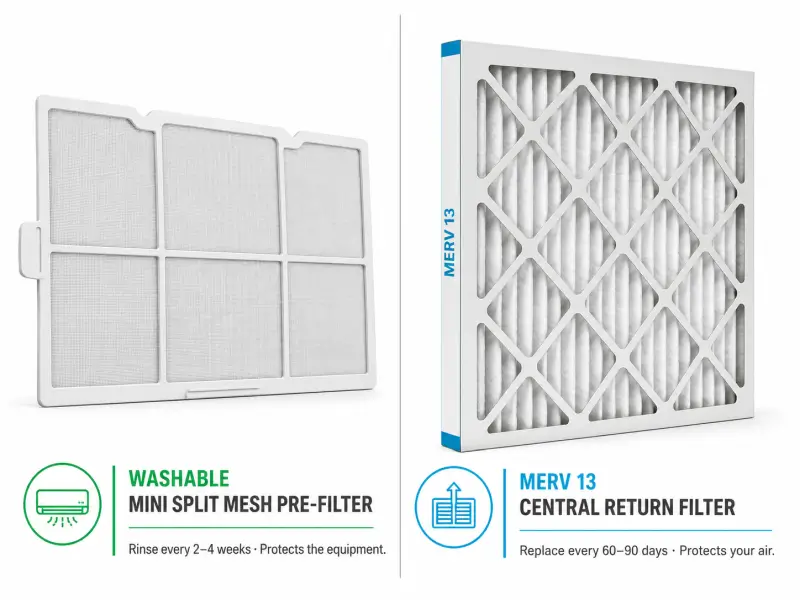
The indoor head uses a washable mesh pre-filter. You rinse it and reinstall it. Cleaning one takes ten minutes and no tools, every two to four weeks in peak season. Some models add a secondary carbon, silver-ion, or photocatalytic insert behind the mesh; those get replaced on a schedule, not washed.
What the mesh will not do is clean your home's air. The EPA is unambiguous: ductless mini splits generally do not filter fine particles, because those filters are built to stop pet hair and lint from clogging the equipment. If a manufacturer claims otherwise, EPA says to verify a documented MERV 13 rating.
We sell filters, so take this as the opposite of a pitch: the mesh in your wall unit protects the equipment, not your lungs. Skipping it is still costly. Across the ductless systems Filterbuy HVAC Solutions technicians service, a restricted filter cuts efficiency by 5–30%, and restoring a dust-coated coil runs $350–600, against a screen you rinse free.
"What surprised me on the Filterbuy factory floor is that the dust doing the damage isn't the dust you can see. In our particle-capture testing, material under 10 microns settled deepest and was hardest to clean off later. 'It still looks okay' is the worst reason to skip a cycle."
Michelle Wan, Brand Manager & Air Quality Writer, Filterbuy
Where filter replacement still matters: most Indianapolis installs are supplemental. The bonus room or basement gets a ductless head while the furnace and central return serve the rest of the house. That return filter carries the whole-home load, and Marion County gives it plenty to do (see Supporting Statistics). EPA guidance: at least MERV 13, or as high a rating as your system's fan and filter slot can accommodate, replaced every 60 to 90 days and closer to 60 during tree pollen and ragweed. EPA notes most systems handle MERV 13 when the filter is changed on schedule, but check your furnace manual or ask an HVAC technician before stepping up. Check today's AQI before opening windows, and let auto-delivery handle the remembering.
A correctly sized, maintained mini split in Indianapolis lasts 15 to 20 years. Without pre-filter discipline and annual service, expect 12 to 15. Book a tune-up once a year so a technician can deep-clean the evaporator coil and blower wheel, check refrigerant charge, and clear the condensate drain before winter. Three local failure points drive most repair calls:
• Condensate line freeze in unheated basements and crawlspaces. A freeze-protection wrap costs $40 to $80.
• Outdoor unit snow burial. Marion County installs should sit on a 12- to 18-inch raised stand.
• Refrigerant loss at line-set joints, usually surfacing in years seven through ten.
Filter cleaning is homeowner work. Repair is not. Call a licensed technician if the unit ices over, drips from the indoor head, short-cycles, or holds a musty smell after the mesh is clean and dry. Those point past the filter, and running the system through them turns a service call into a replacement. Filterbuy's full maintenance routine covers coils, drain, and outdoor unit. Register the warranty within 60 days.
Three findings behind the guidance above. All verifiable at the source.
• 22 prototype units, field-tested in occupied homes.
• U.S. and Canada, winters 2022–2024.
• Units delivered at or above 100% of nominal heating capacity at 5°F.
Applies to: the 0°F sizing question. 5°F performance is a documented spec, not an adjective.
Source: PNNL-37127, DOE Cold Climate Heat Pump Challenge Field Validation (2025).
• 53% of total household energy use in Midwest homes, the largest single end use.
• 27% of Midwest homes built before 1970 report poor or no insulation.
• 11% for homes built since 1970.
• Sample: 18,496 households.
Applies to: the insulation check above, and Manual J sizing.
Source: U.S. Energy Information Administration, 2020 Residential Energy Consumption Survey.
• F on ozone. F on 24-hour particle pollution. F on annual particle pollution.
• Indianapolis-Carmel-Muncie metro: 11th worst nationally for year-round particle pollution.
• Nearly 33 million Americans live in counties failing all three. Marion is one.
Applies to: filter choice. The mesh pre-filter is not built for fine particles.
Source: American Lung Association, State of the Air 2026, Indianapolis-Carmel-Muncie, IN.
Indiana Energy Saver covers two: HEAR up to $8,000 at or below 150% of Area Median Income, and HOMES up to $4,000 with no cap. AES Indiana rebates of $100 to $725 run by efficiency tier. Federal 25C expired December 31, 2025.
Verify a current BNS license through indy.gov. Indiana issues no statewide license, so local licensing is the credential that matters. Also confirm EPA 608 certification, a written Manual J, A2L training, and contractor-pulled permits.
Any BNS-licensed HVAC contractor with EPA 608–certified technicians can service and repair a ductless system in Marion County. Filter cleaning is homeowner work. Icing, water dripping from the indoor head, short-cycling, or a musty smell that survives a clean, dry filter all call for a licensed technician.
Every two to four weeks in peak season. The mesh is rinsed and reused; secondary carbon or ion filters behind it are swapped on a schedule. If your home keeps a central return, replace that filter every 60 to 90 days. Filterbuy ships MERV 13 in over 600 standard and custom sizes.
MERV 13, the EPA's minimum recommendation and a sensible floor in a county that failed all three American Lung Association measures in 2026.
Michelle Wan is Filterbuy's Brand Manager and air quality writer. She works directly with Filterbuy's U.S.-based manufacturing team across factories in Alabama, Florida, Pennsylvania, and Utah, so her guidance is grounded in how filters are actually built, tested, and used in real homes. Filterbuy has manufactured air filters in the United States since 2013, producing more than 50 million and serving over two million households.
Reviewed for technical accuracy by David Clark, CEO of Filterbuy HVAC Solutions and a licensed HVAC technician.
• ENERGY STAR: Ductless Heating & Cooling (5°F cold-climate certification threshold; Manual J sizing guidance)
• U.S. EPA: Do ductless mini-split heat pumps filter fine particles out of indoor air? (updated July 2026)
• U.S. EPA: Guide to Air Cleaners in the Home (MERV 13 minimum; 60–90 day replacement)
• NEEP: Cold Climate Air Source Heat Pump Product List
• U.S. EPA: Section 608 Technician Certification Requirements
• Indiana Office of Energy Development: Home Energy Rebates / Indiana Energy Saver
• AES Indiana: Appliance Rebates (mini split heat pump tiers)
• City of Indianapolis: Department of Business and Neighborhood Services
• ACCA: Manual J Residential Load Calculation
• American Lung Association: State of the Air 2026: Indianapolis-Carmel-Muncie, IN
• Pacific Northwest National Laboratory / U.S. DOE: Performance Results from DOE Cold Climate Heat Pump Challenge Field Validation (PNNL-37127)
• U.S. Energy Information Administration: 2020 Residential Energy Consumption Survey: Midwest home energy use
• Public Law 119-21 (One Big Beautiful Bill Act), Section 25C termination effective December 31, 2025
ASHRAE design temperature: the outdoor temperature equipment must handle 99% (winter) or 1% (summer) of the year. Indianapolis: 0°F and 91°F.
Cold-climate heat pump (ccASHP): an air-source heat pump with third-party verified heating performance at 5°F under ENERGY STAR.
HEAR / HOMES: the two arms of the Indiana Energy Saver Program: up to $8,000 income-qualified, up to $4,000 with no income cap.
MERV 13: an ASHRAE 52.2 filter rating; the EPA's recommended minimum for central returns.